• Some users have recently had their accounts hijacked. It seems that the now defunct EVGA forums might have compromised your password there and seems many are using the same PW here. We would suggest you UPDATE YOUR PASSWORD and TURN ON 2FA for your account here to further secure it. None of the compromised accounts had 2FA turned on.
    Once you have enabled 2FA, your account will be updated soon to show a badge, letting other members know that you use 2FA to protect your account. This should be beneficial for everyone that uses FSFT.

LG 48CX

Please don't listen to Advil for this advice. I've disabled ASBL a long time ago with no issues at all. You will not regret it. Sorry Advil,no disrespect.
OK, well, I would like to stop the LG48cx from dimming itself automatically so if a few others can weigh in on any possible risks from doing that, then I'll know with a bit more confidence whether to proceed with that.
 
Can you guys give the gradients here a look and let me know what you see: https://www.eizo.be/monitor-test/

After calibration in SDR mode, they are all quite good for me -- no color cast in the greyscale, colors all decent and relatively smooth (though not as good as a half decent LCD). I went down the calibration path in the first place due to very poor gradients in HDR mode but starting to wonder if it's actually a Windows 10 or Nvidia problem. The problem is there was an obvious color cast depending on luminance especially noticeable in greyscale, but present in blended colors as well (i.e. CMY, not RGB). Calibration didn't really help, but in my testing I noticed that gradient video files played from a USB stick in Cinema mode at least looked good (no game mode available in USB video player mode). Switch to cinema mode playing same files from my PC, gradients look like crap again. One thing I just discovered that helped significantly and seems to have removed color cast from greyscale is going into Windows advanced display settings and changing refresh rate from 119.998 Hz to 120 Hz even -- no idea why it was set there, the NVCP just displayed 120. Yellow still looks bad though.

Anyway I was hoping to just use HDR mode full time with brightness slider set appropriately, but looks like there are some bugs still. In normal usage it looks totally fine but I wouldn't trust it for photo editing, while I do trust SDR post-cal. This is all with a 3080 on the latest hotfix driver by the way.

The gradients look pretty awful here. Both calibrated and uncalibrated. How did you calibrate them in SDR to get them decent? Wonder if you could take a pic of how it looks for you.
 
The gradients look pretty awful here. Both calibrated and uncalibrated. How did you calibrate them in SDR to get them decent? Wonder if you could take a pic of how it looks for you.

I used the standard Calman routine with an i1display pro. Read some stuff online about how using the 1D LUT can create artifacts (no idea what they mean by that though, just sorting through thousands of confusing forum posts) but honestly it looks really good to me. No luminance-dependent color cast whatsoever anywhere in SDR mode. HDR mode is not quite as good but I am not as worried about it since it’s just for gaming and regular desktop use with the windows brightness slider way down when I’m too lazy to switch back to SDR. I had to do a full 42-pt greyscale cal to make color cast in greyscale gradients go away.

I removed both cals with picture mode reset after too much forum reading but will reapply and take some before and after pictures with my real non-phone camera tomorrow ..
 
I used the standard Calman routine with an i1display pro. Read some stuff online about how using the 1D LUT can create artifacts (no idea what they mean by that though, just sorting through thousands of confusing forum posts) but honestly it looks really good to me. No luminance-dependent color cast whatsoever anywhere in SDR mode. HDR mode is not quite as good but I am not as worried about it since it’s just for gaming and regular desktop use with the windows brightness slider way down when I’m too lazy to switch back to SDR. I had to do a full 42-pt greyscale cal to make color cast in greyscale gradients go away.

I removed both cals with picture mode reset after too much forum reading but will reapply and take some before and after pictures with my real non-phone camera tomorrow ..

avsforum and calibrating this TV is a total nerd trap. I have spent more time on it than just enjoying the TV in the last 2 weeks. And my results seem "okay" but not amazing - I still have a bit of washed out look to everything and the gradients are pretty awful. My last attempt was using the d-nice AWP but it makes everything green. Anyways, I think you sold me on calman, I just want to be done w/ calibrating this TV and not worry about it anymore.

I think the problem with avforums calibration threads is they are filled with experts but also a lot of those experts are biased towards their own commercial products, so you can get really conflicting information sometimes. Almost feels like disinformation sometimes, to push you towards a particular product.
 
avsforum and calibrating this TV is a total nerd trap. I have spent more time on it than just enjoying the TV in the last 2 weeks. And my results seem "okay" but not amazing - I still have a bit of washed out look to everything and the gradients are pretty awful. My last attempt was using the d-nice AWP but it makes everything green. Anyways, I think you sold me on calman, I just want to be done w/ calibrating this TV and not worry about it anymore.

I think the problem with avforums calibration threads is they are filled with experts but also a lot of those experts are biased towards their own commercial products, so you can get really conflicting information sometimes. Almost feels like disinformation sometimes, to push you towards a particular product.

It is possible that D-Nice's AWP does not work for you eyes as it was determined based on his own perception. So you should use whatever WP that looks better to you.
If you have time to spare, some pros on AVS have suggested 0.3163x 0.3345y (plasma-ish) and 0.312x 0.3356y.

While the i1 Display is unbeatable for the price, the level of accuracy varies by unit and can deteriorate over time (humidity, etc.)... so could explain the green push you are observing.
BTW, I fixed the red push of my i1 Display on WOLED by profiling it to a spectrophotometer (but $$$).
 
avsforum and calibrating this TV is a total nerd trap. I have spent more time on it than just enjoying the TV in the last 2 weeks. And my results seem "okay" but not amazing - I still have a bit of washed out look to everything and the gradients are pretty awful. My last attempt was using the d-nice AWP but it makes everything green. Anyways, I think you sold me on calman, I just want to be done w/ calibrating this TV and not worry about it anymore.

I think the problem with avforums calibration threads is they are filled with experts but also a lot of those experts are biased towards their own commercial products, so you can get really conflicting information sometimes. Almost feels like disinformation sometimes, to push you towards a particular product.

Yeah, think you are right about that re: avsforum. Calman works fine, at least for SDR. I've been retrying HDR just now and based on my precal results, not sure I’m even going to bother, especially since LG has not finalized gamma and brightness curves for this mode as far as I can tell (based on the fact that peak brightness is nerfed as of the last firmware update). I have average dE of 2.0 in color and 2.2 in greyscale. Not good but not terrible, and not worth worrying about for a gaming only mode. Worth noting that the gradients actually aren’t terrible with the HDR/SDR brightness slider maxed out .. Windows and/or nvidia seems to screw up the color output with the slider at a reasonable 7-15ishvalue though. Gradient output is total laughable trash with brightness scaled down in software.

Here are some photos in SDR mode with OLED light at 36 after cal:

D88500D9-9EFB-41FF-9550-BFBE64ED0784.jpeg

7C5E520F-7F04-47F0-801E-7FE2E856117B.jpeg


607C67F3-5B8D-438F-8C88-C70EF96FC1EE.jpeg


Looks good to my eyes. There should be discrete steps every quarter to fifth inch by my calculation and that’s what I see, with minimal to no color cast and decent step uniformity. More than good enough for my amateur photo editing I think.
 
  • Like
Reactions: hhkb
like this
Ah I'm an idiot. I had the dark mode extension enabled in my browser (OLED protection of course!), which completely messed up the gradients. It actually looks pretty good after manual HCFR 20 point calibration, all the green tint is gone from the <50% greys.

Pre calibration

IMG_1562.jpg


Post calibration (AWP used here)

IMG_1561.jpg
 
It is possible that D-Nice's AWP does not work for you eyes as it was determined based on his own perception. So you should use whatever WP that looks better to you.
If you have time to spare, some pros on AVS have suggested 0.3163x 0.3345y (plasma-ish) and 0.312x 0.3356y.

While the i1 Display is unbeatable for the price, the level of accuracy varies by unit and can deteriorate over time (humidity, etc.)... so could explain the green push you are observing.
BTW, I fixed the red push of my i1 Display on WOLED by profiling it to a spectrophotometer (but $$$).

Yeah definitely it could be my eyes. Although I think actually what I was seeing was the green tint in the darker greys (above), which I fixed by doing 20 point calibration. When I used plain D65 in the service menu this green tint was eliminated without needing to adjust the greys at all. However it significantly reduced green channel, which reduces peak illuminance a lot.

Interestingly the AWP produced almost an identical service menu white balance to factory. My factory warm (6500k) is 192,174,124. AWP gets me 192,178,125 - so you can see it actually bumps up the green slightly, which made the tinting worse in the greys I think.

Who knows how HDR is performing, all I did was the 100% white point, which again to AWP, was almost identical to factory (192, 178, 125). So when targeting AWP, it seems calibration does barely anything on this screen for HDR.

I'm not too worried about i1d3 accuracy, using the FSI ccss it should be quite within reasonable dE, as by all accounts the internal correction in i1d3s are very good, and i1d3s are not known to drift much or at all over time (unlike a spectrophotometer). Even though mine is pretty old now, I still get similar readings I took years ago on my other displays.
 
View attachment 317763

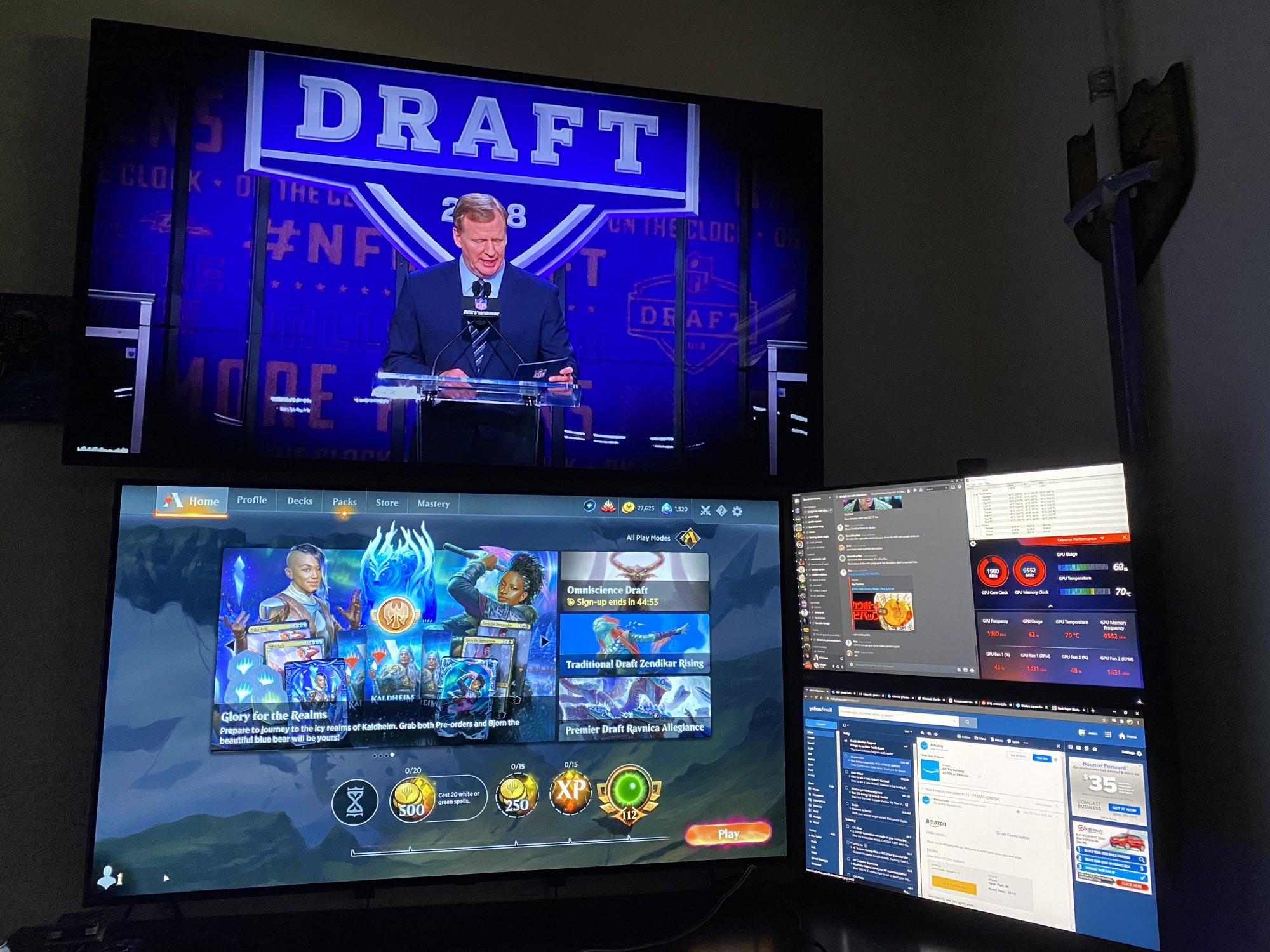
Got around to raising my 55 C6 up and mounting the 48 CX under it.

New desk coming this week but done for the most part now.
Nice to see the scale difference. The 55" somehow does not look as big as I thought it would.

What are the sizes and resolutions of the two side displays? I like that they are almost the same height as the 48".
 
Nice to see the scale difference. The 55" somehow does not look as big as I thought it would.

What are the sizes and resolutions of the two side displays? I like that they are almost the same height as the 48".
Sides are 2560x1440, they are just slightly larger stacked than the 48".

Will adjust them a bit more once i get my new desk in this week.
 
Nice to see the scale difference. The 55" somehow does not look as big as I thought it would.

What are the sizes and resolutions of the two side displays? I like that they are almost the same height as the 48".
24" monitors stacked would be the same height as a 48", adjusting slightly for bezel differences. 24" 1080p monitors are also the same DPI for no scaling differences.
 
Has anyone experienced significant and permanent burn-in? I am still trying to determine whether or not this TV would be suitable for a daily driver for WFH (in addition to gaming/media consumption). I do a lot of Excel, Word, PDF, Power-Point 8:00-17:00 Mon-Fri. Then game/media 20:00-:23:00.

I know that this isn't the "TV" for office use, but I still haven't heard any real negative anecdotes around WFH office use. Obviously I know the mitigations that can be used, but at the end of the day 7-9 hours of bright office documents is a PITA for an OLED! Right?

Probably just going to go with the incoming alienware 38" AW3821DW - but I would love some OLED goodness as my daily driver.
 
Has anyone experienced significant and permanent burn-in? I am still trying to determine whether or not this TV would be suitable for a daily driver for WFH (in addition to gaming/media consumption). I do a lot of Excel, Word, PDF, Power-Point 8:00-17:00 Mon-Fri. Then game/media 20:00-:23:00.

I know that this isn't the "TV" for office use, but I still haven't heard any real negative anecdotes around WFH office use. Obviously I know the mitigations that can be used, but at the end of the day 7-9 hours of bright office documents is a PITA for an OLED! Right?

Probably just going to go with the incoming alienware 38" AW3821DW - but I would love some OLED goodness as my daily driver.
2117 hours power on time including WFH during the day. No burn in. I WFH with OLED light 0, dark mode where available, etc.
 
2117 hours power on time including WFH during the day. No burn in. I WFH with OLED light 0, dark mode where available, etc.
OLED light 0 sounds pretty rough - is it usable during the day with a bit of light? Text is readable etc.?

That's great to hear an example of no burn in. Is it a pain to switch from OLED 0 to something more pleasant at night when gaming/media consuming and back to 0? Or just routine by now?
 
OLED light 0 sounds pretty rough - is it usable during the day with a bit of light? Text is readable etc.?

That's great to hear an example of no burn in. Is it a pain to switch from OLED 0 to something more pleasant at night when gaming/media consuming and back to 0? Or just routine by now?
Completely usable, with a window shining on the TV even. You think it looks a bit dim right when you turn it down, but you don't even notice after 5 minutes.

I just toggle between HDR off set to OLED light 0, and HDR on with the SDR balance slider set to 7 in Windows. I don't need to mess with any settings on the TV, just toggle HDR in Windows on/off.
 
Has anyone experienced significant and permanent burn-in? I am still trying to determine whether or not this TV would be suitable for a daily driver for WFH (in addition to gaming/media consumption). I do a lot of Excel, Word, PDF, Power-Point 8:00-17:00 Mon-Fri. Then game/media 20:00-:23:00.

I know that this isn't the "TV" for office use, but I still haven't heard any real negative anecdotes around WFH office use. Obviously I know the mitigations that can be used, but at the end of the day 7-9 hours of bright office documents is a PITA for an OLED! Right?

Probably just going to go with the incoming alienware 38" AW3821DW - but I would love some OLED goodness as my daily driver.

These TVs are too new to get any reports of burn in. Our best source is https://www.rtings.com/tv/learn/real-life-oled-burn-in-test. This is a C7, so the same subpixel structure as the CX (which was vastly improved over the C6 in terms of burn in). 5000 hours before they got noticeable burn in on static channel logos at 200 nits (~55 OLED LIGHT). 9000 hours before noticeable uniformity issues on live TV. C8 and after added logo dimming protection, so I'm guessing C8+ would perform even better on static logos.

So based on this, it seems the lifespan is about 9000 hours at 200 nits for dynamic content. If you are running at the more typical 100 nits, which is around 30 OLED LIGHT, I'm guessing conservatively that will be extended to ~13000 hours for dynamic content. 0 OLED is pretty crazy low, I have no idea what nits that is, maybe like 50? So maybe that gives you another 4000 hours, let's say.

It's hard to say how PC content will perform as there are no conclusive tests just for this use case. I suppose it depends heavily on how varied the stuff you do is and whether you're using dark themes, and leaving all protections on. Leaving ABSL on for example will help a lot - it will reduce your static brightness by ~50% or so for extended static content, which could increase your screen life span significantly like when coding in an IDE.

I have been using it daily for everything since I bought it end of October. But I checked my hours recently and with WFH I'm putting around 10 hours a day on this screen... I think this is too much to be honest, that is 3650 hours a year. In 3 years I'll have over 10k hours. Last week I actually swapped back to my 27 LG IPS just for office work, I feel like sacrificing my OLED lifespan for work is not really worth it. It sort of sucks cause I don't really have the desk space. Still trying to decide whether I should just not care, as I do have 5 year burn in protection.
 
Last edited:
Has anyone experienced significant and permanent burn-in? I am still trying to determine whether or not this TV would be suitable for a daily driver for WFH (in addition to gaming/media consumption). I do a lot of Excel, Word, PDF, Power-Point 8:00-17:00 Mon-Fri. Then game/media 20:00-:23:00.

I know that this isn't the "TV" for office use, but I still haven't heard any real negative anecdotes around WFH office use. Obviously I know the mitigations that can be used, but at the end of the day 7-9 hours of bright office documents is a PITA for an OLED! Right?

Probably just going to go with the incoming alienware 38" AW3821DW - but I would love some OLED goodness as my daily driver.
I can only speak to my B6, which is almost four years old now.

I can say that I do have some permanent burn in from early use, due to not reducing brightness and some other poor usage (specifically: The Windows taskbar and the overlay for one of the games I was playing).

Since WFH however, the situation has gotten noticeably worse. With static backgrounds up I can see the parts of the screen where I normally dock my various windows has begun to wear. Nothing blatantly permanent yet, but I can see the screen is visibly starting to wear in areas.

It's honestly enough of a concern where I'm seriously considering going with Samsungs newest 2021 models instead of another OLED display. WFH is kinda the worst-cast honestly, and unless you have apps that support dark-themed backgrounds, then you are eventually going to run into some wear.

Again: I can only speak to my B6. I know additional anti-burn-in tech has gone into newer models, but I can't speak for those.
 
4 years is pretty good though. What OLED light setting did you use before and what is it at now? And for how long was it running at the original setting?
 
Has anyone experienced significant and permanent burn-in? I am still trying to determine whether or not this TV would be suitable for a daily driver for WFH (in addition to gaming/media consumption). I do a lot of Excel, Word, PDF, Power-Point 8:00-17:00 Mon-Fri. Then game/media 20:00-:23:00.

I know that this isn't the "TV" for office use, but I still haven't heard any real negative anecdotes around WFH office use. Obviously I know the mitigations that can be used, but at the end of the day 7-9 hours of bright office documents is a PITA for an OLED! Right?

Probably just going to go with the incoming alienware 38" AW3821DW - but I would love some OLED goodness as my daily driver.

~6 months on the CX 48, using it almost daily for 8+ hours. Zero burn-in. Programming and for personal stuff it's music production software and gaming. I don't use MS Office Suite much but does it have a dark mode? If not, then I would not necessarily recommend this display. Aside from websites that are light, majority of the apps I use can be run with a dark mode and that is sure to help in the long run.
 
Has anyone experienced significant and permanent burn-in? I am still trying to determine whether or not this TV would be suitable for a daily driver for WFH (in addition to gaming/media consumption). I do a lot of Excel, Word, PDF, Power-Point 8:00-17:00 Mon-Fri. Then game/media 20:00-:23:00.

I know that this isn't the "TV" for office use, but I still haven't heard any real negative anecdotes around WFH office use. Obviously I know the mitigations that can be used, but at the end of the day 7-9 hours of bright office documents is a PITA for an OLED! Right?

Probably just going to go with the incoming alienware 38" AW3821DW - but I would love some OLED goodness as my daily driver.

Using an OLED as an office monitor isn't ideal. Most people who are currently doing that simply haven't had the display long enough for any burn in to develop. Keep in mind the CX hasn't even been out for 1 year yet so even the heaviest of users has probably only clocked a couple thousand hours on their units at most. Pretty sure once it's been 3-4 years then the issues will definitely start to creep up.
 
I can only speak to my B6, which is almost four years old now.

I can say that I do have some permanent burn in from early use, due to not reducing brightness and some other poor usage (specifically: The Windows taskbar and the overlay for one of the games I was playing).

Since WFH however, the situation has gotten noticeably worse. With static backgrounds up I can see the parts of the screen where I normally dock my various windows has begun to wear. Nothing blatantly permanent yet, but I can see the screen is visibly starting to wear in areas.

It's honestly enough of a concern where I'm seriously considering going with Samsungs newest 2021 models instead of another OLED display. WFH is kinda the worst-cast honestly, and unless you have apps that support dark-themed backgrounds, then you are eventually going to run into some wear.

Again: I can only speak to my B6. I know additional anti-burn-in tech has gone into newer models, but I can't speak for those.
LG substantially improved burn in issues with 7 series and later, by changing the subpixel structure to reduce effect of reds on burn in. I believe rtings showed this improved burn in for bright static logos from 600 hours on 6 series to 5000 hours on 7 series. So you should get way better burn in protection if you upgrade.
 
A little extra detail to add to what I mentioned before...

As some may know, when you hold the mic button down and say "turn the screen off" (or by doing it in the OSD) it will turn the emitters off without dropping the display from the windows+nvidia array, allowing a quick button press on the remote to instantly display the content again. I'm mentioning it again because I confirmed last night that it works the same even while in a HDR game. I did it during jedi fallen order in HDR a few different times and it re-displayed it again with issue. I can still hear the game audio as well unless I mute it with my volume button. This is way more convenient than minimizing a full screen exclusive game to a black background and how clunky it transitions out of HDR/full screen and back, and the fact that the game could spontaneously pop back up while I was away. I thought it might work this way, seamlessly, with a fullscreen exclusive HDR title running but I wasn't sure until I tried it. I'm assuming it will keep the eARC pass-through audio going with the screen "off" this way too but I haven't tried my shARC yet to find out.

It doesn't unlock your mouse from fullscreen exclusive for side screen(s) obviously but it's a very safe and convenient way to "turn off" the display at any time without losing your game or dropping your display"monitor" and window layouts/placements. Some walk-aways I have that are "only for a minute" turn out to be quite awhile. No, not just bathroom visits :LOL: .

----------------------------------------------------------


Very cool for people who want smaller options. With my 2nd desk island setup I think 48" ended up just about perfect for me however. In fact, for letterboxed content any smaller would be bad at my normal minimum available viewing distance in this configuration. That is unless were to adjust my mobile desk taller and overlap the long rectangular desk my monitors are on by more, and then I'd be sitting too close to view my side monitors comfortably.
 
  • Like
Reactions: hhkb
like this
This is just the panel though, so we don't know yet when or if it will be available in a consumer model. But there is hope now. I think 42 would be a great improvement for a PC monitor - the PPI would be vastly improved over the 48.
 
I get what you want one for and while the ppi is increased technically - the ppi's perceived density in use is relative to your viewing distance. So it's more about how much room you have, and if you desire it to be on the same desk sitting very close and not have it on a TV mount stand (flat footed or caster-wheeled), wall-mounted, or on a 2nd desk, bench. mini-hutch, etc. The optimal THX wide viewing angle is 45deg - 50deg so if that remains the same the ppi of a 4k 16:9 screen's contents will look the same no matter what size screen you are using.
 
Yeah you're right. I think for most people though 42" PPI will make sense given typical desk depths of 60-80cm.
 
For example, according to this calculator..

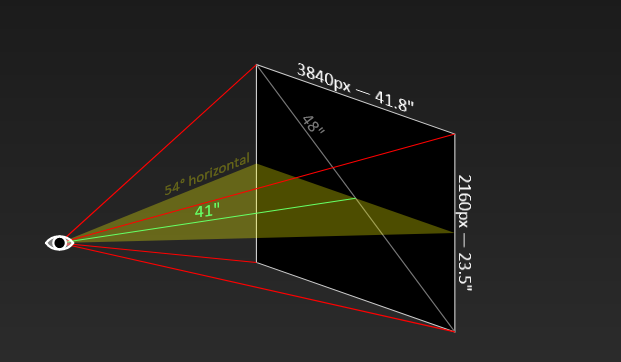
...a 48" 4k at 43" viewing distance (74ppd) <<------ 43" or greater (up to 48" ~> 85.1ppd if seat back relaxed slightly in chair) viewing distance is when I'm using the side monitors more

...a 48" 4k at 41" viewing distance (71.0ppd) <<--- ~41" is sometimes my gaming distance on it.

are higher ppd than

...a 32" 4k at 24" viewing distance (63.7ppd).

http://phrogz.net/tmp/ScreenDensity...sizeUnit:in,axis:diag,distance:41,distUnit:in

http://phrogz.net/tmp/ScreenDensity...sizeUnit:in,axis:diag,distance:24,distUnit:in

-----------------------------------------------------------------------------------

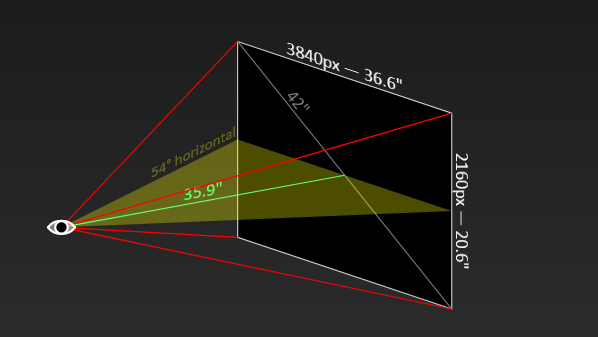
A 42" 4k would have the same ppd as my my 48" screen if:
... viewing the 42" screen at 36" - from screen to eyeballs compared to 41" view distance on the 48" screen
....viewing the 42" screen at 37.5" or greater from screen to eyeballs compared to 43" or greater view distance on the 48" screen.

so it's ~ +/- 5 inch difference in viewing distances between 42" screen and 48" screens.

kJphNu1.png

LUXgBOf.png

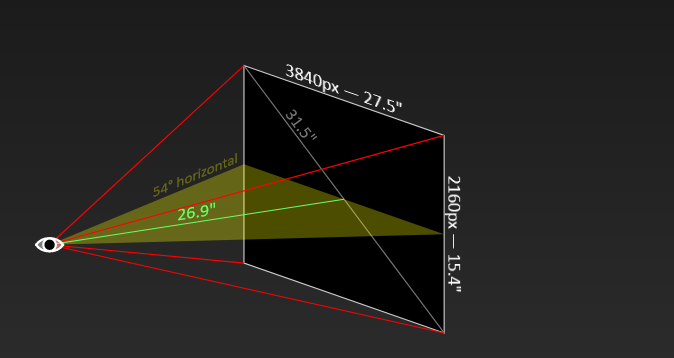
32" 4k screen for comparison at same ppd

dwQg0Le.png


---------------------------------------------------------------------------------------------------------

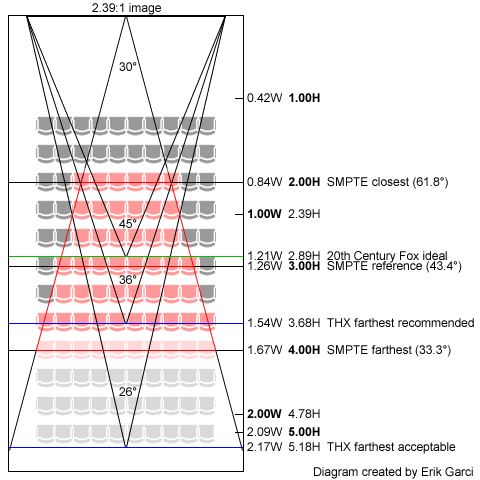
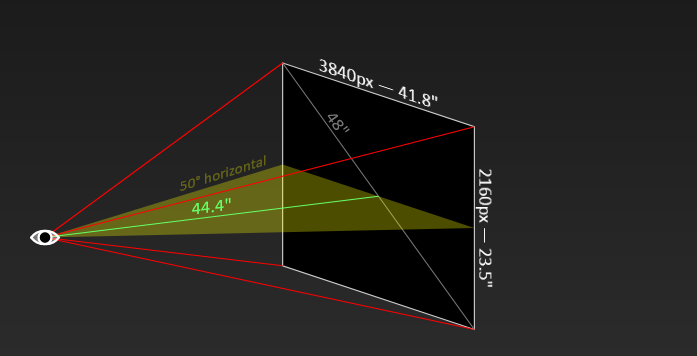
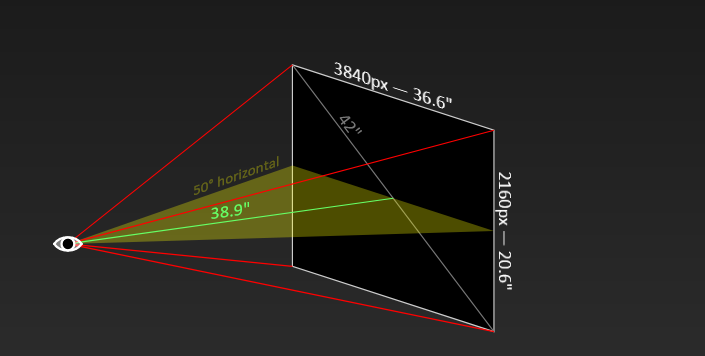
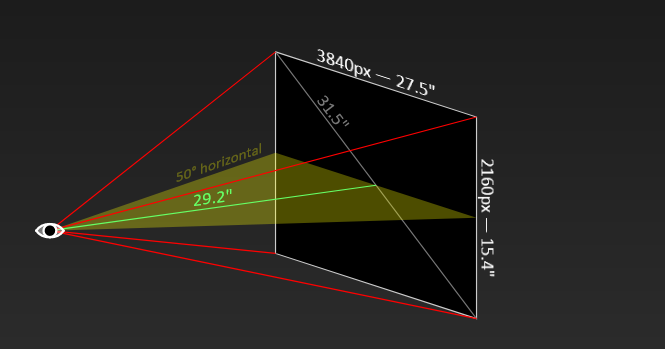
Interestingly, in order to be in the THX standard optimal "sweet spot" of ~ 45 to 50 degree viewing angle (for films) at 50deg your viewing distances for a 48" and 42" screen would be as shown below:

2:39:1 is a little wider, like an ultra-wide version of the same screen height, but the degree calculation is in relation to the screen width so the recommended degrees should still be a good reference.


http://www.acousticfrontiers.com/2013314viewing-angles/
Nx1vsnv.gif


48" 4k screen = 44.4" minimum in order to have 50deg viewing angle
w7zaY99.png

42" 4k screen = 38.9" minimum in order to have 50deg viewing angle

WsB4tSA.png

31.5" screen's minimum viewing distance for 50 deg THX = 29.2"
Du2FNYy.png
 
Last edited:
I managed to snag a 3080 FE this weekend. I have it hooked to my CX48 (4k 120Hz 10bpc RGB Full) and an Acer Predator XB271HU (1440p 144Hz). I set Gsync to be on for fullscreen and windowed, limit fps to 117 in NVCP, and Vsync to be based on ingame. When I tested a game (Genshin Impact) that's ingame capped at 60fps, I get massive stutters. When I turn Gsync off, I get smooth gameplay like my previous GTX 1080. I also tested having Gsync on BUT having the Acer monitor set at 60Hz (or unplugged) and I get no (or almost no) stutter. Has anyone experienced something like this? Could it be the GPU is not capable of providing Gsync at 120-144Hz for BOTH displays? Or is my settings wrong somewhere causing the stutters? Or Nvidia driver/LG firmware problem?
 
I like this trend. Maybe one day we'll finally see the end of rubbish LCD tech. Unlike the death of CRTs, I won't be sad at all. 1000 Hz 32" OLED gaming panels anyone? :)
 
I managed to snag a 3080 FE this weekend. I have it hooked to my CX48 (4k 120Hz 10bpc RGB Full) and an Acer Predator XB271HU (1440p 144Hz). I set Gsync to be on for fullscreen and windowed, limit fps to 117 in NVCP, and Vsync to be based on ingame. When I tested a game (Genshin Impact) that's ingame capped at 60fps, I get massive stutters. When I turn Gsync off, I get smooth gameplay like my previous GTX 1080. I also tested having Gsync on BUT having the Acer monitor set at 60Hz (or unplugged) and I get no (or almost no) stutter. Has anyone experienced something like this? Could it be the GPU is not capable of providing Gsync at 120-144Hz for BOTH displays? Or is my settings wrong somewhere causing the stutters? Or Nvidia driver/LG firmware problem?
I would try to enable vsync on driver and disable in game, sometimes it helps.
 
I managed to snag a 3080 FE this weekend. I have it hooked to my CX48 (4k 120Hz 10bpc RGB Full) and an Acer Predator XB271HU (1440p 144Hz). I set Gsync to be on for fullscreen and windowed, limit fps to 117 in NVCP, and Vsync to be based on ingame. When I tested a game (Genshin Impact) that's ingame capped at 60fps, I get massive stutters. When I turn Gsync off, I get smooth gameplay like my previous GTX 1080. I also tested having Gsync on BUT having the Acer monitor set at 60Hz (or unplugged) and I get no (or almost no) stutter. Has anyone experienced something like this? Could it be the GPU is not capable of providing Gsync at 120-144Hz for BOTH displays? Or is my settings wrong somewhere causing the stutters? Or Nvidia driver/LG firmware problem?

Did you try disabling the FPS limiter? That can cause stutter in some games in my experience (Hades being a notable example).
 
Back
Top