Yes.No.
At 4K the 4080 is limited by its GPU, not VRAM.
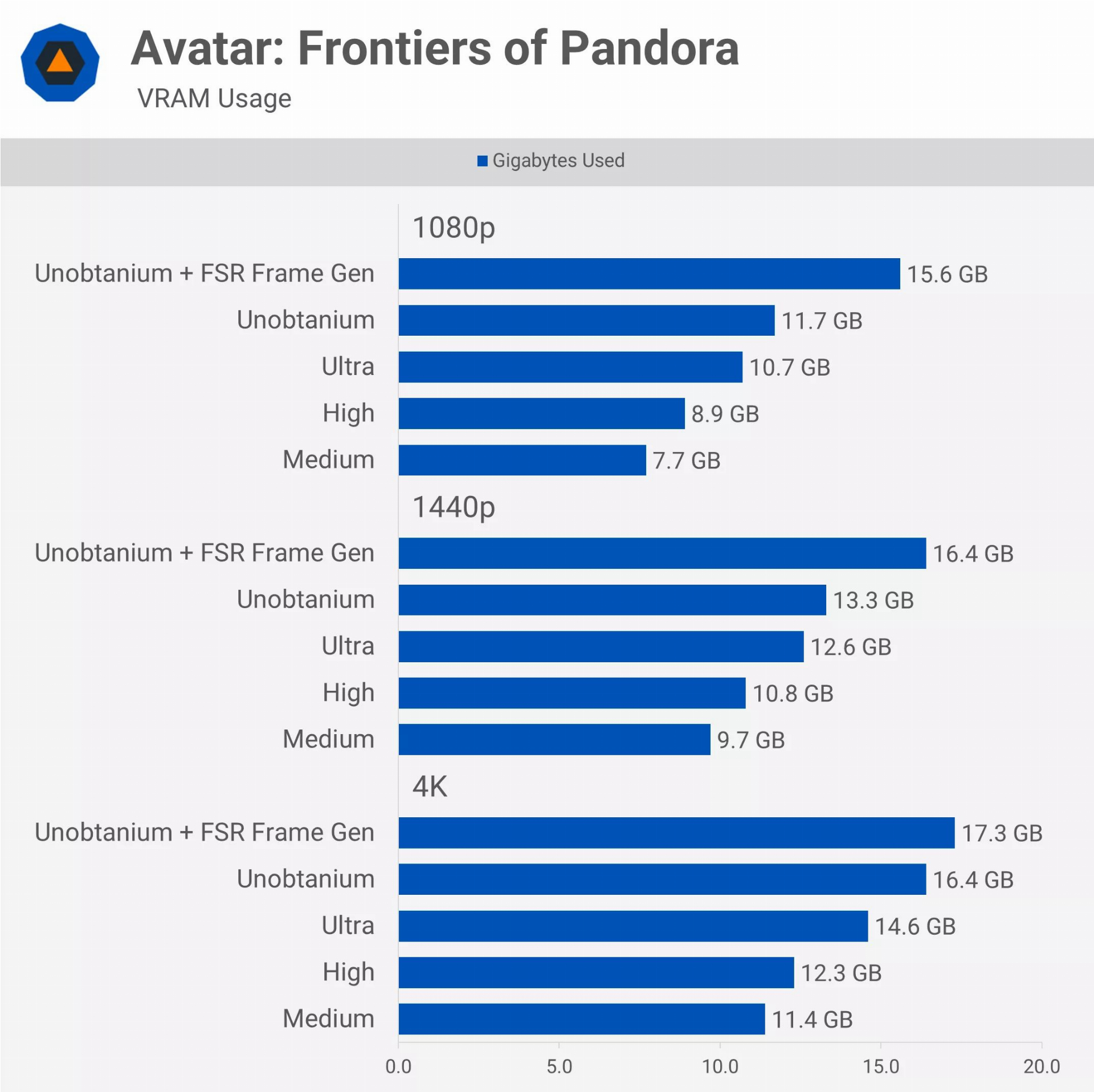
At 4K the 4080 is limited by its VRAM:
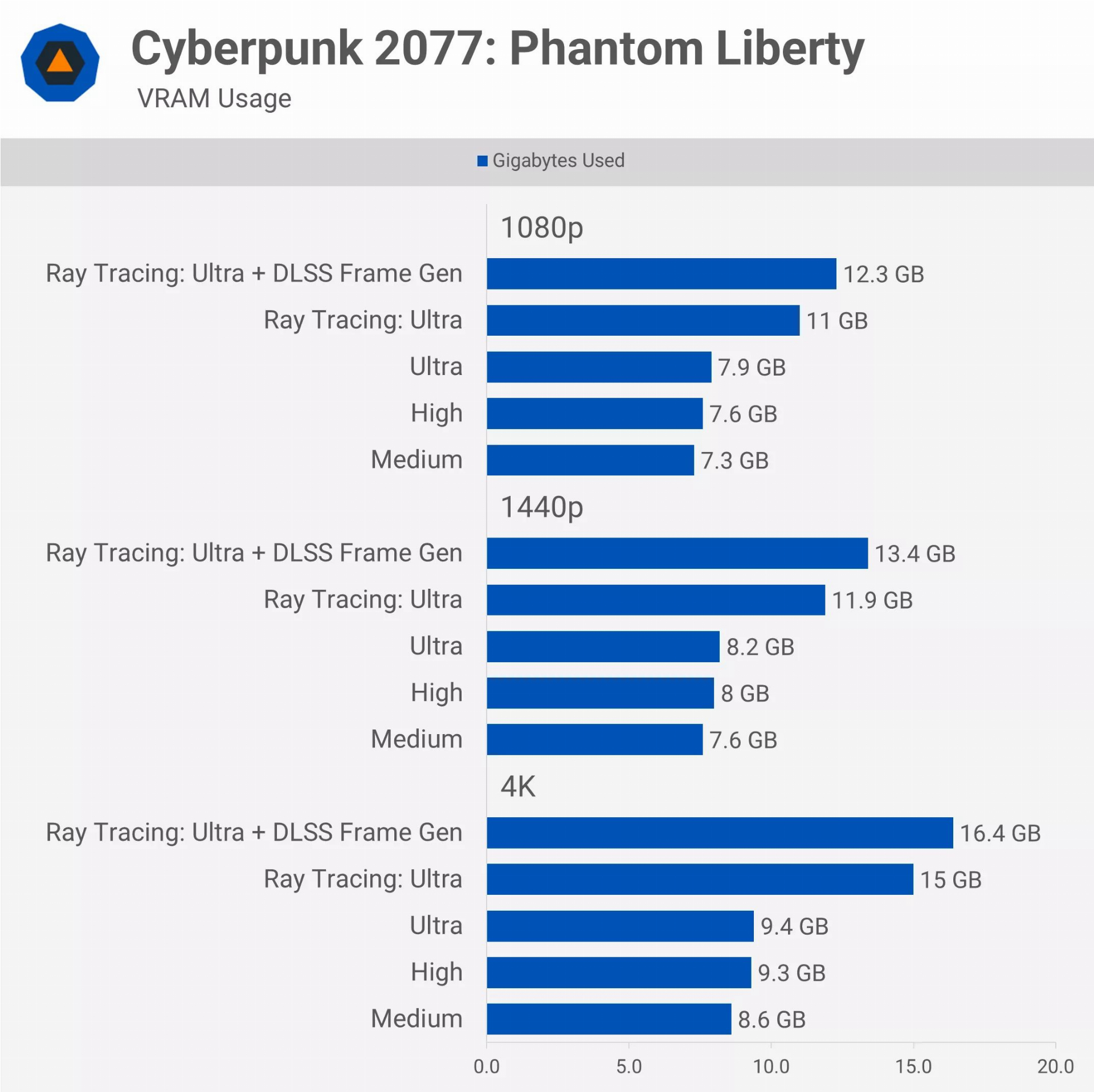
At 1440p the 4080 is limited by it's VRAM:
![[H]ard|Forum](/styles/hardforum/xenforo/logo_dark.png)
Follow along with the video below to see how to install our site as a web app on your home screen.
Note: This feature may not be available in some browsers.
Yes.No.
At 4K the 4080 is limited by its GPU, not VRAM.

Yet it lacks the performance to run that stuff at native anyway, and with DLSS it is not lacking vram for Cyberpunk. You also could simply turn down a raytracing setting a notch and not be even at native, which is a thought exercise since it doesn't have the horsepower.Yes.
At 4K the 4080 is limited by its VRAM:
View attachment 693944
At 1440p the 4080 is limited by it's VRAM:
View attachment 693945
You are not necessarily saying different things, a 4090 cannot run Avatar ubnotanium 4k native and the gap between the 4080 and 4090 between ultra and unobtanium is really similar, if vram is an issue, the lack of performance to run this would be there if the 4080 had 48 gb.Yes.
Uh, take a look at the chart again.Yet it lacks the performance to run that stuff at native anyway, and with DLSS it is not lacking vram for Cyberpunk. You also could simply turn down a raytracing setting a notch and not be even at native, which is a thought exercise since it doesn't have the horsepower.
P. S in Avatar, the unobtanium setting wasn't meant for current cards per the developers, and thus is 100% irrelevant. Nice try, but you're being disingenuous.
That's frame generation, not dlss scaling. Nice try again. You know the difference, so stop being disingenuous and pretending otherwise. This has already been covered earlier in the thread.Uh, take a look at the chart again.
DLSS is what lifts cyberpunk past 16GB threshold. And you need DLSS to make it nicely playable.
DLSS3 provides a hefty performance upgrade over DLSS2, so of course we will use it and take it into account instead of pretending like it doesn't exist:That's frame generation, not dlss scaling. Nice try again. You know the difference, so stop being disingenuous and pretending otherwise. This has already been covered earlier in the thread.
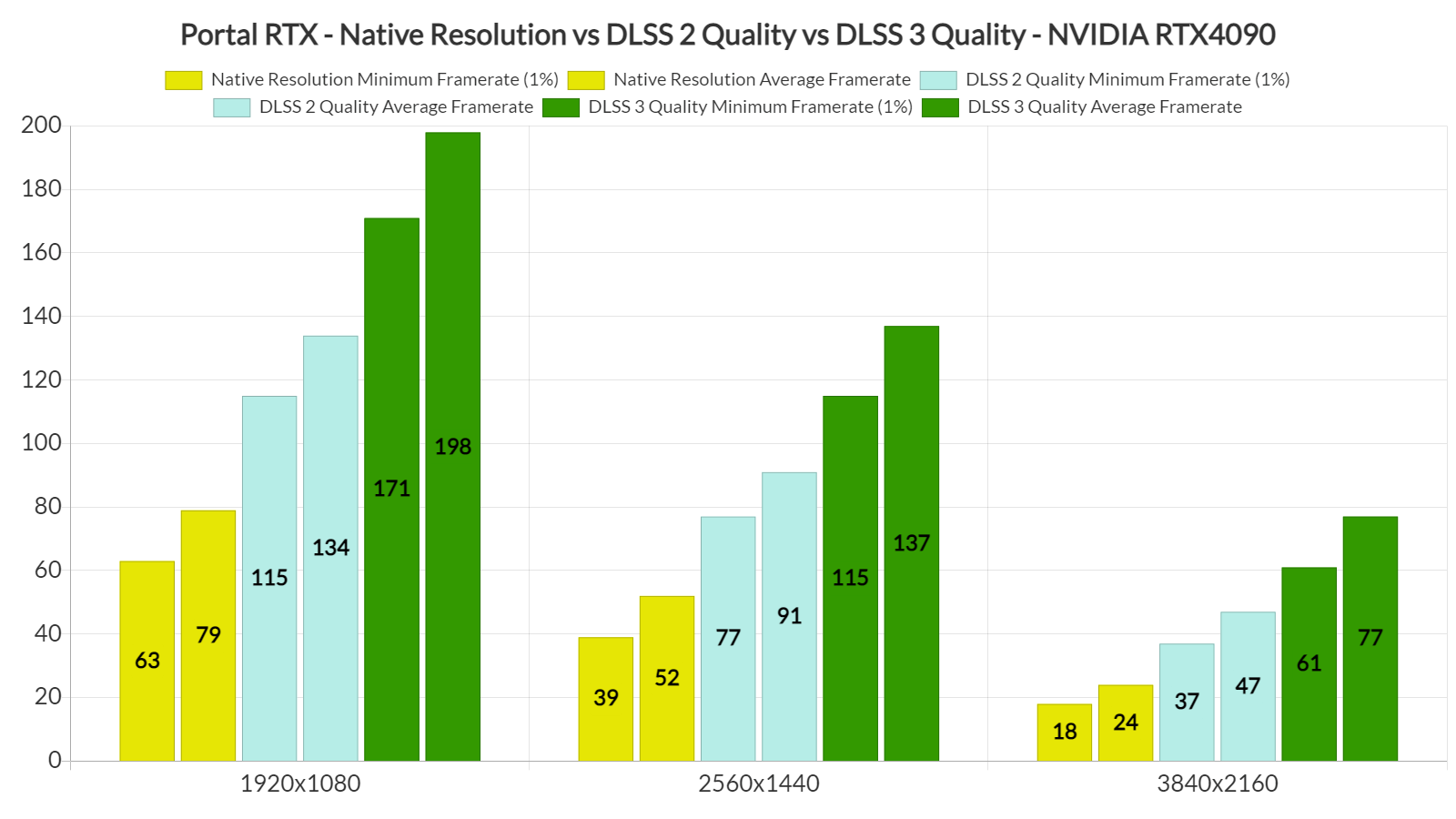
Ok, now you're just trolling. DLSS3 is the marketing name for frame generation. I even said I was referring to dlss upscaling, not frame generation. The new graph you just posted shows fps using upscaling or upscaling + frame gen, it has nothing to go with the vram usage I was talking about.DLSS3 provides a hefty performance upgrade over DLSS2, so of course we will use it and take it into account instead of pretending like it doesn't exist:
View attachment 693947
So are you telling me that you can run full DLSS3 frame generation at 4K at below 16GB VRAM usage in Cyberpunk? The techspot chart just doesn't have upscaling feature of DLSS enabled?Ok, now you're just trolling. DLSS3 is the marketing name for frame generation. I even said I was referring to dlss upscaling, not frame generation. The new graph you just posted shows fps using upscaling or upscaling + frame gen, it has nothing to go with the vram usage I was talking about.
Yes. That's exactly what the chart says. Upscaling is not tied to frame generation with Nvidia's dlss feature.So are you telling me that you can run full DLSS3 frame generation at 4K at below 16GB VRAM usage in Cyberpunk? The techspot chart just doesn't have upscaling feature of DLSS enabled?

The chips are made in Taiwan. Most everything else is made (and assembled for most cards) in China.5090 will not be made in China I do not think (not even sure if it is "legal" for them to make 5090 in China anymore), that more for peasant gpus.
And thats a +10% tarrif over the 25% biden tarrif already there on China electronic, I would imagine and not a 15% cut ?
True I would imagine even if the chips is made in Taiwan and assembled in taiwan (like the 4090 was), malaysia, lot of substrate, ram, cooling part and others could be from China, but is there a tarrif to pay if you assemble the card in Taiwan ?. At least that 2 big part outside tariff and we have been in a 25% tariff for China electronic world for a while now.The chips are made in Taiwan. Most everything else is made in China.

and what was the second part of that statement? "if they dont close their borders"....(25% for Canada and Mexico).
That's the point of these higher tariff, for Canada and Mexico, ostensibly at least, and shirking NAFTA. And this is more the point than protecting American product and trade. Whether it actually works to in practice to influence our neighbors to close their borders, we'll see.and what was the second part of that statement? "if they dont close their borders"....
but we have another thread for that.
we'll see...That's the point of these higher tariff, for Canada and Mexico, ostensibly at least, and shirking NAFTA. And this is more the point than protecting American product and trade. Whether it actually works to in practice to influence our neighbors to close their borders, we'll see.
What's clear is automobiles, electronics and many other retail goods will cost notably more in the US (with knock-on effects Globally) starting next year.

They weren't going to further dilute AD102 supply to even lower cost cards to do so. Only way you would have gotten 20gb out of a 4080 Super as AD103 is max 256-bit in its design and max density for GDDR6X chips were 2GB.Well, well to be fair the 4080 was released in 2022 when 16gb was ''enough'' then but clearly wasn't futureproof enough. As I said, when they put out the 4080 super it should have included 20gb in that update.
Yep, this. Plus you'd be using dlss quality to improve framerates anyway, which means even less vram usage. People way overblow how much is really needed for their cards nowadays at a given performance tier.

LLM folks will buy up 5090 if it has 32GB of ram.
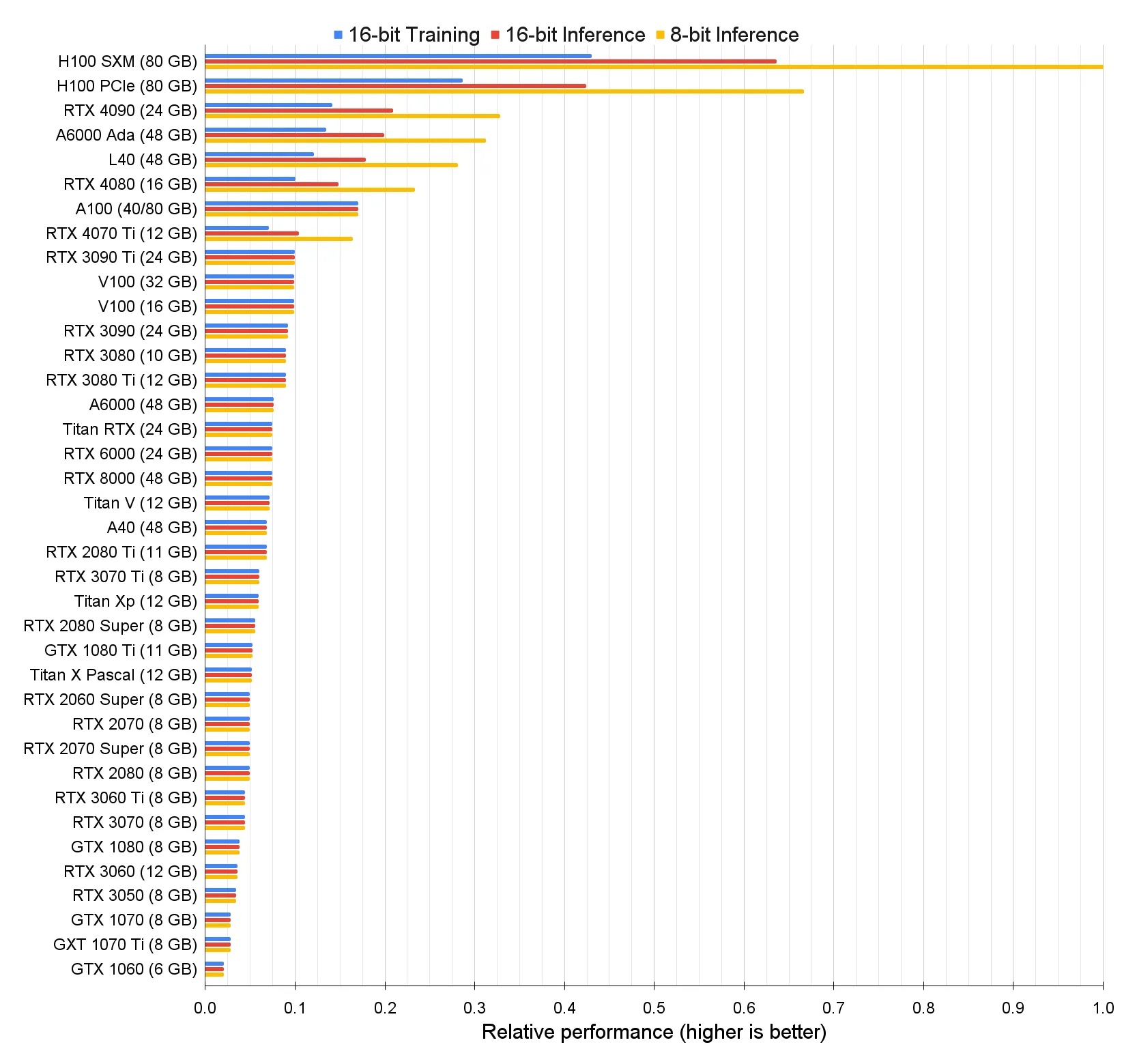
yupIf that pans out this card won't be had for less than $3,000 and probably be out of stock everywhere immediately for quite a long time.

You can get RTX 5000 32GB of Lovelace generation now around that price point:Doesn't matter if its a 32GB 3060, it will sell for over $3000


In other words, bend over and take it, GPU enthusiasts!So the reality is, the RTX-5090 is this:
MSRP will start @ $2,000 for the FE version, and $2300+ for AIB, but won't be available anywhere, as it will be permanently sold out, and with it never in stock anywhere. The market will price them out @ $3,000+ if you want to do Craigslist or Marketplace purchases in person, I would imagine $3,500 being the typical price on Facebook Marketplace.
My point, if you want to purchase an in-stock 5090 at MSRP of $1,999, that won't happen until mid 2026, until then expect to be paying $3,000+ for a 5090.
For the PC Gaming peeps, this will be for the 00.01%.
That just means we won't get a 5090.means they shouldnt be called gaming cards and should be marketed to professionals...
means they shouldnt be called gaming cards and should be marketed to professionals...
That just means we won't get a 5090.
yes,isnt that what they did with the titan series? technically they'd be marketing to high level influencers twitch cam girls etc etc.
 I fully realize that people on such forums as this are enthusiasts, but more grounded discussion is preferable in any case, though by all means express your endorsement and enjoyment of any features of your choice freely - I'm glad if you benefit of any.
![Zarathustra[H]](/data/avatars/m/9/9298.jpg?1723407683)
Has anyone actually seen a reliable leak on price, or are we just randomly speculating here?
I totally expect a price increase over the 4090's MSRP with actual prices on available GPU's being nuts, just like they were when the 4090 launched, but a $2,500 MSRP seems a bit excessive.
$2,500 is just a number some youtuber or website decided to throw out and now people are just running with it as if it's solidified fact.
I happen to know for a fact that something very close this has happened (albeit in a totally different market).Heh. Figured as much, but I wasn't sure what I had missed.
Fun fact. Nvidia was planning on launching it at an MSRP of $1,799 but then they saw this $2,500 price being floated around the internet and were like "Oh, so THATS what they are willing to pay" and upped it
Is there a tl'dr?It would be silly to introduce another xx60 tier model with 8 GBs, at least without a variant with more, but I'm not totally debunking 12 GBs on xx70, since you get along quite fine with that, especially if using upscaling, which should lower memory usage. Like the discussion in this topic related to the RTX 4080, we should always evaluate the proper amount of VRAM relatively to the performance of the card, while not caring of what resolution the manufacturer has marketed the product for, because often we buy our displays with various factors in mind, one of the most usual being desktop usage, which is of course better at 4K than on a lesser resolution; by this I simply counter the menial arguments saying that, for example, RTX 4060 is for 1080p so we should only evaluate it's capabilites for the given resolution. You might play at 4K something lighter like Counter Strike 2 on an RTX 4060, which could create a scenario (not necessarily in CS2 but in similar games), depending on settings used, where the amount of VRAM is exceeded; I don't think people preferring higher resolution displays, pairing them with lesser GPUs, is too uncommon these days, because PCs are used for multiple purposes and for some gaming is only the secondary intent. So, how well could you manage on an RTX 5070 with 12 GBs of VRAM at 4K, given that this particular model likely is close in performance if not equal to the RTX 4080? Tweaking settings appropriately, I think you'll almost always get a satisfactory experience even in the near future, but certainly tweaking is required and some small sacrifices are to be made here and there, but in these instances where they are due, we should assess how they actually affect the experience and not simply assume that higher setting X is always unconditionally desirable - the visual difference may be very nuanced, often companied with a performance cost (does not apply to textures in general). I think any 12 GB card at this point offers a very satisfactory experience even at 4K - I'll repeat, as long as you tweak - but I do hope, like anybody else excited about the upcoming RTX 5000 line-up, that RTX 5070 will have more for lenient usage and in consideration of any edge case. There is naturally the possibility that we get variants, perhaps in line with availability of memory chips as discussed above, so first a lesser model, then one with more VRAM and other possible improvements – good to keep in mind.
Somewhat related to this ever continuing VRAM discussion (which I've enjoyed!), I'm excited about the future line-up as already said, but I'm quite a bit saddened how the tech media and some fans alike tend to treat Nvidia's new features and whatever advantages, like they are essential things. I think, currently as a Radeon user who actually swapped from RTX 4000 series to RX 7000, that depending on what you play, the overall better Nvidia feature set, like their upscaling and frame generation, also possibly the revised control panel, Reflex, more performant ray tracing and likely better streaming features, are all very welcome and appreciated, but how important are these is certainly situational. For example, like many already realize, something like an RTX 4070 cannot run ray tracing very well at all, if we don't count the modified retro titles, but on the other hand, having DLSS especially at 4K is very nice (lower internal resolution is more feasible with DLSS), at least till FSR 4 arrives (which can take any amount of time, quality being an open question). More precisely what bothers me is how on every release, no matter how marginally useful some feature might be, like ray tracing on the RTX 2000 series as a definite example (perhaps exclude the RTX 2080 Ti), so many sites and users overstate the importance of these features, while downplaying possible shortcomings, like the VRAM - some sites even gave their recommendation badge for the RTX 4060. But! Once a new line-up is at hand, many authors seem to suddenly admit the shortcomings, even spinning them under quite a negative light, while moving to hype the new stuff no matter if they offer anything truly useful or not; some supported singular games may be used as a justification. I've witnessed the same behavior with Apple products and I fully expect the same behavior regarding the RTX 5000 series. To note, I will not personally downplay anything they offer before seeing what they offer, and additionally do not claim that the current Radeon competition is truly competitive in terms of features - to add, the drivers have been quite messy for a long while on Radeon, which to me is the most valuable asset of Geforce cards.
I don't mean to upset anyone by this latter chapter, I simply wanted to get this out, because I'm already feeling the hype machine rumbling, the attunement to praise incontinently whatever comes out. What I wish for, is not a rejectful or in any way negative approach - I admire Nvidia's work in pushing new features out, their pricing being often the only real dilemma - but a careful, mindful evaluation of how important everything is: for what kind of users, for what amount of users, meanwhile considering the future. As you see, I don't deem for my personal PC usage today's Nvidia feature set that important, but it's impressive yes, and yet again, I certainly would like to have the stability of their drivers.
Ground rules are hard to come by in this scene, so it's good we have options.
Heh. Figured as much, but I wasn't sure what I had missed.
Fun fact. Nvidia was planning on launching it at an MSRP of $1,799 but then they saw this $2,500 price being floated around the internet and were like "Oh, so THATS what they are willing to pay" and upped it