![[H]ard|Forum](/styles/hardforum/xenforo/logo_dark.png)
Navigation
Install the app
How to install the app on iOS
Follow along with the video below to see how to install our site as a web app on your home screen.
Note: This feature may not be available in some browsers.
More options
-
Some users have recently had their accounts hijacked. It seems that the now defunct EVGA forums might have compromised your password there and seems many are using the same PW here. We would suggest you UPDATE YOUR PASSWORD and TURN ON 2FA for your account here to further secure it. None of the compromised accounts had 2FA turned on.
Once you have enabled 2FA, your account will be updated soon to show a badge, letting other members know that you use 2FA to protect your account. This should be beneficial for everyone that uses FSFT.
You are using an out of date browser. It may not display this or other websites correctly.
You should upgrade or use an alternative browser.
You should upgrade or use an alternative browser.
RTX 3xxx performance speculation
- Thread starter Nebell
- Start date
You'd might as well just go with a less expensive Nvidia product then. If AMDs TDPs are that much lower, their performance will be even worse...
Yeah that was some youtuber logic from that guy. Overall efficiency will be not be that far off. Just because Nvidia is making a 400w mega card, does not mean new cards are inefficient.
Just knee jerk reactions as always.
I do not buy that there will be a TMSC 7nm refresh next year... When is the last time that NVIDIA did a refresh and would it makes any economical sense at all? I suspect that that the relatively minimal performance gain would not justify the material development cost.
There won't be. People assemble multiple layer, house of cards stories on top of rumors when we actually know nothing.
People made the exact same BS claim after Turing launched. That there would a 7nm refresh within a year.
Which never happened because the up front costs of building a line of GPU chips costs hundreds of millions of dollars, and you want to run those chips as long as possible to make back all the money you poured in, and then make profits.
Cutting the run short with a new chip, means cutting short the profit phase, and incurring another up front cost phase. It doesn't make financial sense.

- Joined
- Apr 15, 2005
- Messages
- 22,089
Yeah that was some youtuber logic from that guy. Overall efficiency will be not be that far off. Just because Nvidia is making a 400w mega card, does not mean new cards are inefficient.
Just knee jerk reactions as always.
The exact same thing was said about each previous gen card when it was brought up.
Yet here I am, with another 250W TDP "more efficient card" than my previous 220-250W cards, and dealing with the same heat.
Arguing the efficiency angle is a total dismissive cop-out.

Auer
[H]ard|Gawd
- Joined
- Nov 2, 2018
- Messages
- 1,972
Which one dumps more heat in to a room, a aircooled card running at 80C or a liquid cooled card at 68C? I dont do thermal physics so educate me.You'd might as well just go with a less expensive Nvidia product then. If AMDs TDPs are that much lower, their performance will be even worse.
Should be said that unless the tubing for the liquid cooling goes into another room, it's going to be dumping the same heat into the same room -- just more efficiently.
- Joined
- Apr 15, 2005
- Messages
- 22,089
Which one dumps more heat in to a room, a air-cooled card running at 80C or a liquid cooled card at 68C? I don't do thermal physics so educate me.
Both. TDP is TDP, and that heat needs to go somewhere. That somewhere is right outside of the chassis.
The only thing that liquid cooling will have an advantage over is the rate at which it can remove the heat from the die, reducing or eliminating the chance of thermal throttling due to heat soak/saturation.
Both will dump the same amount of heat into your room if at the same power. One is more efficient removing that heat thus can keep the component at a cooler temperature.Which one dumps more heat in to a room, a aircooled card running at 80C or a liquid cooled card at 68C? I dont do thermal physics so educate me.
The exact same thing was said about each previous gen card when it was brought up.
Yet here I am, with another 250W TDP "more efficient card" than my previous 220-250W cards, and dealing with the same heat.
Arguing the efficiency angle is a total dismissive cop-out.
"The efficiency angle is a dismissive cop-out" Isn't that the entire point? Here is an idea: don't buy the flagship as it seems to be getting bigger and bigger. Example of an upgrade path: GTX 980 > GTX 1080 > RTX 2060 Super > RTX 3060.
More performance each upgrade while staying below 200w. Wow, neat!
Which one dumps more heat in to a room, a aircooled card running at 80C or a liquid cooled card at 68C? I dont do thermal physics so educate me.
It's the same heat load in the closed system ( your room) either way.
If the GPU consumes 300W, then 300W of heat load makes it into your room (eventually) regardless of the cooling system. That is basic thermodynamics.
All the various cooling systems do is shuffle that heat around differently in what is effectively a closed system (your room).
If anything a more efficient cooler (liquid) might get the heat into the room sooner, while the less efficient air cooler traps longer in the PC...

- Joined
- Apr 25, 2001
- Messages
- 16,122
I do not buy that there will be a TMSC 7nm refresh next year... When is the last time that NVIDIA did a refresh and would it makes any economical sense at all? I suspect that that the relatively minimal performance gain would not justify the material development cost.
Me either. I think we'll see 5 nm Hopper NLT spring 2022.

Nenu
[H]ardened
- Joined
- Apr 28, 2007
- Messages
- 20,314
Which one dumps more heat in to a room, a aircooled card running at 80C or a liquid cooled card at 68C? I dont do thermal physics so educate me.
Others have correctly stated the heat fed into the room is the same, what differs between coolers is how long before the cooler ramps up to releasing maximum heat from the source.
A good cooler will keep the core at a low temperature, releasing the maximum heat quite quickly.
A not so good cooler will allow the core temperature to rise higher, which means the poorer cooler also heats up more before releasing the same heat into the room. ie it creates a larger delta T to ambient.
Good cooler = lower core and coolers fin temps.
Poorer cooler = higher core and coolers fin temps.
When selecting a cooler, what matters (at a basic level) is whether the temperature for the core is safe or if its low enough for the clock speed you want to achieve.
Fan speeds can often be lower with a better cooler, depending on why its better.
Both will dump the same amount of heat into a room. The difference is that water cooling allows you to direct the heat further away depending on where the radiator is located.Which one dumps more heat in to a room, a aircooled card running at 80C or a liquid cooled card at 68C? I dont do thermal physics so educate me.
It's energy, so it cannot be created or destroyed, it can only be transferred or changed from one form to another.
EDIT: Actually I'll go a step further and say that high end WC setups require a powerful pump (or 2) and more fans than air cooling. Because the fans and pumps produce heat (mind you, not very much head compared to a CPU and/or GPU) that WC actually produces MORE heat than a standard air cooling setup. But the goal of water cooling is to cool more efficiently. It does this via 3 elements.
1. Large radiators (spreads heat out)
2. Slow turning fans (reduces noise pollution)
3. Highly efficient CPU/GPU blocks that xfer heat -> water very efficiently.
So the negative of 5-10 watts extra heat is greatly outweighed by the lower operating temperatures of the CPU/GPU and quiet operation of a good WC setup.
Last edited:

Dayaks
[H]F Junkie
- Joined
- Feb 22, 2012
- Messages
- 10,314
Well, technically you save somewhere between 1-3% on leakage per 10C. So an aircooled card and a water cool carded; both putting out the exact same fps (and all things equal) will save 2-6% on wattage, or 6-18 watts off of the 300W TDP.
Kind of nitpicking since no one could ever tell that difference lol.
Personally I have my reservoir / radiator / pumps in my basement and I run a line upstairs. Computer is basically completely silent + less heat for the AC to remove in the summer. I have my entire HTPC in the basement and run a 30' HDMI cord upstairs.
Kind of nitpicking since no one could ever tell that difference lol.
Personally I have my reservoir / radiator / pumps in my basement and I run a line upstairs. Computer is basically completely silent + less heat for the AC to remove in the summer. I have my entire HTPC in the basement and run a 30' HDMI cord upstairs.
Nenu
[H]ardened
- Joined
- Apr 28, 2007
- Messages
- 20,314
Yep, also lower temps can allow lower voltage to be used, lowering temps/power use further.Well, technically you save somewhere between 1-3% on leakage per 10C. So an aircooled card and a water cool carded; both putting out the exact same fps (and all things equal) will save 2-6% on wattage, or 6-18 watts off of the 300W TDP.
Kind of nitpicking since no one could ever tell that difference lol.
Personally I have my reservoir / radiator / pumps in my basement and I run a line upstairs. Computer is basically completely silent + less heat for the AC to remove in the summer. I have my entire HTPC in the basement and run a 30' HDMI cord upstairs.
I decided not to complicate my post above too much.
Good point.Well, technically you save somewhere between 1-3% on leakage per 10C. So an aircooled card and a water cool carded; both putting out the exact same fps (and all things equal) will save 2-6% on wattage, or 6-18 watts off of the 300W TDP.
Kind of nitpicking since no one could ever tell that difference lol.
Personally I have my reservoir / radiator / pumps in my basement and I run a line upstairs. Computer is basically completely silent + less heat for the AC to remove in the summer. I have my entire HTPC in the basement and run a 30' HDMI cord upstairs.
Thermodynamics is a tricky SOB.

- Joined
- May 18, 1997
- Messages
- 58,518
ON TOPIC PLEASE!
- Joined
- Apr 15, 2005
- Messages
- 22,089
"The efficiency angle is a dismissive cop-out" Isn't that the entire point? Here is an idea: don't buy the flagship as it seems to be getting bigger and bigger. Example of an upgrade path: GTX 980 > GTX 1080 > RTX 2060 Super > RTX 3060.
More performance each upgrade while staying below 200w. Wow, neat!
So I should reduce my product tier with each upgrade just because of TDP? That'll likely shorten my own targeted upgrade cycles and end up costing me more money in the long run.
ON TOPIC PLEASE!
Power === Performance
These days GPUs and CPUs are primarily limited by their power. If you can make your GPU/CPU 20% more efficient you can get 20% more performance out of it.
We are likely seeing the twilight of 30% generational performance improvements in GPUs due to power and process limits

IdiotInCharge
NVIDIA SHILL
- Joined
- Jun 13, 2003
- Messages
- 14,669
There's efficiency at a certain level of performance (set by clock frequencies and voltage and cooling), and then there's the curve that that level of efficiency is situated between levels that may be more or less efficient. No matter how much juice (wattage) you feed a particular processor, and how well you cool it, there's a point where no more juice and no more cooling will make it run any faster. The more you push here, the more power you feed and more exotic the cooling,These days GPUs and CPUs are primarily limited by their power. If you can make your GPU/CPU 20% more efficient you can get 20% more performance out of it.
And then attendent cooling brackets that set similar limitations. Air cooling, various levels of water cooling, phase change, and so on.
So yes, power is one limitation, but the processor itself, by design and by limitations placed on the power and cooling and the node it was built on, also place significant limitations on performance.
Case in point: AMD Ryzen CPUs are generally considered to be a smidge more efficient and yet a smidge slower per-core, and that doesn't have the opportunity to change without significant end-user binning and exotic cooling, at which point it becomes a comparison of individual samples and not of much use to the community as a whole that must rely on retail CPUs.
GPUs aren't much different in that regard, and really, they're more limited by reticle limits at foundries, which limit how large a GPU may be produced on a particular node, and then alongside the feature sizes of the node, how much circuitry can actually be manufactured per die.
Happy to see that the responses to this question were all reasonable. I was worried. I worked with an engineering manager a decade ago that basically got this concept wrong and holy shit did I lose respect for him. Glad that didn't happen with this forum.Which one dumps more heat in to a room, a aircooled card running at 80C or a liquid cooled card at 68C? I dont do thermal physics so educate me.
To stay on topic .... I just hope it has HDMI 2.1 so that I can drive this C9.

- Joined
- Nov 13, 2006
- Messages
- 3,772
Well, it looks like EK will have blocks out for the 3090 relatively soon: https://videocardz.com/newz/ek-promises-geforce-rtx-30-water-blocks-ready-at-or-close-to-launch
That should help the 3090 with any heat related performance issues for those so inclined. I definitely plan on water cooling it - haven’t air cooled a GPU in over a decade.
That should help the 3090 with any heat related performance issues for those so inclined. I definitely plan on water cooling it - haven’t air cooled a GPU in over a decade.
To stay on topic .... I just hope it has HDMI 2.1 so that I can drive this C9.
Can't imagine it would lack HDMI 2.1 at this stage. This Fall is a big turning point. Going forward I expect all (non entry level) new Discrete and Console GPUs will have Ray Tracing and HDMI 2.1.
This really is a massive fall/winter for new tech. All new top end consoles (PS5 and XBSX), and big new Generation Discrete GPU from both NVidia and AMD, and new AMD ZEN 3 CPUs.
Wow! So much new tech crammed into a short time frame. It's going to get really boring for a while after. New consoles will be the same for probably 5+ years. New GPUs probably 2 years....
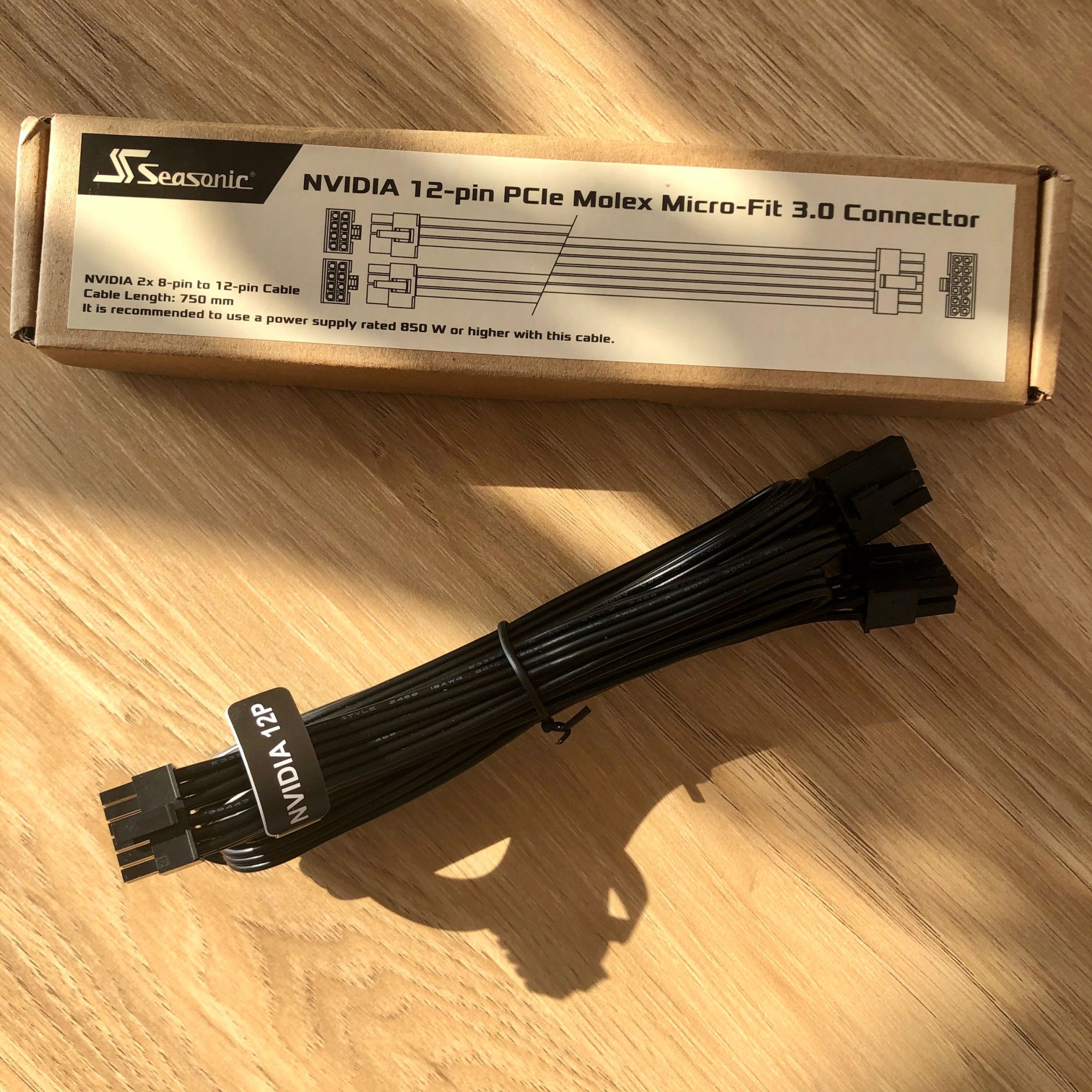
not sure if this has already been posted...
Seasonic Shows off 12-Pin Micro-Fit 3.0 Power Connector Adapter For Next-Gen NVIDIA GeForce RTX 30 Founders Edition Graphics Cards...
The 2x 8-pin to 1x 12-pin power connector features a length of 750mm...Seasonic has posted a power supply rating of 850W or beyond for use with the 12-pin connector cable...
Seasonic Shows off 12-Pin Micro-Fit 3.0 Power Connector Adapter For Next-Gen NVIDIA GeForce RTX 30 Founders Edition Graphics Cards...
The 2x 8-pin to 1x 12-pin power connector features a length of 750mm...Seasonic has posted a power supply rating of 850W or beyond for use with the 12-pin connector cable...
Attachments


Mylex
Gawd
- Joined
- Aug 30, 2018
- Messages
- 852
It has but doesn't hurt posting again if you just came across it. I saw a Tweet from Moore's Law saying he can guarantee 3070 performs like 2080ti and another post on MSI submitting 28 models total for approval. All in all it helps the time go by.not sure if this has already been posted...
Seasonic Shows off 12-Pin Micro-Fit 3.0 Power Connector Adapter For Next-Gen NVIDIA GeForce RTX 30 Founders Edition Graphics Cards...
The 2x 8-pin to 1x 12-pin power connector features a length of 750mm...Seasonic has posted a power supply rating of 850W or beyond for use with the 12-pin connector cable...
That's great news it really seems the 3090 can use all the cooling it can get. I was thinking of going custom loop at some point once I upgraded my CPU. Waiting for Zen 3 to get a 4900X or something alone those lines and also means a mobo upgrade for me.Well, it looks like EK will have blocks out for the 3090 relatively soon: https://videocardz.com/newz/ek-promises-geforce-rtx-30-water-blocks-ready-at-or-close-to-launch
That should help the 3090 with any heat related performance issues for those so inclined. I definitely plan on water cooling it - haven’t air cooled a GPU in over a decade.
I was hoping for $700 for the 3080 but that might be a bit optimistic...Jensen has been known to come up with final pricing right before he takes the stage so there's still hope...3090 is too much for my 1440p needs (especially at $1400)
I’m ready to spend $800 Max on a GPU this Generation. I really want the 3080 due to it having atleast 10GB of VRAM. If the rumors of the 3070 having 8/16 GB of ram turn out to be true ill skip it and definitely go for the 10GB 3080. Fingers crossed for a $699 RTX 3080!
I’m ready to spend $800 Max on a GPU this Generation. I really want the 3080 due to it having atleast 10GB of VRAM. If the rumors of the 3070 having 8/16 GB of ram turn out to be true ill skip it and definitely go for the 10GB 3080. Fingers crossed for a $699 RTX 3080!
rumors have the custom 3080 cards having 20GB VRAM and the Founders Edition having 10GB
Rev. Night
2[H]4U
- Joined
- Mar 30, 2004
- Messages
- 2,263
Time for some speculation about 2000/3000 performance and cost comparisons. I'm bored at work today so I used this TweakTown article that shows the cost breakdowns and a performance comparison:
Tweet:
Where does this leave us? With the chart below. We have the 3060 Regular (FE?) being just a hair better than the 2080 FE for the same estimated MSRP of $399 of last gen. The x6 has the same price, but, yet again, we see a price increase on the x7 and x8 tiers. They are $100 more than the 2000 gen, which was already $100 more than the 1000 gen. Great news if you own stock in Nvidia (i do) and the idiots will still go out and buy it.
Yes, you have a $599 part equaling last gens $1000 part. But how is this different than 1000 series to 2000? Look at that same TPU link, the 2070 is about 90% of the 1080ti. And 9th gen to 10th gen? The 980ti is about 8% less than 1070. So equal to, +/- 10% for the past few generations, nothing really to write home about. Except for higher prices that is!
I tried to attach the excel file if you all wanted to check my math, zipping it, renaming to .zzz. I can't seem to attach it. Weird.

Tweet:
- "GeForce RTX 3070 has around the same level of performance of the GeForce RTX 2080 Ti"
- "You all can do the math on how much stronger the 3080 & 3060 are relative to this based on the previous gen"
Where does this leave us? With the chart below. We have the 3060 Regular (FE?) being just a hair better than the 2080 FE for the same estimated MSRP of $399 of last gen. The x6 has the same price, but, yet again, we see a price increase on the x7 and x8 tiers. They are $100 more than the 2000 gen, which was already $100 more than the 1000 gen. Great news if you own stock in Nvidia (i do) and the idiots will still go out and buy it.
Yes, you have a $599 part equaling last gens $1000 part. But how is this different than 1000 series to 2000? Look at that same TPU link, the 2070 is about 90% of the 1080ti. And 9th gen to 10th gen? The 980ti is about 8% less than 1070. So equal to, +/- 10% for the past few generations, nothing really to write home about. Except for higher prices that is!
I tried to attach the excel file if you all wanted to check my math, zipping it, renaming to .zzz. I can't seem to attach it. Weird.
Last edited:
Time for some speculation about 2000/3000 performance and cost comparisons. I'm bored at work today so I used this TweakTown article that shows the cost breakdowns and a performance comparison:
Tweet:
Using TechPowerUp's Geforce 2070 FE page as a guide, you can start to build how powerful the 2070 was compared to the entire 2000 product stack. Granted this is only at 1080p, but its good enough for a quick comparison. Why use 2070? Because its the same x7xx tier, but I guess you could use any 2000s product as long as you kept the comparison math the same.
- "GeForce RTX 3070 has around the same level of performance of the GeForce RTX 2080 Ti"
- "You all can do the math on how much stronger the 3080 & 3060 are relative to this based on the previous gen"
Where does this leave us? With the chart below. We have the 3060 Regular (FE?) being just a hair better than the 2080 FE for the same estimated MSRP of $399 of last gen. The x6 has the same price, but, yet again, we see a price increase on the x7 and x8 tiers. They are $100 more than the 2000 gen, which was already $100 more than the 1000 gen. Great news if you own stock in Nvidia (i do) and the idiots will still go out and buy it.
Yes, you have a $599 part equaling last gens $1000 part. But how is this different than 1000 series to 2000? Look at that same TPU link, the 2070 is about 90% of the 1080ti. And 9th gen to 10th gen? The 980ti is about 8% less than 1070. So equal to, +/- 10% for the past few generations, nothing really to write home about. Except for higher prices that is!
I tried to attach the excel file if you all wanted to check my math, zipping it, renaming to .zzz. I can't seem to attach it. Weird.
View attachment 272997
Maybe I missed a few things, but where did you get that the RTX 3060 will be 86% of the 3070. Also, this is the first I have heard of models like 3080 Super and 3080ti.
Rev. Night
2[H]4U
- Joined
- Mar 30, 2004
- Messages
- 2,263
Look at the column to the left. You take how 2000 series compared to each other and you apply that ratio to the 3000. You have to use 2080ti=3070 as a starting point so you can compare the two generations. So all things being equal, the 2060 FE was 86% of the 2070 FE. Since the 3070 now =the 2080ti, and the 2080ti is normalized to be 100, that mean it gets a relative score of 86. What does a score of 86 get us last gen? Just a bit better than the 2080 FE.Maybe I missed a few things, but where did you get that the RTX 3060 will be 86% of the 3070.
Also, this is the first I have heard of models like 3080 Super and 3080ti.
100% speculative, but nvidia typically releases one Regular flavor, and one Improved flavor, for each tier for each generation
technologically-speaking, GPU hardware isn't that complicated.
Tell that to 3DFX and Intel.
Can't imagine it would lack HDMI 2.1 at this stage. This Fall is a big turning point. Going forward I expect all (non entry level) new Discrete and Console GPUs will have Ray Tracing and HDMI 2.1.
This really is a massive fall/winter for new tech. All new top end consoles (PS5 and XBSX), and big new Generation Discrete GPU from both NVidia and AMD, and new AMD ZEN 3 CPUs.
Wow! So much new tech crammed into a short time frame. It's going to get really boring for a while after. New consoles will be the same for probably 5+ years. New GPUs probably 2 years....
I've said it before, and I'll say it again: if Nvidia/AMD misses the boat on HDMI 2.1 and Nvidia/AMD includes it, it'll be Nvidia's/AMD's win for that generation.
Everyone wants a GPU to drive those LG OLEDs...
I've said it before, and I'll say it again: if Nvidia/AMD misses the boat on HDMI 2.1 and Nvidia/AMD includes it, it'll be Nvidia's/AMD's win for that generation.
Everyone wants a GPU to drive those LG OLEDs...
There's no way that either of them misses the boat on that. Would be suicide. Even the consoles have it!

- Joined
- Apr 9, 2016
- Messages
- 1,919
Time for some speculation about 2000/3000 performance and cost comparisons. I'm bored at work today so I used this TweakTown article that shows the cost breakdowns and a performance comparison:
Tweet:
Using TechPowerUp's Geforce 2070 FE page as a guide, you can start to build how powerful the 2070 was compared to the entire 2000 product stack. Granted this is only at 1080p, but its good enough for a quick comparison. Why use 2070? Because its the same x7xx tier, but I guess you could use any 2000s product as long as you kept the comparison math the same.
- "GeForce RTX 3070 has around the same level of performance of the GeForce RTX 2080 Ti"
- "You all can do the math on how much stronger the 3080 & 3060 are relative to this based on the previous gen"
Where does this leave us? With the chart below. We have the 3060 Regular (FE?) being just a hair better than the 2080 FE for the same estimated MSRP of $399 of last gen. The x6 has the same price, but, yet again, we see a price increase on the x7 and x8 tiers. They are $100 more than the 2000 gen, which was already $100 more than the 1000 gen. Great news if you own stock in Nvidia (i do) and the idiots will still go out and buy it.
Yes, you have a $599 part equaling last gens $1000 part. But how is this different than 1000 series to 2000? Look at that same TPU link, the 2070 is about 90% of the 1080ti. And 9th gen to 10th gen? The 980ti is about 8% less than 1070. So equal to, +/- 10% for the past few generations, nothing really to write home about. Except for higher prices that is!
I tried to attach the excel file if you all wanted to check my math, zipping it, renaming to .zzz. I can't seem to attach it. Weird.
View attachment 272997
I think pricing will hold up in that 2080ti performance no matter what card gets you there will still be close to a grand. Maybe $800. Would love to be proven wrong though!
IdiotInCharge
NVIDIA SHILL
- Joined
- Jun 13, 2003
- Messages
- 14,669
3Dfx just straight up stopped trying to innovate and got buried by Nvidia; Intel has been putting out great integrated parts for... nearly two decades?Tell that to 3DFX and Intel.
Rev. Night
2[H]4U
- Joined
- Mar 30, 2004
- Messages
- 2,263
great? Intels integrated have been crap for 20 years
IdiotInCharge
NVIDIA SHILL
- Joined
- Jun 13, 2003
- Messages
- 14,669
I've been gaming on them for a decade... see my signature for my points of comparison.great? Intels integrated have been crap for 20 years
Beyond gaming they've been quite effective for twice that length of time.
Rev. Night
2[H]4U
- Joined
- Mar 30, 2004
- Messages
- 2,263
i hope you have enjoyed your 15fps