• Some users have recently had their accounts hijacked. It seems that the now defunct EVGA forums might have compromised your password there and seems many are using the same PW here. We would suggest you UPDATE YOUR PASSWORD and TURN ON 2FA for your account here to further secure it. None of the compromised accounts had 2FA turned on.
    Once you have enabled 2FA, your account will be updated soon to show a badge, letting other members know that you use 2FA to protect your account. This should be beneficial for everyone that uses FSFT.

LG 48CX

Apparently there is a HDR brightness slider so you could experiment with turning the HDR brightness down , using a dim viewing environment in your room, and seeing if Dynamic Tone Mapping looks better than HGiG or not. Also try putting black level on low instead of auto.

From:
https://www.rockpapershotgun.com/how-to-enable-auto-hdr-in-windows-11

How to enable Auto HDR using Xbox Game Bar​


Step 1: Press the Windows key + G at the same time to open the Game Bar. You can do this anywhere, any time, including if you’re not actually playing a game. Presumably “Xbox Game and Everyone Else Bar” didn’t focus test as well. Anyhow, click on the cog icon in the central bar to open Settings.

Step 2: Click the Gaming features tab on the left, and make sure both the “Use HDR with compatible displays” box and the “Use Auto HDR with supported games” box are checked.

Step 3: Optionally, you can click Adjust HDR Intensity and use the slider to make the image brighter or darker. I found the degree to which this makes a difference varies from game to game, but you can see any changes in real time as you move the slider, so just find your desired level of intensity and click Done to apply.

how-to-enable-auto-hdr-using-xbox-game-bar-step-3.jpg
 
Last edited:
Apparently there is a HDR brightness slider so you could experiment with turning the HDR brightness down , using a dim viewing environment in your room, and seeing if Dynamic Tone Mapping looks better than HGiG or not. Also try putting black level on low instead of auto.

From:
https://www.rockpapershotgun.com/how-to-enable-auto-hdr-in-windows-11


View attachment 408834

Thanks. Will give these options a shot. I only tested out what the default AutoHDR option provides so far. Also is there a table that shows that absolute values the HDR intensity corresponds to? Say for example 100/100 = 4,000 nits, 50/100 = 2,000 nits and so on.
 
Last edited:
Op of the reddit thread in response to your tomb raider picture which I forwarded to the replies there via imgur:

I've never seen anything close to that. That just looks washed out, not overblown necessarily, since all of it looks like shit. My recommendation is still going to be, dtm on, auto hdr on and black level low (if you're going for nice HDR pop. Do not recommend it for competitive, like rainbow, because it slightly crushes shadows).


Also, I use -4,-5 fine tune black level, as I don't trust devs to do proper black levels and so far, I've been right for most games.

..

I'll also add, after messing with all of those settings:
If HGiG looks too dull compared to dynamic tone mapping's over the top saturation - you can try sticking with HGiG and just turn the color slider up in the LG TV's OSD on the named game setting to start with. After turning up the color in the OSD, you can then optionally use reshade to fine tune a game using the lightroom filter (and maybe even the fakeHDR filter) until it looks a lot better than either extreme.
 
Last edited:
Thanks. Will give these options a shot. I only tested out what the default AutoHDR option provides so far. Also is there a table that shows that absolute values the HDR intensity corresponds to? Say for example 100/100 = 4,000 nits, 50/100 = 2,000 nits and so on.

Yeah that's the main complaint about that slider .. :love:
Don't know what it's doing exactly.

If you send the wrong curve with whatever settings or sliders you are using - rather than clipping the LG TV would probably compress farther down than it needs to. That is, going below the 560nit accurate range and compressing a larger range at the top (thus losing more color and detail than necessary at the top end).

LG's 1000-nit curve is accurate up to 560 nits, and squeezes 560 - 1000 nits into 560 - 800 nits.
LG's 4000-nit curve is accurate up to 480 nits, and squeezes 480 - 4000 nits into 480 - 800 nits.
LG's 10000-nit curve is accurate up to 400 nits, and squeezes 400 - 10000 nits into 400 - 800 nits.

So potentially, while maxing the slider might not clip the peak color brigthnesses/detail, you could still be losing detail depending just how bright of a signal it's sending due to a higher LG curve compressing more than you'd really have to. But like I said, I don't know what any % of that slider corresponds to.

I also don't know if altering window's default Dynamic Tone Mapping peak from 1500 using cru would help when using DTM instead of HGiG or if lowering that to 800 or 1000 would lower the peak nits autoHDR was capable of by the same proportion (e.g. lose 1/3 of autoHDR's typical ~ 600 to 800nits when you cut the peak from 1500 to 1000 ??).
 
Last edited:
Well so much for that. The adjust autohdr intensity button is completely greyed out for me. Not sure why.
 

Attachments

  • Screenshot 2021-11-02 205638.png
    Screenshot 2021-11-02 205638.png
    150.5 KB · Views: 1
I can confirm that Max luminance in CRU limits the peak brightness when Auto HDR Intensity is set to 100%.
I used values of 130 / 56 / Blank for Max luminance / Max frame-avg / Min luminance to get 798 & 160 nits for peak & frame average brightness.
Blank for Min luminance resulted in a PQ value of 5, which was lower than 1 for Min luminancewhich resulted in a PQ value of 6.

Auto HDR Intensity is also affected by the SDR content brightness slider.
On Windows 11, an Auto HDR Intensity of 0% starts at the SDR content brightness value.
On Windows 10, low values of Auto HDR Intensity would invert the brightness and make the image dimmer than SDR if the SDR content brightness slider was too high.

In my testing, Auto HDR Intensity appears to increase both the colour gamut and brightness. In some games, just cranking up SDR content brightness looks better than Auto HDR which produces searing white text sure to result in burn-in unless I restrict Intensity to 25%.
 
Last edited:
Well so much for that. The adjust autohdr intensity button is completely greyed out for me. Not sure why.


This worked for someone but not everyone:
You need to close and reopen the settings in the game bar app for the slider to show up...
Took me forever to figure that out.

In that case it looks like they needed to close the settings panel to get the activation checkbox states to "save". Then when they re-opened that panel the adjust button was no longer greyed out.

It could be that simple for some people apparently. Other than that I'm not sure what it could be but you can try enabling and disabling and re-enabling autoHDR and/or Windows HDR and closing the game bar and reopening it one or more times to see if it pops up. Are you keeping windows desktop in HDR mode the whole time normally?

I can confirm that Max luminance in CRU limits the peak brightness when Auto HDR Intensity is set to 100%.
I used values of 130 / 56 / Blank for Max luminance / Max frame-avg / Min luminance to get 798 & 160 nits for peak & frame average brightness.
Blank for Min luminance resulted in a PQ value of 5, which was lower than 1 for Min luminancewhich resulted in a PQ value of 6.

Auto HDR Intensity is also affected by the SDR content brightness slider.
On Windows 11, an Auto HDR Intensity of 0% starts at the SDR content brightness value.
On Windows 10, low values of Auto HDR Intensity would invert the brightness and make the image dimmer than SDR if the SDR content brightness slider was too high.

In my testing, Auto HDR Intensity appears to increase both the colour gamut and brightness. In some games, just cranking up SDR content brightness looks better than Auto HDR which produces searing white text sure to result in burn-in unless I restrict Intensity to 25%.


Good news and good information. Thanks.

If I can bother you with a few more questions, if you find the time:

- Are you using HGiG mode or DynamicToneMapping (DTM) on the TV after you edited the peak brightness, etc. with CRU ? Are autoHDR's settings and the CRU edits being made in relation to windows 11's own dynamic tone mapping and if so, how does that relate to the TV in HGiG or the TV's DTM?

- Are you saying the autoHDR brightness slider affects both color gamut and brightness and the SDR brightness slider affects only brightness so is preferable? If so can you do the same thing with the windows desktopHDR brightness slider?

- That is, what is the difference between:

.... your "just cranking up the SDR content brightness" (the regular windows brightness slider I'm assuming?) instead of using the autoHDR slider's color gamut+brightness increases
.... Keeping HDR mode active on the desktop all of the time and setting that windows 11 HDR brightness slider at a SDR level, then boosting it from there a bit using the autoHDR brightness slider in the xbox gaming panel slider alone
.... Keeping HDR mode active on the desktop and setting that windows 11 HDR brightness slider at a SDR level, then manually adjusting that same slider higher when using autoHDR

I'm also curious if HGiG on the TV works well with autoHDR and if I can still boost the color slider in the LG TV OSD and then use reshade with lightroom filter to adjust everything from there but I can search google to see if anyone is having luck with reshade + autoHDR.
 
Last edited:
This just tells me that AutoHDR is indeed a crapshoot and needs more work if we are having to rely on CRU to fix things up. I also managed to get the INTENSITY slider working by restarting the game, but it didn't seem to change anything besides making the overall entire picture brighter/dimmer. I don't gain or lose detail it's all the same, just the picture as a whole gets brighter or dimmer by adjusting the intensity slider. Also can confirm that the reddit post suggesting DTM to ON, black level to LOW, and FINE TUNE DARK AREAS being tweaked gives a better looking picture.
 
  • Like
Reactions: elvn
like this
This just tells me that AutoHDR is indeed a crapshoot and needs more work if we are having to rely on CRU to fix things up. I also managed to get the INTENSITY slider working by restarting the game, but it didn't seem to change anything besides making the overall entire picture brighter/dimmer. I don't gain or lose detail it's all the same, just the picture as a whole gets brighter or dimmer by adjusting the intensity slider. Also can confirm that the reddit post suggesting DTM to ON, black level to LOW, and FINE TUNE DARK AREAS being tweaked gives a better looking picture.

Thanks for all the feedback.
 
In looking around I came across this. At first glance it might sound outdated since windows has autoHDR now but the specialK mod seems to have a lot more control over settings, more like reshade filters. I'm going to read up on it.


https://discourse.differentk.fyi/t/download-special-k/1461

https://wiki.special-k.info/en/FAQ

In 2018 the framework innovated a general-purpose method of “retrofitting” HDR support for existing Direct3D 11-based SDR games in Windows, a feature that has since continued to evolve and in 2020 was updated to support most D3D11 and D3D12 based games compatible with flip model presentation, including some emulators such as Dolphin and PCSX2.

Special K has a varied and diverse featureset with these being some of its major features:
  • Custom frame limiter that can improve the frame pacing and alleviate stutters in many games.
  • HDR retrofit support in Direct3D 11 and Direct3D 12 games.
  • Enhanced borderless window mode in DirectX 11 games through the use of flip model presentation.
  • Texture cache for DirectX 11 games to minimize the impact to rendering by the act of streaming textures.
  • Texture modding in DirectX 11 games.
  • Game-specific features, tweaks, or bug fixes in a few select games (e.g. NieR: Automata).
  • Various Steam enhancements such as custom achievement popups or screenshot capture on achievement unlocks.
  • Force a custom display mode (borderless/exclusive fullscreen etc) in games.

Special K can also manipulate games in many various minor ways such as locking the cursor to the game window, disabling gamepad input, disabling specific shaders (DX11 only), and much more.

...
vqxewdX.png


sfRuldn.png


dqUEC1E.png


YbOyXPS.png
\

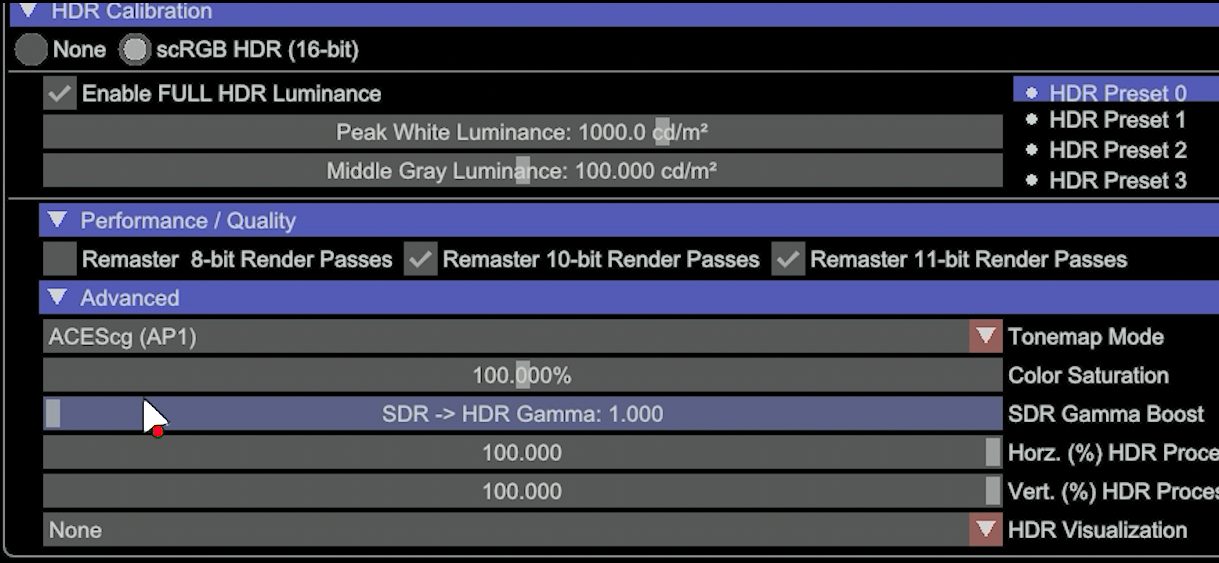
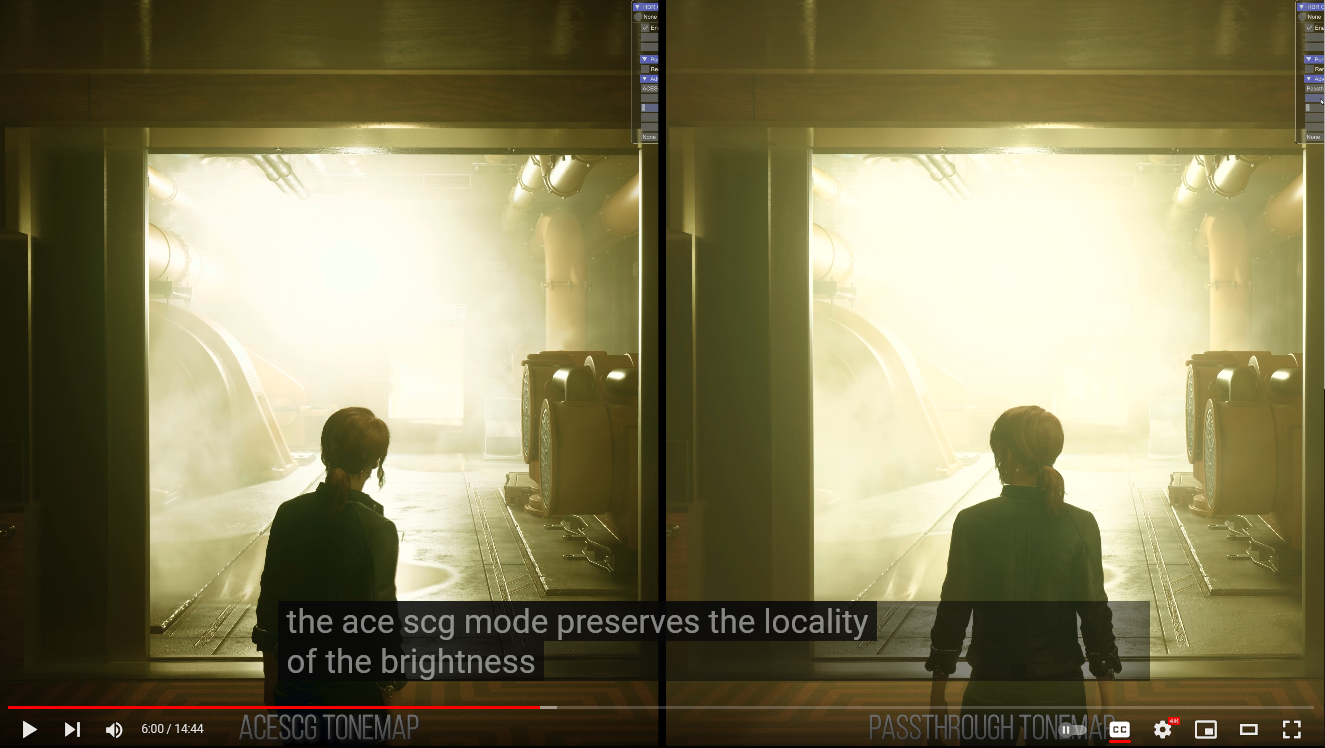
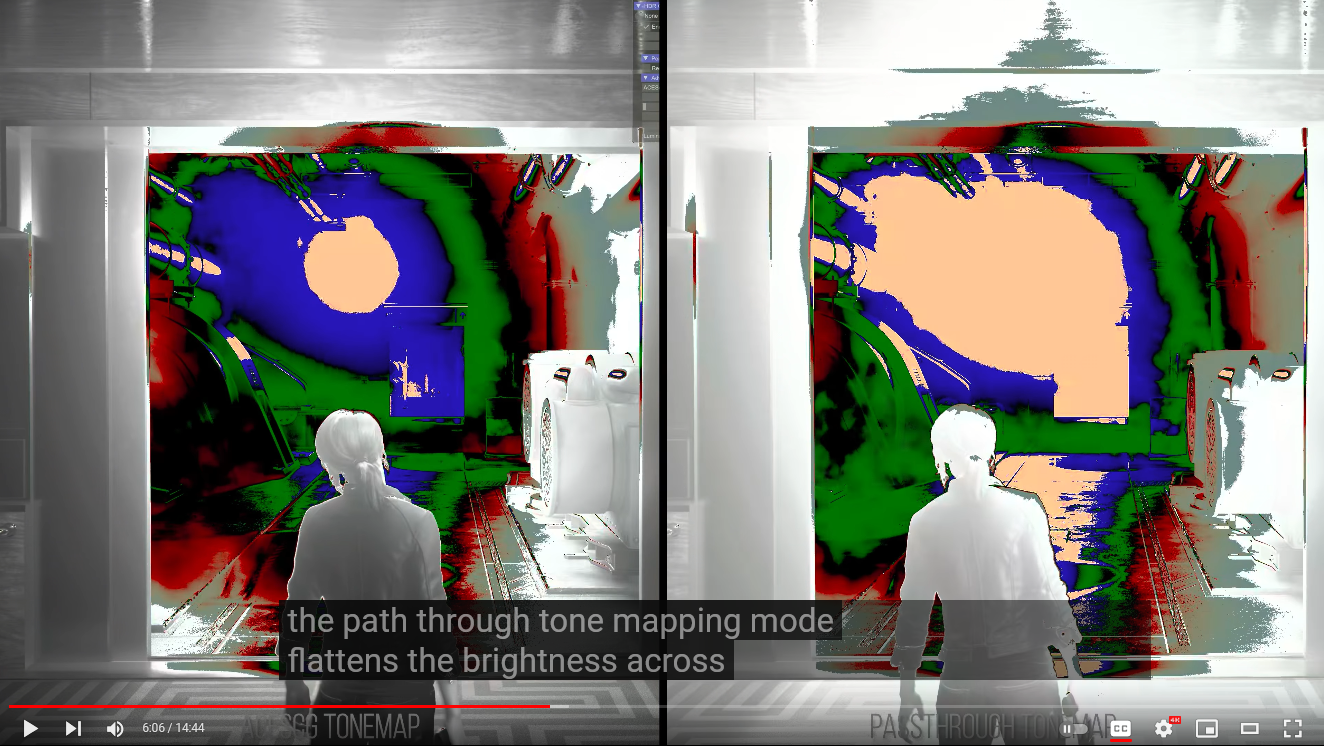
Along with the brightness being uncomfortable, that amount of light crushes the detail in the sky itself so you cannot see the more subtle artwork making up the sky box. Switching over to the default ACESCG tone mapping mode really helped out in dark souls2 as it localizes the brightness more and offers greater image contrast which I found pleasing so the sky was no longer so crushingly bright across the entire surface and detail was more visible in it which you can see well when I show the heat map visualization of the two modes here – where there’s a greater gradation to the brightness in that mode. On top of that you can actually tweak the image even more should you want.

Another feature in the special K tools is the ability to tweak the middle grey value of the image which not a lot of hdr games actually allow you to do. The middle grey value is linked to your max luminance value and can be used to effectively compress or elongate the range of HDR highlights when in ACE SG mode. If you push down this middle grey value in dark souls 2 while looking at the sky with the heat map on you can see how it lowers the overall brightness in doing so and localizes the brightest areas to more specific parts of the image. By pushing down this middle grey variable you can also tweak the brightness of certain UI elements which was another issue tom mentioned in his look at autoHDR on xbox series.

So just with some small adjustments like adjusting the grey point you can produce a very pleasing game with HDR. This specialK HDR can require some tweaking but there’s flexibility in the options here to get an image you might like.
 
Last edited:
I'm at a point in life where I don't want to deal with injecting crap or 20 .ini files/tweaks on a per game basis. I just want to plug and play for the most part and auto HDR does that decently as is currently.

Half the fun before was tweaking stuff until you realize you're tweaking more than playing and enjoying the game. For that reason I've stepped back from it.
 
Yeah after using the settings from Reddit, AutoHDR looks much much better now. Big thanks to elvn for digging around and finding the info. Dynamic tone mapping definitely helps to restore some that detail that is otherwise lost if you stick to HGiG. Example with Kingdom Come Deliverance shown, notice how the detail in the sky is restored with DTM set to ON. Not sure how I can get a good looking picture on my X27 though since I don't think it has any sort of dynamic tone mapping function which is a bummer because all games with RT/DLSS are played on that display as that's my 3080 Ti rig.
 

Attachments

  • 20211103_214421.jpg
    20211103_214421.jpg
    589.8 KB · Views: 0
  • 20211103_214415.jpg
    20211103_214415.jpg
    483.6 KB · Views: 0
Good news and good information. Thanks.

If I can bother you with a few more questions, if you find the time:

- Are you using HGiG mode or DynamicToneMapping (DTM) on the TV after you edited the peak brightness, etc. with CRU ? Are autoHDR's settings and the CRU edits being made in relation to windows 11's own dynamic tone mapping and if so, how does that relate to the TV in HGiG or the TV's DTM?

- Are you saying the autoHDR brightness slider affects both color gamut and brightness and the SDR brightness slider affects only brightness so is preferable? If so can you do the same thing with the windows desktopHDR brightness slider?

- That is, what is the difference between:

.... your "just cranking up the SDR content brightness" (the regular windows brightness slider I'm assuming?) instead of using the autoHDR slider's color gamut+brightness increases
.... Keeping HDR mode active on the desktop all of the time and setting that windows 11 HDR brightness slider at a SDR level, then boosting it from there a bit using the autoHDR brightness slider in the xbox gaming panel slider alone
.... Keeping HDR mode active on the desktop and setting that windows 11 HDR brightness slider at a SDR level, then manually adjusting that same slider higher when using autoHDR

I'm also curious if HGiG on the TV works well with autoHDR and if I can still boost the color slider in the LG TV OSD and then use reshade with lightroom filter to adjust everything from there but I can search google to see if anyone is having luck with reshade + autoHDR.
By DTM I assume you mean DTM Off versus HGIG. DTM On is incorrect in all situations. I use HGIG mode for everything unless I know the content is hardcoded to 1000 / 4000 / 10000 nits, in which case I use DTM Off and override the HDMI Mastering Peak on the TV. If you set the Max Luminance to 800 nits with CRU, you should use HGIG mode with Auto HDR. For native HDR titles that don't have peak luminance calibration, you'll have to check on a case-by-case basis whether they respect Max Luminance in CRU. If they do, use HGIG, otherwise use DTM Off with the appropriate HDMI Mastering Peak override.

The searing white text is caused by the brightness component of Auto HDR, not gamut. Because of the way pure white in SDR (255,255,255) gets mapped to the brightest PQ value by Auto HDR, you may be able to achieve a brighter overall image without searing whites using just the SDR content brightness slider without Auto HDR. You won't get the benefit of wide gamut though. Auto HDR seems to map white in 2D overlays to the maximum brightness, but not so in 3D. It depends on the individual game.

Technically you'd get the most accurate Auto HDR image by setting the SDR content brightness slider to 0 and tweaking Auto HDR Intensity to your preference, especially in games that Auto HDR has specifically been tested and optimized for. This gives Auto HDR the full PQ curve to work with. If SDR content brightness is greater than 0, you're scaling the luminance linearly before it reaches Auto HDR instead of giving it the original colour values to work with. For convenience reasons I leave the SDR content brightness slider at 10 as the difference is not noticeable if you crank Auto HDR Intensity to a high value. Ideally Microsoft should issue an update to override the SDR content brightness slider to 0 when using Auto HDR.
 
Last edited:
Yeah after using the settings from Reddit, AutoHDR looks much much better now. Big thanks to elvn for digging around and finding the info. Dynamic tone mapping definitely helps to restore some that detail that is otherwise lost if you stick to HGiG. Example with Kingdom Come Deliverance shown, notice how the detail in the sky is restored with DTM set to ON. Not sure how I can get a good looking picture on my X27 though since I don't think it has any sort of dynamic tone mapping function which is a bummer because all games with RT/DLSS are played on that display as that's my 3080 Ti rig.
You're losing detail in the highlights because the Max Luminance is too high - the game thinks your display can hit 1500 nits when it's actually hard clipping below that. Reduce it to 1200 nits for the X27 or 800 nits for an OLED and use HGIG.

DTM On compresses and expands different parts of the luminance range to fit the input (however large) into 800 nits. It's better to let the game engine or Auto HDR do this by setting Max Luminance correctly in the first place.
 
You're losing detail in the highlights because the Max Luminance is too high - the game thinks your display can hit 1500 nits when it's actually hard clipping below that. Reduce it to 1200 nits for the X27 or 800 nits for an OLED and use HGIG.

DTM On compresses and expands different parts of the luminance range to fit the input (however large) into 800 nits. It's better to let the game engine or Auto HDR do this by setting Max Luminance correctly in the first place.

This is AutoHDR. I CAN'T reduce the max luminance as there is no slider for that (Intensity function in Xbox game bar does not adjust the max luminance). Although I suppose I can check out how to do that with CRU but at this point I don't wanna mess around any further as I'm happy enough with the image as is. I'll look into it for the X27 though.

EDIT: I tested out a different area and the Intensity function does seem to lower the max luminance as some detail is restored when going from 100 to 0. Still looks blown out even at 0 though so CRU is probably needed to really dial it in.


Attachments

  • 20211103_232701.jpg
    20211103_232701.jpg
    365.6 KB · Views: 1
Last edited:
This is AutoHDR. I CAN'T reduce the max luminance as there is no slider for that (Intensity function in Xbox game bar does not adjust the max luminance). Although I suppose I can check out how to do that with CRU but at this point I don't wanna mess around any further as I'm happy enough with the image as is. I'll look into it for the X27 though.

EDIT: I tested out a different area and the Intensity function does seem to lower the max luminance as some detail is restored when going from 100 to 0. Still looks blown out even at 0 though so CRU is probably needed to really dial it in.


..

Im not set up to at the moment but I'd try that special K app from my last comment. It appears to allow a lot more control yet in an easy interface with a handful of sliders. Similar to setting the curve/peak in madVR for mpc + allowing several other fine tuning adjustments almost like a reshade filter. Notably the middle grey slider. It has several presets you can save so you can switch between for testing and adjusting them. Then once you have some presets dialed in you could switch between presets if you prefer one set of settings or another for different games.

529999_YbOyXPS.png
 
Last edited:
..

Im not set up to at the moment but I'd try that special K app from my last comment. It appears to allow a lot more control yet in an easy interface with a handful of sliders. Similar to setting the curve/peak in madVR for mpc + allowing several other fine tuning adjustments almost like a reshade filter. Notably the middle grey slider. It has several presets you can save so you can switch between for testing and adjusting them. Then once you have some presets dialed in you could switch between presets if you prefer one set of settings or another for different games.

View attachment 409454

I've only ever used Special K once for fixing the trash PC port that was Nier Automata. Does it need to be installed into every single game that you plan to use AutoHDR on? Or can you have it work as a global setting for all games, heck can CRU do that? I never actually used CRU before as I never had any need to.
 
I've only ever used Special K once for fixing the trash PC port that was Nier Automata. Does it need to be installed into every single game that you plan to use AutoHDR on? Or can you have it work as a global setting for all games, heck can CRU do that? I never actually used CRU before as I never had any need to.

Depends how you want to do it I think. There is a local per game method or global method which has a whitelist/blacklist for individual games.

I think the global method sounds best since you can just disallow different games individually using the front end. The caveat about specialK is that some particular online games cheat busting tech can mistake it for a cheat, particularly if you use the local/game-specific mode.. so your mileage may vary with those. Most of the games I play are souls-like, adventure games, and rpgs though I do play some co-op games like vermintide2/L4D2 genre games and once in awhile a co-op mmo or rpg online world.

https://discourse.differentk.fyi/t/download-special-k/1461

(latest version update appears to have been january 2021)


------------------------
https://www.pcgamingwiki.com/wiki/Special_K
-------------------------
Special K Injection Front-end (SKIF)
is used to manage the local Special K install. Features includes toggling global injection, disable individual games, or change the whitelist or blacklist for non-Steam games. As the tool is still under constant development in 2020 it often sees new features or functionality arrive monthly. As of August 2020 following the delisting of Special K on Steam the focus for the tool changed to become a cross-platform solution and is now provided through the Special K forums.

Local (game-specific)
When you simply don't need SK in all games

A local install (also known as a ‘game-specific’ install) refers to an install where the DLL files of Special K are added to the folder of the game executable and renamed to the DLL filename (the <DLL-name> mentioned further down) that Special K should use as an injection method.

This method allows the use of a specific version of Special K for a game without having the global injector running in the background, and means the install is mostly separate from the global injector with only a few common configuration files (for widgets, hotkeys, UI, etc) being shared between the two types of install.

Compatibility with some games might also be improved by using a specific version of Special K known to work best for the game, although with the caveat of not having features or fixes introduced in newer versions of Special K.

This method of using a local DLL file in the game folder is also used by software such as ReShade, dgVoodoo 2, and various mods.

..
GLOBAL VERSION
Install the global injector of Special K:
  1. Start by downloading the latest version available of either of the two:
  2. Extract the archive you downloaded at a location of your choice.
  3. Run the Special K Injection Frontend (SKIF) using SKIF.exe located within the extracted files.
  4. Click on Start Service.
  5. Launch the desired game.
    • Non-Steam games needs to be manually whitelisted, see the fixbox right below.
  6. Use Ctrl+⇧ Shift+← Backspace to access the control panel while in-game.
  7. Use the Special K Injection Frontend (aka SKIF) to start/stop the global injector.
..
Enable for non-Steam games:
  1. Start the global injection.
  2. Navigate to <path-to-game> and the appropriate subfolder containing the game executable.
  3. Look up what API the game uses. Refer to game-specific articles for details.
  4. Create a new empty file based on what API the game uses out of these:
    • OpenGL: SpecialK.OpenGL32
    • DirectX 11.x: SpecialK.dxgi or SpecialK.d3d11
    • DirectX 9: SpecialK.d3d9
    • DirectX 8: SpecialK.d3d8 - Requires the dgVoodoo plugin installed for Special K.
    • DirectDraw: SpecialK.ddraw - Requires the dgVoodoo plugin installed for Special K.
    • DirectInput 8: SpecialK.DInput8 - Alternative injection-method for titles that support DirectInput 8.
  5. Launch the game. Special K should now detect and hook it.
  6. Use Ctrl+⇧ Shift+← Backspace to access the control panel while in-game.
.
===============================================

Local (game-specific) • Link

Use at own risk in multiplayer games where Special K might have an adverse effect.
A local (game-specific) install refers to an install where the DLL files of Special K is locally added to the folder of the game executable and renamed accordingly to the API Special K should use to inject itself into the game, in a manner identical to that of ReShade, dgVoodoo 2, and other DLL-based mods or tools. This method allows the use of Special K for one or more games without having the global injection running, as well as using static versions of Special K that is not updated alongside the global injection. This can enhance compatibility with games where newer versions of Special K does not work as well for games as an older version of Special K might do.
================================================

So I'd just use the global version and it's whitelist/blacklist and steam game enable/disable.
That way you can use it on the games you like with your handful of presets on the fly after a little initial tweaking of the presets. You can always blacklist games from specialK if you ever needed to on a certain ones and try windows autoHDR on those instead.


https://discourse.differentk.fyi/t/new-hdr-calibration-procedure-sk-0-11-1-hgig/970

Tonemap Modes​


These control luminance response when processing HDR
  1. Passthrough​

  • No tonemap is applied, only luminance gets scaled from SDR source to your target luminance
  • No control over saturation or middle-gray contrast is possible in passthrough
  • Passthrough tends to over-saturate and over-brighten, but … some people really like that
  1. ACES Filmic​

  • Applies a modified ACES Filmic tonemap
    • Very slightly dims the scene
    • Also applies a small desaturation
  • To counter-act the dimming and desaturation: tweak middle-gray and saturation
  1. HDR10 Passthrough​

  • Use only in games that are native HDR to begin with
  • Intended to analyze HDR quality in games, but has some potential for image adjustment
You may apply a small tweak to a (Native HDR) game’s Paper White level using this
 
Last edited:
This is AutoHDR. I CAN'T reduce the max luminance as there is no slider for that (Intensity function in Xbox game bar does not adjust the max luminance). Although I suppose I can check out how to do that with CRU but at this point I don't wanna mess around any further as I'm happy enough with the image as is. I'll look into it for the X27 though.

EDIT: I tested out a different area and the Intensity function does seem to lower the max luminance as some detail is restored when going from 100 to 0. Still looks blown out even at 0 though so CRU is probably needed to really dial it in.


The SDR content brightness slider has an effect on how Auto HDR looks with Intensity at 0. You may want to try switching off the Auto HDR checkbox completely and increasing SDR content brightness to 30 (200 nits) or above. If you use Auto HDR, zero or low values on the SDR content brightness slider are ideal.

Windows already selects the correct luminance values for the X27 IIRC, so you don't need CRU. You can verify them with the VESA DisplayHDR Test app on the Microsoft Store.
https://images.idgesg.net/images/article/2018/08/predator-x27-gamut-vesa-100768751-orig.jpg
 
Last edited:
What software do you use to manage desktop windows in Win10? Is DisplayFusion still the go to or are there other worthwhile alternatives?

for example-
I use a 4k desk monitor for most non-multimedia stuff. When I turn on the C1, I have it set as the primary display since most games only appear on the primary monitor afaik. Then I have to drag all my windows (Firefox, music player, chat, etc) back to the desk monitor.
Also the taskbar icons (near clock) only show on the primary display which is inconvenient.
I have to go into Settings>Display and set 'multiple displays' every time I turn the C1 on or off. If I accidentally turn the TV off then open Windows settings, it will appear in the C1 desktop space, so I can't see it unless I turn the TV back on.
 
What software do you use to manage desktop windows in Win10? Is DisplayFusion still the go to or are there other worthwhile alternatives?

for example-
I use a 4k desk monitor for most non-multimedia stuff. When I turn on the C1, I have it set as the primary display since most games only appear on the primary monitor afaik. Then I have to drag all my windows (Firefox, music player, chat, etc) back to the desk monitor.
Also the taskbar icons (near clock) only show on the primary display which is inconvenient.
I have to go into Settings>Display and set 'multiple displays' every time I turn the C1 on or off. If I accidentally turn the TV off then open Windows settings, it will appear in the C1 desktop space, so I can't see it unless I turn the TV back on.
Use Win + P to disable the C1 and move all windows to the other display. The problem is the C1 doesn't disconnect its HDMI input after powering off - it takes a few minutes.
 
Last edited:
What software do you use to manage desktop windows in Win10? Is DisplayFusion still the go to or are there other worthwhile alternatives?

for example-
I use a 4k desk monitor for most non-multimedia stuff. When I turn on the C1, I have it set as the primary display since most games only appear on the primary monitor afaik. Then I have to drag all my windows (Firefox, music player, chat, etc) back to the desk monitor.
Also the taskbar icons (near clock) only show on the primary display which is inconvenient.
I have to go into Settings>Display and set 'multiple displays' every time I turn the C1 on or off. If I accidentally turn the TV off then open Windows settings, it will appear in the C1 desktop space, so I can't see it unless I turn the TV back on.


-------------------------------------------------------------

I use the "turn off the screen" trick with the LG magic remote's mic or I have it set up on the quick menu so can activate it with 2 clicks. This turns off the oled emitters but doesn't drop the LG OLED out of the monitor array and it leaves whatever is running on it untouched (including audio of apps still running and earc hdmi audio functionality). One click of anything on the remote wakes up the emitters instantly. I only turn the screen off when leaving home, doing something else for hours, or going to sleep for the night.


I also found this in case anyone wasn't aware. I have been using the "turn off the screen" trick , holding the mic button and saying that to turn off the emitters without powering down the screen to standby. I do that any time I leave my keyboard or page off a paused game for awhile. If I hit the windows key while in game I get my mouse cursor back when windowed+fullscreen without minimizing windows like alt-tab tends to do.


There is a a way to "turn of the screen" (emitters) drilling down in the menus of the tv but this way I looked up is a lot faster:


https://www.reddit.com/r/OLED/comments/j0mia1/quick_tip_for_a_fast_way_to_turn_off_the_screen/

Quick Tip for a fast way to turn off the screen without voice commands or deep menu selection. Discussion​


This option seems to only be for the LG CX, BX and GX unfortunately.. Would be nice for LG to add this to previous models with enough requests.

I notice many people have been going all the way through the settings or using voice commands to turn the screen off. Screen off comes in handy for many things like Spotify and podcasts with a static image while still hearing sound (the tv isn't actually off). There is a very quick and convenient way to simply add a screen off button to your quick settings when you press the settings button once (not holding as that will take you to main settings)

So you want to press the settings cog button once and then scroll to the bottom pencil button aka edit. You may have to delete a less used button to make room and then press the + button and find 'screen off'. This will add it to your quick menu which is really fast and doesn't require you to find it deep in settings or talk into your remote and wait for the countdown (it's instant). You can add a bunch of other stuff to quick menu via + but screen off was the big one for me.

I hope this helps! I've noticed many users didn't know this when I've commented so I figured it may help some of you worried about static images.

--------------------------------------------------------


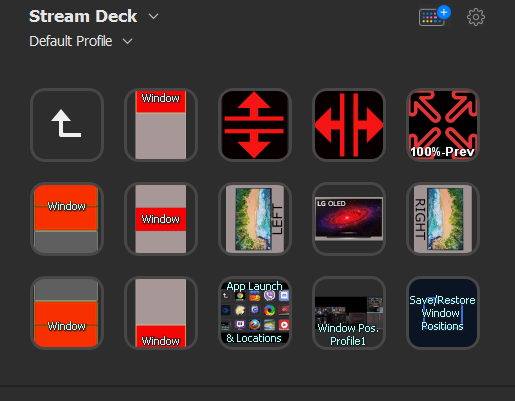
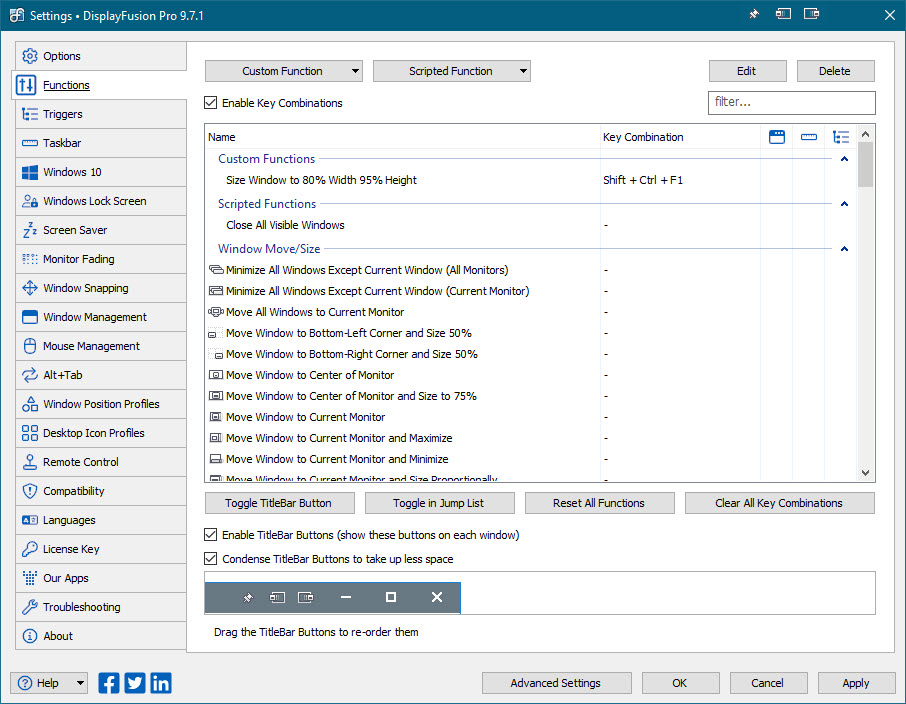
I use displayfusion for window management. To start with you can just easily set up several named "saved window positions" profiles that will shuffle all of your windows to where they were when you took that "snapshot" of window placements. You can hotkey these and if you have a stream deck it makes it even easier to press a streamdeck button mapped to that named saved window position hotkey. You can also set up an instant on the fly save and restore button for temporary or on the fly window arrangements almost like copy/paste.

https://www.displayfusion.com/Discu...iles/?ID=a9e84956-db3d-4f2c-b7e2-e3499f7570e4

Window Position Profiles
Easily save and load your window size and positions using DisplayFusion's Window Position Profile feature. Loading a previously saved Window Position Profile is an easy way to quickly organize your windows into preset arrangements.

The Window Position Profiles feature is a great choice for people who like an organized desktop. Arrange your desktop windows how you like them, save the layout as a Window Position Profile, then load this profile any time you're using these windows. Quickly load a Window Position Profile using a key combination, TitleBar Button, the DisplayFusion system tray menu, or from the command line using DFCommand. You can even assign a Window Position Profile to a Monitor Profile so that when your monitor layout changes, DisplayFusion will automatically arrange your desktop windows to a preset layout.

?ID=99dc651f-e605-4cfd-85fe-3eab982912b2.png


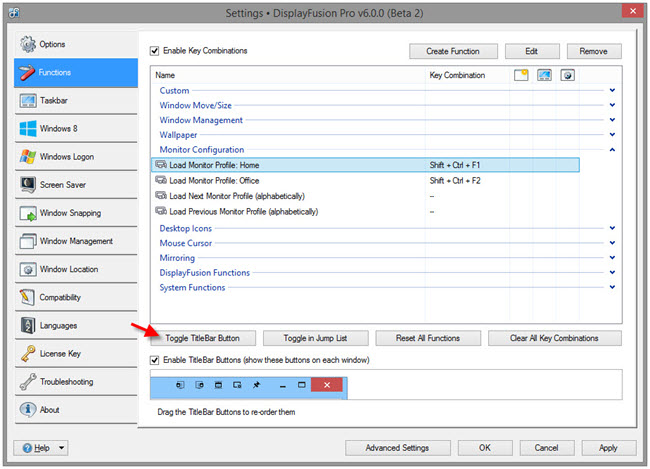
There is a hokey interface like this that has headings for "saved windows position profile <name>" in several rows. You can put the key combos in next to any function.

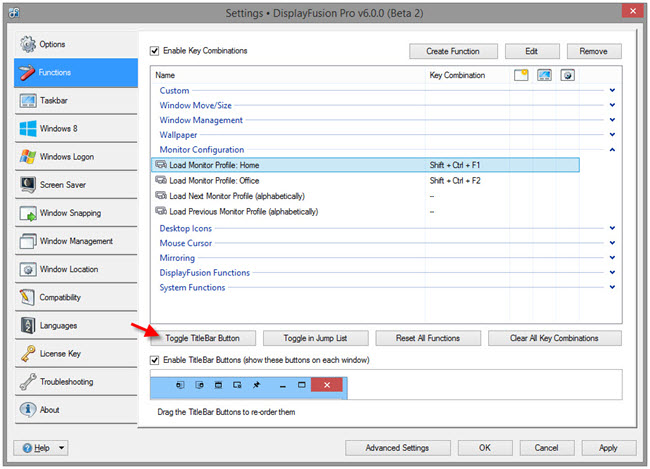
KB-MonitorProfiles-04.jpg


There are also custom monitor profiles that can switch different screen configs around like you are doing manually but I don't use those because dropping a screen from my array screws up a lot of my custom window placement script's placements. It's easier to just use the "turn off the screen" functionality of the LG TV using the remote for my purposes. Incidentally this is also why the "Ghost monitor" trick to use hdmi sound to a receiver without arc/earc was never a good solution for me either (any time I'd turn the receiver off, my window placements/saved positions would all be off).


-----------------------------------------------------

I use taskbarhider to lock the taskbar away via a hotkey and translucent taskbar to make it transparent - but I drag the actual windows taskbar to the top of one of my side portrait mode monitors. My oled only does media/gaming. Displayfusion's own windows taskbar is enabled on my other portrait mode monitor and it does in fact show the system tray duplicated on it. Other than the system tray I really don't use the taskbars. I can use win+S and type two letters + enter to launch practically anything. Win key to open the start menu if ever needed, win-tab or alt-tab to switch between apps, etc. However I use my streamdeck to launch and manage most apps and common windows/system items and settings panels.


I set up my streamdeck + displayfusion to launch/min/restore a bunch of my most used desktop apps individually and to defined home locations as a multi press toggle type action on a single key for each app by using some simple scripts - but I enjoy micromanaging things a little like that. I also have buttons that let me move whatever is the active window to each 1/3 height of the portrait mode screens (totem pole style), or 2/3 portrait mode height from bottom or top leaving whatever else as the last 1/3.

EOKDETC.png
 

Attachments

  • settings-functions.jpg
    settings-functions.jpg
    216.3 KB · Views: 4
  • KB-MonitorProfiles-04.jpg
    KB-MonitorProfiles-04.jpg
    84.6 KB · Views: 4
Last edited:
To further answer your question about a windows system panel being left behind (e.g. on the "turn off the screen" mode OLED's screen as primary monitor, where you can't see it) --

You can run a script to move all the windows to a different monitor, and then set that script to a hotkey (and a streamdeck button in my case). You could easily modify the script to different monitor #'s.

Swap All Windows Between Monitors 1 and 2​

DescriptionThis script will swap all open windows between monitors 1 and 2.
https://www.displayfusion.com/ScriptedFunctions/View/?ID=6b5dea6c-94b1-4820-8c3a-54fa8110e7d7

using System;
using System.Drawing;
using System.Windows.Forms;

public static class DisplayFusionFunction
{
public static void Run(IntPtr windowHandle)
{
// set the monitor IDs of the monitors you want to swap here
uint monitorA = 1;
uint monitorB = 2;

//if the passed window handle doesn't exist, exit the function
if (windowHandle == IntPtr.Zero)
return;

//get the open windows for each monitor
IntPtr[] srcWindowsMonitor2 = BFS.Window.GetVisibleWindowHandlesByMonitor(monitorB);
IntPtr[] srcWindowsMonitor1 = BFS.Window.GetVisibleWindowHandlesByMonitor(monitorA);

//move all of the windows in the destination monitor to the source monitor
foreach (IntPtr window in srcWindowsMonitor2)
{
if (BFS.Window.GetText(window).Contains("Chrome"))
{
BFS.Window.Restore(window);
BFS.Window.MoveToMonitor(monitorA, window);
BFS.Window.Maximize(window);
}
BFS.Window.MoveToMonitor(monitorA, window);
}

BFS.General.ThreadWait(1000);

//move all of the windows in the source monitor to the destination monitor
foreach (IntPtr window in srcWindowsMonitor1)
{
if (BFS.Window.GetText(window).Contains("Chrome"))
{
BFS.Window.Restore(window);
BFS.Window.MoveToMonitor(monitorB, window);
BFS.Window.Maximize(window);
}
BFS.Window.MoveToMonitor(monitorB, window);
}
}
}

You can search here for a lot of scripted functions but you can also search this from displayfusion's own interface and automatically import the ones you want (then if necessary edit them as you see fit and rename them):
https://www.displayfusion.com/ScriptedFunctions/
hw3lF3f.png


Or you can do it the longhand way by using the windows key + TAB to open taskview see all open windows. That essentially shows you all of your windows from all of your screens combined into a virtual thumbnail view. Your mouse has to have clicked on a side screen to make the panel the active screen so that the taskview is shown on it instead of the primary though. Then you click on that system window you wanted in the thumbnails to make it active and then use a displayfusion hotkey to teleport-move it to side screen.
In my case once I got that window active I'd just hit the streamdeck key corresponding to either of my side monitors which places the window in a 2/3 bottom position on either side screen.
 
I let this thread stew a little bit, but on my return I'm kind of disappointed now the thread as a whole seems to have doubled on HDR and isn't even willing to experiment to see if this BFI + VRR thing even works let alone if it's useful.

I find it very interesting that, with high-refresh monitors, BFI + VRR is seen as a sort of "holy grail", and I figured there's be more of those types of people here considering OLED's crazy-fast response time. But it seems I was mistaken and that the crowd here is a third niche between the cinema buff's "BFI good, HDR good, high framerate bad" and the high refresh gamer's "BFI good, high framerate good, HDR unnecessary".

This is making me think that most OLED users actually fall into the more 60fps-to-100fps gaming category rather than the 100fps+ category which, as I'm typing this, I'm kind of coming to the conclusion may be an audience that is exactly as I said - they value high framerate up to a point but will put more focus on static image quality such as resolution and HDR and will very much sacrifice top-end framerates to do so (one only has to note the kinds of GPUs most people here are using... and I very much don't have interest in such high-end GPUs). And it's this 60fps-to-100fps that's simply not going to be as useful with any sort of BFI+VRR combination.


Basically, I made the mistake of figuring that the high frame-rate gamer would be the main PC OLED customer - it turns out it's the high graphics settings gamer instead. And while I'm not really a high frame-rate gamer, I'm even less of a high graphics settings gamer. Really I'm just a "I want to be able to use a screen in the dark without it either blinding me or looking like crap without sacrificing the motion resolution I've become used to on a CRT" and I've been in that camp for over a decade now.

I want to make one thing very clear though - I'm not married to the idea of BFI and will happily ditch it if the screen has a high enough refresh rate to compensate, but "only" 120Hz ain't gonna cut it since that's already what I've been doing on my CRT for ages.

Also while typing this, I'm reminded that the flickering on a CRT is less noticeable than BFI on at least an LED-backlit LCD screen of comparable flicker-rate, presumably because a CRT's PWM is more akin to a sine wave while LEDs output much more of a square wave. And IIRC I'm pretty sure I found the flickering on CRTs to be reduced as you decrease brightness and/or contrast as I do in dark environments as it's simply reducing the amplitude of the PWM waveform, but on LED-backlit LCDs the flicker instead increases as it instead increases the "off" time during the backlight strobing in order to reduce brightness.

For reference I have no idea how a flicker-less LED backlight would behave with any sort of backlight strobing, but with OLED I would imagine that it would be both similar to a CRT where it just simply reduces the amplitude but also like an LED-backlit LCD whereby it operates as square wave on/off rather than a smoother CRT-like sine wave.
 
Last edited:
I'm not sure what you're referring to but you can't even enable BFI without disabling VRR first.
 
I'm not sure what you're referring to but you can't even enable BFI without disabling VRR first.
I mentioned at the top of the previous page that John from Digital Foundry found that BFI + VRR worked on his CX's latest firmware at least from the Xbox Series X, but only when Dolby Vision was enabled:
https://hardforum.com/threads/lg-48cx.1991077/page-197#post-1045180420

There was no clarification as to whether this could also work on a PC whether with Dolby Vision-enabled software or via some CRU tweaking or the like.
 
I mentioned at the top of the previous page that John from Digital Foundry found that BFI + VRR worked on his CX's latest firmware at least from the Xbox Series X, but only when Dolby Vision was enabled:
https://hardforum.com/threads/lg-48cx.1991077/page-197#post-1045180420

There was no clarification as to whether this could also work on a PC whether with Dolby Vision-enabled software or via some CRU tweaking or the like.

I asked if there's any Dolby Vision titles on PC that I could try it out with as I do not own an XSX but I got no reply to that but instead the BFI = bad, HDR = more better response lol. I'm willing to test it out if anyone can give me a Dolby Vision title for PC, but I heard even Forza 5 doesn't support Dolby Vision on PC. Supposely Halo Infinite will be a Dolby Vision PC title so I guess that will be the first and perhaps only test we can do of BFI + VRR combo. And then of course I'm expecting to the get bombared with the "PLAYING HALO INFINITE IN HDR IS BETTER THAN BFI".
 
I would love simultaneous BFI VRR, but I don't have time to experiment to try to get it working. I'm hoping someone else does though.
 
It's likely a bug and will result in variable brightness when the frame rate fluctuates.
 
I mentioned at the top of the previous page that John from Digital Foundry found that BFI + VRR worked on his CX's latest firmware at least from the Xbox Series X, but only when Dolby Vision was enabled:
https://hardforum.com/threads/lg-48cx.1991077/page-197#post-1045180420

There was no clarification as to whether this could also work on a PC whether with Dolby Vision-enabled software or via some CRU tweaking or the like.
I let this thread stew a little bit, but on my return I'm kind of disappointed now the thread as a whole seems to have doubled on HDR and isn't even willing to experiment to see if this BFI + VRR thing even works let alone if it's useful.

I find it very interesting that, with high-refresh monitors, BFI + VRR is seen as a sort of "holy grail", and I figured there's be more of those types of people here considering OLED's crazy-fast response time. But it seems I was mistaken and that the crowd here is a third niche between the cinema buff's "BFI good, HDR good, high framerate bad" and the high refresh gamer's "BFI good, high framerate good, HDR unnecessary".

This is making me think that most OLED users actually fall into the more 60fps-to-100fps gaming category rather than the 100fps+ category which, as I'm typing this, I'm kind of coming to the conclusion may be an audience that is exactly as I said - they value high framerate up to a point but will put more focus on static image quality such as resolution and HDR and will very much sacrifice top-end framerates to do so (one only has to note the kinds of GPUs most people here are using... and I very much don't have interest in such high-end GPUs). And it's this 60fps-to-100fps that's simply not going to be as useful with any sort of BFI+VRR combination.


Basically, I made the mistake of figuring that the high frame-rate gamer would be the main PC OLED customer - it turns out it's the high graphics settings gamer instead. And while I'm not really a high frame-rate gamer, I'm even less of a high graphics settings gamer. Really I'm just a "I want to be able to use a screen in the dark without it either blinding me or looking like crap without sacrificing the motion resolution I've become used to on a CRT" and I've been in that camp for over a decade now.

I want to make one thing very clear though - I'm not married to the idea of BFI and will happily ditch it if the screen has a high enough refresh rate to compensate, but "only" 120Hz ain't gonna cut it since that's already what I've been doing on my CRT for ages.

Also while typing this, I'm reminded that the flickering on a CRT is less noticeable than BFI on at least an LED-backlit LCD screen of comparable flicker-rate, presumably because a CRT's PWM is more akin to a sine wave while LEDs output much more of a square wave. And IIRC I'm pretty sure I found the flickering on CRTs to be reduced as you decrease brightness and/or contrast as I do in dark environments as it's simply reducing the amplitude of the PWM waveform, but on LED-backlit LCDs the flicker instead increases as it instead increases the "off" time during the backlight strobing in order to reduce brightness.

For reference I have no idea how a flicker-less LED backlight would behave with any sort of backlight strobing, but with OLED I would imagine that it would be both similar to a CRT where it just simply reduces the amplitude but also like an LED-backlit LCD whereby it operates as square wave on/off rather than a smoother CRT-like sine wave.


=========================

This is making me think that most OLED users actually fall into the more 60fps-to-100fps gaming category rather than the 100fps+ category

If you can maintain 120fps minimum, even without BFI, you'd already be cutting the sample-and-hold blur by 50% compared to 60fpsHz solid to more of a "soften" blur at speed rather than smearing at 60. That full soften is not all of the time but rather during moving the viewport at speed. At lower panning rates and depending on the game genre that can be less aggressive (isometric rpg, 3rd person locked on to target souls-like games and other slower pan by nature of orbiting follow camera games, etc) .. so even that soften blur during mouse-look/game pad panning FoV movement will be exhibited less. And with oled's response time that 50% reduction vs 60fpsHz is probably slightly tighter than doing so on most lcds,. especially VA lcds that get any kind of black depth and contrast outside of very few FALD IPS gaming screens.

However - outside of a few highly optimized corridor shooters (i.e. narrow view distance), modern demanding games at 4k resolutions are lucky if they can get over 100fps average let alone 120fps minimum at "high+" to ultra graphics settings. BFI works best at 120fps minimum which is more like 150fps average or more.

These are 120hz 4K HDR + VRR screens designed to give you a glorious eye-candy viewing and gaming experience :

...at up to double the motion definition compared to 60fpsHz ("glassy" movement smoothness, up to double the pathing articulation: more dots on a dotted line/curve, and even greater animation cycle def/smoothness)
...much less aggressive FoV movement blurring at higher frame rates ("soften" vs "smearing").
...a TON more colors and color detail above the very low SDR ceiling in HDR material
...a TON more black depth and "low-lights" detail in dark areas in HDR material well beyond the narrow "2D" SDR limitation. And down to "infinite" black depth.
...those tall and deep 3D color volumes side by side displayed down to the pixel generating greater depth perception effect and much higher texture ID.
...somewhat higher graphics settings vs frame rates "unlocked" or thrown into the mix by being able to lean on VRR and ride a frame rate roller coaster smoothly.
...at 4k resolution for greater detail overall and better PPD at reasonable distances, but at the cost of much greater gpu power demand. One goes with the other.

HDR is a greater advancement to movie and game visualizations than any of the other facets, and the fact that it can be combined with them all at the same time (save BFI) - it's even more of a landslide.

HDR (high color and "lowlight" volumes, color detail and dark details in all areas and surfaces gained, depth perception increase, material/texture ID) + VRR (smoothing of varying fps to hz and making higher graphics settings available when leaning on VRR) are features that eliminate BFI , but using BFI properly eliminates both VRR and it's higher graphics settings along with HDR capability (and can be eye-fatiguing due to continual strobe throughout every second of every scene).

Using 90 - 120fps average not only reduces sample-and-hold blur but it increases motion definition for "glassy" movement, more articulated pathing (more dots per dotted line/curve), and even more animation cycle definition (more unique pages in an animation flip book).
Combining that with reduction of sample-and-hold blur (the worst blur which is exhibited during high speed FoV movement periods) to more of a "soften" blur photoshop effect isolated to individual on screen objects and architecture rather than a full smearing viewport and you are getting appreciable gains.

I had a 23.5" 16:10 fw900 graphics profession crt for years next to various LCDs. I got a 27" 120hz 1080p samsung, one of the first 120hz LCD gaming screens relatively early on. I got one of the first 27" 144hz 2560x1440p g-sync LCDs too, and later a 31.5" 1440p g-sync VA for the black depth/contrast. I eventually dropped the crt in the long run. CRTs like the FW900 require maintenance internally and even so with age they eventually start to fade and/or bloom and it proceeds to get worse and worse. They also all take a half hour to "warm up" before they are fully saturated and contrasted among other things like being subject to electrical and magnetic interference/noise. In regard to LCDs - even back when I got my 31.5" va and had 60hz VA alongside it for desktop/apps - I swore I'd never go back to a pale IPS/TN screen again. Now I'll never go back to regular LCD tech again (outside of some future pixel-level microLED or something) at all for my media and gaming "stage" screen.. I'm never backpedaling from infinite black depth, per pixel emission, and I'll never have a non-HDR color volume screen as my media/gaming display if I can help it. Eventually everything will be HDR including photography, graphic art, posted photos and video clips online in social media, youtube videos, news media, etc. Just like high color displays, 4:3 -> 16:9 , lesser resolutions to 1080p "HD", 1440p gaming screens, now 4k "uhd".. etc. and in the very long run everything will likely go to AR/mixed reality with virtual screens in real space and "living documents", avatars, assistants,etc as well as "holographic games" either in small scale wherever you are (like on a table or floor on a floating virtual screen) or more VR like immersed in them.

I can understand if you feel the same way about not backpedaling in regard to zero blur but for me that ship has sailed in regard to "zero" for the foreseeable future until we get something like duplication-interpolation of 100fps solid x5 or x10 for up to 500fps or 1000fps on 500hz or 1000hz screens for negligible to 1px "zero" blur at those rates without bfi/strobing/pwm. When I first got my 48CX OLED I had a 1080ti sc and played a few great HDR games at 60hz (60fps minimum). I would have gone with a 120hz ceiling and used VRR and more graphics horsepower if I could have but that was what I was stuck with for awhile due to gpu shortages. While not optimal being stuck at 60fpsHz solid (especially in the motion definition facet), they were still great games and they looked gorgeous in HDR (jedi:fallen order and Nioh2). They were also very challenging games (jedi on jedi master with zero hud ini mod, nioh2 is just a challenging game out of the gate esp as a heavy 2-handed axe user) - so it's not like I'm playing some tourist mode games on my screen :LOL: . Of course I do look to appreciably lower FoV movement-at-speed blur down from smearing using higher hz (combined with the motion definition benefits aspect of higher fpsHz) but I balance that vs all of the other features modern displays like this one provide. I shoot for 100fpsHz average or 110fpsHz average (or higher) if I can get it and rely on VRR to keep that variance smooth. That gives me, on more demanding games, something like (70) 85fpsHz <<<<---- 100fpsHz ave ----->>>> 115fpsHz (117capped). That range can still require some dialing in of graphics settings on a 4k screen on demanding games ,even using a 3090 gpu.
 
Last edited:


Well I guess my hunch from back then about my CX feeling far more responsive than my X27 wasn't just placebo.

RTings measured lag to be 11ms at 4k with VRR. I have an Acer X27 and RTings measured that monitor to have 14ms of lag at 4k with VRR. Using both my CX and X27 side by side, the CX feels vastly more responsive than my X27, more than a 3ms difference. OLED's instant response time probably has something to do with it, but yeah the CX feels plenty responsive and only the 0.1% of super hardcore competitive gamers will find it to be "not responsive enough".

I guess it also goes to show that the need for BFI on an OLED isn't needed as much as it is on an LCD since the image is just so clean already, the only limiting factor is the 120Hz refresh rate itself.
 
I let this thread stew a little bit, but on my return I'm kind of disappointed now the thread as a whole seems to have doubled on HDR and isn't even willing to experiment to see if this BFI + VRR thing even works let alone if it's useful.

I find it very interesting that, with high-refresh monitors, BFI + VRR is seen as a sort of "holy grail", and I figured there's be more of those types of people here considering OLED's crazy-fast response time. But it seems I was mistaken and that the crowd here is a third niche between the cinema buff's "BFI good, HDR good, high framerate bad" and the high refresh gamer's "BFI good, high framerate good, HDR unnecessary".

This is making me think that most OLED users actually fall into the more 60fps-to-100fps gaming category rather than the 100fps+ category which, as I'm typing this, I'm kind of coming to the conclusion may be an audience that is exactly as I said - they value high framerate up to a point but will put more focus on static image quality such as resolution and HDR and will very much sacrifice top-end framerates to do so (one only has to note the kinds of GPUs most people here are using... and I very much don't have interest in such high-end GPUs). And it's this 60fps-to-100fps that's simply not going to be as useful with any sort of BFI+VRR combination.


Basically, I made the mistake of figuring that the high frame-rate gamer would be the main PC OLED customer - it turns out it's the high graphics settings gamer instead. And while I'm not really a high frame-rate gamer, I'm even less of a high graphics settings gamer. Really I'm just a "I want to be able to use a screen in the dark without it either blinding me or looking like crap without sacrificing the motion resolution I've become used to on a CRT" and I've been in that camp for over a decade now.

I want to make one thing very clear though - I'm not married to the idea of BFI and will happily ditch it if the screen has a high enough refresh rate to compensate, but "only" 120Hz ain't gonna cut it since that's already what I've been doing on my CRT for ages.

Also while typing this, I'm reminded that the flickering on a CRT is less noticeable than BFI on at least an LED-backlit LCD screen of comparable flicker-rate, presumably because a CRT's PWM is more akin to a sine wave while LEDs output much more of a square wave. And IIRC I'm pretty sure I found the flickering on CRTs to be reduced as you decrease brightness and/or contrast as I do in dark environments as it's simply reducing the amplitude of the PWM waveform, but on LED-backlit LCDs the flicker instead increases as it instead increases the "off" time during the backlight strobing in order to reduce brightness.

For reference I have no idea how a flicker-less LED backlight would behave with any sort of backlight strobing, but with OLED I would imagine that it would be both similar to a CRT where it just simply reduces the amplitude but also like an LED-backlit LCD whereby it operates as square wave on/off rather than a smoother CRT-like sine wave.
I tried just BFI its self when I first got the tv. It is indeed smooth, but the brightness drop is too severe and most of us here don't like maxing out the brightness (oled light) anyway.
On top of that if I remember correctly it had a dreadful pwm like flicker.

I am a high refresh rate evangelist, but the way I see it is I am using a display with the best image quality that I have ever seen. If I wanted to mar the image quality. I would pick up a 240hz or better display for competitive games that require that clarity.

One thing to keep in mind is that due to oled response times, it seems faster than the 120hz refresh rate would imply.
 
I tried just BFI its self when I first got the tv. It is indeed smooth, but the brightness drop is too severe and most of us here don't like maxing out the brightness (oled light) anyway.
On top of that if I remember correctly it had a dreadful pwm like flicker.

I am a high refresh rate evangelist, but the way I see it is I am using a display with the best image quality that I have ever seen. If I wanted to mar the image quality. I would pick up a 240hz or better display for competitive games that require that clarity.

One thing to keep in mind is that due to oled response times, it seems faster than the 120hz refresh rate would imply.

If you were using BFI at 60Hz it's going to flicker like crazy. At 120Hz the flicker shouldn't be noticeable and I even used BFI on High which is suppose to be the worst for flickering but couldn't really notice it at 120Hz. Also I would say BFI isn't just used for some competitive advantage in a multiplayer game. For me I would use it in really old single player titles that completely lack any form of HDR or perhaps super easy to run side scrollers where the side to side camera panning can greatly benefit from BFI giving the best clarity possible. Even top-down isometric RPG's can also benefit from BFI when you pan the camera around the map, zero sample and hold blur. BFI is just a great option to have even if I don't use it very often and BFI + VRR would've sweetened the deal even more as long as I could maintain at least 90fps at all times.
 
Last edited:


Well I guess my hunch from back then about my CX feeling far more responsive than my X27 wasn't just placebo.


I guess it also goes to show that the need for BFI on an OLED isn't needed as much as it is on an LCD since the image is just so clean already, the only limiting factor is the 120Hz refresh rate itself.


Well there is response time trailing and blurring which is a more mechanical thing, and there is sample and hold blur which is from the way our eyes and brains work. You are correct that OLED response time is beyond crisp. It's actually "too fast" for low frame rate content like 24p movie content, so shows stuttering where LCDs are so slow that they blend the stuttering out a little. That speed when using high hz gaming on an OLED probably eliminates any response time related blur and trailing issues that a LCD would have besides sample and hold blur. I wouldn't say an LCD always has sample-and-hold blur PLUS response time trailing and blurring though because sample and hold blur can potentially mask those issues depending how many pixels of blur it is (which in regard to your whole screen blurring is also in effect related to how fast you are moving the viewport in 1st/3rd person games at any given time).

So it for example on a LCD screen would depend on:

-how bad the response time was
-how slow of a fpsHz you were running at any given time in your game/frame-rate graph
-how fast the viewport is moving in a particular game at any given time


From RTings c1 review
Because of the TV's fast response time, low frame rate content can appear to stutter since each frame is held on for longer. If it bothers you, motion interpolation can help.
The LG C1 can completely remove 24p judder though, which is a different side effect from stutter. It can completely remove it when you enable cinema screen mode which multiplies the 24fps x5 to match the 120hz panel refresh rate exactly.


from blurbusters.com:

Even instant pixel response (0 ms) can have lots of motion blur due to sample-and-hold

Your eyes are always moving when you track moving objects on a screen. Sample-and-hold means frames are statically displayed until the next refresh. Your eyes are in a different position at the beginning of a refresh than at the end of a refresh; this causes the frame to be blurred across your retinas

Sample and hold blur will still happen but at 120fpsHz solid it is more of a soften blur where the baseline 60fpsHz solid is smearing blur. The slower the fpsHz and the faster the viewport movement (or movie panning), the worse it appears. So it happens to one degree or another on the whole viewport when moving it at speed. Otherwise it's less obnoxious.. in games where you are 3rd person with an orbiting tracking camera that moves while you move the fov it's usually much less aggressive in effect. Isometric rpgs and full map rts games suffer less of this too usually, depending on the frame rate of the moving map and the movement speed it pans by default (or that you customize). When spinning the FoV like a dervish at speed in a first person shooter or 3rd person "dumb camera" action game/mmo it's typically the most blur in my experience. As you slow your movement arc (which is in effect moving the entire game world around relative to you) and then just move your weapon or reticule around it's not happening or to that degree, at least not viewport wide. Similarly if you are flick aiming from point to point like a gnat you aren't really going to have as much of a chance to see the soften (120fpsHz) or smearing (60fpsHz) blur of the viewport/game-world spinning.

As that video shows, oled eliminates any blur exacerbating factors that aren't sample-and-hold from the equation so 120fpsHz on an OLED could appear in actual practice a little less sample-and-hold blurred than an LCD at 120fpsHz, and it could feel a lot more responsive. That video is very impressive. You'll notice that vincent did his tests at 120fpsHz solid. At lower frame rates, sample-and-hold-blur (to our eyes and our brains rather than his tracking hardware) would be worse on both oled and lcd. At some point the frame rate would be so slow that the sample-and-hold blur could overtake the lcd response time trailing/blurring/ghosting and essentially mask it.
 
When streaming music to the C1 with Apple AirPlay or whatever its called, is there a way to stop the TV from going into the firework screensaver? I ordered a service remote...
 
At 120Hz the flicker shouldn't be noticeable and I even used BFI on High which is suppose to be the worst for flickering but couldn't really notice it at 120Hz.
<...>

I feel like it fatigues your (especially my) eyes even if you supposedly aren't consciously "seeing" it. People claim to "not really notice it" , etc. as if it is borderline. While you might try to be obvlivious to it I don't think your eyes and brain are.


BFI + VRR would've sweetened the deal even more.

Idk if they could do it without changing the rate of the black frame insertion which would require the brightness to change on the fly in relation to that rate. Varying the rate could be like PWM but in relation to your varying frame rate graph. Changing the brightness down/up to match, even if normalized to what we think we are seeing could have a negative effect on our eyes/fatigue. I don't like the effect of BFI on my eyes by default even at lower graphics settings(lacking VRR) or simple games able to achieve 120fpsHz solid - let alone running lower Hz VRR BFI. VRR varying all over the place could make it even worse depending how they implemented it. They could do rolling scans independent of the refresh rate but non-global can cause artifacts so probably wouldn't be great in the end result.

For me I'm prioritizing HDR games anyway as you can tell from my replies and hopefully auto HDR will get better over time for a lot more games. (I'll also mess with speacialK hdr mod).


------------------------------------------------------


I am a high refresh rate evangelist, but the way I see it is I am using a display with the best image quality that I have ever seen. If I wanted to mar the image quality. I would pick up a 240hz or better display for competitive games that require that clarity.

One thing to keep in mind is that due to oled response times, it seems faster than the 120hz refresh rate would imply.

I agree wholeheartedly with most of this. I wouldn't say *require* though. You can be just as competitive at 120fpsHz - especailly in online games.
Online game's tick rates are at best 128tick (7.8ms) and on the worst tick games 20 to 22 tick (50ms). That is slow. Then they take another tick worth of buffer 8ms to 50ms more which combines as 16ms to 100ms total (respective to 128tick - 20 tick servers) in order to prevent adding another 250ms of latency on any network hiccups. So now you are at around 62Hz to 10Hz rate, 16ms to 100ms depending on the game/tick rate. Then they add your ping time, say another ~ 40ms, and the server then calculates everyone's actions with biased by dev's netcode choices "best guess" and "rewinds time" a bit, sending you that new game action "slice" state back. Meanwhile you finally see that new interpolated "best guess" frame and the fastest gamers take another 150ms - 180ms to react to it (up to 200ms).

So in online games as opposed to LAN gaming tournaments (or even single player gaming), outside of reduction from the worst smearing blur viewport movement - very high hz benefits in regard to scoring and reaction times (in online games) are more marketing than anything imo. You can't react to what you haven't been delivered yet and even then you are getting an interpolated/biased guess result from the server as to what is happening so it's a fuzzy rubberband to one degree or another depending on the server tick and netcode, and is slower than your local action states. Even the linus tech tips "tests" comparing different Hz monitors were done locally I believe with bots/AI opponents, not even with ~ 7ms of LAN latency let alone that large online gaming latency chain I outlined above.


-------------------------------------------------------------------------
https://hardforum.com/threads/lg-48cx.1991077/post-1044802892

Command Execution Time = Current Server Time – (Packet Latency + Client View Interpolation)


Put into English this means that once you pull the trigger and this information package gets sent to the server, it then goes back from the current server time (the time the pulling the trigger package was received) by your ping plus your interpolation time. Only then it is determined if the client hit the shot or not.

If you were playing on a LAN against other players on the same LAN, on a server on the same LAN, you'd get latency of 3ms to 7ms. Marketing for monitors acts like you are being served at 144hz or 360Hz of game world states in online game competitions . That's just false advertising... (and with lower frame rates locally for most people on most games besides).

Imagine you want to reach the boxes on top mid on Mirage while an AWP is perched in window. You jump out of the cover of the wall, fly and land safe behind the boxes. In the moment you land, the AWP shot goes off and you somehow die and end up right on the edge of the boxes, a good half meter away from where you stood on your screen. In the German scene, you would have just been “interped”, even though “being lag compensated” might be the more accurate term (I acknowledge that is way more clunky and less easy to complain about).


As the peeking CT moves into the gap of the double doors, his lag compensated hitbox and model are still behind the door, giving the Terrorist no real chance to respond. However, it is imperative in this scenario for the peeking player to actually hit (and in most cases kill) his opponent in the time it takes the server to compute all executed commands and the appropriate lag compensation. Of course, the showcased example is taken with a ping of 150ms, which is unrealistically high for most people, artificially lengthening that time.

Should any of you reading this have the good fortune to play on LAN one day, you should keep in mind that peeker's advantage is solely dependent on lag compensation, a big part of which is made up by a players ping. With the typical LAN connection ping of 3-7ms, peeker's advantage is practically non-existent anymore. Together with many other factors, this is one of the reasons why CS:GO has to be played differently in certain aspects on LAN than on the internet.

--------------------------

https://www.reddit.com/r/Overwatch/comments/3u5kfg/everything_you_need_to_know_about_tick_rate/


Note: In an example where two players shoot each other, and both shots are hits, the game may behave differently. In some games. e.g. CSGO, if the first shot arriving at the server kills the target, any subsequent shots by that player that arrive to the server later will be ignored. In this case, there cannot be any "mutual kills", where both players shoot within 1 tick and both die. In Overwatch, mutual kills are possible. There is a tradeoff here.

  • If you use the CSGO model, people with better latency have a significant advantage, and it may seem like "Oh I shot that guy before I died, but he didn't die!" in some cases. You may even hear your gun go "bang" before you die, and still not do any damage.
  • If you use the current Overwatch model, tiny differences in reaction time matter less. I.e. if the server tick rate is 64 for example, if Player A shoots 15ms faster than player B, but they both do so within the same 15.6ms tick, they will both die.
  • If lag compensation is overtuned, it will result in "I shot behind the target and still hit him"
  • If it is undertuned, it results in "I need to lead the target to hit them".
 
Last edited:
When streaming music to the C1 with Apple AirPlay or whatever its called, is there a way to stop the TV from going into the firework screensaver? I ordered a service remote...

I don't know if this helps your scenario or not but I use the "turn off the screen" feature which turns the oled emitters off. You can set that turn off the screen command icon to the quick menu so it's only 2 clicks to activate with the remote (I set mine to the bottom-most icon on the quick menu), or you can enable voice commands and then hold the mic button and say "turn off the screen". I wish there was a way to set it to one of the colored buttons so you could just hit one button but otherwise it works well enough. Clicking any button on the remote wakes up the emitters instantly. I usually hit the right side of the navigation wheel personally.

https://www.reddit.com/r/OLED/comments/j0mia1/quick_tip_for_a_fast_way_to_turn_off_the_screen/

While the emitters are off everything is still running, including sound. This works great to pause games or movies and go afk/out of the room for awhile for example. I sometimes cast tidalHD to my nvidia shield in my living room from my tablet utilizing the "turn off the screen" (emitters) feature. That allows me to control the playlists, find other material, pause, skip etc from my tablet with the TV emitters off when I'm not watching tv. You can do the same with youtube material that is more about people talking than viewing anything. I do that sometimes when cooking in my kitchen that is adjacent to my living room tv. You can probably cast or airplay to the tv webOS itself similarly. Some receivers also do airplay/tidal etc directly to the receiver.
 
<...>

I feel like it fatigues your (especially my) eyes even if you supposedly aren't consciously "seeing" it. People claim to "not really notice it" , etc. as if it is borderline. While you might try to be obvlivious to it I don't think your eyes and brain are.

Well I don't notice it and I don't get any fatigue even after hours of use but that's just me. I have been using backlight strobing tech since the very first LCD monitor did it which was the Asus VG248QE back in 2013 and called it Lightboost. I will say that over the years I have used backlight strobing less and less due to how much more demanding games have become making it nearly impossible to maintain triple digit frame rates at all times. But the thing is that the hardware we have today is now more than capable of running those older titles at 4k maxed settings and 100+ fps so if I wanted to enjoy those older games with BFI then I could. And again as someone who has used this tech for years now I can confidently say that it does not bother me nor cause me any eye strain/fatigue. However, like you I am probably going to prioritize HDR now because after doing those AutoHDR tweaks on my CX and having played around with it for over 2 weeks now, games just look absolutely FANTASTIC now with AutoHDR. So given the choice between BFI and AutoHDR, it's going to be AutoHDR. I've been having a blast playing Fallout 4 with some fan made DLC mods and AutoHDR. Sure maybe the DTM ON + Low Black Level tweak isn't the most "accurate" way of doing it compared to CRU or Special K, but when we are literally taking a game that never had any HDR to begin with and are now shoehorning HDR into it through AutoHDR, should we REALLY be debating "accuracy" here? I say just use whatever looks the best to you and for me these tweaks give me a good enough picture 90% of the way there that I don't feel the need to go messing with CRU/Special K to get that extra 10%.
 

Attachments

  • 20211113_000445.jpg
    20211113_000445.jpg
    820.4 KB · Views: 0
Back
Top