
Porter_
[H]F Junkie
- Joined
- Sep 10, 2007
- Messages
- 8,467
Looks like with the Nvidia hotfix driver and the upcoming LG firmware update, I’ll be able to take CP2077 from ‘very milky blacks’ to ‘only kinda milky blacks’ 
![[H]ard|Forum](/styles/hardforum/xenforo/logo_dark.png)
Follow along with the video below to see how to install our site as a web app on your home screen.
Note: This feature may not be available in some browsers.
Wow! Cyberpunk is on another level now that the black level is fixed. Looks fantastic.
I upgraded to 03.21.09.Some guy on reddit said the new fw 03.21.09 fixes the raised blacks/flickering greys on HDR/Dolby Vision and VRR raised black/flicker issues! Anyone can confirm?
Hotfix 1.05 just announced with "Added some warmth to HDR." in the patch notes. We'll see WTF that actually means when it drops for PC.To be clear, this doesn’t fix the separate Cyberpunk HDR black level issue as far as I can tell. It fixes the relatively minor black level problem on the nvidia side but regardless HDR in 2077 still has grey blacks and looks like it has a grey filter over all the colors, due to it being derived from a scaled SDR image. Right? I hope I’m wrong, only tested for a minute and couldn’t get to an obvious problem area.

When you turn on Screen Shift, it only takes effect after the first timeout delay. This behaviour changed on an earlier firmware.I checked it by toggling screenshift on and seeing that there was a change. Previously when it was broken it would show off, but you would turn it on and nothing would happen, then when you turned it back off you'd see a change.
You still see the screen flash when enabling/disabling it. In previous firmware when it was bugged on but showing off, you saw no flash when turning it on (because it was already on) and then a flash when you turned it off.When you turn on Screen Shift, it only takes effect after the first timeout delay. This behaviour changed on an earlier firmware.
https://github.com/bradgearon/hdr-switchIs there a faster way to turn HDR on and off in Windows besides right clicking the desktop and going to display settings? Would be cool to have a shortcut pinned to the start menu or quicklaunch on the taskbar.
Perfect, thank you!
What HDR mode and Max brightness / Midpoint are you using ?Wow! Cyberpunk is on another level now that the black level is fixed. Looks fantastic.
I’m also curious what other people are settling on. So far the following looks best to me:What HDR mode and Max brightness / Midpoint are you using ?

now you can call hdr_switch_tray while it is running (in the tray) with a paramaeter 'hdr'
hdr_switch_exe hdr
Just got my CX and thanks to this message i finally understood that my CX was displaying HDR even if it was stating 8bit...
Is there any way to know when there is a 10/12bit source from the hidden menu for 24hz?
how come the CX can display the correct info,12bit for the PS5 but not my shield!?
30 on the slider is still quite bright. 7 is more like 120nit.Cool options. It's nice that it can be triggered with scripting
That way I could set it to a streamdeck key to toggle it on and off if I wanted to.
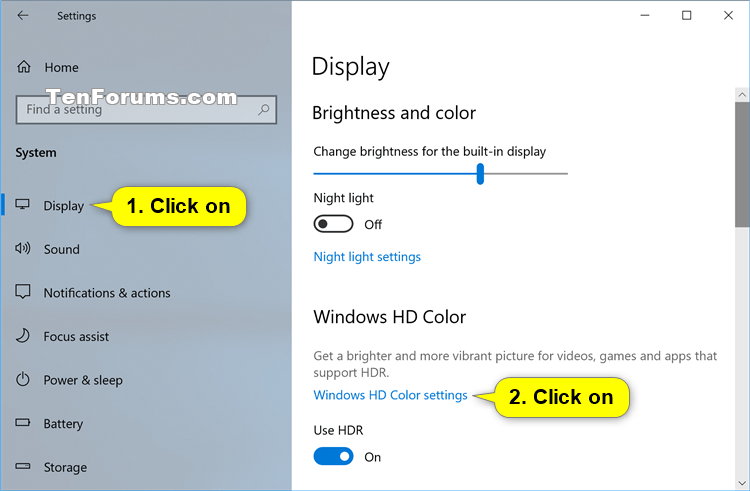
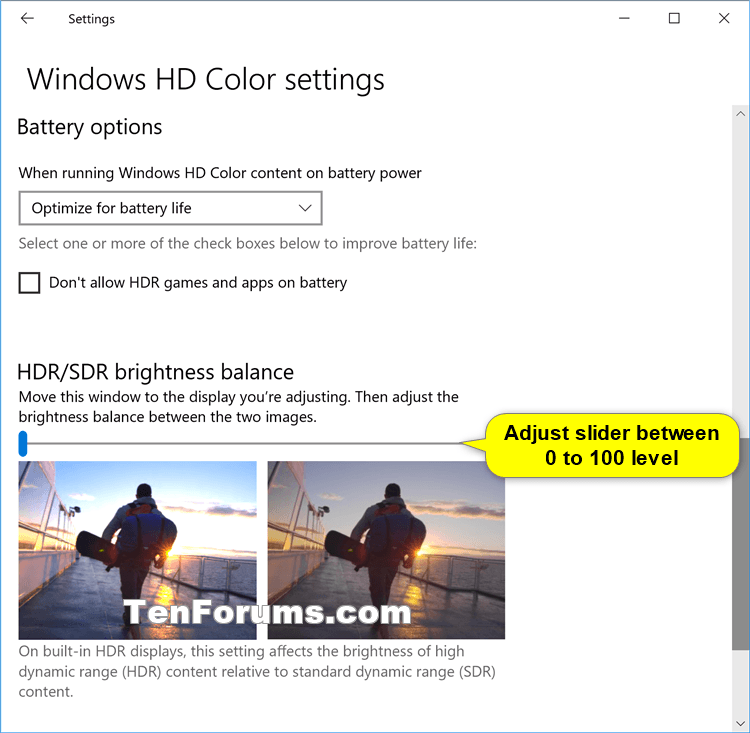
Like a lot of other people in this thread, I've instead been leaving HDR on in windows 10 all the time. You just turn the HDR desktop brightness setting down very low in the extended windows hdr color settings until it looks like SDR levels. I think someone measured that a setting of 30 on the win10 HDR color brightness slider is equivalent to 120nits but you can easily be comfortable using a lot lower than that.
Active HDR content still switches to full 100% brightness range capability for HDR, with the HDR overlay flag popping up when it kicks on. So having desktop HDR settings color brightness slider turned down to SDR levels does not affect the active HDR metatdata content of movies or games ability to use the full 100 brightness range (~800nit) of the display so you still get the full HDR capability that the CX is capable of. I've had that slider zeroed out before and it would have otherwise made games and movies look dim and bad if it translated to them. Full screen HDR content's metadata is based on absolute values , not relative values (though displays do have to further tone map due to brightness range limitations of current displays).
https://www.tenforums.com/tutorials...dr-brightness-balance-level-windows-10-a.html
Earlier, I posted the formula to calculate the slider value for any desired brightness in nits.30 on the slider is still quite bright. 7 is more like 120nit.
Make sure you have dynamic tone mapping set to HGIG for any game with a peak brightness calibration, I was doing this wrong for a long time, because the settings are named oddly. 350 peak brightness is really low.Best solution I've found for the Cyberpunk HDR black level bug: tweak shadow level and gamma in the Geforce Experience overlay. I've messed with it a lot and IMO this gives the best picture compromise without having to mess with TV settings just for this game. I have it set to the following right now with the newest hotfix driver and it's pretty decent. Blacks are black, highlights are bright, colors are not washed out.
Brightness: 500
Tone mapping: 1.75
in Geforce Experience Brightness / Contrast filter:
Shadows at +15%
Gamma -12%
Edit: adjusted brightness to 350 and tone mapping to 0.55 with same shadows and gamma since it way overexposes in bright daylight conditions otherwise.
Make sure you have dynamic tone mapping set to HGIG for any game with a peak brightness calibration, I was doing this wrong for a long time, because the settings are named oddly. 350 peak brightness is really low.
Dynamic tone mapping on - This one makes sense. Dynamically every frame, the brightest part of the scene is assigned the peak brightness the display can do, and the rest of the scene is scaled accordingly. This can make parts of the scene change brightness that shouldn't if one spot on the screen goes from say 1500nit to 10000nit and the rest of the scene stays the same. Even though the rest of the scene didn't actually change in the signal, it will darken in the frame with a 10000nit spot because it is proportionally way less than 10000nit.
Dynamic ton mapping off - This is the one that threw me. The "off" part refers to the "dynamic", not the "tone mapping". "Dynamic tone mapping off" = static tone mapping. Everything in the scene 4000nit and above is assigned peak brightness on the display, values 0-3999nit are assigned brightness proportionally to where they fall between 0nit (OLED black) and peak brightness (something like 850nit on a CX). What this means is if you properly configure peak brightness in a game to 800-900nit like the TV can handle, you're actually only setting a peak brightness around 200nit because the tone mapping is being scaled with 4000nit as the peak.
HGIG - This is "tone mapping off". The TV will display exactly the signal it gets, any part of a scene that's brighter than it can display is clipped to the peak brightness of the display. So if you're in HGIG mode and send a frame that varies from 1000nit-10000nit brightness, the entire screen will be the same color/brightness solid white because it is all being clipped to peak brightness. But if you can tell a game via calibration settings that your peak brightness is 800-900nit, the game won't send any frames with brightness higher than that, and your TV will display exactly what the game is sending. That's why this is what you want if you can set peak brightness in a game.
Acording to HDTVtest you will get best result with playing it in SDR.Yeah, I've been messing with it since I discovered the Geforce experience trick .. never installed it before. Set brightness to 750, tone mapping to 0.85, shadows to +3 and gamma to -12 and it seems pretty solid. Already had DTM on HGIG mode.
edited: ok, patch 1.05 just went live and there's a major change in how HDR is output ... completely stops the filters from working well. Will have to check out if it can output black properly at night.
I have to say I'm pretty impressed by everything I have run across about this.
I have one probably very stupid question. Here is an OLED (pretty new tech) great specs, etc. and at these kinds of sizes... how in the world is this 48 incher more or less the same price as my 27 inch Asus ROG Swift PG27UQ? Supply and demand?
Acording to HDTVtest you will get best result with playing it in SDR.
I have to say I'm pretty impressed by everything I have run across about this.
I have one probably very stupid question. Here is an OLED (pretty new tech) great specs, etc. and at these kinds of sizes... how in the world is this 48 incher more or less the same price as my 27 inch Asus ROG Swift PG27UQ? Supply and demand?
TL;DR, because they can.I have to say I'm pretty impressed by everything I have run across about this.
I have one probably very stupid question. Here is an OLED (pretty new tech) great specs, etc. and at these kinds of sizes... how in the world is this 48 incher more or less the same price as my 27 inch Asus ROG Swift PG27UQ? Supply and demand?
Makes sense. Just so no one misunderstands me: I'm pleasantly amazed at the prices of the OLEDs vs computer monitors like the one I have.TL;DR, because they can.
If they charged say $3000 for a 48" OLED, they'd have to charge more for the 55"...and more for the 65"...and more for the 77". Suddenly no one is buying any of those for a TV because they're cool with Samsung's best for half the price.
But make it 27-32" and call it a monitor...you can charge $1500 because it isn't competing with anything.
I dont think, the trend nowdays is to put 2 monitors on each other, so people are getting even taller combined screens than 48" TV.Because they have been overcharging people for the luxury of a display port connection for the last few years which used to be the only way to get 120hz 4k or any VRR(g-sync/free-sync).
They had that 27" HDR FALD ips (13" tall for $2000) at least but then pushed some 43" 16:9 and other large size UW's without any local dimming at all ! and without real HDR.. yet still commanding $1500 - $2000 price tags.
I'm guessing another reason is because a lot of people are still stuck in the old "hide the pc up against the wall like a bookshelf" mindset so they still push out mostly 13" tall screens. Even most of the uw displays are 13" tall. The 38" uw are 14.4"h. the 48 CX is around 23.5"h.
For reference, ordered by height.. (roughly, based on raw sizes):
----------------------------------------------------------------
22.5" diagonal 16:10 .. 19.1" w x 11.9" h (1920x1200 ~ 100.6 ppi) FW900 crt
27.0" diagonal 16:9 .... 23.5" w x 13.2" h (2560x1440 ~ 108.79 ppi)
34.0" diagonal 21:9 .... 31.4" w x 13.1" h (3440x1440 ~ 109.68 ppi)
37.5" diagonal 21:10 .. 34.6" w x 14.4" h (3840x1600 ~ 110.93 ppi)
31.5" diagonal 16:9 .... 27.5" w x 15.4" h (2560x1440 ~ 93.24 ppi) .. (3840x2160 ~ 137.68ppi)
40.0" diagonal 16:9 .... 34.9"w x 19.6" h (3840x2160 ~ 110.15ppi)
43.0" diagonal 16:9 .... 37.5" w x 21.1" h (3840x2160 ~ 102.46 ppi)
48.0" diagonal 16:9 .... 41.8"w x 23.5" h (3840x2160 ~ 91.79 ppi)
55.0" diagonal 16:9 .... 47.9"w x 27.0"h (3840x2160 ~ 80.11 ppi)
----------------------------------------------------------------
* you also have to consider view distance in relation to the sizes and effective pixel density to your eyeballs obviously

Acording to HDTVtest you will get best result with playing it in SDR.
I'd be curious to see that on PC instead of PS5, because I'm not seeing what he's seeing (since fixed Nvidia drivers and 1.05)....although it's hard to tell what he's seeing since all we see is what his camera's seeing...
I dont think, the trend nowdays is to put 2 monitors on each other, so people are getting even taller combined screens than 48" TV.
For me it looks uber non practical.
Random example from reddit:
View attachment 310922

The camera might not be perfect, but there's no world where those results are reversed when viewed with the naked eye. Those results are exactly what other reviewers are saying; and I'm sure Vincent wouldn't have used that video as his evidence unless what the camera saw is also what he sawI'd be curious to see that on PC instead of PS5, because I'm not seeing what he's seeing (since fixed Nvidia drivers and 1.05)....although it's hard to tell what he's seeing since all we see is what his camera's seeing...
Yes yes, this is exactly what I’m experiencing... always BSOD on startup and then it’s fine on restart. And I also noticed it after driver 460.xxBefore you blame your cabling, which it could be, make sure you try driver 457.51 before doing a bunch of other stuff.
The 460.79 and 460.89 drivers are seriously broken in several ways, especially if you use VRR (initial flashing/corruption at startup until a restart) or HDR (just plain broken black levels).
Those two drivers will cause my cx48 when VRR is on on initial boot where my pc and monitors are all powering on at once, to freak out and flash constantly until I do another quick reboot of the PC then it's fine for the rest of the day. It seems like something to do with the handshake for VRR not happening properly.
457.51 doesn't have either of these problems for me.
No big issues here with FTW 3090..latest hot fix and new Korean firmware on my CX 48 Canadian model! Everything runs fine! My only issue is the power usage on idle.. Goes around 75-80w and peaks up to 140w..I swear 2 drivers ago it was hovering around 20w usage on idle..Anyone with the latest driver and rtx 3090 have this problem: computer always BSOD within 3-5 mins of first start and then it’s fine after restarting. And then when I shutdown, it always BSOD on the first boot and then no problem gaming for hours on the restart. I noticed this happening with the latest drivers....wtf.
Is your card not clocking down from 3D clocks? Do you have more than one monitor connected above 60hz?No big issues here with FTW 3090..latest hot fix and new Korean firmware on my CX 48 Canadian model! Everything runs fine! My only issue is the power usage on idle.. Goes around 75-80w and peaks up to 140w..I swear 2 drivers ago it was hovering around 20w usage on idle..
Anyone else with this issue?