• Some users have recently had their accounts hijacked. It seems that the now defunct EVGA forums might have compromised your password there and seems many are using the same PW here. We would suggest you UPDATE YOUR PASSWORD and TURN ON 2FA for your account here to further secure it. None of the compromised accounts had 2FA turned on.
    Once you have enabled 2FA, your account will be updated soon to show a badge, letting other members know that you use 2FA to protect your account. This should be beneficial for everyone that uses FSFT.

Leaked AMD Ryzen Benchmarks?

I'm asking for the links since you know where they are lol.

Can't seem to find them, but I still stick by my assumptions. I am seeing a lot of reviewers claiming great clocks though.

AMD can't jump the gun or intel will have a fire sale...and that means many less Ryzen's sold.

I may have all my wires crossed on the 4.5 ghz. The only one I can find is that discredited Chinese one.

I guess bottom line is all the people doing OC testing are under some pretty tight NDA.
 
Last edited:
Can't seem to find them, but I still stick by my assumptions. I am seeing a lot of reviewers claiming great clocks though.

AMD can't jump the gun or intel will have a fire sale...and that means many less Ryzen's sold.

I may have all my wires crossed on the 4.5 ghz. The only one I can find is that discredited Chinese one.

I guess bottom line is all the people doing OC testing are under some pretty tight NDA.


NP man mistakes happen.

Intel can't do a fire sale, the reason is people that have bought systems with Intel chips, haven't been buying systems every new Intel generation because there is no need to, the performance increases Intel has been doing have been small enough that its not a necessity to upgrade every gen. So if Intel does a fire sale, they don't get anything from that.

And they can't just shove their x99 chips down either, cause, well the cost of the x99 motherboard is not something they have control over lol. Motherboard manufacturers need to make their money back and then some too.

Intel can only compete with their volume desktop products, i3, i5, i7, socket 1151. The upper end x99 there is very little Intel can do to increase the adoption rate, because we can see AMD's 6 core and 8 core products are going to force Intel's hand there. Intel is stuck in a rock and a hard place with those enthusiast products, either drop the price of their CPU's down to Ryzen, or they won't sell at all and even then its going to be hard because of the price of their motherboard.

And just imagine if air cooling 4.5 ghz, is possible, that is a what a ~30% increase in base frequencies, and they can't validate it for 4.0 ghz? That doesn't jive. Chip manufactures don't usually give that much head room for a reason. Money, they loose money.

Look at nV they have oh a ~15% max over clock on average on their top end cards, and that has been the biggest overclocks we have seen. And nV did not expect that much overclock room at least for pascal for pretty much all their cards.

If a chip manufacture is making a chip they already have clocks set in stone, they are making a chip based on targeting a certain clock speed. So to go more than 10% above that is rare. There was a guy that worked for AMD on this forum, he might still be here, even stated the same thing, 10% overclocks can happen but don't expect em to just be something automatic. Chips aren't made that way. He was talking about GPU's but that goes for CPU's too
 
Last edited:
NP man mistakes happen.

Intel can't do a fire sale, the reason is people that have bought systems with Intel chips, haven't been buying systems every new Intel generation because there is no need to, the performance increases Intel has been doing have been small enough that its not a necessity to upgrade every gen. So if Intel does a fire sale, they don't get anything from that.

And they can't just shove their x99 chips down either, cause, well the cost of the x99 motherboard is not something they have control over lol. Motherboard manufacturers need to make their money back and then some too.

Intel can only compete with their volume desktop products, i3, i5, i7, socket 1151. The upper end x99 there is very little Intel can do to increase the adoption rate, because we can see AMD's 6 core and 8 core products are going to force Intel's hand there. Intel is stuck in a rock and a hard place with those enthusiast products, either drop the price of their CPU's down to Ryzen, or they won't sell at all and even then its going to be hard because of the price of their motherboard.

I'm trying to finish my 4.5ghz of crow..

Well if Intel does a fire sale there will be a hell of alot of pissed off people. Not a good place for Intel market wise.

What I did find is the ES were supposedly CAS locked. Zero OC allowed. The supposed LN-OC 7ghz leak that happened might be legit.
 
I'm trying to finish my 4.5ghz of crow..

Well if Intel does a fire sale there will be a hell of alot of pissed off people. Not a good place for Intel market wise.

What I did find is the ES were supposedly CAS locked. Zero OC allowed. The supposed LN-OC 7ghz leak that happened might be legit.


The LN2 one I heard about, yeah that I can definitely believe.

Intel has no choice, they have to drop prices lol, which is great for us as consumers, not for them of course. But if they don't I would expect them to loose 10% marketshare within 1 full year of Ryzen's release. And that will be enthusiests and gamers. Something that will not be good for them cause once that happens, and Ryzen comes out with and APU, OEM's will start pushing Ryzen over Intel, because they will be able to make more money on Ryzen, since its initial cost is less than Intel.
 
The LN2 one I heard about, yeah that I can definitely believe.

Intel has no choice, they have to drop prices lol, which is great for us as consumers, not for them of course. But if they don't I would expect them to loose 10% marketshare within 1 full year of Ryzen's release. And that will be enthusiests and gamers. Something that will not be good for them cause once that happens, and Ryzen comes out with and APU, OEM's will start pushing Ryzen over Intel, because they will be able to make more money on Ryzen, since its initial cost is less than Intel.

I would assume AMD is putting a lot of work into a monster APU since the work parallels what Sony, and MS want for their next consoles. If PS4, and XB1 has shown AMD anything it's that they can make quite a lot of money by keeping the console market happy. Could possibly have HBM for PC market, but IDK. That would start to step on current line ups, but then again a sale is a sale.
 
Nothing exact, but The Stilt seems to heavily imply that common theory about auto overclocking is wrong. And if we are to interpret name literally, then Intel's unlocked CPUs do have.... extended frequency range. I would not be surprised if it was another marketing spin that is about to backfire at this point.

Nah, Skylake OCd decently from the get go. Broadwell had and still has clock issues though.
XFR may be doing something subtle bit like the Intel Turbo Boost Max Technology 3.0 that is designed to be a bit more dynamic and work beyond the normal boost spec with regards to the strongest core/s; in reality it seems to be a single core.
To be fair to AMD they have not said anything to hype XFR in same way Intel never really talked about the single core boost tech until a fair bit after launch, just some sites doing that as usual for AMD and XFR.

But TBH I am happy that all core performance seems to be at max boost for the Cinebench Ryzen 6-core test as it has a score 7% better than the 6850K (Anandtech database for the 6850K) and the 6850K would be pretty close to its boost ceiling for all cores.
Yeah one still has to be cautious with such results as we do not know the system environments, but trend seems to be indicating behaviour similar to that of Intel so far.

How it behaves overclocked manually and like you say what XFR actually does will be interesting.
But then the 6850K is not a great overclocker itself, have to push the voltage once reach 4GHz and to get past it.
Cheers
 
Last edited:
Well, he is a God, after all. Anyways, there has to be a catch with such pricing on 8 cores.
Yeah what he knows about Intel Microcode and getting the most out of Xeons is impressive, Dufus even more so.
Has great knowledge when it comes to higher core CPUS, which usually behave differently to 4C/8T CPUs.
Cheers
 
Last edited:
We are talking about weather or not Ryzen overclocks well. If it doesn't then in that context it would be a bad process.

Follow Reddit, or the Semiaccurate thread, or the Ananandtech thread. They all have posted those. It seems that you are arguing without doing due diligence.

My POS Asrock 970 pushes 150w with aftermarket VRM sinks.

There aren't boost clocks with a standard OC. You push it to the edge of stability and then back off a bit. What would turbo accomplish?
In my post #615 in this thread.
I quoted the person Buildzoid suggests following comments on as Flank3r works for one of the big publications that has Ryzen and seems similar experience to Buildzoid (was careful how he worded it due to also being under NDA).
Flank3r says:
5 GHz Ryzen AIR - not real. Thats all.
4.2-4.4 GHz could be doable at all cores.
For me that seems pretty damn good considering what it takes to get a 6850K to 4.3GHz and not necessarily all cores active.
I think 4.4GHz will be like Broadwell-E and need excessive voltage.
Cheers
 
Last edited:
XFR may be doing something subtle bit like the Intel Turbo Boost Max Technology 3.0 that is designed to be a bit more dynamic and work beyond the normal boost spec with regards to the strongest core/s; in reality it seems to be a single core.
To be fair to AMD they have not said anything to hype XFR in same way Intel never really talked about the single core boost tech until a fair bit after launch, just some sites doing that as usual for AMD and XFR.

XFR has been explicitly stated to be automatic overclocking/underclocking of frequency, and power for the entire chip. Weather or not that is on a per core basis is up in the air.

I think we will see significant leaks within the week. All our OC questions should be answered relatively soon.
 
XFR has been explicitly stated to be automatic overclocking/underclocking of frequency, and power for the entire chip. Weather or not that is on a per core basis is up in the air.
That is a very vague statement is my point and people are taking that beyond its context, it is ONLY one part of the power management/clocking of the CPU that is part of SenseMI.
Can you provide the actual explicit definition from AMD as not sure it has been done outside of general AMD slides, I do not remember it being part of the presentation at the recent ISCC.
Hence why I said in a post above its effects are probably subtle just like the Intel Max Boost Technology 3.0 - that is not the normal Boost mechanism and is subtle in use as it pertains to the strongest core, not saying is the same but example of a subtle mechanism.
Thanks
 
Last edited:
That is a very vague statement is my point and people are taking that beyond its context.
Can you provide the actual explicit definition from AMD as not sure it has been done outside of general AMD slides, I do not remember it being part of the presentation at the recent ISCC.
Hence why I said in a post above its effects are probably subtle just like the Intel Max Boost Technology 3.0 - that is not the normal Boost mechanism and is subtle in use as it pertains to the strongest core, not saying is the same but example of a subtle mechanism.
Thanks

If all these sites that are under NDA are saying "automatically overclock" in preliminary articles then I gotta go with it.
 
XFR has been explicitly stated to be automatic overclocking/underclocking of frequency, and power for the entire chip. Weather or not that is on a per core basis is up in the air.

I think we will see significant leaks within the week. All our OC questions should be answered relatively soon.

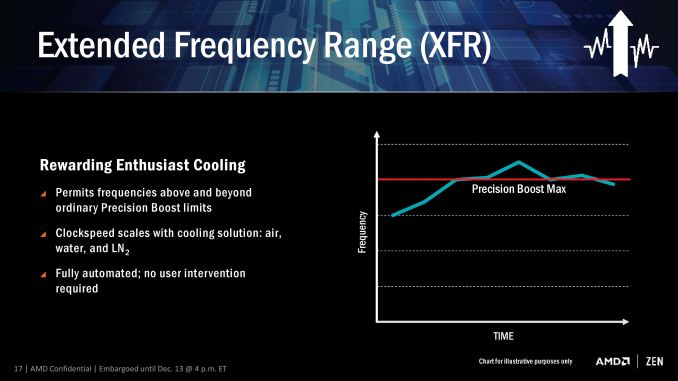
OK found the slide and it is very vague when also considering number of cores active-thermal operation.
No explicit mention of performance/core behaviour/mechanism behaviour/explicit criteria/etc.

AMD%20Zen%20December%202016%20Update_Final%20For%20Distribution-page-017_575px.jpg


If you really want to literally interpret that slide, then maybe also consider the chart suggesting around 10% improvement peak.
And this fits in with Flank3er who I keep quoting and recommended by Buildzoid who said "4.2-4.4 GHz could be doable at all cores." - context was air but we do not know whether with provided or performance air cooler such as a Noctua D15.
Emphasising could as not guaranteed, also I still think upper 4.4GHz is high voltages-temp.
Also literal interpretation of the chart suggests this is only dynamic temporary and not sustained, so fits my analogy of the Intel Max Boost 3.0 beyond standard boost that is also dynamic but focused instead on the strongest core.
Cheers
 
Last edited:
If all these sites that are under NDA are saying "automatically overclock" in preliminary articles then I gotta go with it.

Then you agree that people/sites should not be hyping its ability for overclocking with XFR, and why lolfail9001 said :" Anyways, i have a bad feeling that this XFR thing IS NOT what we think it is".
Expectations are potentially being skewed and even in this thread (and other sites) some are taking it to mean high automatic overclocking on air.
Not sure why you decided to argue about this and my point in #651 that still stands as a possibility and because I mention that it could be subtle mechanism (context was generally on air even though I did not mention that).
Cheers
 
Last edited:
XFR has been explicitly stated to be automatic overclocking/underclocking of frequency, and power for the entire chip. Weather or not that is on a per core basis is up in the air.

I think we will see significant leaks within the week. All our OC questions should be answered relatively soon.
Not really, XFR has been explicitly stated to allow clocks beyond max of default boost.

That may mean few things:

1) Automatic overclocking
2) Locking XFR-less chips to max turbo as their multiplier. Basically Ivy Bridge status of OCing locked chips.
3) Clever usage of these power saving tricks from Carrizo/Bristol/Mullins to make it possible to do the opposite: push frequency higher on same voltage.
 
Not really, XFR has been explicitly stated to allow clocks beyond max of default boost.

That may mean few things:

1) Automatic overclocking
2) Locking XFR-less chips to max turbo as their multiplier. Basically Ivy Bridge status of OCing locked chips.
3) Clever usage of these power saving tricks from Carrizo/Bristol/Mullins to make it possible to do the opposite: push frequency higher on same voltage.
Yeah.

And if taking the 6C/12T Cinebench most recent result at cautious face value (has been posted in this thread) then it does suggest XFR is pretty subtle as I mention in post #615 when comparing it to the 6850K results and both left to default clocks and boost behaviour.

The Ryzen was about 7% better multi-threaded benchmark score while having 5% higher top boost spec, and we know Intel 6850K would use all cores as close as possible to its boost ceiling but dropping a little (which stands out more in the score with 12 threads and the clock gap).
Yeah still having to make bad assumptions but better than what we currently know about XFR performance behaviour.
Part of that assumption is that AMD's SMT implementation at best is equal to Intel's and probably a little bit behind.

Cheers
 
Last edited:
I have a feeling that XFR is AMD's jargon for what Intel has for extended boost frequency which is natively set to off in BIOS and like Intel's it will be solely limited to Z type or X for AMD type motherboards.
 
How does The Stilt know so much anyway?

It is is the same person which apologized for being wrong about Zen ;) someone in this forum posted the grand message of The Stilt buying Intel and there for Zen being doomed ;) that was such a good laugh even back then ;) .

He is responsible for the bios fix for one of the pi benchmarks on the Bulldozer series. In general terms he has a clue ;) But when people are quoted I would rather see a link to what they said then someone repeating something.
 
Last edited:
I have a feeling that XFR is AMD's jargon for what Intel has for extended boost frequency which is natively set to off in BIOS and like Intel's it will be solely limited to Z type or X for AMD type motherboards.

It makes little sense if this was nickel and dime stuff , why would you get better results from water cooling unless the difference between air and water are capitalized on ?
If the difference is just 100 mhz between water and air then the wording is still true but holds so little value in the grand scheme of things ...
 
Yeah.

And if taking the 6C/12T Cinebench most recent result at cautious face value (has been posted in this thread) then it does suggest XFR is pretty subtle as I mention in post #615 when comparing it to the 6850K results and both left to default clocks and boost behaviour.

The Ryzen was about 7% better multi-threaded benchmark score while having 5% higher top boost spec, and we know Intel 6850K would use all cores as close as possible to its boost ceiling but dropping a little (which stands out more in the score with 12 threads and the clock gap).
Yeah still having to make bad assumptions but better than what we currently know about XFR performance behaviour.
Part of that assumption is that AMD's SMT implementation at best is equal to Intel's and probably a little bit behind.

Cheers


But the opposite is apparent. Ryzens' SMT is more efficient than Intel's Hyper Threading. There is No other explanation for Ryzen with 10 to 15% lower IPC being equal in SMT numbers and sometimes a little better clock for clock.
 
Not really, XFR has been explicitly stated to allow clocks beyond max of default boost.

That may mean few things:

1) Automatic overclocking
2) Locking XFR-less chips to max turbo as their multiplier. Basically Ivy Bridge status of OCing locked chips.
3) Clever usage of these power saving tricks from Carrizo/Bristol/Mullins to make it possible to do the opposite: push frequency higher on same voltage.

No one seems to know if XFR overclocks on all cores , a few, or only 1 core, or if that totally depends on how much overhead cooling and voltage give it???
 
But the opposite is apparent. Ryzens' SMT is more efficient than Intel's Hyper Threading. There is No other explanation for Ryzen with 10 to 15% lower IPC being equal in SMT numbers and sometimes a little better clock for clock.

Not really.
The 6850K with 6 cores is probably clocking all cores around 3.6GHz dropping a bit from max boost of 3.8 GHz(does behave like this), the 6-Core Ryzen is clocking all cores at 4GHz and fits some of the leaks from those that would know.
The difference in score is 7%, clock difference is 11%.
Even allowing for some deviation it still is not behaving with SMT being more efficient but with better all core clocks and not to the extent with XFR making a large difference - for the 6-core Cinebench test anyway.
Cheers
 
Last edited:
AMD's SMT is more efficient averages around 12% better but application to application there will be difference. Workloads of different apps are different lol.
 
AMD's SMT is more efficient averages around 12% better but application to application there will be difference. Workloads of different apps are different lol.
We have only one reasonable result so far Razor, and that is the recent Cinebench.
Anything else is meaningless because of cache size-loops/how tested/etc.
Cheers
 
that is the thing I like about cinebench though the way it splits up work loads its easier to see what is going on.
 
that is the thing I like about cinebench though the way it splits up work loads its easier to see what is going on.

Yeah and so far showing the 7% higher mult-thread score for 11% higher clock allowing for 6850K to drop 200MHz all cores, also nice the scores involved leaving the CPUs to default behaviour and only test result so far that shows this.
Cheers
 
It's about time we got some interesting leaked benchmarks.

IMHO these Cinebench leaks are the first of any value at all I've seen of Ryzen. (That Blender and CPU-Z shit was completely and totally uninteresting)

So my conclusion right now is that it will have to come down to how well they overclock on water.

I've been pretty vocal about how if Zen can beat my 5+ year old 32nm i7-3930k at its max overclock of 4.8 on water in single threaded Cinebench, when also overclocked on water, I'll almost definitely buy it. Otherwise, no sale.

I just re-ran my Cinebench's since it was a while ago I last ran them.

Cinebench 15: 1215cb all / 163cb Single
Cinebench 11.5: 13.90cb all / 1.93cb Single

So, with the numbers leaked today, it's not impossible. I'll still need to get a good overclock for it to happen, but it is not impossible.

The part I'm grappling with right now is understanding how AMD's new Turbo/X/whatever it is called works in the background, and what the actual clock was of the core that got the single threaded score of 146. Then I can do more projections as to what clock I'd likely need to hit in order to match my 5+ year old 32nm Intel chip.

Do we actually know more about this yet? Some of the comments suggest the clock was 3.7Ghz. If that is accurate, I'd only need to hit 4.13Ghz on water for this thing to match the 3930k. That sounds doable.

(It's a little sad though, that a current design on 14nm may not definitively beat a 5+ year old design on more than double the process size...)
 
(It's a little sad though, that a current design on 14nm may not definitively beat a 5+ year old design on more than double the process size...)
Come on, it took AMD only 10 years to beat Conroe in ST Cinebench/clock.

P. S. Rumor has it it does hit over 4.5Ghz on water, so even in worse of possible cases it beats your ST Cinebench on water. 5 years do take a toll.
 
Come on, it took AMD only 10 years to beat Conroe in ST Cinebench/clock.

P. S. Rumor has it it does hit over 4.5Ghz on water, so even in worse of possible cases it beats your ST Cinebench on water. 5 years do take a toll.

True, IF that 3.7Ghz estimate is accurate, and it isn't actually boosting higher than that using AMD's fancy new dynamic clock speed thing...
 
It's about time we got some interesting leaked benchmarks.

IMHO these Cinebench leaks are the first of any value at all I've seen of Ryzen. (That Blender and CPU-Z shit was completely and totally uninteresting)

So my conclusion right now is that it will have to come down to how well they overclock on water.

I've been pretty vocal about how if Zen can beat my 5+ year old 32nm i7-3930k at its max overclock of 4.8 on water in single threaded Cinebench, when also overclocked on water, I'll almost definitely buy it. Otherwise, no sale.

I just re-ran my Cinebench's since it was a while ago I last ran them.

Cinebench 15: 1215cb all / 163cb Single
Cinebench 11.5: 13.90cb all / 1.93cb Single

So, with the numbers leaked today, it's not impossible. I'll still need to get a good overclock for it to happen, but it is not impossible.

The part I'm grappling with right now is understanding how AMD's new Turbo/X/whatever it is called works in the background, and what the actual clock was of the core that got the single threaded score of 146. Then I can do more projections as to what clock I'd likely need to hit in order to match my 5+ year old 32nm Intel chip.

Do we actually know more about this yet? Some of the comments suggest the clock was 3.7Ghz. If that is accurate, I'd only need to hit 4.13Ghz on water for this thing to match the 3930k. That sounds doable.

(It's a little sad though, that a current design on 14nm may not definitively beat a 5+ year old design on more than double the process size...)

Well it isn't about beating Intel, Ryzen can match Intel that is actually very good. Because Rzyen might be more extensible than Intel's current u arch, for the near future, as we already saw Intel falter a bit with Kaby Lake. So end result is AMD is now safe for 3 years minimum on the CPU side.
 
True, IF that 3.7Ghz estimate is accurate, and it isn't actually boosting higher than that using AMD's fancy new dynamic clock speed thing...
I don't buy that dynamic clock thingy yet, so far every sign of performance suggests that qual samples boost follow a distinct single core/all core turbo scheme.
 
I don't buy that dynamic clock thingy yet, so far every sign of performance suggests that qual samples boost follow a distinct single core/all core turbo scheme.


There has been no leaks on performance of XFR or even if XFR is active yet right?
 
There has been no leaks on performance of XFR or even if XFR is active yet right?
Yes, but the leaked benchmarks do align with the turbo scheme of early ESs: some single core turbo (300 or 400 mhz higher than base) and 150Mhz higher all core turbo. Either way, we will learn soon. If it turns out that XFR was present all along, then either Ryzen or XFR will look bad. For the sake of AMD, i hope it would be XFR turning into overhyped blunder.
 
Yes, but the leaked benchmarks do align with the turbo scheme of early ESs: some single core turbo (300 or 400 mhz higher than base) and 150Mhz higher all core turbo. Either way, we will learn soon. If it turns out that XFR was present all along, then either Ryzen or XFR will look bad. For the sake of AMD, i hope it would be XFR turning into overhyped blunder.
If XFR can manage 10%, would you feel that is still bad?
Maybe splits opinion but on this node to me that would be pretty reasonable, although we need voltage-frequency-core numbers and behaviour to make a more informed decision, so I appreciate your response is only based upon the basics.
Cheers
 
If XFR can manage 10%, would you feel that is still bad?
Maybe splits opinion but on this node to me that would be pretty reasonable, although we need voltage-frequency-core numbers and behaviour to make a more informed decision, so I appreciate your response is only based upon the basics.
Cheers

It doesn't seem like a bad tech, just that if it was active in current leaks, it would throw off expectations quite a bit.
 
Back
Top