One GPU can NOT handle physx + video: benchmarks

Status
Not open for further replies.
At this point it makes more sense to just buy the damn PhysX PPU card for $120 bucks and call it a day.

How did you reach that conclusion ?

You buy a 9800 GTX for $199 that does physics calculations better than CPUs, while providing an enjoyable and smooth gameplay experience @ reasonable resolutions for what is a mid-range card at this point.

Does adding $120 for a PPU (over the $199) make any sense ? $120 for what ? 10-12 fps ?
 
Another caveat: There are how many games right now that utilize physx? No, 3D vantage does not count.

There will be how many games in the future that will support physx? Who knows. Maybe everyone will just move to Havok, or maybe combine the two into something different.

I currently see almost nothing to get excited or unexcited about.

14 to 16 new games until the end of the year and double that next year.

http://www.legitreviews.com/article/733/1/

Legit Reviews said:
We also spoke with Brian Burke (Senior PR Manager) and Roy Taylor (Vice President of Developer Relations) on the phone and they had a ton of things to say about PhysX and were obviously all for it. They were happy to announce that 14 to 16 new PhysX game titles would be available before Christmas and double that next summer.
 
Again, a 9800 GTX is not exactly the most powerful GPU at this point. Show me results with a GTX 280 and if the numbers are similar, then I may agree that under heavy graphics loads, the GPU may not handle physics properly or show benefits over CPUs or PPUs. Until then, this link pretty much proved how much better physics on the GPU are, especially when compared with CPUs.

We need a test that uses various CPUs and GPUs.
Include some dualcores or slower/cheaper quadcores aswell as some more expensive GPUs, and see how they relate.
You'll see that GPUs give you more bang for the buck with physics.
Currently there's some advantage to having a PPU, but it's not very cost-effective either.
I mean, the PPU gives about 10 fps more than the 9800GTX. But a 9800GTX+ will probably give about 10 more fps aswell, and not just with physics, and the price difference is smaller than the cost of a PPU.
 
I don't see why you would dedicate an entire GPU though. Just a small amount of processing power will already blow the CPU and PPU out of the water, you don't need an entire GPU.

That should be the point anyway. In an unified architecture, the idea is to keep all the processing units busy and, in this case, the workload is made of both graphics and physics. Graphics should still take the larger portion of resources obviously. Something like 70-75% of Stream Processing units, while Physics should not need more than 25%.
 
We need a test that uses various CPUs and GPUs.
Include some dualcores or slower/cheaper quadcores aswell as some more expensive GPUs, and see how they relate.
You'll see that GPUs give you more bang for the buck with physics.
Currently there's some advantage to having a PPU, but it's not very cost-effective either.
I mean, the PPU gives about 10 fps more than the 9800GTX. But a 9800GTX+ will probably give about 10 more fps aswell, and not just with physics, and the price difference is smaller than the cost of a PPU.

They already do, not to mention that there's no need to use another slot for a PPU card. The PPU card was a good start, but with such powerful GPUs, it only makes sense to actually use all that power, to do more than graphics.
 
GPU takes less of a hit than a CPU, that's the whole point.
It's a better tradeoff.

Wrong, PhysX and Havok are already optimized for multithreading and can easily use 4 or more cores. What you're seeing here is about as good as it gets. CPUs are just really poor at physics (which is why most games have such simple physics. This test already uses special levels with significantly more detailed physics than the regular game, to demonstrate the point of how GPUs or PPUs can enhance games beyond the level of even the fastest of CPUs).

I'm sorry, this just isn't correct at all. There is good evidence to show that most modern game engines simply do not use multicore CPU's well at all.

Valve hyped up the source engine for doing physics on multicores, yet in a quad core system all the source based games use 1 core 100% and the 2nd core a little bit, and then that's about it. Similar results with almost all modern game engines, theres simply no evidence anywhere that I've seen which suggest any games actually make full use of all 4 cores of a quad core system, or even good use of both cores in dual core system.

Unless you have some evidence to show otherwise?

Dont forget that every additional particle/rigid body/fluid body that needs physics applied also needs rendering by the video card which is additional strain on the video card, before you even consider putting the physics calculations behind those effects also onto the GPU.

Let me try explain through an example:

Say you wanted +50% additional particles in an explosion, these maybe chunks of rock and debris, some solid meshes, some particles and some smoke particles.

What we need is something to calculate the +50% additional physics calculations that need doing, and we also expect the GPU to render 50% more particles in the explosion to begin with.

If we have a system where we have the GPU rendering all the physics enabled items, and doing the physics calculations behind them, we're expecting +100% extra workload when concerned with particles in explosions, yet we're expecting 0% extra work from the CPU.

A good bit of proof that this is a real world problem, take a look at the PPU reviews in something like GRAW (or was it GRAW2?) where it had PPU support for additional particles in explosions. Testing confirmed that the PPU was doing the physics calculations corrcetly but there was still a drop in frame rate, this was due to the graphics card also having to render these additional particles.

In my mind we have 3 options, dedicated hardware (PPU), or non dedicated CPU or GPU.

The GPU already has additional workload associated with increased amounts of physics, since it has to render them, it makes sense to not burden the card further with even more calculations thus decreasing the frame rate further, but to keep those done on the CPU and use the additional cores of multicore CPU's which we also have proof are not currently being used by almost all mainstream games.
 
I'm sorry, this just isn't correct at all. There is good evidence to show that most modern game engines simply do not use multicore CPU's well at all.

Firstly, I wasn't talking about "most modern game engines", I was talking about PhysX. Secondly, I already pointed out dozens of times that most games have a low physics load, so there simply isn't enough to do for a fast CPU. However this particular test uses special levels with much higher physics load.

Thirdly, as I already explained elsewhere, CPU load is no measure of how efficient a solution is. Multithreaded software design is a very complex issue, and keeping all cores 100% busy is not the primary goal. The primary goal is to process the workload in the smallest possible amount of time. These things are sometimes mutually exclusive.
Especially with games, where there are multiple workloads at the same time, a simple CPU meter tells you absolutely nothing. You don't even know what is running on which core... You get a complex mix of audio, video, physics, AI and user input workloads that are running on the various cores.
When a certain core doesn't get 100% usage, it means nothing more and nothing less than that there are no workloads being processed at that time. You have no indication whatsoever as to the reason why. It could just be that there simply aren't any workloads. Especially with physics, most of the time there's not a lot happening. Only when you shoot/blow up things/etc do physics really come into play. So you will generally see short bursts of physics workloads, it's not constant.

Dont forget that every additional particle/rigid body/fluid body that needs physics applied also needs rendering by the video card which is additional strain on the video card, before you even consider putting the physics calculations behind those effects also onto the GPU.

Let me try explain through an example:

Say you wanted +50% additional particles in an explosion, these maybe chunks of rock and debris, some solid meshes, some particles and some smoke particles.

What we need is something to calculate the +50% additional physics calculations that need doing, and we also expect the GPU to render 50% more particles in the explosion to begin with.

If we have a system where we have the GPU rendering all the physics enabled items, and doing the physics calculations behind them, we're expecting +100% extra workload when concerned with particles in explosions, yet we're expecting 0% extra work from the CPU.

A good bit of proof that this is a real world problem, take a look at the PPU reviews in something like GRAW (or was it GRAW2?) where it had PPU support for additional particles in explosions. Testing confirmed that the PPU was doing the physics calculations corrcetly but there was still a drop in frame rate, this was due to the graphics card also having to render these additional particles.

In my mind we have 3 options, dedicated hardware (PPU), or non dedicated CPU or GPU.

The GPU already has additional workload associated with increased amounts of physics, since it has to render them, it makes sense to not burden the card further with even more calculations thus decreasing the frame rate further, but to keep those done on the CPU and use the additional cores of multicore CPU's which we also have proof are not currently being used by almost all mainstream games.

This would only be true under the assumption that CPUs and GPUs have equal processing power for physics.
In reality they do not. GPUs are far more powerful. Therefore it is generally better to offload at least some of the physics workload to the GPU, because it has much more processing power to spare. A CPU cannot process the suggested workload in the first place, because it's not fast enough, and would limit the rest of the system.
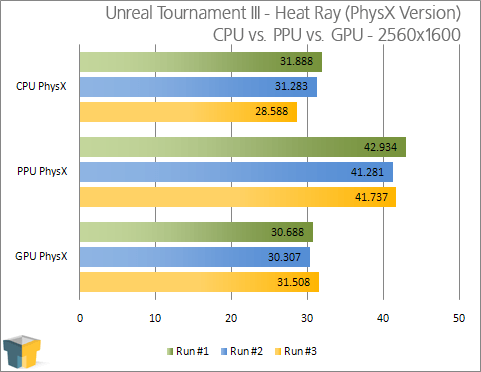
This test clearly shows that the CPU is limiting the game at 30 fps with the enhanced PhysX levels, while the GPU can tear through it at 60 fps with a PhysX card, or 50 fps when processing the physics itself. Obviously the cost of physics on the GPU is just a lot smaller than on the CPU.

As an aside, particle effects can be run as part of the vertex/geometry shading process, which means they can be run DURING rendering, which is far more efficient than having the CPU/PPU calc the particles first, and constantly streaming the updated geometry to the videocard (where the GPU has to wait until it's received completely before it can render).

These are just the same naive arguments I keep hearing over and over.
 
What point ? That a 9800 GTX cannot handle 2560x1600 properly in most games, even when NOT using PhysX ?

Did you really need a thread to say that ?

Because the link you posted clearly shows the advantages of having physics calculations done on the GPU instead of CPU or a PPU. So your title is either wrong or you tried to prove a point that is implicit i.e. a 9800 GTX cannot handle 2560x1600 properly.
The point is the 9800GTX can push 42 fps when physics is fully offloaded from the CPU and GPU.

The CPU can't fully handle physics, resulting in an 11 fps drop.
The GPU also can't handle physics under heavy 3d load, resulting in an 11 fps drop.
 
The point is the 9800GTX can push 42 fps when physics is fully offloaded from the CPU and GPU.

The CPU can't fully handle physics, resulting in an 11 fps drop.
The GPU also can't handle physics under heavy 3d load, resulting in an 11 fps drop.

But you are still taking these numbers as the only numbers. The 9800 GTX is NOT the fastest card around. Obviously you need something more powerful than a 9800 GTX, to render graphics and do physics calculations at the same time, at such a high resolution, which is pointed out the conclusion of the article, by referencing the GTX 280.

For 1660x1080, the numbers are pretty good and show the advantages of doing the physics calculations over a CPU or even a dedicated PPU. And as you mentioned yourself in a previous post, it should be interesting to see how this fares with second, less powerful cards, that could easily handle physics, while the most powerful card, renders graphics.

Still, the advantages are visible in both cost and performance, even with just one GPU.
 
The point is the 9800GTX can push 42 fps when physics is fully offloaded from the CPU and GPU.

The CPU can't fully handle physics, resulting in an 11 fps drop.
The GPU also can't handle physics under heavy 3d load, resulting in an 11 fps drop.

So what is the point exactly then?
Without a PPU you have less total processing power in your system, so no matter how you try to perform physics, it will be slower?
I think that's pretty obvious.
Since not a lot of people have a PPU, and the PPU price isn't that enticing, I don't think it's a very relevant point either.
 
For 1660x1080, the numbers are pretty good and show the advantages of doing the physics calculations over a CPU or even a dedicated PPU.

Yes, I'm amazed at how deliberately blind people are to this.
Also, they focus on there being no difference in framerate at 2560x1600, and somehow try to make it sound like it's a bad thing.
That's just nonsense. The PhysX functionality doesn't cost you anything extra. All you need to do is update your drivers (as you probably do anyway). Perhaps it may not always improve performance, but so far these numbers confirm that it doesn't hurt performance either (and even if it does, you can disable it in the control panel).

So, there aren't any disadvantages to GPU PhysX at all, are there? I only see advantages.
Amazing how people try to give a negative spin to that. And they try so hard aswell! For pages and pages they're just... in denial!
hah. I think this thread is full of either miscommunication or stubbornness. Maybe both.

I would never say GPU physics is a bad thing. It's definitely a good thing. Especially if/when the possibility of using older cards for physics along with newer cards for 3d is opened up. I would love to jam an "old" 8800GT into a system with one or two 280GTX for example. That would be the best of all worlds IMHO.

I think the bottom line is this. When the GPU has some headroom (i.e. UT3 at 1600 res), it is great to have the option to run physics on the GPU and receive a speed boost vs running physics on a quad core (or especially on a dual core, like I think Scali mentioned earlier).

However when the 3d requirements are increased, the GPU offers no benefit compared to a quad core CPU.

I think we would all agree that the optimal solution would be a separate physics processor (either ppu or gpu).
 
However when the 3d requirements are increased, the GPU offers no benefit compared to a quad core CPU.

Where you have to keep in mind that this is a mid-end GPU vs a high-end CPU.
Take a faster GPU or a slower CPU, and the balance changes in favour of GPU physics.

I think we would all agree that the optimal solution would be a separate physics processor (either ppu or gpu).

No, as I already stated, regardless of one or more GPUs, I think it's nonsense to dedicate an entire card to it. What you want is dynamic allocation of resources.
 
No offense to anyone, and I have NOT read this thread beyond OP.

If you are using your GPU at a resolution and quality setting that makes it the bottleneck in your gaming system, which I would argue 75% of you do, then of coure doing PhysX on the GPU is going to slow your framerate down. If you have a GPU that is not being fully loaded, then of course it would have stream processors available to do other things. But do not let anyone tell you that PhysX is free, because it is not. IMO, it is better off being on its own card as originally designed. That said, I think PhysX will not be succesful now days with Quad core and soon to be Octo processors in the market.

I buy a video card to do video. We have been wishing and hoping for games to start taking advantage of all these extra CPU cores and physics is exactly that IMO.
 
I completely agree with you on this. Some people have said that one can have a SLI setup and use 1 card to do graphics and the other GPU to do Physx.

I personally don't see the logic in getting a second GTX280 just so you can run Physx on it.

I mean, we would've been better off in just running a single GTX280 and a standalone Physx addon card for much less and accomplish the same thing.

No one ever said that a second GTX 280 would be needed, but rather a CUDA ready IGP or a 8400 GS. Something along those lines.

Also, the point is that even with just ONE card (in the OP's link a 9800 GTX), the advantages are more than visible.
 
To me, paying $10 per FPS gained seems like a pretty good deal. Or spending $200+ and getting the no change in the FPS. Maybe I'm just crazy?

If you don't get a change in FPS, you already had the same GPU in the first place?
Doesn't seem to make sense.
 
If you don't get a change in FPS, you already had the same GPU in the first place?
Doesn't seem to make sense.
What doesn't make sense is that people are totally panning the PPU card when the results are pretty clear:

utiii_results.png

utiii_results_2.png


And those comparisons are with a PPU card from 3 years ago versus a video card that came out a few months ago.
 
Someone just showed their true colours...

how so? they aquired a company and effectively killed thier product............tell me can you actually get a ageia physics card? outside of the lone model offered by asus? and from what I understand it is no longer in production.............

so what is the choice now? buy a vastly overpriced video card to get the ability to run physics that will be of absolutely no benifit once the GPU gets loaded up...........

at least with a stand a lone card, your ability to do physics is NOT dependant on your video card's resources.........
 
But these tests prove you wrong.
A mid-end GPU like the 9800GTX easily outperforms a high-end quadcore CPU when it comes to physics.
Multi-core CPUs are not the way to go when it comes to physics.
It makes about as much sense as saying you buy quadcores hoping that software renderers will start to take advantage of them.
The difference in performance between CPUs and GPUs is just too large, both in graphics and in physics. I think CPU-based physics will go the way of the dodo, once there is a standard API which is supported by all major GPU manufacturers. Just as software rendering died out about 10 years ago.

I agree with this, and think part of the problem is exactly that, the non-standardized APIs. I'd be willing to bet that when DirectX11 comes out (possibly with Windows 7, who can say?), that will be one of the new features.

In any case, I'm guessing the $120 add-on card performs less well than an 8800GT handling pure physics, so one wonders if one had the choice, who someone would prefer tp buy $200 9800GTX + $120 Ageia PPU, instead of simply TWO 8800GTs in SLI for the same amount.

Does anyone honestly think otherwise?
That would be great, except the driver doesn't support SLI at the moment. It seems like it should work, but then it seems like dual-monitor support should work too and how long have they promised that? So here we are again in this mode of endlessly waiting for better drivers to give us the supposed performance claimed by the hype. Again, I will believe it when I see it (and an inflated score in Vantage doesn't count, I'm talking real-world performance).
 
What doesn't make sense is that people are totally panning the PPU card when the results are pretty clear:

I think you're missing the point.
You need the 9800GTX anyway, else you won't get those results with the CPU or PPU either.
At least the GPU gives you better performance in 'low' resolutions (I don't consider this a low resolution because I'm still stuck at 1280x1024 myself), if you don't have a fast quadcore and/or PPU.
So if you have neither a 9800GTX, a quadcore CPU or a PPU, I would say the 9800GTX is the best upgrade your money can buy.
 
I agree with this, and think part of the problem is exactly that, the non-standardized APIs. I'd be willing to bet that when DirectX11 comes out (possibly with Windows 7, who can say?), that will be one of the new features.

I'm not sure how big of a problem that is, really.
Once nVidia releases a driver for all their 8000 series and higher, at least half of all the gamers in the relevant market segment will have PhysX support immediately.
That's quite a large demographic to ignore. Voodoo support was around for many games when only a very small percentage of gamers owned one (I never had any 3dfx card myself, even).
 
They reported FPS to 3 decimal places, seriously, if your not smart enough to understand significant digits, then I have zero faith in thier ability to run an unbiased test.
 
This thread is hilarious. Most of the other threads in this forum have been people asking "Why the hell do we need these new cards? I can already play everything maxed on my 8800GT,GTS,etc...". In this thread people are screaming bloody murder over losing 0 FPS at an insanely high resolution. :rolleyes:
 
What doesn't make sense is that people are totally panning the PPU card when the results are pretty clear:

...

And those comparisons are with a PPU card from 3 years ago versus a video card that came out a few months ago.

Point is, you don't NEED a PPU card. Just like you shouldn't NEED a Quad-Core to run any game.
However, there's one component that is needed to play video games: a graphics card. You just can't avoid it, especially if you want to play the game decently.

And why spend $120 on a PPU, when you only get 10 fps more than with the GPU doing physics ? Not to mention one less slot occupied.
 
I think you're missing the point.
You need the 9800GTX anyway, else you won't get those results with the CPU or PPU either.
At least the GPU gives you better performance in 'low' resolutions (I don't consider this a low resolution because I'm still stuck at 1280x1024 myself), if you don't have a fast quadcore and/or PPU.
So if you have neither a 9800GTX, a quadcore CPU or a PPU, I would say the 9800GTX is the best upgrade your money can buy.
that makes a lot of sense
 
how so? they aquired a company and effectively killed thier product............tell me can you actually get a ageia physics card? outside of the lone model offered by asus? and from what I understand it is no longer in production.............

so what is the choice now? buy a vastly overpriced video card to get the ability to run physics that will be of absolutely no benifit once the GPU gets loaded up...........

at least with a stand a lone card, your ability to do physics is NOT dependant on your video card's resources.........

Really don't understand your reasoning here, since the point of doing physics on a GPU is EXACTLY to avoid the need to get a PPU (or a more expensive CPU), so what does it matter if PPU cards are not available to purchase anymore ?

And for the last time, the 9800 GTX is not a high-end card anymore. It's already taxed when NOT doing physics at 2560x1600. The tested resolution that matters for a 9800 GTX, is 1650x1080 and the benefits are obvious, over a PPU, but especially the more expensive CPUs.
 
I think you're missing the point.
You need the 9800GTX anyway, else you won't get those results with the CPU or PPU either.
At least the GPU gives you better performance in 'low' resolutions (I don't consider this a low resolution because I'm still stuck at 1280x1024 myself), if you don't have a fast quadcore and/or PPU.
So if you have neither a 9800GTX, a quadcore CPU or a PPU, I would say the 9800GTX is the best upgrade your money can buy.

And the advantages are even more staggering when we consider the fact that not even the fastest quad-core processor can match the GPU, in other types of calculations and in this case, physics.
 
Firstly, I wasn't talking about "most modern game engines", I was talking about PhysX. Secondly, I already pointed out dozens of times that most games have a low physics load, so there simply isn't enough to do for a fast CPU. However this particular test uses special levels with much higher physics load.

Thirdly, as I already explained elsewhere, CPU load is no measure of how efficient a solution is. Multithreaded software design is a very complex issue, and keeping all cores 100% busy is not the primary goal. The primary goal is to process the workload in the smallest possible amount of time. These things are sometimes mutually exclusive.
Especially with games, where there are multiple workloads at the same time, a simple CPU meter tells you absolutely nothing. You don't even know what is running on which core... You get a complex mix of audio, video, physics, AI and user input workloads that are running on the various cores.
When a certain core doesn't get 100% usage, it means nothing more and nothing less than that there are no workloads being processed at that time. You have no indication whatsoever as to the reason why. It could just be that there simply aren't any workloads. Especially with physics, most of the time there's not a lot happening. Only when you shoot/blow up things/etc do physics really come into play. So you will generally see short bursts of physics workloads, it's not constant.


This would only be true under the assumption that CPUs and GPUs have equal processing power for physics.
In reality they do not. GPUs are far more powerful. Therefore it is generally better to offload at least some of the physics workload to the GPU, because it has much more processing power to spare. A CPU cannot process the suggested workload in the first place, because it's not fast enough, and would limit the rest of the system.
This test clearly shows that the CPU is limiting the game at 30 fps with the enhanced PhysX levels, while the GPU can tear through it at 60 fps with a PhysX card, or 50 fps when processing the physics itself. Obviously the cost of physics on the GPU is just a lot smaller than on the CPU.

As an aside, particle effects can be run as part of the vertex/geometry shading process, which means they can be run DURING rendering, which is far more efficient than having the CPU/PPU calc the particles first, and constantly streaming the updated geometry to the videocard (where the GPU has to wait until it's received completely before it can render).

These are just the same naive arguments I keep hearing over and over.

You make some good points and I'd probably agree with most of what you say, but the thing is we have games barely using 2 cores on the CPU, it's not as though we have maybe 5% CPU usage spare to put towards physics we have 2-3 whole other cores available to process physics which simply are not being used for games at the moment.

Yes the GPU is more efficient but it's already a bottleneck if you load it with more instructions the frame rate goes down, if you load a quad core CPU with more instructions onto the unused cores you dont sap frame rate to achieve mroe visuals in game.

I'd rather have a slightly smaller percentage increase in physics and it cost nothing, and sacrafice nothing, rather than having a slightly larger increase but it sacrafice frame rate, or cost me for a PPU.

Clearly utilising the other cores in the CPU is the smartest move here, its exactly what the bods making alan wake are aiming at and what valve harped on about for ages but havn't implimented yet.

it will also scale very well with future cpu upgrades, when we move to oct (8) core we can improve it further again with no additional cost and no hit to frame rates.
 
Aside from that, the PPU is outdated.
If you look at the results in Vantage (where you measure virtually only physics throughput, as the graphics are light), these GPUs have a much higher throughput than the PPU does (up to about 4-5 times).

So if you want to use a separate card, it's probably better to get a 8600GTS or something than to get the actual PPU. They're cheaper, more readily available, and will probably perform at least as well.
nVidia seems to have done such a good job at designing the G80 with Cuda in mind, that the performance seems to be pretty much in line with what a dedicated PPU would be capable of today.


then why not take that GPU tehnology responsible for physics and put into an add in card? that would be a far better solution........
 
Also the problem with using a 2nd gpu to run physics on is that you can't rely on everyone having dual gpu solution, but dual/quad cores are becoming increasingly more popular and is only a matter of time before they're the norm.

From a developers point of view its just much better to scale current physics systems across multiple cores where available, this way they can be important to gameplay rather than just additional eye candy as well, physics done on a GPU cant be used as game dynamics since you cannot gurantee everyone has an additional GPU dedicated towards calculating physics.

There is more to this problem than just technical specs inside a graph full of numbers, no developers ever going to use this tech in a significant way unless its widely adopted, PPU's never were and nor will multiple video cards.
 
You make some good points and I'd probably agree with most of what you say, but the thing is we have games barely using 2 cores on the CPU, it's not as though we have maybe 5% CPU usage spare to put towards physics we have 2-3 whole other cores available to process physics which simply are not being used for games at the moment.

So? Two or three cores don't mean all that much when it comes to physics. They're still extremely limited.

Yes the GPU is more efficient but it's already a bottleneck if you load it with more instructions the frame rate goes down, if you load a quad core CPU with more instructions onto the unused cores you dont sap frame rate to achieve mroe visuals in game.

Firstly, just because SOME parts in the GPU are bottlenecked doesn't mean that ALL parts are. Just like with CPUs, the GPU will have some spare resources on which you can perform physics for free. Think of it as HyperThreading, where extra threads can be run in the 'idle time' of certain CPU resources.
Since GPUs are so incredibly powerful, this 'idle time' will already deliver more physics processing power than two or three cores. Just look at the results here. The quadcore is limiting the game at 30 fps, simply because it cannot process physics fast enough. The GPU doesn't go that low until you up the resolution to 2560x1600. And this is not even a high-end GPU either! The CPU is one of the fastest available today. There are only one or two CPUs faster than this one, and the difference is no more than 10%. The fastest GPU available today is much more than 10% faster than a 9800GTX. So obviously there's more potential for GPU-physics than CPU-physics here.

I'd rather have a slightly smaller percentage increase in physics and it cost nothing, and sacrafice nothing, rather than having a slightly larger increase but it sacrafice frame rate, or cost me for a PPU.

But you can, by using this 'idle time' of the GPU. If you're running the regular UT3 levels, the GPU doesn't take a hit at all, from performing physics, and e

Clearly utilising the other cores in the CPU is the smartest move here, its exactly what the bods making alan wake are aiming at and what valve harped on about for ages but havn't implimented yet.

All 4 cores are already used in the UT3 PhysX levels here. The result is underwhelming.

it will also scale very well with future cpu upgrades, when we move to oct (8) core we can improve it further again with no additional cost and no hit to frame rates.

Except that GPUs will scale far quicker, and by the time octocores become available, CPU physics would be even more of a bottleneck than they already are today.
Physics is just not a task that CPUs are well-suited to.
Just look at the results already. The quadcore CPU is totally limited at 30 fps, regardless of resolution... You really want that instead of the GPU which gets 50 fps at 1680x1050?
Yes the GPU takes a hit, but nowhere near as much as the CPU does. Even an octocore will probably not be able to reach 50 fps, because you likely will get sublinear scaling... The ideal linear case would be 60 fps. Think! This is a dead end! Think! Look at the results! Interpret them!
 
scali2, you have the right idea. Trying to convince others here of certain facts is sometimes impossible. I gave up on this one.
 
Also the problem with using a 2nd gpu to run physics on is that you can't rely on everyone having dual gpu solution, but dual/quad cores are becoming increasingly more popular and is only a matter of time before they're the norm.

From a developers point of view its just much better to scale current physics systems across multiple cores where available, this way they can be important to gameplay rather than just additional eye candy as well, physics done on a GPU cant be used as game dynamics since you cannot gurantee everyone has an additional GPU dedicated towards calculating physics.

There is more to this problem than just technical specs inside a graph full of numbers, no developers ever going to use this tech in a significant way unless its widely adopted, PPU's never were and nor will multiple video cards.

But the point here is exactly that. You don't need a second GPU for physics. A single one already does a great job. And there's no reason why developers can't adopt this since:

1) A video card is the only "must have" component to play a game. You don't need a multi-core CPU (even though some recommend one), much less an expensive one and you sure don't need a PPU either.

2) This is an optional feature. If your video card is already stressed by the graphics load alone or cannot handle these calculations, then you can disable GPU physics and they'll be executed on the CPU as always.
 
I'm sorry, this just isn't correct at all. There is good evidence to show that most modern game engines simply do not use multicore CPU's well at all.

Valve hyped up the source engine for doing physics on multicores, yet in a quad core system all the source based games use 1 core 100% and the 2nd core a little bit, and then that's about it. Similar results with almost all modern game engines, theres simply no evidence anywhere that I've seen which suggest any games actually make full use of all 4 cores of a quad core system, or even good use of both cores in dual core system.

Unless you have some evidence to show otherwise?

What about Quake 4 using the dual-core update? Does that utilize two full cores or is it like the Source engine (using 100% and 5%)?

Granted, Quake 4 is 3+ years old now, but it had dual-core capabilities. Why don't more modern games (excluding RTS games)?
 
I just want to clear something up because I think people are missing my point. Yes, I agree that dedicating a GTX 280 solely to PhysX will blow away a EOL PPU card from 3 years ago. I am not arguing that point. If it didn't then there would be something really wrong. I accept that the PhysX add-on card was never a success, not because it didn't work but simply because enough devs didn't support it. So PhysX on the GPU is very much a good thing and I hope it takes off.

But here is what bothers me. From the day Ageia released their PhysX product, people have been claiming it was unnecessary. People said that those calculations could be done on the CPU with multiple cores. Nvidia (and others) claimed the GPU physics would be the answer. And here we are today, with vastly better hardware then we had 3 years ago, yet the PPU still wins out. That is what I am getting at. So, at this point in time, it makes more sense to move toward CUDA and other GPU processing techniques. But that doesn't excuse all the FUD that was spread over the years that effectively *killed* the PPU and now we know that was a lie. So now we have to wait for some Octo-core CPUs and SLI PhysX drivers just to get the performance that Ageia offered 3 years ago. Does this not bother anyone else?
 
Not in the slightest. I've always been pro-PPU (and I did try to educate people on the virtues of PPus on forums like these), but since it didn't take off, you have to count your losses and move on. GPU PhysX has much better odds of survival.
 
Status
Not open for further replies.
Back
Top