![[H]ard|Forum](/styles/hardforum/xenforo/logo_dark.png)
Navigation
Install the app
How to install the app on iOS
Follow along with the video below to see how to install our site as a web app on your home screen.
Note: This feature may not be available in some browsers.
More options
-
Some users have recently had their accounts hijacked. It seems that the now defunct EVGA forums might have compromised your password there and seems many are using the same PW here. We would suggest you UPDATE YOUR PASSWORD and TURN ON 2FA for your account here to further secure it. None of the compromised accounts had 2FA turned on.
Once you have enabled 2FA, your account will be updated soon to show a badge, letting other members know that you use 2FA to protect your account. This should be beneficial for everyone that uses FSFT.
You are using an out of date browser. It may not display this or other websites correctly.
You should upgrade or use an alternative browser.
You should upgrade or use an alternative browser.
Nehalem Previewed and Benchmarked
- Thread starter UncleDavid218
- Start date
This cancels my plan on getting a Q6600 or Phenom 9550 this year. I'll just wait for Bloomfield
The Q6600 should have cancelled plans for a Phenom 9550

Oh the hyper threading front, I think if I had a 4+ core CPU I'd probably disable it. I do a fair bit of multi-tasking, but nothing that 4 cores cannot handle and I wouldn't want HT to hinder the performance of any programs that are single threaded. IIRC, the P4's did show a slight drop in performance with HT on in a few programs. I'm sure we'll see more in depth reviews that explore the performance difference with HT on or off in the coming weeks.
Do you really think they carried over hyper-threading as is was in the P4 days over to Nehalem? I mean HONESTLY!!! Do you?
I'm positive today's hyper-threading is a whole lot more efficient than it was back then.
It's simple logic and reasoning really. Just like programs that only use 1 or 2 cores more often than not run slightly better on an equally clocked dual core than they would on a quad core because of overhead. HT would add some overhead, hence, there is the very real possibility that single threaded apps might take a hit, even if it is very slight. I'm just saying that with 4 and later on, 8 cores available HT may not really be necessary except for HIGHLY multi-threaded apps or very extreme multi tasking.
Like I said, I'm sure there will be benchmarks to test with HT on and off, so I'm not jumping to any conclusions just yet so ease off the red bull and calm yourself down.
Current/New HT is actually more comparable to IBM POWER6 SMT; use of all available execution units. Intel's pipelining is still decades behind POWER6, but forget catching those things. (BTU's out of a P550 with 4x(8x) 4.2GHz POWER6's are less than many Xeons.)
The original HT was crippled by having partial-execution units that were exclusive or near-exclusive to it, including limited FPU function. New HT stops being retarded in this fashion, and simply adds an additional pathway to all execution units. At least that's per the documentation I've seen.
The original HT was crippled by having partial-execution units that were exclusive or near-exclusive to it, including limited FPU function. New HT stops being retarded in this fashion, and simply adds an additional pathway to all execution units. At least that's per the documentation I've seen.
ScourggeFX
Gawd
- Joined
- Jan 15, 2003
- Messages
- 609
/dreaming
2 Nehalem CPUs overclocked to 4+Ghz on a Skulltrail platform....drool
Quad GTX 280, OC'ed....drool
8GB of DDR3@2000+Mhz....drool
/dreaming
2 Nehalem CPUs overclocked to 4+Ghz on a Skulltrail platform....drool
Quad GTX 280, OC'ed....drool
8GB of DDR3@2000+Mhz....drool
/dreaming

Gideon
Supreme [H]ardness
- Joined
- Apr 13, 2006
- Messages
- 4,249
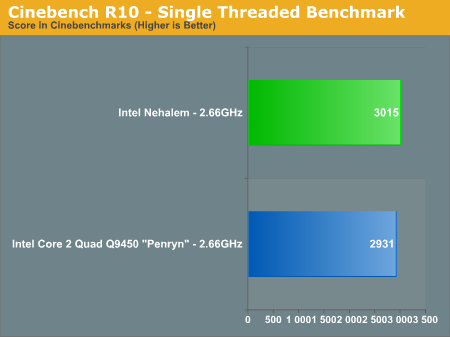
Cinebench shows us only a 2% increase in core-to-core performance from Penryn to Nehalem at the same clock speed. For applications that don't go out to main memory much and can stay confined to a single core, Nehalem behaves very much like Penryn. Remember that outside of the memory architecture and HT tweaks to the core, Nehalem's list of improvements are very specific (e.g. faster unaligned cache accesses).
I dont see Nehalem being that big of a monster, I think AMD is just fine. Biggest increase for Intel will be better scaling on multi sockets now. Less this thing clocks like mad, it will be a slight increase for Intel.
brucedeluxe169
2[H]4U
- Joined
- Aug 24, 2004
- Messages
- 3,720
because we all know that one less than stellar benchmark, out of a slew of excellent ones, on unfinished silicon, running on a very buggy and unfinished motherboard means that this arch won't be that great...
Gideon
Supreme [H]ardness
- Joined
- Apr 13, 2006
- Messages
- 4,249
No if you bother to read guy, thats a benchmark of a single thread not multi threaded. Its 2% better. Try to understand what I was pointing out before you reply. Nehalem will rival amd for multithreaded perfomance but single threads will hardly be any diffrent then Penryn.
brucedeluxe169
2[H]4U
- Joined
- Aug 24, 2004
- Messages
- 3,720
does it even matter? supposedly the K8 core wasn't drastically different from the K7 other than the IMC... why is it so hard for people to believe that Intel could have similar monstrous games from the same tweak?
brucedeluxe169
2[H]4U
- Joined
- Aug 24, 2004
- Messages
- 3,720
Nehalem will rival amd for multithreaded perfomance but single threads will hardly be any diffrent then Penryn.
quoted, b/c this is just too funny
I'm not really impressed with the results to be honest. I was expecting this to be a nice increase to the amount of operations that could be done. Not just adding on HT along with a memory controller. Oh well.
I just hope for AMD's sake Bulldozer comes out early and wipes the floor with what Intel has at the time. At least Bulldozer is being built from scratch, so it should be pretty good.
I just hope for AMD's sake Bulldozer comes out early and wipes the floor with what Intel has at the time. At least Bulldozer is being built from scratch, so it should be pretty good.
brucedeluxe169
2[H]4U
- Joined
- Aug 24, 2004
- Messages
- 3,720
I'm not really impressed with the results to be honest. I was expecting this to be a nice increase to the amount of operations that could be done. Not just adding on HT along with a memory controller. Oh well.
I just hope for AMD's sake Bulldozer comes out early and wipes the floor with what Intel has at the time. At least Bulldozer is being built from scratch, so it should be pretty good.
is anything ever really "built from scratch" at this point in CPU technology? Because unless *everything* about the processor is redesigned down to the smallest aspects, new technology is invented, and old technology is re-developed, "built from scratch" isn't really a fitting term.
besides, how are the results not impressive? If this 25%-35% increase holds across the board, then Nehalem will be just as big a jump on the current gen that Conroe was on the last...
Gideon
Supreme [H]ardness
- Joined
- Apr 13, 2006
- Messages
- 4,249
is anything ever really "built from scratch" at this point in CPU technology? Because unless *everything* about the processor is redesigned down to the smallest aspects, new technology is invented, and old technology is re-developed, "built from scratch" isn't really a fitting term.
besides, how are the results not impressive? If this 25%-35% increase holds across the board, then Nehalem will be just as big a jump on the current gen that Conroe was on the last...
Its not a 25% to 35% gain its a 2% gain on core. Thats the most important part. Plus what Anad uses for Penryn benchmarks looks wrong as well seems lower then they should be which makes the Nehalem look even better then it is. If you want to see huge scaling numbers on certian apps that are multithreaded then go watch a Opty spank a Xeon. Its simple Nehalem is here to stop the spanking Penryn gets in servers in 4P.
Tho I do enjoy the fact that Nehalem is as close as Intel can get to being a Opty processor without just rebadging them. I expect a much tighter server race now but desktop will change very little, less this thing clocks like mad.
So then explain why the K8 was such a big leap from the K7. I mean, the core architecture was largely the same, the biggest change was from the IMC. And like I said for the third time, not many (any?)applications are going to run solely in the processors cache, they WILL go out to main memory.
Sounds like nothing more than misguided fanboy talk to me, unconvincing at that.
If it makes you feel better you are correct. If programs don't access main memory and stay on a single core it may not benefit much. Unfortunately for you, such programs don't exist, except of course benchmarks designed to test specifically that. So if you're running actual applications, you'll see a nice benfiit. And if you use your computer to strictly run Prime95 SmallFFT test, it may not do much more then Penryn.
Sounds like nothing more than misguided fanboy talk to me, unconvincing at that.
If it makes you feel better you are correct. If programs don't access main memory and stay on a single core it may not benefit much. Unfortunately for you, such programs don't exist, except of course benchmarks designed to test specifically that. So if you're running actual applications, you'll see a nice benfiit. And if you use your computer to strictly run Prime95 SmallFFT test, it may not do much more then Penryn.
Gideon
Supreme [H]ardness
- Joined
- Apr 13, 2006
- Messages
- 4,249
You said applications that don't go out to main memory AND stay confined to a single core. I don't know of many apps that meet both those requirments. Even if Nehalem didn't exist, AMD is anything but "just fine"
I copied that little blurb direct from Anad. Plus if you actually read it you would realize that its using memory access as well. So try to read before just lambasting people
For applications that don't go out to main memory much and can stay confined to a single core
I'm not saying it's incorrect buddy, I said you're right. I'm just saying that there isn't much in the way of programs that aren't going to go out to main memory. In other words, it's a scenario that will rarely be seen in real world usage.
jonneymendoza
Supreme [H]ardness
- Joined
- Sep 11, 2004
- Messages
- 6,415
YAY CANT WAIT FOR THIS MONSTER!!!!!!!!
I copied that little blurb direct from Anad. Plus if you actually read it you would realize that its using memory access as well. So try to read before just lambasting people
For applications that don't go out to main memory much and can stay confined to a single core
I think his point is that you're jumping to conclusions.
Yes, in that one benchmark there is only a 2% difference. However, this is still pre-production stuff, and especially the motherboard isn't up to snuff yet. According to Anandtech, the triple-channel memory didn't work yet, and the PCI-e bus didn't work yet.
Aside from that, even if a final motherboard cannot fix performance in this particular benchmark, this does not mean that you can generalize these results to all applications.
Even back when Core2 Duo was introduced, there were still some benchmarks where Pentium D was faster (mostly because of the high clockspeed and fast SSE2 units). Obviously taking such a benchmark and generalizing it to "Core2 Duo is not faster than Pentium D" would be false.
And ofcourse Cinebench could be modified to take advantage of the new SSE4 units.
We'll just have to wait and see with final hardware and a larger set of applications, before we can draw conclusions like these.
However, most of these benchmarks run much faster than you'd expect from just "Core2 Quad + HT". To me the results indicate that Nehalem will indeed improve performance per-core for a lot of applications. The fact that the L2-cache has a lower latency, and there is L3-cache also indicate that certain operations can run faster than on Core2. And then there's the improved unaligned access.
Also, if you look at Cinebench's multithreaded numbers, it only goes up 20%, while eg 3dsmax and Povray go up more than 30-40% compared to Penryn. So Cinebench just scales less than 3dsmax and Povray anyway, so it's not entirely representative.
BillParrish
Supreme [H]ardness
- Joined
- Aug 25, 2006
- Messages
- 7,519
Looks like its going to be hot next spring, time to start stashing the cash (finally ).
(now if parallelism in the software could just catch up we would really be in high cotton. )
).(now if parallelism in the software could just catch up we would really be in high cotton. )
chrisf6969
[H]F Junkie
- Joined
- Oct 27, 2003
- Messages
- 9,011
Cinebench shows us only a 2% increase in core-to-core performance from Penryn to Nehalem at the same clock speed. For applications that don't go out to main memory much and can stay confined to a single core, Nehalem behaves very much like Penryn. Remember that outside of the memory architecture and HT tweaks to the core, Nehalem's list of improvements are very specific (e.g. faster unaligned cache accesses).
I dont see Nehalem being that big of a monster, I think AMD is just fine. Biggest increase for Intel will be better scaling on multi sockets now. Less this thing clocks like mad, it will be a slight increase for Intel.
Ummm why didn't you quote any of the other graphs showing the much larger increases!?
No if you bother to read guy, thats a benchmark of a single thread not multi threaded. Its 2% better. Try to understand what I was pointing out before you reply. Nehalem will rival amd for multithreaded perfomance but single threads will hardly be any diffrent then Penryn.
So you don't believe someone who had his hands on it. And is one of the top hardware websites.... well besides. HardOCP!
http://www.anandtech.com/cpuchipsets/intel/showdoc.aspx?i=3326&p=9 said:AMD never really caught up to the performance of Conroe, through some aggressive pricing we got competition in the low end but it could never touch the upper echelon of Core 2 performance. With Penryn, Intel widened the gap. And now with Nehalem it's going to be even tougher to envision a competitive high-end AMD CPU at the end of this year. 2009 should hold a new architecture for AMD, which is the only thing that could possibly come close to achieving competition here. It's months before Nehalem's launch and there's already no equal in sight, it will take far more than Phenom to make this thing sweat.
Intel's first available Penryn was an extreme edition at well over $1K (and it's still near the same price point today). They have since topped the $1.5K price point with their top of the line chip.
What do you suppose their next step will be with extreme Nehalem chips? Do you think the first ones available this fall will go for $1.5K and then shoot for $2K next spring with their top of the line chip?
And here's me still using his E8400 5 years from now.
What do you suppose their next step will be with extreme Nehalem chips? Do you think the first ones available this fall will go for $1.5K and then shoot for $2K next spring with their top of the line chip?
And here's me still using his E8400 5 years from now.
DemonDiablo
[H]ard|Gawd
- Joined
- Jun 7, 2004
- Messages
- 1,767
Its not a 25% to 35% gain its a 2% gain on core. Thats the most important part. Plus what Anad uses for Penryn benchmarks looks wrong as well seems lower then they should be which makes the Nehalem look even better then it is. If you want to see huge scaling numbers on certian apps that are multithreaded then go watch a Opty spank a Xeon. Its simple Nehalem is here to stop the spanking Penryn gets in servers in 4P.
Tho I do enjoy the fact that Nehalem is as close as Intel can get to being a Opty processor without just rebadging them. I expect a much tighter server race now but desktop will change very little, less this thing clocks like mad.
2.2yrs and you're still a noobie. With posts like this I can see why. You saw one benchmark out of like 20 and you start to base your entire debate, reasoning, and logic around it. One benchmark which speaks for a very very very very very small percentage of similar type apps and you begin to base everything around it.
I think:
a. you need to go back and reread that article.
b. you were doing just fine these past few years watching and not posting so maybe you can go back to that.
c. if you fail at a AND b (not or but both) then just head back to the amd forums cause your posts stink of fanboyism.
Also these were some very impressive benchmarks and a nice first glimpse at nehalem. Intel has done a good job of keeping up with the pacing that conroe started.
Gideon
Supreme [H]ardness
- Joined
- Apr 13, 2006
- Messages
- 4,249
Will see, Anad left alot of data out and then found errors in his own review when questioned on bad numbers. Plus I dont care about the other benchmarks since I wanted to see what single core performance was, sadly Anad only has this one graph to compare with. I'd love to see more tests ran single threaded to really see if it has any improvements.
But since all I did was point out the poor results in one test, instead of saying it owns all, I must be a fan boy. Now I'll explain it simply, If this holds true for single threaded performance, Nehalem will only be about 5% or less better then Penryn, but will scale much better with increased cores, tho Hyperthreading can throw a wrench into that as well.
If [H] had reviewed this, it would have been much more in depth and much more usefull. Anad posted crap and you all ate it up. Hopefully when this thing is final and they do bench it, I think most of you will be dissapointed, much like amd users were when Phenom wasnt as good as AMD claimed it was. Course till we see final revisions of this chip, its just up in the air.
But since all I did was point out the poor results in one test, instead of saying it owns all, I must be a fan boy. Now I'll explain it simply, If this holds true for single threaded performance, Nehalem will only be about 5% or less better then Penryn, but will scale much better with increased cores, tho Hyperthreading can throw a wrench into that as well.
If [H] had reviewed this, it would have been much more in depth and much more usefull. Anad posted crap and you all ate it up. Hopefully when this thing is final and they do bench it, I think most of you will be dissapointed, much like amd users were when Phenom wasnt as good as AMD claimed it was. Course till we see final revisions of this chip, its just up in the air.
Seriously just stop posting because it is painfully obvious you have no clue as to what you're talking about. I'll say it for the 4th time now, 99% of applications are going to use memory, many times, a lot of memory. This fact alone, even if the app is single threaded will see a benefit far grater than 5%
If what you say were true, a single core Athlon 64 would only be marginally better than a Socket A Barton processor, we both know that isn't true because of the IMC making a huge difference.
So please do yourself a favor and stop posting unless you are insistent on showing everyone here exactly how far your ignorance goes.
If what you say were true, a single core Athlon 64 would only be marginally better than a Socket A Barton processor, we both know that isn't true because of the IMC making a huge difference.
So please do yourself a favor and stop posting unless you are insistent on showing everyone here exactly how far your ignorance goes.
Gideon
Supreme [H]ardness
- Joined
- Apr 13, 2006
- Messages
- 4,249
Wow Ramon you like to assume alot dont ya. IMC will improve the numbers, but Intel may not have hammered the IMC out fully. And to know this we need benchmarks that are memory intensive as well to see that. If you think my knowledge lacks then go to Scientia's site and read his blog, he breaks it down quite nicely.
Gideon
Supreme [H]ardness
- Joined
- Apr 13, 2006
- Messages
- 4,249
What was that suppose to teach me? Sounds like someone with their own agenda. Funny how the only benchmark that they aren't trying to pick apart is the same one you're stuck on. Like I said, it's futile to try and argue. We'll just wait until more people get their hands on Nehalem and then we'll see who can say "I told you so"
Yep, that's old Dementia all right. His blog is funny because when anyone questions his dubious "facts" or conclusions, the post is immediately deleted.What was that suppose to teach me? Sounds like someone with their own agenda.
Although Roborat's blog is also slanted (a bit less), he has a regular assortment of chip designers and process engineers who post comments. It's actually very informative, especially if you want to check veracity of some of Dementia's claims (which, mentioned above, are quickly deleted from his blog). http://roborat64.blogspot.com/
http://chicagrafo.blogspot.com/ is also a good blog, but he's been straying away from AMD for various reasons.
- Joined
- Jun 3, 2003
- Messages
- 6,677
I'd laugh if all of those bloggers were the same person.
Back on topic: Looks like I'm saving my money, and *not* building a Q6600 system!
(As if I could afford it anyway)
Back on topic: Looks like I'm saving my money, and *not* building a Q6600 system!
(As if I could afford it anyway)
Hot damn, Intel is really on the ball right now. All I know is, if you are in the market for a cpu, it isnt even a question anymore that you should go Intel. If AMD cant get its Phenom clocks up to 3GHz and quickly, they wont stand a chance. Then again, they dont stand a chance right now anyway...