• Some users have recently had their accounts hijacked. It seems that the now defunct EVGA forums might have compromised your password there and seems many are using the same PW here. We would suggest you UPDATE YOUR PASSWORD and TURN ON 2FA for your account here to further secure it. None of the compromised accounts had 2FA turned on.
    Once you have enabled 2FA, your account will be updated soon to show a badge, letting other members know that you use 2FA to protect your account. This should be beneficial for everyone that uses FSFT.

More DLSS...

I was a big fan of SLI until the 1080 TI era. I even had quad-SLI at one point lol. It was pretty useful in the Xbox 360/PS3 era when lots of games were poorly optimize and ran around 1080p/30fps even on a 8800 GTX.

But when the 1080 TI came along, I was still using a 1080P monitor so the 1080 TI was good enough. But I think 1080 SLI was really useful for people who got 4K displays. Since DLSS wasn't available yet, 1080 TI in SLI was pretty much the only way to have a good 4k gaming experience.

Yes! I had this exact configuration and, at the time, it was just so bad ass!

Ah, the days of having to find the right SLI profile using Inspector, or trying to get 21:9 to work properly.

You’d spend days trying to get a game to work properly… a kind of secondary game… and, often times, this secondary game would turn out to be as much fun as the actual game itself!
 
.
I'm not saying that they aren't getting vector information into the system, I'm saying that there is a difference between deriving that vector information by comparing information from prior frames, and a system where the application is delivering vector information from the application/game engine directly.

(As occulus described it) There is a difference between tracking things, hooking things, and guessing vectors solely by inference from prior frames = asynchronous spacewarp (asynchronous = not happening at the same time, indicating inference from prior frames)
. . . . and an engine+peripherals actually delivering vectors from the code of it's movement entities, which they called *application* spacewarp, where the application provides vector information from the application/game-engine and peripheral input "live" or directly from the engine anyway (usually in addition to prediction).

A frame generation system utilizing application spacewarp informing it of actual vectors as well as inferring vector information from previous frames would likely be a lot more accurate, could probably generate many more frames per native frame with less % inaccuracy.
 
SLI on 3dfx Voodoo2/5 was ScanLine Interleave and worked by having each card render every second line. It did not give 2x performance as in 2x FPS but it did basically double filltrate... back then GPUs were not GPUs and more like accelerators to drawing triangles on the screen. With super fast CPU you could approach 2x improvement in frame rates.
Great explanation. Thanks!

So theoretically, if at that time, it was possible to put like 6 3DFX videocards in one system, it'd have 6x the fillrate?
 
Great explanation. Thanks!

So theoretically, if at that time, it was possible to put like 6 3DFX videocards in one system, it'd have 6x the fillrate?
See: voodoo 5 6000 ;). 4x chips on one card, never released to consumers.
 
So theoretically, if at that time, it was possible to put like 6 3DFX videocards in one system, it'd have 6x the fillrate?
Fun ends with four VSA-100 chips for 4x fillrate.
But I guess you could scale such tech indefinitely if you really wanted.
You could put 2160 chips for 4K or 4320 chips for 8K and have each card render only 3840 or 7680 pixels respectively for blazing fast frame rates... but isn't it what we already have anyways? Just instead of lines modern GPUs split their work in some sort of rectangular patterns and offload culling operations to the GPUs themselves. It is more efficient to have everything on one die and share memory. Especially once complexity of your 3d accelerator rise and you need fast access to results of operations performed in other 'cores'. In the past it did not matter than much but over time it became very hard to separate parts of the graphics chip in to separate chip - and you can bet that many tried because at some point it would greatly help with production costs and scalability.

BTW. For anyone interested here is a great video about Voodoo 5 6000 and 3dfx history and why it kicked the bucket

View: https://www.youtube.com/watch?v=-aMiEszQBik
Voodoo5 6000 in benchmarks does deliver what 4 VSA-100 chips promised but you have to have very fast CPU to get 4x scaling. Athlon XP 2600+ used by Steve in these tests is a bit too slow to fully leverage full potential of these cards 😉
 
FYI to those who is unaware, the third party framegen engine Lossless Scaling (LSS) just recently unlocked framegen ratios up to 20:1.

It doesn't have as much access to ground truth (vectors etc) to de-artifact large ratios, but for those pimping 4090's a wee bit longer, it can be an alternative. The temporal quality upgrade on 240Hz+ OLEDs may still exceed the slight spatial downgrades even with LSS, but YMMV --

There is a preference factor and sometimes health/accessibility factors (e.g. people who get motion sick from motion blur or strobe backlights --> Even more flawed framegen can be a lesser evil for some).

LSS is a third party framegen engine that now supports up to 20:1 ratios on any performant GPU --
View: https://store.steampowered.com/app/993090/Lossless_Scaling/

(Note: Pasting steam links is automatically HardForum affilated, they get the penny, not me. Obviously a much cheaper framegen upgrade)

Of course, I feel DLSS 4 produces much better framegen quality (even if not perfect), but hey, at least there's a third party 4:1 to 8:1 option now not locked to NVIDIA's 5000 series. That's at least Very Good, in my book.

Hopefully Steam's Gamescope soon supports it, as it could be useful to get 90fps on the mobile OLED of the Deck.

1737245776897.png


I'd love to see content creators benchmark LSFG versus DLSS4 both for use as a motion clarity enhancer for 480Hz OLEDs.

Large-ratio framegen produces quite noticeable blur busting benefits on high-Hz OLEDs, so I have a great interest in seeing more >4:1 framegen engines hit the market.
 
Last edited:
I watched that whole thing earlier. Interesting stuff and affable characters. A pleasant interview with two people who seem to honestly love gaming simulation tech. I appreciate the interviewer asking the types of pointed questions he did, but Catanzaro had to give some political answers so to speak, towing the company line on a few occasions and smoothing over a few of the answers but that's expected. Nothing agregious or anything.

He did say that the low latency Reflex tech does take mouse movement tracking as a vector in some way, but I don't know that he meant it is getting it right from the game software itself. It may be that they are tracking the "FoV mouse movement" still by comparing frames, especially in "corridor shooters"/"arena shooters" and hooking that sway to predict rather than getting actual vectors from peripherals or game engine's input values. Still very interesting and sounds like they are progressing toward using inputs, at least in spirit,(although perhaps by referencing frame differences currently), so maybe they will pursue doing that more directly in future gens.

In my opinion, he sidestepped or gave a politician-like answer to the question of what would be the optimal frame rate for using frame gen for the best (highest performing and cleanest) results. On one hand he had earlier said that the larger the difference between frames, the harder it is to determine where things will be - resulting in more ghosting, artifacts, and anomalies. On the other hand, he more generically stated that when you are comparing two native frames, essentially said that once you get your % accuracy between those frames, it doesn't lose much in dividing it across 1 , 2, or 3, frames. That it's more dependent on the calculation between the two native frames. Which is saying something true but it is however glossing over the question with a political answer (imo). I think, like he said previously in the interview, it stands to reason that the higher the (native) frame rate, the smaller the %difference between action slices to guess between. That because everything has moved a shorter distance and changed less over shorter periods.

The future of frame gen is very intriguing. 1000fpsHz starting to get mentioned more is good to hear. :)
 
Last edited:
FYI to those who is unaware, the third party framegen engine Lossless Scaling (LSS) just recently unlocked framegen ratios up to 20:1.
No one needs 20:1 frame generator. Heavy games already support DLSS FG and/or FSR FG which work better and you need high input frame rate to use the tech confortably so you are basically already playing at 120+fps with FG. Moving it to e.g. 360Hz but with external tool that generates artifacts to remove slight motion blur no one cares makes little sense. IMHO.

I mean I care for motion blur when I play game at 60fps. When I play game at 120fps then unless this is like 2d platformer/shooter I don't care anymore. 240fps look better and 360fps looks even better but I using tools like LS to fake 360fps from 60fps... come on! It makes no sense. Better to save GPU cycles and play at 75fps.

What I would rather see is BFI implementation.
Does this tool support BFI?
Or your CRT emulator?
 
I'd take the progression of Nvidia AI and Nvidia frame gen to eventually get to 1000fpsHz worth of motion clarity/blur reduction and motion definition/articulation, and with higher %accuracy of generated frames (less artifacting/anomalies) as the tech progresses. That would also be helpful in order to use advanced Ray tracing, where you need a lot of fpsHz to keep very high fpsHz minimums. I'd also like to get to HDR 4000 and HDR 10,000 eventually while BFI delivers a considerable hit to brightness and can cause stroboscopic artifacts. That and, while technically it could work with VRR, afaik there hasn't been standard, clean, non-problematic implementations of that delivered.

That said , if you had extremely high fpsHz minimums well above the peak Hz of an extremely high fpsHz screen, with no variance you wouldn't need VRR much if at all anymore so maybe you wouldn't have it clashing with BFI anymore at that point (though that is a long ways off yet). The black frame or partial scan would be very brief too. Speaking of that, maybe with enough frames being generated with frame gen, they could generate some black frames with frame gen, within the peak Hz of a display instead of the display doing it.
. . .

480fpsHz solid
996053_project480-mousearrow.jpg


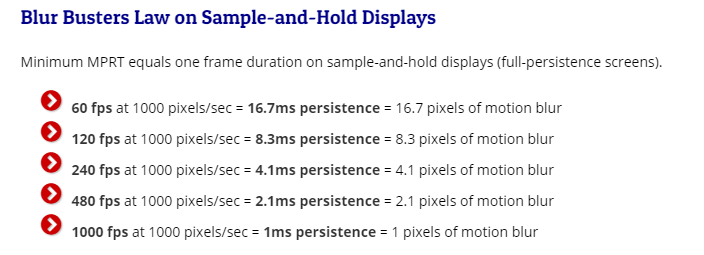
1059174_blurbusters.pixels.of.motion.blur.fpsHz.png


View: https://www.youtube.com/watch?v=gKFsPeRVqaY
 
Last edited:
  • Like
Reactions: Advil
like this
No one needs 20:1 frame generator. Heavy games already support DLSS FG and/or FSR FG which work better and you need high input frame rate to use the tech confortably so you are basically already playing at 120+fps with FG. Moving it to e.g. 360Hz but with external tool that generates artifacts to remove slight motion blur no one cares makes little sense. IMHO.

I mean I care for motion blur when I play game at 60fps. When I play game at 120fps then unless this is like 2d platformer/shooter I don't care anymore. 240fps look better and 360fps looks even better but I using tools like LS to fake 360fps from 60fps... come on! It makes no sense. Better to save GPU cycles and play at 75fps.
Hard disagree.

Even just LSFG x2 with 60fps is way better than 75 native fps IMO. It looks way way better, but of course it is more laggy, so not competitive online.
 
  • Like
Reactions: Advil
like this
Speaking of that, maybe with enough frames being generated with frame gen, they could generate some black frames with frame gen, within the peak Hz of a display instead of the display doing it.
This can be done already and for basically zero processing cost.
Advantage of it is that display implementing BFI needs to read the frame and start drawing it at 2x or faster rate in order to accommodate for BFI.
It then is not that different than FG in latency cost.

This is of course because displays don't do it optimally and will fetch whole frame before start drawing them doubling the latency cost compared to doing it optimally - which is start drawing frame as soon as we are sure we will have last line before we draw last line and this amounts to waiting for half of the lines for 60Hz BFI on 120Hz panel. I this case we would only have half of the frame of lag at the top of the screen, quarter in the middle and none for last line. Quarter of the frame worth of lag in the middle is not that terrible. Do it wrong and you add half of the frame of lag totaling three fourths frame time worth of lag. And we still see that enabling BFI on displays for 60Hz modes adds more lag - 16.6ms on average so it is even less optimal than what I just described.

Running BFI on GPU, be it by having it in GPU drivers themselves or via external program like LS would reduce latency cost of BFI to zero. Have frame rendered -> push it to the display ASAP.
 
  • Like
Reactions: Advil
like this
Seems like applying things from different modular approaches would be more likely to overstep or be out of sync. Even slightly imperfect matching of things can cause stoboscopic/ drawing anomalies, artifacts, (even vision fatigue over time potentially).

Utilizing one or more frames from a higher frame generation multiplier sounds to me like it could be a clean approach. It would probably work better with VRR because it could blank a fpsHz frame in the actual fpsHz~vrr graph. Unfortunately it would still dim the screen from the HDR range a display is capable of, plus with VRR that dimming would be fluctuating so would be bad.

That's why I said that might work well if something like application space warp (game engine informing FrameGen of vectors directly) combined with previous frame comparative framegen - once able to cleanly generate frames exceeding the peak Hz of displays in the entire frame rate graphs (at 4k or higher) - was able to eliminate the need for VRR. At that point, you wouldn't have any brightness variance or other sync issues with BFI. But you'd still be losing the full HDR range capability of the display. Would be a nice option for people though, even if cutting HDR 4000 screen down to HDR 2000, for example, when enabled.

With 1080p ~ simple to render games that kind if overage could probably be achieved a lot sooner but I have no interest in lower rez.

(Though you could set lower peak Hz on screens manually if your frame rate minimums are high enough. avoiding VRR).. even if a framegen including a BFI function was an option it would have to compete with the benefit of using higher peak Hz of ever increasing Hz screens(e.g. 480fpsHz of motion definition), frame rate lowering features (like advanced ray tracing, higher graphics complexity as well as longer view distances with detailed animated object in rge distance, large # of entities onscreen) and importantly in the long run, higher nit HDR ranged screens.


If I was greatly exceeding my peak Hz in frame rate minimums while all of the eye candy settings were cranked up, and I had a HDR 4000 or HDR 10,000 screen, then I'd consider throwing BFI at it for some games, even if it ended up halving the hdr color range nits. However likely by that point to already have a very high fpsHz performance and cutting the sample-and-hold blur down by a lot so BFI might not be as valuable by then , (e.g. in the nearer future, 480fpsHz at 480min with oled response time.. and eventually to 1000fpsHz at 1000 min).

It would still be nice to have the option along the way, regardless.
 
Last edited:
Hope he doesn't mind me shuffling his reply to here. This is one of mark R's replies from the reddit r/MotionClarity sub.

https://sh.reddit.com/r/MotionClari...z_oled_pursuit_camera_clearest_sampleandhold/

This is one reply. There are a lot of interesting replies from him in the full thread that go into some technical detail.

. . . . .


"
I have information that engineers are working on 8:1 to 10:1 framgen ratios. We need that badly, to get RTX ON at 1000fps for 1000Hz OLEDs coming ~2027.

Then it'll be GSYNC Pulsar but without needing strobing.

A future destuttering lagless framegen at 10:1 ratio is potentially having 4 cakes and eating all 4 at the same time:

  • It's like DLSS because it's framegen
  • It's like ULMB because it blur-reduces (but via brute framerate)
  • It's like GSYNC because it can destutter to framerate=Hz
  • It's also Ergonomic FlickerFree PWM-free.
Eating four cakes at the same time! CRT motion clarity without flicker/strobe/phosphor/pulsing/PWM/etc. Sadly that requires framerate out of the wazoo, and Moore's Law is mostly dead, so going multitiered/parallelized approaches becomes necessary.

One approach is lagless framegen algorithms is probably the the Way of the Future (for non-retro materialz), though requires game engine integration. Preferably in core engines (Unreal, Unity, etc).

Or for TL;DR, see the lagless framegen algorithm infographic image.

Yes, BFI isn't going to be fully obsolete. I love CRTs especially for my retro material. But real life does not flicker, and real life has no frame rate (analog motion). Bruting displays to a defacto analog frame rate is the closest thing to flickerless AND blurless AND stroboscopicless AND more fully ergonomic concurrently (matching real life), all at the same time.

And 120-vs-480 OLED is more mainstream visible than 60-vs-120 LCD. 1000Hz isn't just for esports <.....>

"
 
Thanks for reposting that elvn, I had no idea that subreddit existed let alone that Chief Blurbuster posted there! :)
 
Hope he doesn't mind me shuffling his reply to here. This is one of mark R's replies from the reddit r/MotionClarity sub.

https://sh.reddit.com/r/MotionClari...z_oled_pursuit_camera_clearest_sampleandhold/

This is one reply. There are a lot of interesting replies from him in the full thread that go into some technical detail.

. . . . .


"
I have information that engineers are working on 8:1 to 10:1 framgen ratios. We need that badly, to get RTX ON at 1000fps for 1000Hz OLEDs coming ~2027.

Then it'll be GSYNC Pulsar but without needing strobing.

A future destuttering lagless framegen at 10:1 ratio is potentially having 4 cakes and eating all 4 at the same time:

  • It's like DLSS because it's framegen
  • It's like ULMB because it blur-reduces (but via brute framerate)
  • It's like GSYNC because it can destutter to framerate=Hz
  • It's also Ergonomic FlickerFree PWM-free.
Eating four cakes at the same time! CRT motion clarity without flicker/strobe/phosphor/pulsing/PWM/etc. Sadly that requires framerate out of the wazoo, and Moore's Law is mostly dead, so going multitiered/parallelized approaches becomes necessary.

One approach is lagless framegen algorithms is probably the the Way of the Future (for non-retro materialz), though requires game engine integration. Preferably in core engines (Unreal, Unity, etc).

Or for TL;DR, see the lagless framegen algorithm infographic image.

Yes, BFI isn't going to be fully obsolete. I love CRTs especially for my retro material. But real life does not flicker, and real life has no frame rate (analog motion). Bruting displays to a defacto analog frame rate is the closest thing to flickerless AND blurless AND stroboscopicless AND more fully ergonomic concurrently (matching real life), all at the same time.

And 120-vs-480 OLED is more mainstream visible than 60-vs-120 LCD. 1000Hz isn't just for esports <.....>

"

Hopefully it was ok for him to leak the fact that 1000Hz OLEDs are coming in just 2 years. :eek: I know what I'll be upgrading to in 2027/2028.
 
I have an idea!
We have path traced games Cyberpunk 2077 and at times it is unclear what noise generated by path tracing is about so filter needs to wait for more frames to resolve details.

We could make upscaler be able to shoot rays from specific place and angles of its choosing to clarify details.
Say if we want 4K image and normally use 1440p render resolution let's drop it to 1080p and give upscaler specific ray budget - say delta between 1440p and 1080p.
Then as far as number of rays is concerned we shoot the same number of rays but having more say about how we shoot rays we can make much better use of them.

Not that it is a new idea. I had it even back when RTX cards were being teased.
I pondered if Ray Reconstruction is already doing it like that.
RR looks so terrible at places I have my doubts that is the case. Maybe it is terrible because it is terrible. From what I have seen it will get better soon.
And if RR does not shoot its own rays sooner or later it will be how upscaling is done though.

With full RT it is easy to do such things.
Full RT as I understand it is ability for game engine to produce the same pixels with just RT as it normally would even if it doesn't render everything using RT and also mixed rasterization.
In this case then we make rough image - detect edges and other possible places where details can hide can fill in samples we need to have nice anti-aliased and even upscaled image.

---
Interestingly this approach could be used for frame generation also.
If we prepare by the game engine more frames than we render and merely request rays to be shot to fill in blanks which frame generation model is unsure about we could reduce computational cost of generating pretty much native looking frames.
It would work for case where CPU can prepare everything needed to shoot rays fast enough.
Looking at how much better games run at 720p vs 4K it is easy to imagine that without rendering anything at all games could run even faster.

It can also be used to render frames after last generated frame... Is Reflex 2 using such approach?

Nvidia claims it is AI predicting future... why the hell predict future if you could have game engine quickly prepare data for new frame and using last rendered frame we could fill in blanks by shooting rays. Quickly as in faster than it takes GPU to render frame. No need to guess any pixels here in this case and any enemy movements could be represented perfectly. For generated frame we can guess where we need to fill in the blanks and maybe also shoot some number of rays at the whole scene to detect any sudden change we could not predict otherwise.

Again I am wondering if this is what Reflex 2 is because I feel like if it works good then everyone will be bamboozled by "AI" performance whereas it has nothing to do with AI predicting and more to do with... doing it correctly?

Maybe it will be Reflex 3 🙃
Anyways, if it is just Nvidia trying to bamboozle us and Reflex 2 already uses actual engine data and blanks are filled in by shooting rays then such tech will be absolutely bloody perfect. Otherwise it will be interesting gimmick but otherwise very flawed for actual online games.
 
Last edited:
Hopefully it was ok for him to leak the fact that 1000Hz OLEDs are coming in just 2 years. :eek: I know what I'll be upgrading to in 2027/2028.

I have no info on it, but he could mean 1000Hz at 1080p, on perhaps on a 480Hz 4k OLED or something. Without having read that, I already wouldn't have been shocked to see 480Hz 4k oleds in 2 - 3 years, at least gaming monitors-wise. I don't have interest in higher Hz at 1080p but dual function like that just indicates that the Hz that 1080p is capable of at that point means it's just a matter of time before 4k+ oled gets it. Sometimes a few years after but it might accelerate, at least in monitors rather than gaming tvs. It will be interesting to see how and when it progresses along with more advanced frame gen (more frames and at higher accuracy in concert with cooperative game engines).

I know what I'll be upgrading to in 2027/2028.

I agree with your comment but conservatively I wouldn't expect it until 2028, just a gut feeling. I have no idea really to be honest. Along for the ride.

I'm still trying to piece out parts for my base rig minus gpu upgrade atm. Hopefully a 5090 sometime this year but I'm chill about it this time so not in any kind of doorbuster mode about it. Keeping eye on the 45" 5120x ultwawides but I'm being a stickler for my next gaming screen to be at least 240hz 4k, and I really dislike matte abraded outer layer on screens so I'd have to really like a screen to upgrade in the next 1.5 years. Eventually I'll upgrade each facet but the display is taking the back burner for now with the way things went over time and release dates for me personally.
 
Last edited:
I have no info on it, but he could mean 1000Hz at 1080p, on perhaps on a 480Hz 4k OLED or something. Without having read that, I already wouldn't have been shocked to see 480Hz 4k oleds in 2 - 3 years, at least gaming monitors-wise. I don't have interest in higher Hz at 1080p but dual function like that just indicates that the Hz that 1080p is capable of at that point means it's just a matter of time before 4k+ oled gets it. Sometimes a few years after but it might accelerate, at least in monitors rather than gaming tvs. It will be interesting to see how and when it progresses along with more advanced frame gen (more frames and at higher accuracy in concert with cooperative game engines).


I agree with your comment but conservatively I wouldn't expect it until 2028, just a gut feeling. I have no idea really to be honest. Along for the ride.

I'm still trying to piece out parts for my base rig minus gpu upgrade atm. Hopefully a 5090 sometime this year but I'm chill about it this time so not in any kind of doorbuster mode about it. Keeping eye on the 45" 5120x ultwawides but I'm being a stickler for my next gaming screen to be at least 240hz 4k, and I really dislike matte abraded outer layer on screens so I'd have to really like a screen to upgrade in the next 1.5 years. Eventually I'll upgrade each facet but the display is taking the back burner for now with the way things went over time and release dates for me personally.

I would happily take 4K 480Hz OLED as well. I'm currently using the dual mode 1080p/480Hz OLED and yes there is definitely a noticeable improvement when you go from 240Hz to 480Hz, it's just that 480fps was out of reach until the recent announcement of the 50 series and MFG which means you can now get 480fps from just a 120fps base frame rate using the 4x multiplier. Very excited.
 
There is path 2.21 for Cyberpunk 2077 with new Transformer model.
DLSS RR changed from being atrocious and looking terrible to actually looking pretty good and better way to play the game than orignal denoising filter.
DLSS SR it is hard to say, seems better.
Performance is about the same between both models.
 
For those with older RTX cards like my RTX2060 is there a guide or know the proper settings I should set for Cyberpunk2077? Tried it this morning and it didn't look or perform right in different settings so I defaulted back to my original setting with ray tracing off till I can figure it out.
 
I just tested performance in CP2077. 1440p DLSS Balanced on RTX 4090 with some OC.

RT Transformer RR - 128.36 107.47 151.56
RT CNN RR - 127.00 102.68 152.05
RT Transformer - 125.71 104.46 149.82
RT CNN - 125.95 102.34 150.23
PT CNN RR - 99.68 81.09 119.69
PT Transformer RR - 97.60 79.97 115.36
PT CNN - 98.90 80.14 117.93
PT Transformer - 95.92 78.33 112.85

Biggest image quality improvement is with Ray Reconstruction which changes from broken and unplayable (with PT - with normal RT its ugliness is harder to notice) to actually pretty amazing.
Normal SR looks like I changed preset from Balanced to DLAA but with barely any performance drop.

Difference is incredible. There is visibly more aliasing on moving objects or when moving camera with CNN than Transformer.
 
The transformer model looks very good. I'm very impressed, I wonder how much they can improve it from here, seems DLSS-SR is nearing the endgame. DLAA looks incredible with the transformer model. It's like it was downsampled from 8K or something.
 
Transformer open the door for a lot of improvement and ability to be trained on very large set of data, using all the current screen and previous frames that it keep in its context is so much more information than the previous affair.

A big revolution for it would be some new game engine that are made from design to be able to generate training data (a special build that generate game engine level frame at the same time as a 16K-lot of rays-super high quality neural rendering generated at a half a frame per second on a super computer rate).

With game that would feed to dlss training data, hard to imagine just how good it could get here.
 
Yes! I had this exact configuration and, at the time, it was just so bad ass!

Ah, the days of having to find the right SLI profile using Inspector, or trying to get 21:9 to work properly.

You’d spend days trying to get a game to work properly… a kind of secondary game… and, often times, this secondary game would turn out to be as much fun as the actual game itself!
Lol...I had a 5x1 portrait surround setup running off quadfire and the only game I could get running perfectly was bf3.....which was the only game I played at the time anyway lol
 
So I just copied the .dll files for DLSS and Frame Gen from CP2077 to Stalker 2 and FH5, and HOLY SHIT.... NO GHOSTING!!!! It looks so damn good. It "should" just default to the Transformer model and use Preset J from what I have been reading, sure looks like it.
 
DLSS (transformer) can't save UE4/5 games, they still looks bad, it actually looks comparable to CNN. Games with other engines, DLSS (transformer) looks great mostly, the only other engine I saw problems with was Glacier 2, it didn't look awful but there were some artifacts.
 
So I just copied the .dll files for DLSS and Frame Gen from CP2077 to Stalker 2 and FH5, and HOLY SHIT.... NO GHOSTING!!!! It looks so damn good. It "should" just default to the Transformer model and use Preset J from what I have been reading, sure looks like it.
I still get some ghosting in Stalker 2, but it's certainly a lot better. Way less blurry, and only seems to ghost with a combination of factors (like rotating the camera while debris blows past).
 
I still get some ghosting in Stalker 2, but it's certainly a lot better. Way less blurry, and only seems to ghost with a combination of factors (like rotating the camera while debris blows past).
Yeah, I did not test Stalker 2 terribly long, but Forza Horizon 5 looks WAY better after almost 2 hours... no more ghosting behind the cars or on power lines, looks cleaner overall too.
 
So multiframe gen kind of sucks unless you have a good base framerate. Also, everyone with an optical flow sensor in their 40 gpu has wasted space on their GPU now.
Is it wasted? I've enjoyed FrameGen for 2 years solid, I'd say it was worth it to advance the technology.
 
So multiframe gen kind of sucks unless you have a good base framerate. Also, everyone with an optical flow sensor in their 40 gpu has wasted space on their GPU now.
According to the long hair-glass AI nvidia spokemen, those would have been put in there for NvNVC (codec engine) and the robotic and other vision-imagery users I think, they were used by the framegen team because it was a "free" already there available hardware. If you look at 2020 when OFA hardware accelerator start to pop-up on A100 gpus Nvidia, no mention of DLSS3 frame gen around it, all about computer-vision, they did put them on some of the new Orin Ampere gpu has well that would have never ran game.

Maybe they did put more of them once it was decided Frame gen would use them...

Would not surprise me if Blackwell card will still have them, even if DLSS FG do not use them, someone will need to try NvidiaHWOpticalFlow, but maybe the tensor core way is superior for all scenario of comparing 2 images now and has been axed..
 
I have information that engineers are working on 8:1 to 10:1 framgen ratios. We need that badly, to get RTX ON at 1000fps for 1000Hz OLEDs coming ~2027.

I predicted large ratio framegen in 2019 with my "Frame Rate Amplification Technologies" article on the Blur Busters website, which is now pumped to Page 2 of /area51/ url appended to the blurbusters url..

IMG_3576.jpeg


Large-Ratio Frame Rate Amplifications of 5:1 and 10:1​

The higher the frame rate, the briefer individual frames are displayed for, and the less critical imperfections in some interframes become. We envision large-ratio 5:1 or 10:1 frame rate amplification to be practical for converting 100fps to 1000fps in a perceptually lagless and lossless way.

Look at the year.

April 4th, 2019.

While not perceptually lagless or lossless yet, the emergence of 480Hz OLEDs, along with LSS and DLSS4, plus Reflex2 lagless warp framegen, means a lot of my predictions are likely becoming correct by 2030s.

But it is very controversial method of "superior than strobe backlight blur busting". 120vs480 looks quite noticeably more impressive than 60vs120, but ONLY if you have an OLED.

8x framegen = 87.5% blur busting without PWM. Ergonomic FlickerFree!!

Read again: Ergonomic FlickerFree Blur Busting. Now you know why I sometimes advocate framegen, as one of the possible optional user choice.

But...

The GPU companies are doing too many marketing sheningians.

Users need choice so I am super happy about LSS unlocking their ratios. Amd BFI and CRT sim, etc.

Not all of us like the flicker of BFI or strobe, nor the stroboscopic effects of finite frame rates (article at /stroboscopics/ URL) that is completely unfixable by BFI or CRT. Big Whoop to some, Headache/distraction or even migraines to others. So everybody is bothered differently by different motion artifacts.

As long as it's not ChatGPT hallucinations and at least the now-better Transformer quality instead, it now allows people to play Cyberpunk 2077 for the first time via framerate-based motion blur reduction...

Everybody is picky in different ways so users need choice.

CRT simulator is the crème de a crème of 60Hz strobing, for 60 years of legacy 60fps 60Hz content, but I must admit I like the 4x FG during Cyberpunk 2077. Finally RTX ON graphics without display motion blur... looks so much better than BFI if run on OLED.

But what a deal with the devil?!

What hath we wrought with "fake frames"? Or are we faking photorealism anyway with triangles and textures!?

The GPU companies marketing cesspool, and the holy wars. But at least one understands the blur busting ability of large ratio framegen.

Framegen now lets people (in some cases) play with less motion blur than LightBoost.

480fps OLED = 2.1ms MPRT FlickerFree
LightBoost = 2.4ms MPRT.

Blur = pulse width on strobed
Blur = frame time on sample-and-hold at GtG=0.00 (so LCD doesn't apply, framerate based motion blur reduction is much more efficient on OLED).

To understand better why you don't want 1ms GtG before/after your 2.78ms 360Hz refresh time:

GtG = like a slowly opening/closing camera shutter
MPRT = like a camera shutter full open time

So now you get it, big ratio framegen + 480Hz OLED = marriage in heaven.

Less motion blur than yesteryear BFI.
- Blurless sample and hold.
- Ergonomic FlickerFree & PWM-free.
A longtime simultaneous Holy Grail.

Achievement unlocked.
On the market today.

(Of course you can still do better with a good cherry-picked strobe tech. Meta Quest 2/3 strobes at 0.3ms pulse width. You would need 1000/0.3 equals 3333fps 3333Hz to do it strobelessly. But we have now matched and exceeded a lot of the previous decade's BFI and strobe, via strobeless ftamerate-based means). Real life does not strobe and there are still strobe artifacts even at 540Hz strobe backlight (visible even if it doesn't bother you).

I play all blur busting games.
Strobe based and framerate based.
BFI, strobe, CRT, etc.
Framegen keeps Ultra/pathtrace/HDR/etc.
Pick poisons yes. But understand it well.
Users need choice.

Those businesses not reading my purple "Research" button at my website will be at a business competitive disadvantage.

That section of my website is mandatory textbook reading for display manufacturers and GPU manufacturers, and I am now cited in 30 research papers today!
 
Last edited:
I predicted large ratio framegen in 2019 with my "Frame Rate Amplification Technologies" article on the Blur Busters website, which is now pumped to Page 2 of /area51/ url appended to the blurbusters url..

View attachment 706350


Look at the year.

April 4th, 2019.

While not perceptually lagless or lossless yet, the emergence of 480Hz OLEDs, along with LSS and DLSS4, plus Reflex2 lagless warp framegen, means a lot of my predictions are likely becoming correct by 2030s.

But it is very controversial method of "superior than strobe backlight blur busting". 120vs480 looks gigantically more amazing than 60vs120, but ONLY if you have an OLED.

8x framegen = 87.5% blur busting without PWM. Ergonomic FlickerFree!!

The GPU companies are doing too many marketing sheningians.

But users need choice so I am super happy about LSS unlocking their ratios. Amd BFI and CRT sim, etc.

Not all of us like the flicker of BFI or strobe, nor the stroboscopic effects of finite frame rates (article at /stroboscopics/ URL) that is completely unfixable by BFI or CRT. Big Whoop to some, Headache/distraction or even migraines to others. So everybody is bothered differently by different motion artifacts.

Everybody is picky in different ways so users need choice.

Those not reading my purple "Research" button at my website will be at a competitive disadvantage.

That section of my website is mandatory textbook reading for display manufacturers and GPU manufacturers, and I am now cited in 30 research papers today!

While I used a graphics professional fw900 crt for gaming for several years, and I used an oculus VR headset at times which can be fatiguing for several reasons - I never really liked BFI on monitors with the available game frame rate and Hz minimums/maximums and the con of dimming, and the dimming con even worse vs. HDR content now... (and I never liked shutter 3d glasses monitors back in the day 120hz ~> 60/60 either which were even worse).

I remember having a discussion with you in 2021-2022 about frame amplification where you answered a lot of questions I had about it and "why don't they do" X type of musings I had. The parts about informed vector information delivered vs. inferred and simulated from previous frames really stuck with me, (along with the old quote about it from an oculus dev about application space warp being different from regular space warp). Appreciate all of the work, knowledge, and the forum replies all over to everyone.


. . . .
 
Very cool stuff people are reporting about the new tech in this thread.


When reading people's opinion in threads and site reviews on the tech I can't help wondering the user's


..resolution and view distance (PPD)

..display type (oled or lcd, fald lcd, va)

..average native frame rate of the game

..what frame gen multiplier +1, +2, +3

..raytracing info


Those could impact the %accuracy of generated frames and how obvious innaccuracies incl "ghosting" appear.


Someone running 40fps native x3 on a low ppd VA screen setup (lower rez or sitting "too close" to a 4k based resolution), or applying dlss from 1080p worth of information, might see worse results overall than 60 to 70 PPD screen viewing 100fpsHz native with framegen applied after on an oled for example, due to less time difference between compared frames at 100fps, higher base rez that dlss is being applied to, faster response time of oled, and tinier perceived pixel sizes.


I suspect that overall results could vary, so saying x game looks like this might not be the same for a different usage scenario.
 
Last edited:
Back
Top