• Some users have recently had their accounts hijacked. It seems that the now defunct EVGA forums might have compromised your password there and seems many are using the same PW here. We would suggest you UPDATE YOUR PASSWORD and TURN ON 2FA for your account here to further secure it. None of the compromised accounts had 2FA turned on.
    Once you have enabled 2FA, your account will be updated soon to show a badge, letting other members know that you use 2FA to protect your account. This should be beneficial for everyone that uses FSFT.

Closed.

Status
Not open for further replies.
Looking at available information through the slides and specs...

5090: ~35% faster than 4090 (raster) | possibly 50% faster in RT
5080: ~25% faster than 4080 (raster) | possibly 40% faster in RT
5070: ~15% faster than 4070 (raster) | possibly 20% faster in RT

Nvidia is hiding everything behind DLSS tech differences, no example was a 1:1 comparison other than maybe FC6. I think real benchmarks will expose this.
I hope I'm wrong, but not very optimistic looking at the shenanigans in the slides. On paper the 5090 should be around 35%-40% faster than the 4090, but the 5090 has a lower boost clock as well to account for.

During the presentation Jensen Huang says the 5090 is double the performance of the 4090, I think he considers DLSS Framegen "performance" otherwise his claims don't align with the specifications and slides shown. He's a very good salesman, but I'm seeing right through his nonsense. It's not even going to be 2x faster in AI. Hopefully I'm not killing anyone's hype here. But if my thoughts are wrong on this someone correct me.

So I dropped the full specs of the 4090 and 5090 into ChatGPT o1 (reasoning model).
  • Rasterized Gaming: Likely +30–40% over 4090.
  • Raytracing Gaming: Likely +60–70% over 4090, based on the jump from 191 to 318 RT TFLOPS.
  • AI (FP16, FP8, BF16, etc.): Could see anywhere from +2× to +2.5× improvement in lower precisions, thanks to 5th‐gen Tensor cores.
  • Power Efficiency (Joules/Frame): Despite the higher TGP (575 W vs. 450 W), real‐world joules/frame may be slightly better or at least very close to the 4090—depending on how large the actual performance jump is in your workload/game. If the performance uplift is substantial (40%+), you end up with a mild improvement in joules/frame. If it’s more modest (25–30%), efficiency might be nearly a wash.
So ChatGPT seems to confirm what I initially said. Except that we should expect a better uplift in AI performance. We'll know for sure in 9 days.
 
Now do it with the super cards, 4080 super to 4080 is like a 6 to 7 percent increase in raster.

No it isn't lol the 4080S is literally 1-2% faster
 

Attachments

  • IMG_1654.jpeg
    IMG_1654.jpeg
    256.8 KB · Views: 0
No it isn't lol the 4080S is literally 1-2% faster
Yeah I guess it doesn't matter, I meant to write I wanted to see the chart with the super cards vs the new cards. Comparing them to the 40 series prior to the refresh doesn't seem correct. I forgot they're the same card with a price cut basically.
 
So I dropped the full specs of the 4090 and 5090 into ChatGPT o1 (reasoning model).
  • Rasterized Gaming: Likely +30–40% over 4090.
  • Raytracing Gaming: Likely +60–70% over 4090, based on the jump from 191 to 318 RT TFLOPS.
  • AI (FP16, FP8, BF16, etc.): Could see anywhere from +2× to +2.5× improvement in lower precisions, thanks to 5th‐gen Tensor cores.
  • Power Efficiency (Joules/Frame): Despite the higher TGP (575 W vs. 450 W), real‐world joules/frame may be slightly better or at least very close to the 4090—depending on how large the actual performance jump is in your workload/game. If the performance uplift is substantial (40%+), you end up with a mild improvement in joules/frame. If it’s more modest (25–30%), efficiency might be nearly a wash.
So ChatGPT seems to confirm what I initially said. Except that we should expect a better uplift in AI performance. We'll know for sure in 9 days.
That seems too optimistic. I'm pretty sure that Nvidia would be much more vocal about the 5090's improved RT performance it if it were anywhere close to 60-70%.
 
Nvidia would be much more vocal about the 5090's improved RT performance it if it were anywhere close to 60-70%.
60-70% improved RT performance does not really show up clearly in many of the popular scenarios that will involve some RT.

Take a 4080 and its 112.7 rt tflops that was vastly superior to the 3080 (a bit below 65 tflops from memory, the 3080ti was at 66).

It will show clearly if you do only raytracing, say in vray:
https://www.pugetsystems.com/labs/articles/v-ray-nvidia-geforce-rtx-40-series-performance/

The 4080 beat the 3080 by 72%, about 1:1 their raw RT performance being expressed, an RT game still do a lot of non RT task, it will be more say 40% faster.

The 318 RT tflops (+66% or so) is a not a rumor, thats directly from Nvidia, how much in today game part of the rendering was in raw raytracing on a 4090 right now, how much ms can you save being way stronger and how much it will show in a game benchmark, that left to see but it will not be as big as the raytracing performance gain.
 
Last edited:
60-70% improved RT performance does not really show up clearly in many of the popular scenarios that will involve some RT.

Take a 4080 and its 112.7 rt tflops that was vastly superior to the 3080 (a bit below 65 tflops from memory, the 3080ti was at 66).

It will show clearly if you do only raytracing, say in vray:
https://www.pugetsystems.com/labs/articles/v-ray-nvidia-geforce-rtx-40-series-performance/

The 4080 beat the 3080 by 72%, about 1:1 their raw RT performance being expressed, an RT game still do a lot of non RT task, it will be more say 40% faster.

The 318 RT tflops is a not a rumor that directly from Nvidia, how much in today game part of the rendering was in raw raytracing on a 4090 right now, how much ms can you save being way stronger and how much it will show in a game benchmark, that left to see but it will not be as big as the raytracing performance gain.
What is the point of increasing RT performance significantly on the 5090 if it's bottlenecked somewhere else? For gamers, we just want higher FPS with max settings, not theoretical numbers.
 
What is the point of increasing RT performance significantly on the 5090 if it's bottlenecked somewhere else?
Imagine a frame that take 30 millisecond to render and that having RT vs RT off added 12 ms to that total.

Double your RT performance you take 6ms instead and it is now at 24 ms, you went from 33.3 fps to 41.66 fps, despite twice the RT raw power, that a nice boost and still better to have just augmented your RT speed by 50%. It is probably always a bit more complicated than that, some things run in parallel and so on (which could make the impact of boosting your raytracing performance even harder to translate in FPS) but you get the general idea than boosting the performance of a particular part of the pipeline will not be 1:1 represented in the total performance, everything need to boost in the same way by as much for that to happen.

And there is some application (pure RT non-realtime rendering and so on) that would fully express it and we can imagine render farm like rtx 6000, x40, 5090 cards. Here we have very little idea, I am not sure Nvidia showed a single RT heavy title without frame gen on yet to give us some clue. The more RT heavy a title get, the larger the percentage of frame time is use on RT, the larger an RT boost can show up, the Quake or portal pathtraced title for example, there maybe it show up a bit more like vray.

We can try to infer from Cyberpunk running number, but that a new build of the game yet to be released we never saw other card run, the farcry-Resident evil type are on the low amount of raytracing workload. But would those numbers be amazing, we could guess Nvidia would have made them clear instead of hiding them all under dlss 4 malarkey benchmarking, it is a bit strange they went with the far cry-RE type of title, could be to keep AMD guessing how close they got or not to Nvidia.
 
Last edited:
Imagine a frame that take 30 millisecond to render and that having RT vs RT off added 12 ms to that total.

Double your RT performance you take 6ms instead and it is now at 24 ms, you went from 33.3 fps to 41.66 fps, despite twice the RT raw power, that a nice boost and still better to have just augmented your RT speed by 50%. It is probably always a bit more complicated than that, some things run in parallel and so on (which could make the impact of boosting your raytracing performance even harder to translate in FPS) but you get the general idea than boosting the performance of a particular part of the pipeline will not be 1:1 represented in the total performance, everything need to boost in the same way by as much for that to happen.

And there is some application (pure RT non-realtime rendering and so on) that would fully express it and we can imagine render farm like rtx 6000, x40, 5090 cards. Here we have very little idea, I am not sure Nvidia showed a single RT heavy title without frame gen on yet to give us some clue. The more RT heavy a title get, the larger the percentage of frame time is use on RT, the larger an RT boost can show up, the Quake or portal pathtraced title for example, there maybe it show up a bit more like vray.

We can try to infer from Cyberpunk running number, but that a new build of the game yet to be released we never saw other card run, the farcry-Resident evil type are on the low amount of raytracing workload.
Thanks for the explanation. That makes a lot of sense.
 
People keep saying there’s a performance wall, but I’m not seeing it. Apple has more-than-doubled GPU raster performance from M1 to M4 in 4 years. NV 2080 Ti -> 4090 was more than double in even less time. Just because AMD fell on its face after RDNA 2 and NV has chosen to be stingy with price-to-performance upgrades doesn’t mean there’s some hard physical limitation. In the 2010’s, we all thought CPU performance had hit a brick wall, when the reality was that Intel was badly mismanaged and AMD was still down for the count. When AMD got back on its feet, we saw massive increases in CPU performance again.

Now, it’s clearly true that upscaling and frame generation are going to be cheaper ways to increase performance for the foreseeable future, but that doesn’t mean there’s a hard physical limit to improvements in nodes, architectural efficiency, or just the market enforcing a lower market-clearing price.
 
we will have a good idea how much doubling everything hardware wise on the GPU (5080->5090) gave them in term of where the diminishing return with the current software-strategy-how core work is going.
 
If I was on 4090 I'd wait for a refreshed ti card at least for sure. The raw performance just isn't there. Not to mention, 4090 owners will get DLSS 4 as well. I'd even hang on to my 3090 until a 5090 TI card...if I knew there was going to be a TI card, which I don't of course. They underdelivered here.
Yep. Waiting for the 5090 Ti.
 
Yep. Waiting for the 5090 Ti.
Don’t hold your breath. 575 watts doesn’t leave a whole lot of room for more performance, and NV has clearly chosen not to do any major work on architectural improvements in raster on the current 4nm node, focusing instead on AI uplifts that will help sell high-priced GPU’s while there’s still an AI bubble and also translate to future architectures. In a way, this is already the 4090 Ti under a different name. The 6x00 series will be the one to watch, IMO.
 
If you have a 4090 you can sell it almost for what you paid for it.

The 4090 stock has dried up, but they’re still in demand.

It’s weird, but every generation I auction my previous GPU after upgrading, and every time I’m absolutely floored at the price I get for the card.

If I do upgrade it will be because my 4090 will nearly pay for the 5090.
 
Don’t hold your breath. 575 watts doesn’t leave a whole lot of room for more performance, and NV has clearly chosen not to do any major work on architectural improvements in raster on the current 4nm node, focusing instead on AI uplifts that will help sell high-priced GPU’s while there’s still an AI bubble and also translate to future architectures. In a way, this is already the 4090 Ti under a different name. The 6x00 series will be the one to watch, IMO.

Exactly!

This AI thing is fascinating because, without seeing proper benchmarks, it looks like some games will have staggering performance increases, while others will have only modest gains.

It’s a transitional space we’re in?
 
Don’t hold your breath. 575 watts doesn’t leave a whole lot of room for more performance, and NV has clearly chosen not to do any major work on architectural improvements in raster on the current 4nm node, focusing instead on AI uplifts that will help sell high-priced GPU’s while there’s still an AI bubble and also translate to future architectures. In a way, this is already the 4090 Ti under a different name. The 6x00 series will be the one to watch, IMO.
Big AI improvement in AI is mostly because FP4 which was added to Blackwell had the twice the performance of FP8
Otherwise 5090 at FP8 will most likely have 1676 TOPS at FP8 so 27% more than 4090 - same as improvements to normal compute.

We would like to have much faster GPUs but keep in mind it is directly related to process node improvements.
RTX 30 series was on Samsung 8nm node and 40 series went to TSMC 5nm - much better node and therefore good improvements.
50 series is TSMC 4nm - which is pretty much the same 40 series process node.
There are some positive technologies for RT and for AI adding support for FP4 will be positive and we can expect some minor tweaks to architecture so maybe 33% more fps?

Even Jensen won't pour performance improvements from an empty node improvements. Not when architecture is already very optimized - that is until some breakthrough happens. It is unreasonable to expect arhitectural breakthrough each generation.
 
I just think you end up better positioned if you don’t upgrade every cycle.

I think it depends on how much money you can sell your current GPU for.

I have a 4090 FE, which I paid $2000 CAD for. Presently, at eBay.ca, used 4090 FES are going past $2000 at auction.

That’s just bonkers… but it’s also what I’ve experienced from auctioning my GPUs.

It’s beginning to look like the 50xx series just plain sucks… but if the upgrade only costs me a few hundred dollars, why not?
 
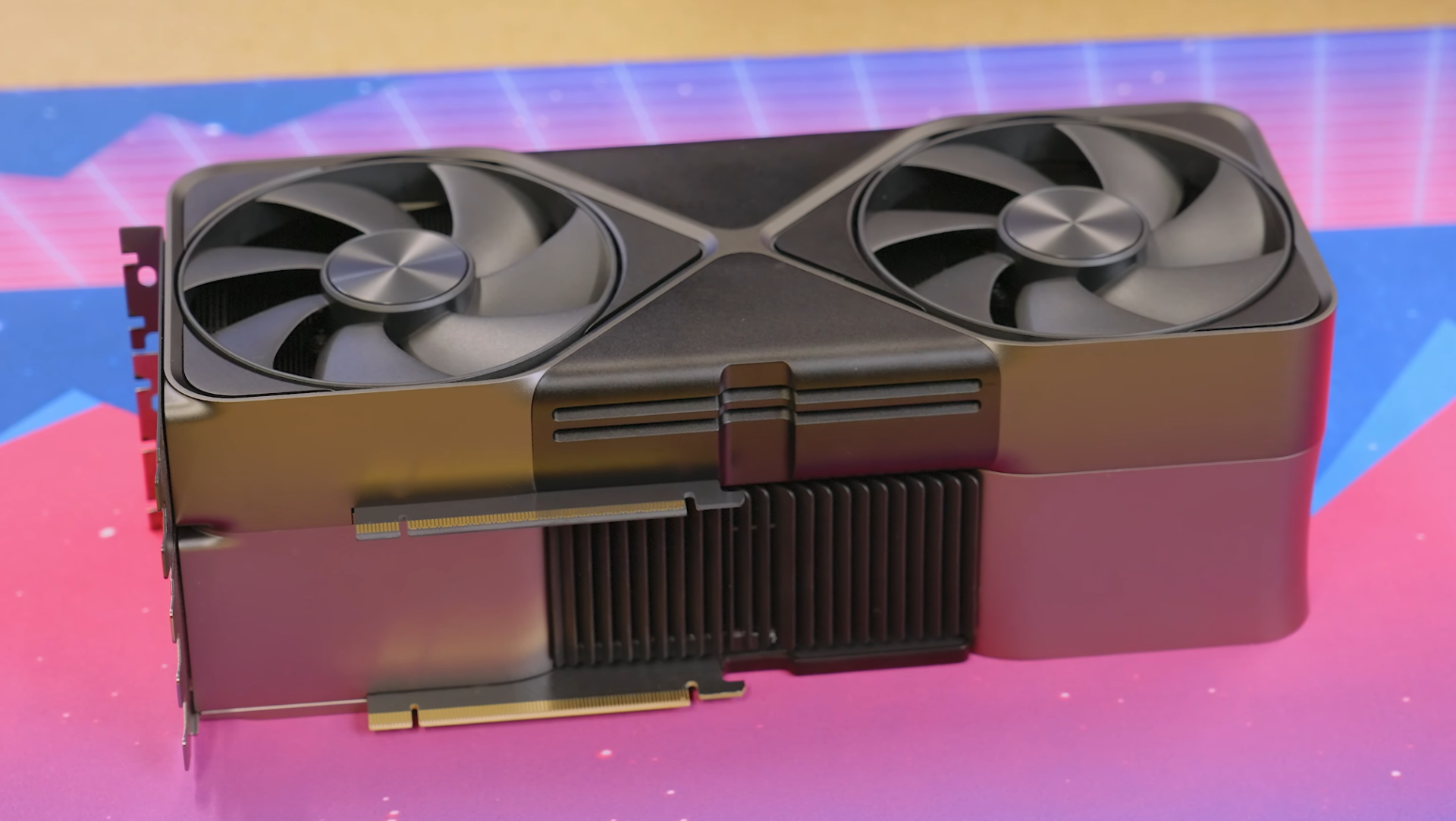
I saw the video but that photo made me think for a second it was one card, lol.
its the 7090 SC Ti Titan, requires two pcie x16 slots AND an external 750w psu! ;)
thought it was a good comparison in size but if you look too quick...
 
I just watched one video about the Founders Edition. The phrases that stood out was "crazy amount of heat" and "space heater" and "don't use a CPU air cooler". Yikes!

I mean 575 watts is unprecedented for a GPU, closest thing before that was the 295x2 which was 500 watts. My 4090 typically pulls no more than 360 watts since I power limited it to 80% and my previous card before the 4090 was a 3080 Ti FTW3 Ultra which pulled 450 watts consistently. Let me tell you the difference between 360 and 450 watts might not seem that big on paper, but I could absolutely feel that difference in my room temperature over long gaming sessions. Going from 360 watts to 575 watts is gonna be wild.
 
I just watched one video about the Founders Edition. The phrases that stood out was "crazy amount of heat" and "space heater" and "don't use a CPU air cooler". Yikes!
Uh, I have an air-cooled 7900x so eh.

Maybe I'll wait for the aibs.
 
Assuming those numbers are accurate, Speedway tells us everything we need to know. Precisely 30% over 4090. Respectable, but nothing to get hyped about. It almost seems like that is all they wanted to give us. Why so I feel like this will be a two year card, not a four year card?
You're doing the math wrong :).
 
Almost 2x as fast as the 7900xtx in some circumstances. I was planning on buying a high end Nvidia card anyways. Liked my 7900xtx but extremely disappointed in its RT and upscaling/FG PQ.
 
Assuming those numbers are accurate, Speedway tells us everything we need to know. Respectable, but nothing to get hyped about. It almost seems like that is all they wanted to give us. Why so I feel like this will be a two year card, not a four year card?
42% at 1440p seem quite good (at launch the 4090 was 35% faster than the 3090 at 1440p needed for 4k to spread its wing, now the gap has grown considerably with more modern title), ... but the 4090 had a bit higher than average boost from the 4080s (34-35% versus the usual 20-21% in game), so maybe it is something that make video card gain bigger than usual kind of test, as they could match an about 20% in actual pure raster game at native resolution.

Yup that is what I got when I redid it as well. Why did they do their chart this way?
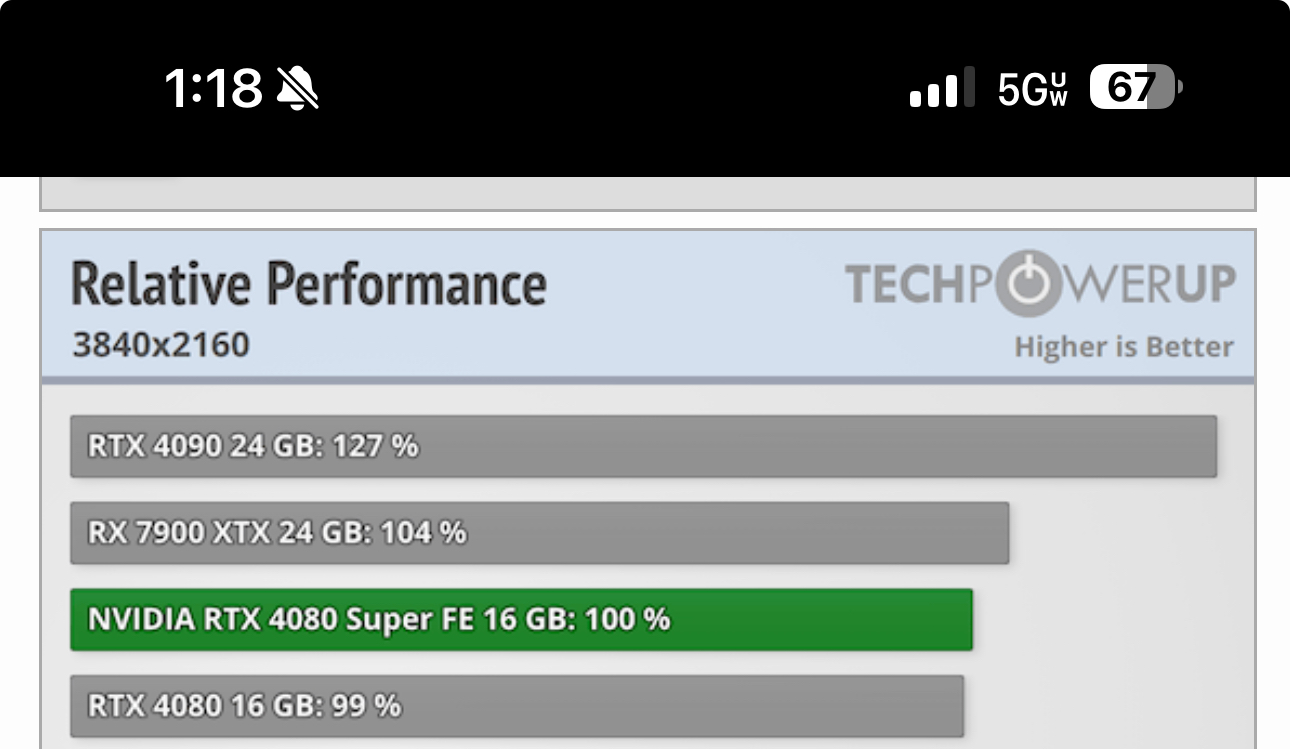
That a common way chart are made (to have the reviewed product at 100% and the others relative to it), Techpowerup realative perforamnce reviews benchmark are like that as well:
https://tpucdn.com/review/nvidia-ge...ion/images/relative-performance_3840-2160.png

The 3090 was 61% of an 4090 at 4k, if you wanted to know that the 4090 was 64% faster you needed to calculate it.
 
Last edited:

Okay… this is nice, but is this with frame-gen? I guess it doesn’t matter if you can’t tell.

We still need proper benchmarks, but I think things are looking a bit more positive now.

Of course… it will be almost impossible for a normal person to buy one of these day one… meaning I should be able to get one.
 
I do not think 3dmark support framegen, the number gap is small enough that I would not expect some framegen play and the numbers come from third party reviewer, breaking the NDA secretly and they are telling Videocards to expect +20% in real world.

We still need proper benchmarks, but I think things are looking a bit more positive now.
Those bench game push GPU more than usual game and make new gpu look strong than the average game would, 4080s->4090 is a bit less than 30% faster in average so if we compare the 4090->5090 to the 4080s->4090 in them, maybe it can give an idea.

speed way
4080s->4090: +35%
4090->5090.: +43%


steel nomad
4080s->4090: +38%
4090->5090.: +54%


port royal
4080s->4090: +42%
4090->5090.: +41%


Time spy
4080s->4090: +29%
4090->5090.: +33%


Time spy extreme
4080s->4090: +38%
4090->5090.: +32%


Fire strike
4080s->4090: +14%
4090->5090.: +41%


Fire strike extreme
4080s->4090: +32%
4090->5090.: +35%


Fire strike ultra
4080s->4090: +41%
4090->5090.: +33%


Quick look, do not seem to indicate that we should expect the 5090 gap with a 4090 to be bigger than the gap of a 4090 vs a 4080s, in specific case that seem hard to make sense (like large gap at 1080p with firestrike they get down as you up the resolution, maybe some driver overhead is gone or something or DX11 issue with lovelace), but lot of the time similar.
 
Last edited:
So 40% uplift from the 4090 probably means slightly higher image quality settings while maintaining the same performance? Like, going from 4K DLSS performance to quality.

But games that kinda struggle on the 4090, like Wukong, would probably still not offer a significantly better experience unless the RT improvement is even bigger or 3X/4X MFG is amazing.
 
So 40% uplift from the 4090 probably means slightly higher image quality settings while maintaining the same performance? Like, going from 4K DLSS performance to quality.

But games that kinda struggle on the 4090, like Wukong, would probably still not offer a significantly better experience unless the RT improvement is even bigger or 3X/4X MFG is amazing.

The baseline performance for path tracing set by 4090 was so low that it would take something like a 300% performance uplift to actually get to 60fps at native rendering. If you are getting 20fps on a 4090 then you are literally going to have to wait until something is THREE TIMES faster in order to hit 60fps at those same settings. Would a 6090 be 3x faster than a 4090 without DLSS? Highly doubt it, maybe not even a 7090 can be. So yeah....unless you are going to wait for the RTX 9090 in 2035 you won't get 60fps at native 4K maxed out path tracing because the baseline set by the 4090 was just so low to begin with. I'd personally rather rely on DLSS but of course you got the nay sayers who wanna disregard FG and say I'm justifying my purchase or whatever lol.
 
So 40% uplift from the 4090 probably means slightly higher image quality settings while maintaining the same performance? Like, going from 4K DLSS performance to quality.
40% seem really optimistic, talk of 20% to the people that gave those 3d mark numbers and looking at the 3dmark number not obvious if going to the 5090 from a 4090 is a bigger boost than from a 4080s to a 4090 (which tend to be a bit under 30%)

higher image quality settings while maintaining the same performance? Like, going from 4K DLSS performance to quality.
They will shift to a bit of a new DLSS here that could run faster on the 5000 series than the previous and look better, maybe balanced will already look like quality did before and that were a big jump would come from, the big jump would come from dlss quality and ray reconstruction new level of quality being good enough for people that were not to be ok with dlss on and then none of those game are a big struggle with a +35/45% performance for the DLSS on, RR+PT scenarios.
 
I just want a smooth playing experience in Wukong with 4K DLSS quality and 140+fps with 2x frame-gen or a steady 80fps with no frame-gen. But it seems like DLSS performance or balanced is more realistic even for a 5090. I like the motion clarity benefits of frame-generation but I'm highly skeptical about 3x/4x mfg.

I've been messing around with lossless scaling for awhile and 2X by far brings the most benefit. 3X/4X just reduces the base framerate even more for little improvement in the experience.

40% improvement would make the 5090 a similar jump from a base PS5 to PS5 pro. From my personal experience, that was a extremely meh upgrade. Most games that the PS5 pro improved, were already running quite well on the PS5. The games that ran like crap on a PS5 still weren't fixed to a satisfactory degree on the pro.
 
40% improvement would make the 5090 a similar jump from a base PS5 to PS5 pro. From my personal experience, that was a extremely meh upgrade. Most games that the PS5 pro improved, were already running quite well on the PS5. The games that ran like crap on a PS5 still weren't fixed to a satisfactory degree on the pro.
By performance alone it is significant upgrade only for few games which didn't fit in to VRR window because of GPU bottleneck because these games suddenly became very playable.

On PC it is less of an issue because we can just scale back details.
Also PC has LFC - which unfortunately is an issue by itself on OLEDs literally forcing us in some cases to have higher frame rate to avoid triggering LFC. GPUs should have option to disable LFC completely or at least never LFC above minimum supported range like Nvidia does it. When game runs around 60fps but it is unplayable with VRR because stupid Nvidia insist on sending frames twice is soo lame design.
 
Status
Not open for further replies.
Back
Top