![[H]ard|Forum](/styles/hardforum/xenforo/logo_dark.png)
LittleBuddy
Gawd
- Joined
- Jan 3, 2023
- Messages
- 531
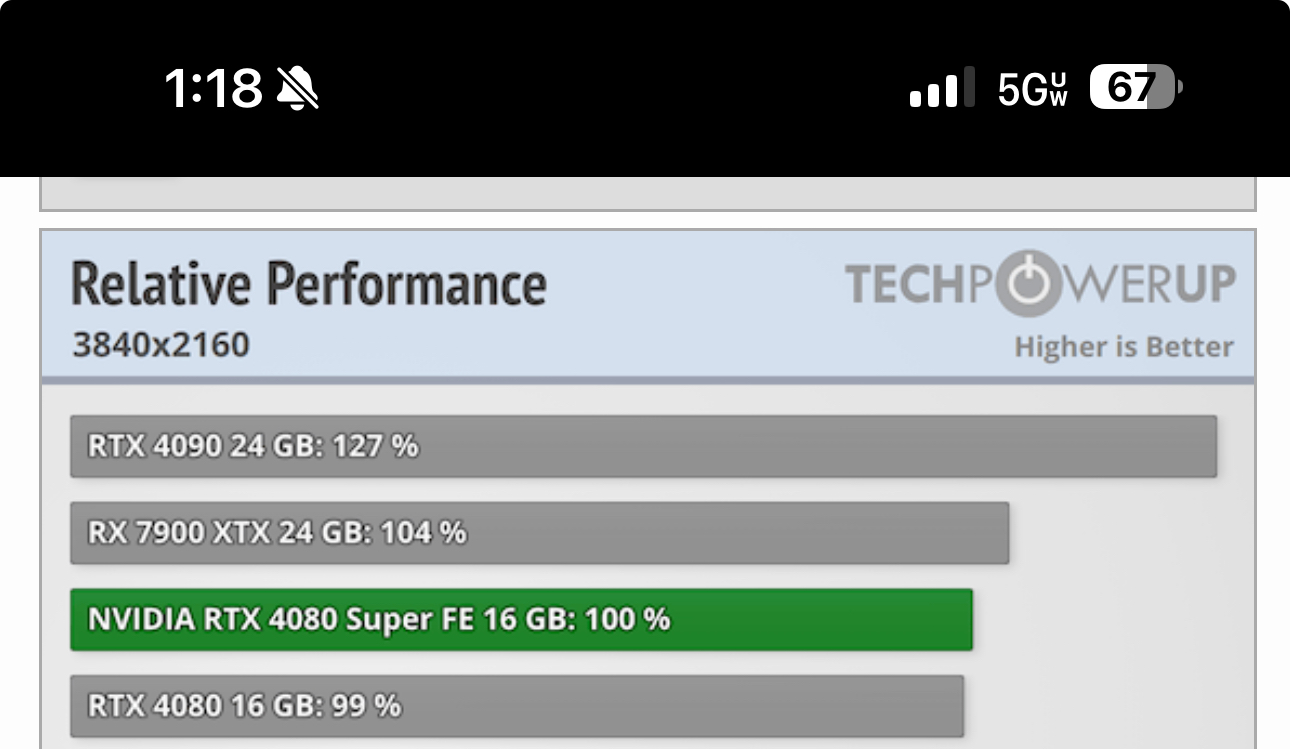
Looking at available information through the slides and specs...
5090: ~35% faster than 4090 (raster) | possibly 50% faster in RT
5080: ~25% faster than 4080 (raster) | possibly 40% faster in RT
5070: ~15% faster than 4070 (raster) | possibly 20% faster in RT
Nvidia is hiding everything behind DLSS tech differences, no example was a 1:1 comparison other than maybe FC6. I think real benchmarks will expose this.
I hope I'm wrong, but not very optimistic looking at the shenanigans in the slides. On paper the 5090 should be around 35%-40% faster than the 4090, but the 5090 has a lower boost clock as well to account for.
During the presentation Jensen Huang says the 5090 is double the performance of the 4090, I think he considers DLSS Framegen "performance" otherwise his claims don't align with the specifications and slides shown. He's a very good salesman, but I'm seeing right through his nonsense. It's not even going to be 2x faster in AI. Hopefully I'm not killing anyone's hype here. But if my thoughts are wrong on this someone correct me.
So I dropped the full specs of the 4090 and 5090 into ChatGPT o1 (reasoning model).
- Rasterized Gaming: Likely +30–40% over 4090.
- Raytracing Gaming: Likely +60–70% over 4090, based on the jump from 191 to 318 RT TFLOPS.
- AI (FP16, FP8, BF16, etc.): Could see anywhere from +2× to +2.5× improvement in lower precisions, thanks to 5th‐gen Tensor cores.
- Power Efficiency (Joules/Frame): Despite the higher TGP (575 W vs. 450 W), real‐world joules/frame may be slightly better or at least very close to the 4090—depending on how large the actual performance jump is in your workload/game. If the performance uplift is substantial (40%+), you end up with a mild improvement in joules/frame. If it’s more modest (25–30%), efficiency might be nearly a wash.