• Some users have recently had their accounts hijacked. It seems that the now defunct EVGA forums might have compromised your password there and seems many are using the same PW here. We would suggest you UPDATE YOUR PASSWORD and TURN ON 2FA for your account here to further secure it. None of the compromised accounts had 2FA turned on.
    Once you have enabled 2FA, your account will be updated soon to show a badge, letting other members know that you use 2FA to protect your account. This should be beneficial for everyone that uses FSFT.

AMD Zen Performance Preview

remember when everybody thought AMD knew how to properly evaluate product pricing, then released the Fury X and Nano at the exact same MSRP as the 980 TI? keep thinking AMD will undercut Intel by 50% lol

Not to mention AMD wanted 850$ before the 980TI was released. And then there is the 220W CPU costs...
 
http://www.anandtech.com/show/9483/intel-skylake-review-6700k-6600k-ddr4-ddr3-ipc-6th-generation/16

A 2011 i7 2600K is still inside 5% of a Skylake 6700K's gaming performance, there are people like myself that have no reason to upgrade our CPU's because Intel has been dolling out the same crap for 5 years. I have a 4960X, 4790 and 4460, neither need to be replaced by a Skylake or Kabylake especially not for gaming.

i7 4790K is still the best bang for buck i7 on the market, it OC's like a boss and it games like a boss.

Its not the same chip is it and some games you have quite massive benefit. But you touch the real issue with software and that's not going to change due to Ryzen or anytime soon.

So just enjoy it, you dont have to replace your 4790K anytime soon.

Intel CPUs tend to gain about 1.5% per 100Mhz in the gaming chart. Even a 5Ghz Ryzen by that measurement wouldn't beat a stock 6700K.
 
Last edited:
The older the game the more it will rely on the frequency of ZEN, some of the newest games will likely do better with the extra cores. The gaming market is slowly shifting to more threads. Looks pretty good since it was ES chip with low clocks, but much will hinge on what AMD releases the chip at.

They still need fast ST performance. Just lookup games and see. DX12 also depends on very fast cores and rarely scales beyond 6 threads. Even AMD says this. When FX launched some people said the same, just wait, software will use more cores. FX will shine with time. We all know how that went.

I wouldn't consider 3.15Ghz base, 3.4Ghz turbo on all cores and 3.5Ghz single core turbo to be low clocks for Ryzen.

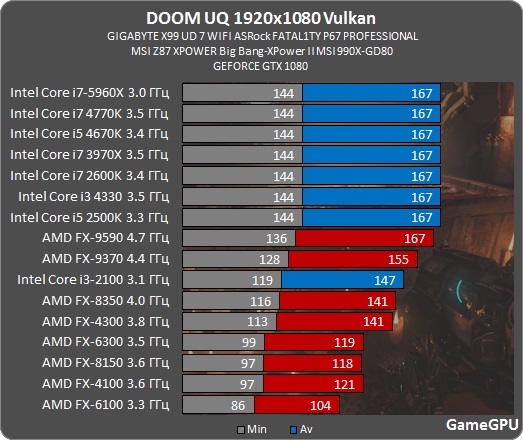
DOOM, perhaps the least CPU demanding game and well threaded. A Sandy Bridge low clocked i3 still beats a FX8350.

doom_proz_v.jpg
 
I think it was Shintai who made fun out of AMD seeking a 10% marketshare in servers. Assuming his statement on shit performance does not come true, AMD is still gonna have to show it can provide stability with their products to a marketplace under virtually Intel's complete proliferation for quite a bit. (I don't know if thats true, do they use ARM in servers yet?) Besides, 10% in marketshare is a shitload of money.

There is a lot more to it than that. I work with servers in large volume. And I can tell you the CPU price is almost so cheap its a joke. When you look at Xeon SKUs, you also see a lot of "weird" SKUs that doesn't make sense to the average PC gamer. Fewer cores, higher clocks. But licensing is the issue.

Example, MS SQL 2016.
https://www.microsoft.com/en-us/sql-server/sql-server-2016-pricing

Example, MS SQL 2014. (Halfway down)
https://msdn.microsoft.com/en-us/library/dn305848.aspx

And there is a lot more expensive products than MS SQL for SQL handling ;)

Now a 2.4Ghz 32C/64T Skylake-EP matches a 1.45Ghz 64C/128 Naples setup. How big would the license difference be between the 2, if we imaged you used those SKUs for SQL 2016. In reality you would use SKUs with less cores and faster clocks.

And if its not this, then its running costs and other parts. I tell people Intel could double their server price and nobody would care as such. They cant obviously do it due to antitrust cases. but from a business perspective nobody would care because its a tiny part of the actual server cost or TCO.

There is a reason why you can buy cheap outdated Xeons that are thrown out on ebay for cheap. They are simply worthless in the servers already.

And then we haven't talked about platform, support and what not yet.
 
Last edited:
average framerates aren't what you're looking for if you're debating going from sandybridge to a newer model intel, you're looking at better minimum framerates

there are quite a few reviews of skylake cpus where (especially in SLI/CF), it really does a number on older Sandybridge cpus when it comes to minimum framerates
 
We haven't seen any Zen parts with high clocks. And the reason may be that getting high IPC isn't hard. High clocks isn't hard either. But high clocks and high IPC is where it gets really hard.

Dont expect better prices, AMD wants better margins. Lisa Su even publicly said she wants more money. Also its suicide to start a price war, it benefits none of the companies.

I don't really expect a price war, but competition never has a negative effect on pricing, so there's no chance costs go up. I agree AMD has little incentive to start a price war. Intel, on the other hand, may be interested in making sure AMD doesn't gain any market share. I don't expect anything crazy, but I think we'll see slightly lower prices, just as a natural effect of competition.
 
We haven't seen any Zen parts with high clocks. And the reason may be that getting high IPC isn't hard. High clocks isn't hard either. But high clocks and high IPC is where it gets really hard.

Dont expect better prices, AMD wants better margins. Lisa Su even publicly said she wants more money. Also its suicide to start a price war, it benefits none of the companies.

Haha, price war. The reason that price wars are utterly dumb is that both companies are capable of reducing prices, which means that if you follow the "price war" to its logical conclusion, you get to the point where both companies are selling product at around cost, and so the company with the lower cost structure wins...in a Pyrrhic victory.
 
I can't see that, cause there is no benefit to under cut to that degree. These markets don't function on price unless there is a reason for them to, Intel can compete on price, this isn't like back in the day where AMD could under cut Intel and maintain margins that were acceptable, and Intel couldn't because of their overhead in technology development.

Curiosity is great, but ignoring the fundamentals of how markets work and just expecting AMD to cut price to gain marketshare, has shown it never works, its harder for them even with Performance parity to gain marketshare just because of what has happened in the past decade with their CPU's, so how would going into a price war with Intel *which Intel can do too* be beneficial to anyone outside of us consumers?

These are corporations, they aren't there to make us happy they are there to make their board members and investors happy.

This is why I stated pricing will tell us A LOT about where Ryzen ends up.
AMD is going to undercut Intel just how they are undercutting Nvidia. Polaris has been a good seller for AMD for instance, and AMD have grown GPU marketshare with it. Speaking of Polaris, Ryzen is about the same diesize, perhaps even smaller. Ryzen is built on the same 9 layer 14nm FinFet.You don't think AMD could charge less than $200 for it? Take a look at the rx470. The entire card sells for $170. Now consider that AIBs have to get their cut, and the cost of VRAM, VRMs, and other GPU components, that don't come on CPUs. AMD could easily charge less than $100 if they wanted to and still have margin left.

Of course AMD wants to make money, and increase their margins. But there is plenty of room to undercut Intel. This is how I think AMD is going to price Ryzen. 8c part $379, 6c part $279, 4c part $179. There will also most likely be a high bin golden sample type limited CPU for more but the main models will be reasonably priced. Intel is going to price adjust some but I don't think they want a price war. Because they will maintain the majority marketshare due to inertia (some people will always buy Intel, just how some folks always buy Nvidia, regardless if the product is good or bad), so chasing AMD to the bottom is a lose lose for them.
 
AMD is going to undercut Intel just how they are undercutting Nvidia. Polaris has been a good seller for AMD for instance, and AMD have grown GPU marketshare with it. Speaking of Polaris, Ryzen is about the same diesize, perhaps even smaller. Ryzen is built on the same 9 layer 14nm FinFet.You don't think AMD could charge less than $200 for it? Take a look at the rx470. The entire card sells for $170. Now consider that AIBs have to get their cut, and the cost of VRAM, VRMs, and other GPU components, that don't come on CPUs. AMD could easily charge less than $100 if they wanted to and still have margin left.

Of course AMD wants to make money, and increase their margins. But there is plenty of room to undercut Intel. This is how I think AMD is going to price Ryzen. 8c part $379, 6c part $279, 4c part $179. There will also most likely be a high bin golden sample type limited CPU for more but the main models will be reasonably priced. Intel is going to price adjust some but I don't think they want a price war. Because they will maintain the majority marketshare due to inertia (some people will always buy Intel, just how some folks always buy Nvidia, regardless if the product is good or bad), so chasing AMD to the bottom is a lose lose for them.


They didn't undercut nV, nV 1060 came out after Polaris, they set their prices higher, and when AMD noticed they weren't selling as much then they cut down prices on some of their GPU's. Fiji wasn't priced less than the 980ti.

If you follow the F Q calls, AMD wants to get 10% more margins, that is their goal, they can't undercut Intel and get that at the same time, not with a new 14nm node. Cause the cost for them will be higher on a per wafer basis than Intel.

Nodes in the recent years have increased cost 2 fold because of the increased R&D and actual chip development. Intel has been on their 14nm process for a very long time, and they will get the savings of node maturity, while AMD (GF) won't.

So if its double the cost per transistor which is around what it is for the 14nm node vs the previous node AMD's chips have to be less than half the size to see savings at the same prices they have now to get increased margins. And we don't know what Zen's size is yet.
 
Last edited:
They didn't undercut nV, nV 1060 came out after Polaris, they set their prices higher, and when AMD noticed they weren't selling as much then they cut down prices on some of their GPU's. Fiji wasn't priced less than the 980ti.

If you follow the F Q calls, AMD wants to get 10% more margins, that is their goal, they can't undercut Intel and get that at the same time, not with a new 14nm node. Cause the cost for them will be higher on a per wafer basis than Intel.
I just explained to you why even at sub $100 Ryzen would have bigger margins than the GPUs. Ar median price of $200 that's way more than 10% more margins, we're talking like 100% more margins. Of course AMD wants to increase the margins by 10% across all their product, which is not easy due to the sheer volume of Console SoCs. But I think you strongly underestimate how much margins x86 CPUs have, especially in the data center.

Also yes AMD did undercut Nvidia. 970 was the top seller before rx480 came out. Fury is a bit different due to HBM and its high manufacturing cost. But remember 290X beating a $999 Titan Z for $650?

Fury is actually a good example of what happens if AMD doesn't undercut the competition. Steam Hardware survey for Fury is less than 0.1%.

AMD want to sell Ryzen.. it costs about the same to manufacture as Polaris 10 and they can charge way more for it.

With the price structure I laid out, AMD will basically offer you 2 more cores in every price bracket. If you consider that Ryzen also doesn't come with an iGPU taking die space, they can absolutely undercut as much as they want.

Intel knows this, this is why i3 Kaby Lake is both unlocked and has hyperthreading enabled.
 
I just explained to you why even at sub $100 Ryzen would have bigger margins than the GPUs. Ar median price of $200 that's way more than 10% more margins, we're talking like 100% more margins. Of course AMD wants to increase the margins by 10% across all their product, which is not easy due to the sheer volume of Console SoCs. But I think you strongly underestimate how much margins x86 CPUs have, especially in the data center.

Also yes AMD did undercut Nvidia. 970 was the top seller before rx480 came out. Fury is a bit different due to HBM and its high manufacturing cost. But remember 290X beating a $999 Titan Z for $650?

Fury is actually a good example of what happens if AMD doesn't undercut the competition. Steam Hardware survey for Fury is less than 0.1%.

AMD want to sell Ryzen.. it costs about the same to manufacture as Polaris 10 and they can charge way more for it.

With the price structure I laid out, AMD will basically offer you 2 more cores in every price bracket. If you consider that Ryzen also doesn't come with an iGPU taking die space, they can absolutely undercut as much as they want.

Intel knows this, this is why i3 Kaby Lake is both unlocked and has hype threading enabled.


Not going to happen because per transistor GF 14nm is double the cost.


If you want to talk about last gen to this gen products yeah AMD undercut nV, but the 970 was replaced by the 1070 which is nV's best seller now.... and its selling a lot better than the rx480 in volume sales....... not only that its selling better than the 970 too, if retailers and nV are to be believed.
 
What as that mean? double of the cost of what?

From the previous node.

New nodes after 20nm, size is no longer giving cost benefits because the research needed to create the nodes and design of the chips going on the nodes are more than doubling. So the die size alone is no longer enough to sustain the same margins as before
 
Not going to happen because per transistor GF 14nm is double the cost.


If you want to talk about last gen to this gen products yeah AMD undercut nV, but the 970 was replaced by the 1070 which is nV's best seller now.... and its selling a lot better than the rx480 in volume sales....... not only that its selling better than the 970 too, if retailers and nV are to be believed.
You are pivoting. I am not arguing market share, or which products sells more, only that AMD will undercut Intel just like they undercut Nvidia. rx470 was price adjusted to compete with the 1050ti.. rx470 is a much better GPU for the price.
 
From the previous node.

New nodes after 20nm, size is no longer giving cost benefits because the research needed to create the nodes and design of the chips going on the nodes are more than doubling. So the die size alone is no longer enough to sustain the same margins as before
Not sure how that applies here, every manufacturer is affected by the increasing costs of die shrinking. This has never stopped AMD before to compete on price.
 
You are pivoting. I am not arguing market share, or which products sells more, only that AMD will undercut Intel just like they undercut Nvidia. rx470 was price adjusted to compete with the 1050ti.. rx470 is a much better GPU for the price.


That is why I stated volume sales, marketshare is not volume sales, volume sales is total number of units moved.

rx470/480 are still only getting 30% margins if we believe what Raji stated, what does that tell us?
 
Not sure how that applies here, every manufacturer is affected by the increasing costs of die shrinking. This has never stopped AMD before to compete on price.


As the node matures, the ability to get fully functional chips increase right? So you get the savings from that, as you can get increased price GPU's because they are fully functional. Instead of cut down parts like the rx470 which you need to eat margins for. Intel has this advantage right now.
 
That is why I stated volume sales, marketshare is not volume sales, volume sales is total number of units moved.

rx470/480 are still only getting 30% margins if we believe what Raji stated, what does that tell us?
Exactly my point.

So take an rx470 for example 4gb model.

$170 price
~$70 is the card with heatsink, shrowd, VRMs VRAM.. all the other components.. except for the GPU itself.
$30 goes to the AIB (for the sake of argument.. it's probably more).
$20 or so goes to the retailer, newegg/amazon shipping etc..
$10 for returns and other issues.. industry standard is 6% returns.

So AMD makes about $40 per rx470. or $40 for a 232mm2 piece of silicon fabbed at Glo Fo 14nm FF.

Ryzen 6 core 12 thread part will literally cost the same thing (similar size, same process and fab, similar yields/binning), and won't have any other components or AIBs to contend with.

They can easily charge sub $200 for it and still quadruple their margin.
 
Last edited:
Do you know the transistor count of Ryzen vs what they have now?

How are you making that conclusion without knowing that?
 
Do you know the transistor count of Ryzen vs what they have now?

How are you making that conclusion without knowing that?
Die size is a more relevant metric here. Transistor count depends on the mask and density. But you should compare die size if you want to figure out the cost. Since the cost depends on the wafer utilization and yields. All the leaks point at a ~220mm2 part, slightly smaller than Polaris 10.

We also know that both Polaris and Ryzen are fabbed using the same 9 layer 14nm FinFett process at Global Foundries.
 
do we know the die size of Ryzen?

keep in mind CPU design is more expensive than GPU design here, cause CPU's are hand laid out. And there is a very good chance AMD would be using custom libraries for Ryzen, unlike on their GPU's which are all automated and using standard libs.

Edit sorry but no 470 is not making 30%, all of Polaris is making 30% that is the p10 to the p11 All variants. Margins dropped last Q from 31% to 30%, so that is telling the are making less per GPU now then they were before but that might also indicate the lack of performance and enthusiast models, but I don't see Fiji or the r390 making a big impact here as margins were at 31% prior to their release too.
 
do we know the die size of Ryzen?

keep in mind CPU design is more expensive than GPU design here, cause CPU's are hand laid out.
As I said the die size is very similar to Polaris 10, based on every leak and people actually analyzing photos of the leaked Zen die etc..

I am not talking about R&D here. AMD definitely wants to make money to invest in future R&D, my point simply is that:

A.) There are plenty of margins to slot these products in, as Intel has been sitting unchallenged for a long time.

B.) AMD needs to offer more performance per dollar if they plan on regaining market share in the CPU market. If AMD price say the 8c Ryzen at $900 no one is going to buy it. Few people yes, but not enough to count. Why take a chance on AMD when for $100 more you can just buy Intel, proven.. it works.
 
As I said the die size is very similar to Polaris 10, based on every leak and people actually analyzing photos of the leaked Zen die etc..

I am not talking about R&D here. AMD definitely wants to make money to invest in future R&D, my point simply is that:

A.) There are plenty of margins to slot these products in, as Intel has been sitting unchallenged for a long time.

B.) AMD needs to offer more performance per dollar if they plan on regaining market share in the CPU market. If AMD price say the 8c Ryzen at $900 no one is going to buy it. Few people yes, but not enough to count. Why take a chance on AMD when for $100 more you can just buy Intel, proven.. it works.


Counter to A)

Lets say AMD is able to get the same margins as Intel that means if they price at Intel's levels right now $ for $, they will get 63% right?

Go from that figure and see what will happen if they cut their prices by half, which is pretty much what you are saying they will do

Counter to B)

Only if it will garner marketshare will this help, have we see this happen ever? When the other company is capable of matching with price?
 
Counter to A)

Lets say AMD is able to get the same margins as Intel that means if they price at Intel's levels right now $ for $, they will get 63% right?

Go from that figure and see what will happen if they cut their prices by half, which is pretty much what you are saying they will do

Counter to B)

Only if it will garner marketshare will this help, have we see this happen ever? When the other company is capable of matching with price?
63% gross margin is a misleading number. Intel has been trying to compete in a lot of different markets. This includes FPGAs now Atom CPUs, mobile chipsets, Edison boards etc..

I can guarantee you that Intel's i7 margins are much bigger than that.
 
Counter to B)

Only if it will garner marketshare will this help, have we see this happen ever? When the other company is capable of matching with price?
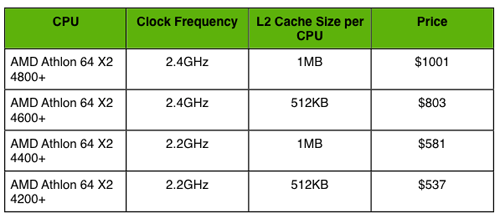
We've seen it time and time again from AMD. Athlon was significantly cheaper than a Pentium III, heck even the superior Athlon64 were cheaper than Prescott's.

People like to remember Athlon64 FX $1000 chips, but those were gold sample rare chips.. your usual mainstream Athlon64 was still reasonably priced. Even when Athlon64 X2 came it offered more performance per dollar.
 
63% gross margin is a misleading number. Intel has been trying to compete in a lot of different markets. This includes FPGAs now Atom CPUs, mobile chipsets, Edison boards etc..

I can guarantee you that Intel's i7 margins are much bigger than that.


63% as a whole but that margin is coming from many things as you stated, but everything you listed there are lowering their margins. AMD aren't going to be going into those markets too? I think outside of FPGA's, and Edison boards, they will be......

What AMD doesn't have chipsets of their own? They don't have mobile chipsets? They don't have low end CPU's, Zen is supposed to span over to all those.
 
We've seen it time and time again from AMD. Athlon was significantly cheaper than a Pentium III, heck even the superior Athlon64 were cheaper than Prescott's.

People like to remember Athlon64 FX $1000 chips, but those were gold sample rare chips.. your usual mainstream Athlon64 was still reasonably priced. Even when Athlon64 X2 came it offered more performance per dollar.


Look you don't see how the dynamics of things changed from back in the day when AMD didn't need the staff as they need now to bring these chips to market? Totally different now.

And the fx 64 chips were 2 grand (opterons were more) not 1 grand, the 1 grand chips weren't even FX's.


table5.png


These were not FX chips and the top end is at 1k.
 
it is great for us, but when companies have close competitive products, going into a price war is not beneficial to them, and that is why they won't. now I can see AMD undercutting by lets say 5% or 10% or even 20% but Intel will match, and then everything will stabilize after that. Anything more than 20% though, I don't think will happen.
 
it is great for us, but when companies have close competitive products, going into a price war is not beneficial to them, and that is why they won't. now I can see AMD undercutting by lets say 5% or 10% or even 20% but Intel will match, and then everything will stabilize after that. Anything more than 20% though, I don't think will happen.
Intel hasn't had competition since Core2Duo days.. I think we're about to see a major disruption here. Intel has been shrinking dies all these years while not lowering prices. The days of dual cores are over. Watch and see.
 
AMD is going to undercut Intel just how they are undercutting Nvidia. Polaris has been a good seller for AMD for instance, and AMD have grown GPU marketshare with it. Speaking of Polaris, Ryzen is about the same diesize, perhaps even smaller. Ryzen is built on the same 9 layer 14nm FinFet.You don't think AMD could charge less than $200 for it? Take a look at the rx470. The entire card sells for $170. Now consider that AIBs have to get their cut, and the cost of VRAM, VRMs, and other GPU components, that don't come on CPUs. AMD could easily charge less than $100 if they wanted to and still have margin left.

Of course AMD wants to make money, and increase their margins. But there is plenty of room to undercut Intel. This is how I think AMD is going to price Ryzen. 8c part $379, 6c part $279, 4c part $179. There will also most likely be a high bin golden sample type limited CPU for more but the main models will be reasonably priced. Intel is going to price adjust some but I don't think they want a price war. Because they will maintain the majority marketshare due to inertia (some people will always buy Intel, just how some folks always buy Nvidia, regardless if the product is good or bad), so chasing AMD to the bottom is a lose lose for them.

AMD didn't gain more market share due to Polaris. And they priced it where its performance metrics was.
 
Not sure how that applies here, every manufacturer is affected by the increasing costs of die shrinking. This has never stopped AMD before to compete on price.

Intel got the best cost structure of any semiconductor company. Because they can afford designs that got higher utilization rates. Intel is the only company in the world that got lower transistor cost at 14nm. You can only lose against them in a price war.
 
Intel hasn't had competition since Core2Duo days.. I think we're about to see a major disruption here. Intel has been shrinking dies all these years while not lowering prices. The days of dual cores are over. Watch and see.

CPU prices have never been lower since Core 2. And you forgot people want perf/watt mainly.

Here is a few things you need to understand. Because its something you certainly haven't considered in all your posts.

IC design cost goes up. This is also why AMDs server parts are MCM designs and why you haven't seen Vega yet etc. AMD cant afford these.
Transistor cost went up 2x for AMD with 14LPP.
Margins needs to pay future R&D. Something AMD desperately needs. The GPU division for example is in complete ruins for the same reason. Everything channeled to CPU for years.
AMD will never be able to compete in price vs Intel. Intel can always go lower than AMD and still make a profit. That's the benefit of being an IDM plus the ability to field IC designs with higher utilization rates.

Since you keep mentioning Polaris. Look at Polaris 10 vs GP106. It needs ~33% more power, ~33% more memory/bandwidth, ~33% more transistors. What does that tell you?

Skylake/Kaby Lake will still destroy Ryzen in any gaming. And that's with lower power doing so and an IGP on top. Oh and a die that's what, 2/3rds the size?

This is also why you only see 0.27% of 8 core CPUs on steam. You know, 5 years of FX8xxx/9xxx sales and 5960X/6900K and whatever Xeons and Opterons you can find.
http://store.steampowered.com/hwsurvey/cpus/
 
Last edited:
I don't really expect a price war, but competition never has a negative effect on pricing, so there's no chance costs go up. I agree AMD has little incentive to start a price war. Intel, on the other hand, may be interested in making sure AMD doesn't gain any market share. I don't expect anything crazy, but I think we'll see slightly lower prices, just as a natural effect of competition.

Here is the catch, if you want better products in the future you may not want cheaper CPUs.

IC design cost goes up 2x per node.
Transistor cost goes up.
R&D cost only goes up rather steep as well.
Volume keeps declining.

You want both AMD and Intel to earn more money so more money can be spend on those. This is also why Lisa Su have said in public she doesn't want AMD to be a cheap company. And why they tried 800$ for FX and wanted 850$ for Fiji. You cant pay workers and expenses with good intentions.

So either price needs to go up or the cost structure needs to go down.

Always remember this:
projectManagementTriangle-e1412797550456.png
 
Last edited:
Here is the catch, if you want better products in the future you may not want cheaper CPUs.

IC design cost goes up 2x per node.
Transistor cost goes up.
R&D cost only goes up rather steep as well.
Volume keeps declining.

You want both AMD and Intel to earn more money so more money can be spend on those. This is also why Lisa Su have said in public she doesn't want AMD to be a cheap company. And why they tried 800$ for FX and wanted 850$ for Fiji. You cant pay workers and expenses with good intentions.

Because Intel is the company that funnels all their money into their R&D you can see it each year with your purchase of a new processor 3 to 5 percent increase. Both Intel and AMD are listed companies and to refer to cheap cpu and run up some BS story about the correlation between cost of the processor and R&D is so far fetched.
 
Last edited:
Because Intel is the company that funnels all their money into their R&D you can see it each year with your purchase of a new processor 3 to 5 percent increase. Both Intel and AMD are listed companies and to refer to cheap cpu and run up some BS story about the correlation between cost of the processor and R&D is so far fetched that even episodes of the twilight zone could not come close to describing the horror.


When you have a vertical company, like Intel, and since their 14nm process is much more mature not to mention they are on their 3rd version of 14nm, its 100% likely they have a cost benefit that AMD could only wish for, remember why AMD started their own foundries? Because they knew they needed them to compete with Intel. It wasn't because it was a whimsical thought, spending billions of dollars per year on fab tech is not a frivolous thought.

GF still needs to put money into their Fab tech that cost is going to go over to AMD when they purchase wafers added to GF needs to take their profits, since we know they don't have any customers other than AMD (large volume clients), all their profits are coming from them.

Now the increase of 3 to 5 percent, that is just BS, processor/gpu prices have been fairly static but the problem is look at what most people are buying. They have changed their buying habits and what segments they are buying at. Now Intel profit margins are going up right? They have in the past few quarters, do we know the difference between what retailers and OEM's are purchasing them at in the past to now? Just look at the the sales and discounts HP and Dell used to give vs now. Its quite different. Do you remember you could have gotten a full system with a monitor for the same price they are selling just the box for now? Why did this change? Well cost of the parts are higher for them. But because of competition from their markets they have to keep the prices relatively the same, so they take things out, like the monitor, some companies (smaller ones) you need to buy the keyboard and mouse separately.

Those 50% discounts that they used to give are all gone now, every month they used to show up on those coupon sites, now maybe twice a year.

Why did Dell's internet only sales fail? Why did they go into retail? Because the cost of the systems they were putting together vs the marketing that retailers offered and they were selling at the same prices as Dell was online (Dell couldn't cut costs anymore) were equalizing. That just shows us Dell was spending more for their systems and their infrastructure was getting too costly to be competitive anymore.
 
Last edited:
AMD started their foundries because IBM required a second source for their PC processors back in the early 80's. The cross licensing agreement that was formed with Intel, as facilitated by IBM required it, actually I am pretty sure AMD already had foundries at that point.

AMD was able to exit that requirement in the agreement after the illegal market behavior by Intel with OEM's, when they tied refunds and preferential pricing to not selling AMD chips. Its a shame Intel did that to, AMD's athlon 64 chips where a huge leap faster then the netburst garbage that Intel was selling at the time.

I would also say that the Athlon chips where not out of line price wise at the time, Intel moved to massively undercutting AMD price wise atleast until they launched their core 2 line.
 
AMD started their foundries because IBM required a second source for their PC processors back in the early 80's. The cross licensing agreement that was formed with Intel, as facilitated by IBM required it, actually I am pretty sure AMD already had foundries at that point.

AMD was able to exit that requirement in the agreement after the illegal market behavior by Intel with OEM's, when they tied refunds and preferential pricing to not selling AMD chips. Its a shame Intel did that to, AMD's athlon 64 chips where a huge leap faster then the netburst garbage that Intel was selling at the time.

I would also say that the Athlon chips where not out of line price wise at the time, Intel moved to massively undercutting AMD price wise atleast until they launched their core 2 line.


Nah Intel gave AMD the opportunity to make x86 chips that were socket compatible with their chipsets because IBM required two sources, AMD made their first fab in 1980 in the US if I remember correctly well before Intel approached them on IBM's behalf. They did have Fabs overseas prior to this, not sure about the timing of those.

AMD vs Intel pricing was all about performance and power usage parity. Intel had to cut prices because otherwise any system with their processors would have to be more expensive, and end result less sales and marketshare loss for Intel.

Edit:

81 was AMD's first fab in the US (went online so they started much earlier than that), was off by a year, the overseas fabs were made in the 70's. 81 was the year Intel and AMD went into a deal for IBM for socket compatible chips.
 
Last edited:
Back
Top