Piledriver ES benchmarks

I know I am in the absolute minority but the current bulldozer and future pile driver cores work better for what I actually do which is extremely threaded applications and multiple instances. I know intel is faster in fact I run intel for my gaming rigs/general use but my specialized apps amd has me currently without the giant cost to bump up to server components.

Your not in the minority, I have several customers who require laptops & servers to be AMD because the multi-threaded & 64-bit operation was a lot smoother in the apps they were using, now if it's true or not I don't know since I've never seen the apps running, but thats what they tell me when placing the orders.
 
its more about the platform costs and power usage then anything else. and no G34 really doesn't work in the desktop market. yes they are good chips when it comes to servers but thats a whole different ball game. a single G34 chip its self is far slower then anything intel has. its only when you get into the 2P and 4P setups where G34 is very competitive. the interlagos chips really aren't that efficient either and to get desktop clocks out of them you are talking about a 200W TDP chip.

Opterons don't make sense for Desktop use.

Desktop use requires high single threaded (or few threaded) performance. Opterons are powerful in servers by throwing lots of cores at problems. This simply won't do much good in desktop environments.

Add to that, that Opterons are typically clocked much LOWER than their dekstop equivalents, and this problem is further exacerbated.

For a typical Desktop use scenario, a Phenom II dual core at 3.5Ghz is going to outperform a 12 core (or 24 core DP) at 1.8Ghz... heck, even if you up that to 2.5Ghz (the top magny cours) it's still going to be slower for typical desktop use, by a LARGE margin.

Many cores simply don't scale well in typical Desktop use. Part of this is due to developers not writing good multi-threaded code, but even if they did, this approach wouldn't work due to the problem of diminishing returns . See Amdahl's Law.


p.s. G34 costs them nothing to develope, lol.. all they do is slap 2 zambezi chips under 1 IHS and boom you have a 8 core/16 thread interlagos. same way magny cour was done with 2 6 core istanbul chips to make a 12 core processor.

True, but as clock speeds start increasing you have a lot more heat being produced under the same heatsink with all those cores going in there, so there are certainly some thermal consderations.

p.p.s AMD's desktop processors are server processors. its been that way since they branched off and created Opteron for the server market. there is nothing fundamentally different from the server chips and the desktop chips except that the desktop chips are clocked higher.

Yep. Intel does the same thing with their Xeon E3's and E5's, and plenty other historical models, though in these cases I think they develop for the Desktop and move to the server, rather than the other way around that AMD has done with their latest generation.


the thing people keep failing to realize is that AMD is not trying to compete with intel on the ultra high end market, there is no point in doing that and there is no money there for them to bother wasting the R&D resources on. what they care about is the APU and middle market(aka the average consumer) where 90% of the money is. AMD is better off letting intel waste money in the high end market while they secure their place in the APU market. intel is years behind AMD when it comes to that. the problem with enthusiast sites and i my self suffer from it as well sometimes is that we are to fixated on numbers and what effects us instead of what is actually needed in the current market.

The problem is that - for typical Desktop use scenarios - AMD's top end FX-8150 chips aren't even competitive with Intel's budget core i3 chips...

They only become competitive if you do relatively uncommon stuff that's optimized for multiple cores, like rendering or encoding, which most people simply don't do.

It's not that AMD isn't competing with Intel on the ultra high end. They aren't even competing with Intel on the mid to low end for what most people do.

right now the problem is software and the fact that its still 5 years behind the hardware.

Multithreading for the desktop really isn't the answer. Yes, it can give us some small gains, but it doesn't take long until Amdahl's Law kicks in, even if all software were perfectly coded for multi threading.
 
Zarathustra[H];1039018655 said:
The problem is that - for typical Desktop use scenarios - AMD's top end FX-8150 chips aren't even competitive with Intel's budget core i3 chips...

They only become competitive if you do relatively uncommon stuff that's optimized for multiple cores, like rendering or encoding, which most people simply don't do.

It's not that AMD isn't competing with Intel on the ultra high end. They aren't even competing with Intel on the mid to low end for what most people do.

I want to take this out because there is a problem within this part. For 'typical' desktop use, the FXs are comparable to i3s, i5s and i7s. It is only when you go beyond 'typical' desktop use do you notice the differences. Would you honestly know the differences between a 8150 and a 3770K if they were not benchmarked? The correct phrase you are looking for is: 'typical high-end/semi-pro desktop'.
 
I want to take this out because there is a problem within this part. For 'typical' desktop use, the FXs are comparable to i3s, i5s and i7s. It is only when you go beyond 'typical' desktop use do you notice the differences. Would you honestly know the differences between a 8150 and a 3770K if they were not benchmarked? The correct phrase you are looking for is: 'typical high-end/semi-pro desktop'.

For email and web? No. I would never tell the difference. An SSD and some RAM would be a much better upgrade than the CPU.

For certain games? definitely. And these days there are a lot more people than just us hardware enthusiasts who play games on their computers.

RO2 is notoriously hard on the CPU. On my X6 1090T@4.1Ghz the frame rates dropped pretty low on occasion, and an 8150 is in many cases a step back from that, at least as far as single threaded performance (which is very important to RO2) goes. After the switch to Intel its smooth sailing. Frame rates almost never drop below 60fps, with the same video cards.

I don't play Starcraft II, but I understand the same goes for this game. You are better off with a core i3-2100 (and possibly a Pentium G620) than a FX-8150
 
Zarathustra[H];1039018655 said:
Multithreading for the desktop really isn't the answer. Yes, it can give us some small gains, but it doesn't take long until Amdahl's Law kicks in, even if all software were perfectly coded for multi threading.

It may not be the answer, but perfectly multithreaded programming doesn't necessarily have near as much diminishing returns as you would think.

The trick is to keep the data size being worked on able to fit in the cache of the processor(s), when upiing the thread count.

If a program is made this way, then you get very close to double the speed by doubling the threads/core count.

If you add threads without taking the data size/cache into account, diminishing returns shows up quite quickly.
 
Wow there are still people who believe that AMD will beat Intel this round. For those people that say that AMD still sucks, why don't you make a better chip ?

It is a minor improvement on Bulldozer that is all, it will do better even tho these benchmarks do not reflect it certain benchmarks from Trinity do.

The only thing AMD has to do is keep the pricing realistic, instead of asking Intel prices because you can find 3 applications that run faster on it.
 
Without benchmarking numbers i think it would be really tough to tell. Beyond "typical desktop use" which is surfing the web, checking email -- you wouldnt tell a difference. As a high end/semi-pro use your probably using more threads where the bulldozer is actually competitive so again I doubt you would notice.

Benchmarking and some gaming is where you see some difference.
 
Wow there are still people who believe that AMD will beat Intel this round. For those people that say that AMD still sucks, why don't you make a better chip ?

It is a minor improvement on Bulldozer that is all, it will do better even tho these benchmarks do not reflect it certain benchmarks from Trinity do.

The only thing AMD has to do is keep the pricing realistic, instead of asking Intel prices because you can find 3 applications that run faster on it.

They aren't exactly doing that, though. Why get an 8150 instead of an i5-3450? Sure, the i5 is an extra $10, but it will outperform that 8150 at stock clocks, is more overclockable with the same level of cooling, and will save you more in energy than the measly $10 price difference. Now we're talking about the second generation of this architecture and it's barely an improvement.

They need to find a better source of revenue to generate more R&D, but I don't see how this minor refresh of a turd is going to do anything for them.
 
They need to find a better source of revenue to generate more R&D, but I don't see how this minor refresh of a turd is going to do anything for them.

I read that they just sold $300M in new bonds. Maybe a major investment in R&D is coming?
 
Lets wait for the retail processors to get a review. Then we can fight over that again.
I don't expect AMD to beat out Intel as perviously..but we need Intel fanboys like a hole in the head.
What counts is bang per buck and let's wait for the rubber to hit the road, the flag to be waved before putting too much into an Eng sample quickie benchmark.
 
You guys are aware that's almost certainly a fake, right?

or its a c0 bd ....if its pd then its no better.... same ipc as bd.
I checked the cinebench numbers... the pII x6 numbers were very close to my "database" of tests... the intel numbers fit with various overclocks... not stock performance.
 
The 3770K in that graph was OC'd, it's a known bug in Cinebench where the OC'd Intel chips don't show their actual clocks.

I worked out the IPC from that supposed Vishera chip and it did look to be better, but that was assuming it was a 8320 at 3.3ghz clock speed. If those other benchmarks are of the same chip then it's just a Bulldozer chip, C0 stepping with a slight OC that didn't register on the Cinebench clock speed reader -- just like the 3770K. It looks to be an engineering sample Bulldozer chip and not Vishera.
 
They aren't exactly doing that, though. Why get an 8150 instead of an i5-3450? Sure, the i5 is an extra $10, but it will outperform that 8150 at stock clocks, is more overclockable with the same level of cooling, and will save you more in energy than the measly $10 price difference. Now we're talking about the second generation of this architecture and it's barely an improvement.

They need to find a better source of revenue to generate more R&D, but I don't see how this minor refresh of a turd is going to do anything for them.

How is a locked multi i5-3450 more overclockable? Hell, and overclocked Bulldozer will beat up a 3450, not to mention these optimized piledriver cores.

Go back under your rock fanboy.
 
How is a locked multi i5-3450 more overclockable? Hell, and overclocked Bulldozer will beat up a 3450, not to mention these optimized piledriver cores.

Go back under your rock fanboy.

Are you on crack?

A FX-8150 would have to be overclocked to 6.13Ghz just to break even with a stock i5-3450 where it counts, in single threaded performance.

At typical overclocked speeds the FX-8150 would get its ass handed to it in everything but multi-threaded encoding/rendering operations, and then its 8 cores only beat the i5-3450 by a relatively small margin.

I think you may have forgotten just how significant an IPC disadvantage the bulldozer architecture actually is when compared to Ivy bridge.

So, Vishera may increase the IPC for a few percentage points, which will make it lose to Ivy Bridge just as badly as Bulldozer lost to Sandy bridge.
 
God that rendering performance is horrible.


Only the Core i7 3960X Extreme Edition will meet the rendering of most people that are not students and studios.

and more than one of them.
 
Zarathustra[H];1039019735 said:
Are you on crack?

A FX-8150 would have to be overclocked to 6.13Ghz just to break even with a stock i5-3450 where it counts, in single threaded performance.

At typical overclocked speeds the FX-8150 would get its ass handed to it in everything but multi-threaded encoding/rendering operations, and then its 8 cores only beat the i5-3450 by a relatively small margin.

I think you may have forgotten just how significant an IPC disadvantage the bulldozer architecture actually is when compared to Ivy bridge.

So, Vishera may increase the IPC for a few percentage points, which will make it lose to Ivy Bridge just as badly as Bulldozer lost to Sandy bridge.

You have lost your mind if you think a 8150 at 4.8ghz will get beaten by a 3450 at 3.5ghz. Outright, lost your mind. I specific work loads, sure, its close, but the higher clocked more multithreaded processor will win. BD has about a 20% IPC disadvantage, but in this fight it has a 30 something percent clock advantage. Simple math.
 
Why is that CB rendering benchmark so popular? That has to be the farthest thing from what the average person does with their pc. Run some IE/FF/Chrome benchmarks rendering FB, haha.
 
You have lost your mind if you think a 8150 at 4.8ghz will get beaten by a 3450 at 3.5ghz. Outright, lost your mind. I specific work loads, sure, its close, but the higher clocked more multithreaded processor will win. BD has about a 20% IPC disadvantage, but in this fight it has a 30 something percent clock advantage. Simple math.

I thought the single threaded IPC disadvantage was ballpark between 40% to 65%. Remember bulldozer has a slightly lower IPC than core2quad. core2quad is about par with Phenom II X6 in IPC and we all know that IPC went down (7% or so) in BD.
 
Last edited:
You have lost your mind if you think a 8150 at 4.8ghz will get beaten by a 3450 at 3.5ghz. Outright, lost your mind. I specific work loads, sure, its close, but the higher clocked more multithreaded processor will win. BD has about a 20% IPC disadvantage, but in this fight it has a 30 something percent clock advantage. Simple math.

Depends what the Turbo Freq is. might be 3.5ghz stock, but once you start a load, it can go up to 3.8-4.0ghz easy

and a BD cannot beat a 4ghz intel Ivy Bridge...or Sandy Bridge...Or Nehelam
 
BD has about a 20% IPC disadvantage

BD had an over 50% IPC disadvantage against Sandy bridge, when not bottlenecked by other system components.

It has an even larger IPC disadvantage compared to Ivy Bridge.

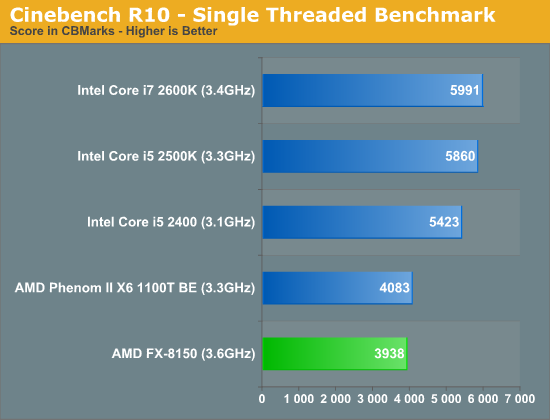
According to my calculations using Single Threaded Cinebench scores from Anandtech's benchmarks, each CPU's max turbo clock, Ivy Bridge has a 75.3% IPC advantage over an FX-8150.

Vishera will close the gap a little, no doubt, but not enough to really change the picture of the kind of ass beating it takes.

Interestingly enough, a stock clocked i7-3770K with 4 cores beats a stock clocked FX-8150 with 8 cores in the multithreaded benchmark by almost 30%, and it only gets uglier the more you overclock the two.

I'm sorry, but Intel's 4 cores >> AMD's 8 Cores even in multithreaded shit.

AMD is bringing a banana to a gun fight. There simply is no comparison.

And this is coming from a huge AMD fan who used nothing but AMD CPU's in my builds and builds for friends and family from ~1999 until last year, when I finally realized how far behind they really were, and decided to temporarily buy Intel until AMD (hopefully) catches back up again.
 
it's not 20% IPC disadvantage but higher than that. The single-threaded deficit between BD and SB was significant and you may have forgotten just how big of a lead Intel has in IPC.

41690.png


41694.png


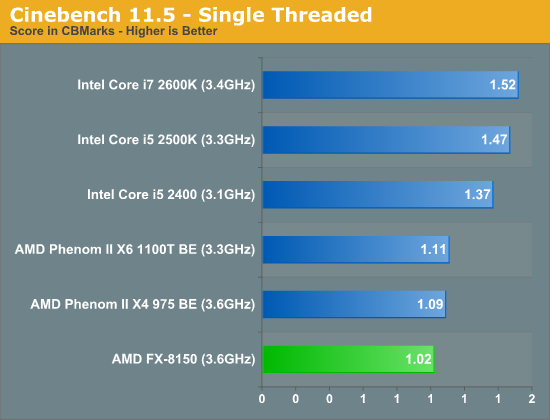
Let's take the 11.5 scores.

8150 at 3.3ghz would score .93

2500K scores 1.47 at a now equal 3.3ghz

That's 1.58 the score at the same clock speed, or ~58% IPC advantage for that benchmark. It fluctuates depending on the benchmark but the IPC disadvantage ranges from 30%-60%

AMD can improve the IPC slightly, but most of the gains will have to come from clock speed. At 4.2ghz it eats away at that IPC advantage, but isn't able to overcome it and as a result BD is usually ~20-30% behind in single-threaded benchmarks.
 
it's not 20% IPC disadvantage but higher than that. The single-threaded deficit between BD and SB was significant and you may have forgotten just how big of a lead Intel has in IPC.

41690.png


41694.png


Let's take the 11.5 scores.

8150 at 3.3ghz would score .93

2500K scores 1.47 at a now equal 3.3ghz

That's 1.58 the score at the same clock speed, or ~58% IPC advantage for that benchmark. It fluctuates depending on the benchmark but the IPC disadvantage ranges from 30%-60%

AMD can improve the IPC slightly, but most of the gains will have to come from clock speed. At 4.2ghz it eats away at that IPC advantage, but isn't able to overcome it and as a result BD is usually ~20-30% behind in single-threaded benchmarks.

Yep, those charts illustrate the point, but for single threaded loads you need to use the max turbo clock for calculations, not the base clock.

So when running the single threaded benchmark, the CPU's in that table are actually boosted up to the following clocks:


- Intel Core i7-2600K: 3.8Ghz
- Intel Core i5-2500K: 3.7Ghz
- Intel Core i5-2400: 3.4Ghz
- AMD Phenom II X6 1100T: 3.7Ghz
- AMD Phenom II X4 975 BE: 3.6Ghz (doesn't have a turbo)
- AMD FX-8150: 4.2Ghz
 
I've had my fill of math today, but the difference would be less... :p

The clock speed gains are AMD's best bet for the moment. The IPC bump should be in the single digits and may be comparable to Ivy's IPC bump (maybe a bit higher?), so the clock speed gains should close the gap in single-threaded performance, but that depends on the chip we're talking about. Remember that AMD's 8350 is only clocked at an equivalent 4.2ghz for single module turbo, meaning the single-threaded benchmarks will look a lot like they do above -- maybe slightly better and replace the Sandys with Ivys. The multi-threaded gains should be more significant, though, because of the 700mhz higher base clock.
 
Zarathustra[H];1039019956 said:
Yep, those charts illustrate the point, but for single threaded loads you need to use the max turbo clock for calculations, not the base clock.

So when running the single threaded benchmark, the CPU's in that table are actually boosted up to the following clocks:


- Intel Core i7-2600K: 3.8Ghz
- Intel Core i5-2500K: 3.7Ghz
- Intel Core i5-2400: 3.4Ghz
- AMD Phenom II X6 1100T: 3.7Ghz
- AMD Phenom II X4 975 BE: 3.6Ghz (doesn't have a turbo)
- AMD FX-8150: 4.2Ghz

In fact, if you plot the relative IPC (in bogus cinebench score per Ghz units) it looks sortof like this:

7742239662_60fb62f395_o.jpg


In this particular test using the data you supplied, this puts SB IPC at a ~65% advantage over AMD, percentage wise.
 
Zarathustra[H];1039019927 said:
BD had an over 50% IPC disadvantage against Sandy bridge, when not bottlenecked by other system components.

It has an even larger IPC disadvantage compared to Ivy Bridge.

According to my calculations using Single Threaded Cinebench scores from Anandtech's benchmarks, each CPU's max turbo clock, Ivy Bridge has a 75.3% IPC advantage over an FX-8150.

Vishera will close the gap a little, no doubt, but not enough to really change the picture of the kind of ass beating it takes.

Interestingly enough, a stock clocked i7-3770K with 4 cores beats a stock clocked FX-8150 with 8 cores in the multithreaded benchmark by almost 30%, and it only gets uglier the more you overclock the two.

I'm sorry, but Intel's 4 cores >> AMD's 8 Cores even in multithreaded shit.

AMD is bringing a banana to a gun fight. There simply is no comparison.

And this is coming from a huge AMD fan who used nothing but AMD CPU's in my builds and builds for friends and family from ~1999 until last year, when I finally realized how far behind they really were, and decided to temporarily buy Intel until AMD (hopefully) catches back up again.

Now your bringing unlocked and HT processors into the discussion. This is about a locked, non hyperthreaded quad VS a Overclocked Octocore. In some situations, yes, its going to goto Intel. Overall performance though, the 8150 is going to be better once overclocked. I know its not a outright and clean win, but because the 3450 can only goto 3.5ghz fully loaded, it just can't hang in threaded tasks. It would have to be at 4ghz on all four cores for it to be faster then the 8core 4.8ghz 8150, which frankly is SAD on AMDs part.

So at the end of the day, yes. On a sinlge threaded front, yes the intel is going to beat it slightly. In damn near every other load, the 8150 is going to be better.
 
How many people actually do heavy rendering work? Cinebench is very variable in it's results at the best of times (I know I benched a few CPU's and the margin of difference was quite a lot)

Cinebench is as useful as a hamster as a guard dog..ie not very useful. There are better things to talk about IMO, yes and better benchmarks. We know FX does best with heavy threading, but also the results can vary depending on the software used. The reality of real world use is that most benchmarks will be of little consequence for the end user. Are we benching the processor or are we benching the software? Because some software is as optimised as a dead cat..I know look at itunes ;-)
 
The real problem with Bulldozer is that the power consumption is atrocious compared to the performance. It uses more power than Gulftown or just as much and doesn't perform any better. That is the real issue.
 
How many people actually do heavy rendering work? Cinebench is very variable in it's results at the best of times (I know I benched a few CPU's and the margin of difference was quite a lot)

Cinebench is as useful as a hamster as a guard dog..ie not very useful. There are better things to talk about IMO, yes and better benchmarks. We know FX does best with heavy threading, but also the results can vary depending on the software used. The reality of real world use is that most benchmarks will be of little consequence for the end user. Are we benching the processor or are we benching the software? Because some software is as optimised as a dead cat..I know look at itunes ;-)

I started using Cinebench for my comparisons for a few different reasons:

1.) You can easily do a single threaded and mulithreaded comparison

2.) It scales well when multithreaded,

3.) It is mostly independent of other bottlenecks, so you see the true performance of the CPU

4.) As opposed to you, I have found it fairly repeatable (but you have to shut down background processes) My CPU scores pretty repeatedly in the 13.38 - 13.43 range, unless I do something stupid.
 
Now your bringing unlocked and HT processors into the discussion. This is about a locked, non hyperthreaded quad VS a Overclocked Octocore. In some situations, yes, its going to goto Intel. Overall performance though, the 8150 is going to be better once overclocked. I know its not a outright and clean win, but because the 3450 can only goto 3.5ghz fully loaded, it just can't hang in threaded tasks. It would have to be at 4ghz on all four cores for it to be faster then the 8core 4.8ghz 8150, which frankly is SAD on AMDs part.

So at the end of the day, yes. On a sinlge threaded front, yes the intel is going to beat it slightly. In damn near every other load, the 8150 is going to be better.

1.) For web browsing, email and office work you won't be able to tell the difference between the two.

2.) For gaming, or any other enthusiast / low thread count application, the FX-8150 will be beaten by a locked 3450 at stock clocks no matter how high you overclock the FX-8150. It is blown out of the water at most common speeds.

3.) The FX-8150 will have an advantage in heavy rendering/encoding operations. This is pretty much the only special case in which the FX-8150 will excel, and most people don't do this all the time.

So, for your average computer-as-web-appliance users, there will be no difference at all.

For most enthusiasts and gamers, a locked low end Ivy Bridge quad core will absolutely destroy the FX-8150.

For a small special case scenario, where multithreaded rendering and encoding is important, the FX-8150 will have a slight advantage.
 
Who gives a shit, this is an early ES chip that may be a fake from a site in china. i mean really, 4 pages of in depth analysis and fanboyism on something that is 90% bollocks and bullshit.

Why doesn't everyone wait until we have some proper numbers from a reputable site
 
Zarathustra[H];1039020125 said:
1.) For web browsing, email and office work you won't be able to tell the difference between the two.

2.) For gaming, or any other enthusiast / low thread count application, the FX-8150 will be beaten by a locked 3450 at stock clocks no matter how high you overclock the FX-8150. It is blown out of the water at most common speeds.

3.) The FX-8150 will have an advantage in heavy rendering/encoding operations. This is pretty much the only special case in which the FX-8150 will excel, and most people don't do this all the time.

So, for your average computer-as-web-appliance users, there will be no difference at all.

For most enthusiasts and gamers, a locked low end Ivy Bridge quad core will absolutely destroy the FX-8150.

For a small special case scenario, where multithreaded rendering and encoding is important, the FX-8150 will have a slight advantage.

I don't understand where you're getting the absolutely destroy from. Only in single threads will it even be close. Most games are atleast dual core optimized, sometimes more. The 3450 won't be able to get to the 4ghz needed to eclipse it. I realize I'm playing devils advocate, but in this single situation, with the processors listed, its just not the blow out you think it is. It's just not.
 
Most games are dual-threaded with rare occasions up to 6. An overwhelming majority are under 4 and as a result AMD's 8 ALUs just can't make up for the deficit in single-threaded performance. It's only in cases where all 8 threads are loaded that AMD has a chance to catch up and usually only against the 4-core 4-thread Intel processors.

Gaming is most definitely NOT a strong suit of the current CMT Bulldozer approach. Far from it. In fact it's one of the worst aspects of the architecture.
 
Who gives a shit, this is an early ES chip that may be a fake from a site in china. i mean really, 4 pages of in depth analysis and fanboyism on something that is 90% bollocks and bullshit.

Why doesn't everyone wait until we have some proper numbers from a reputable site

You don't have to wait for anything their goal in the roadmap was pretty obvious, up to 15% improvement in IPC (over Bulldozer). But the other targets are interesting like default speed and turbo speed since more mhz for the chip means higher ipc.

If we get another "world record overclocking parade" from AMD I'm so thinking of jumping ship.
 
What gets me here is that the BD architecture (is there another name for it like P6/Netburst?) has so much damn potential. They took a quad core design and essentially integrated hardware ALU multi-threading, and then tuned it for high clockspeeds. It's exactly what a CPU should be! It should be downright amazing for anything you throw at it, because it should be able to chew through multi-threaded and branching codebases like there's no tomorrow.

It was obvious on press day that the architecture does indeed work quite well, and it's proven itself in a number of workloads, but it's also obvious that they need to work on optimizing their implementation for single-threaded performance as well as get a clamp on their power usage.

I'll agree with the guys above that think that this is a bogus report and I'll continue to wait for authentic press on PD, but I wanted to say that we should all be holding out hope that AMD makes some real strides with this architecture. Remember that competition is good for all of us!
 
Most games are dual-threaded with rare occasions up to 6. An overwhelming majority are under 4 and as a result AMD's 8 ALUs just can't make up for the deficit in single-threaded performance. It's only in cases where all 8 threads are loaded that AMD has a chance to catch up and usually only against the 4-core 4-thread Intel processors.

Gaming is most definitely NOT a strong suit of the current CMT Bulldozer approach. Far from it. In fact it's one of the worst aspects of the architecture.

You can also say that the gaming industry doesn't really care about writing optimized code they get away with the biggest turd in coding as long as it runs it is good.

Realistically the only performance increase in years to come can only be gotten from supporting more cores since the leap in ghz has been very slow since a few years (were stuck at/near 3ghzsomething).

Also a problem is benchmarks under windows they tend to be old not optimized and not as simple as the linux counterparts which you can recompile with the right flags.

And (repeating myself) the "pepsi taste test" on [H] AMD experience day was the low point for me in several years of supporting AMD , okay so now we don't look at benchmarks and people somehow picked the AMD systems, cool, now only AMD need to rewrite the populations DNA to make them fall for these questionable tactics and I'm sure AMD will start selling more ....
 
The gaming industry doesn't care about the PC in general. We get like 2-3 games a year worth playing on DX11 while the rest is on DX9 because of the lowest common denominator: consoles.

The marketing, the hype and the power consumption were the worst parts of Bulldozer. It was sold as an enthusiast desktop chip when it was quite clearly server-centric. The IPC did dip and the overclocking under normal conditions was worse than SB by -.2ghz. The power consumption has clearly been reeled in and the multi-threaded performance is better. That thread on coolaler isn't of a Vishera chip but a Bulldozer ES. Piledriver itself looks pretty good in laptops, but I'd give it another generation if you're looking to replace your Thuban or PhenomII :p
 
I don't understand where you're getting the absolutely destroy from. Only in single threads will it even be close. Most games are atleast dual core optimized, sometimes more. The 3450 won't be able to get to the 4ghz needed to eclipse it. I realize I'm playing devils advocate, but in this single situation, with the processors listed, its just not the blow out you think it is. It's just not.

It's fine if you don't understand, especially if you're a fan of one and don't use the other. I went from a Deneb to a Sandy Bridge. Loved my PII, still have it and it's working great in my ESXi box. Does it hold a candle to my i7 2600K even if I lock my i7 down to 2 cores in the BIOS? Not a chance. 3 cores @ 3.6GhZ didn't touch the 2 cores at 3.9GhZ. Considering Deneb has higher IPC than Bulldozer, this is probably one of the best tests you can do to see the difference on that scale. The math is not off here, IB represents a good 50-60% higher IPC than BD (as several others have said). In apps that show 50% more on IB, that would make 4 IB cores as fast as 8 BD cores at the same clocks assuming said app utilized all 8 cores. This means for apps that use 4 or less cores, you would need to literally double the speed of the CPU, thus a 6GhZ BD quad to go against a 3GhZ IB quad. Now tell me you can get 6GhZ out of every BD chip with stock cooling and without it taking a ludicrous amount of energy. You can't. So, even if I can only get a 3450 up to 3.6GhZ with its turbo and a low OC on the bclk, BD isn't touching it.

I think that people saying its just a new stepping of BD are more correct here. I really doubt AMD would improve this little and call it their next amazing thing. People were saying with a partial update the new APUs were getting a boost over the thuban-based APUs, which means a full PD should be a bigger boost over BD than this.
 
Back
Top