Official Nvidia Maxwell slides

Well, if madVR is anything to go by, Nvidia's OpenCL is pretty buggy and not that fast when it does work.
Why the heck are you using MadVR when LAV has proper hardware acceleration?

Correct, if 25% isn't "that much" to you...
At these low levels, 25% isn't that much... and I doubt they're off by that much in the first place.

I could understand if we were talking about 300w cards, but we're talking about 65w cards here...

There has been motherboards in the past that have allowed up to 150w through the PCI-e slot though.
And cards are not designed assuming that you're using that particular motherboard. They're designed assuming a normal 75w ceiling.
 
The new OpenCL core seams to run very well on AMD GPUs and even Intel CPUs. No CPU usage on AMD GPUs, but on NVIDIA is is slower and uses a CPU thread.

All OpenCL programs use a CPU thread. I'm not really following.

I said that by Xeloras hoping they are bad at mining he is also hoping they are bad at GPGPU as the two are linked.

Being good at mining and being good at other compute tasks can be different. Mining requires high integer compute performance and AMD also benefits from having the right-shift rotate instruction.

So far NVIDIA hasn't shown much interest in cryptocurrency mining. That doesn't mean GPGPU performance is bad.
 
There is a certain danger that PC gaming could take a blow if mining causes a dramatic spike in consumer GPU prices, putting them generally out of reach from gamers. Since so far this is just an AMD phenomenon, it's not too concerning. But if it applied to nvidia as well, I could see a pretty clear pause in PC gaming.
 
There is a certain danger that PC gaming could take a blow if mining causes a dramatic spike in consumer GPU prices, putting them generally out of reach from gamers. Since so far this is just an AMD phenomenon, it's not too concerning. But if it applied to nvidia as well, I could see a pretty clear pause in PC gaming.

However, if people started buying cards for mining from both camps I think that would even things out. Ultimately, as more miners jump on board, difficulty of these coins go up making it less profitable for everyone. If AMD had more supply now, things would either reach a point where it wouldn't make sense to continually expand your mining setup, or the profitability would dip so low that newcomers wouldn't bother.

So, unless AMD and Nvidia combined couldn't meet the demand then I don't think prices would go up necessarily.

As for Nvidia showing an interest in the crypto market, a developer there actually submitted the kernel used in CudaMiner currently (was released last month, and gave like a 10% performance boost). Granted that doesn't say anything about the company's direction as a whole but interesting nonetheless.
 
Why the heck are you using MadVR when LAV has proper hardware acceleration?

?? LAV is an A/V decoder and madVR is a video renderer.


So far NVIDIA hasn't shown much interest in cryptocurrency mining. That doesn't mean GPGPU performance is bad.

No, but it still is relatively bad on their consumer cards.
 
Last edited:
I use MadVR to upscale blu-ray movies to be displayed on 1440p monitors. It's very resource intensive (especially with NNEDI3) but it's the best renderer out there.
 
Performance-per-watt looks very impressive. However, none of that means shit if the price isn't right.
 
I hope it's downright horrible for mining. All of the Maxwell cards, even GM200, here's hoping it's godawful at mining. :cool:
It's a two-edged sword. General compute performance will, at some point, benefit gaming just as much as it benefits mining. I think it's pretty important that Maxwell be compute-strong from a standpoint of longevity.
 
It's a two-edged sword. General compute performance will, at some point, benefit gaming just as much as it benefits mining. I think it's pretty important that Maxwell be compute-strong from a standpoint of longevity.


I think he might be referring to the crapstorm it caused with AMD's recent product line being an utter disaster thanks to mining. Some of those prices are just absurd because the shortage and AMD really having no solution.

Then again it might even out if both Nvidia and AMD were on equal levels.
 
I understand what he was referring to, but I think he's looking at the situation very narrowmindedly.
 
It's a two-edged sword. General compute performance will, at some point, benefit gaming just as much as it benefits mining. I think it's pretty important that Maxwell be compute-strong from a standpoint of longevity.

Mining boils down to one type of specific ALU bound computation which is generally not used in any GPGPU or gaming application that i'm aware of. These types of computations used in mining do not generally mimic any CPU function, which is the entire point of GPGPU in the first place. GPGPU is designed to use the parallelism of the GPU to do traditional CPU functions better.

Obviously, nvidia created GPGPU and has that entire ecosystem on their side with CUDA and what not, and the computations used by mining have very little relevance overall with either GPGPU or gaming. The type of ALU bound computation is not used in either type of application. Nvidia also sells far more professional cards specifically for the purpose of GPGPU than AMD does or ever has. What does mining have to do with this? Nothing. Now if mining had absolutely any correlation with overall GPGPU performance, which it doesn't, NV would fix it because that's where the vast majority of their profit comes from. HPC and GPGPU products.

Do not confuse the specific ALU computation used with mining for "compute" or "GPGPU". If you do that, point to one single application that uses that type of ALU bound computation. No application does this. Mining is an anomaly and has, from what I can tell, zero correlation to overall GPGPU performance. Your argument would also imply that the cayman cards are better at compute than the GTX Titan. Obviously that would be absurd. The Cayman cards have a better hashrate than Titan, does that mean Cayman had excellent GPGPU performance? Fuck no. If you're going to go down the road of proclaiming that mining has any relevance whatsoever, you would also imply that non GPGPU cards (cayman) are good at GPGPU, and that would also imply that there are applications that use a function similar to mining. And there isn't such a GPGPU application. IF there were, nvidia would be on top of it, because they created GPGPU in the first place - GPGPU is where the vast majority of their profits come from. Certainly AMD does not come close to matching NV's GPGPU related HPC sales.

And let's move back to the original point. I want a great gaming GPU with Maxwell. I do not want a mining GPU. If I did, I would buy tons of AMD cards. I could give a fuck about mining, and I especially don't want the mining related price and supply issues on the NV side, since I do like their products.
 
Last edited:
These types of computations used in mining do not generally mimic any CPU function
All x86 processors have circular shift instructions.

Do not confuse the specific ALU computation used with mining for "compute" or "GPGPU".
Performing computational tasks is compute. Why are we redefining words here?

Your argument would also imply that the cayman cards are better at compute than the GTX Titan.
It implies no such thing.
 
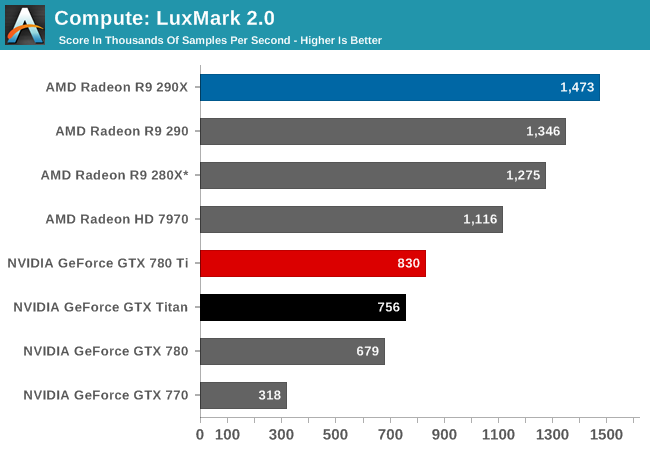
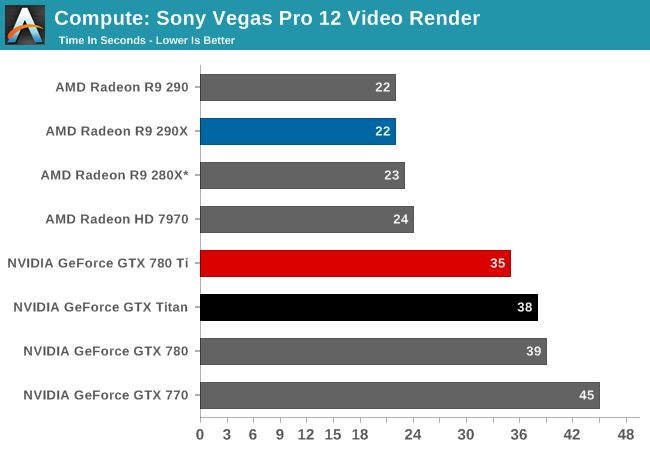
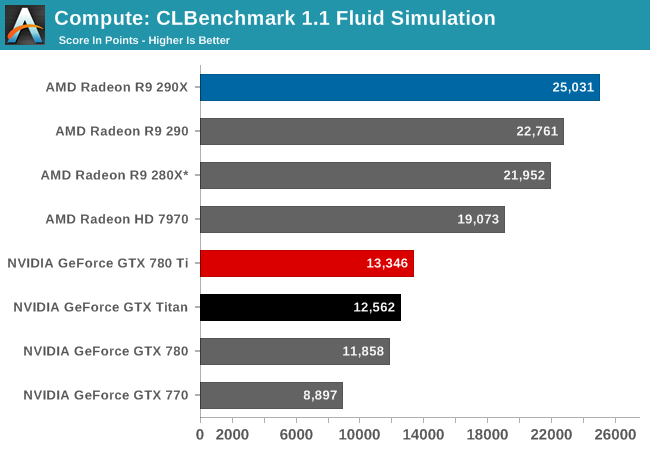
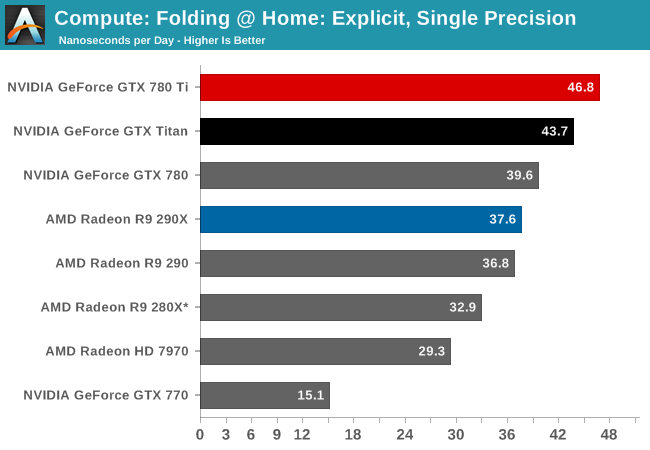
http://www.anandtech.com/show/7492/the-geforce-gtx-780-ti-review/14

59697.png


59698.png


59699.png


59701.png


59703.png


59704.png
 
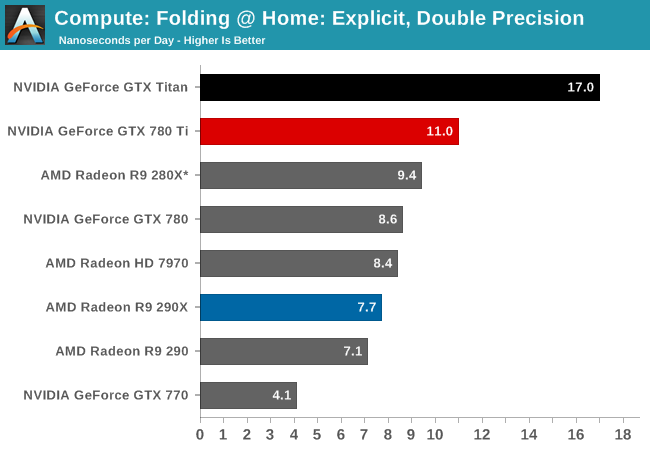
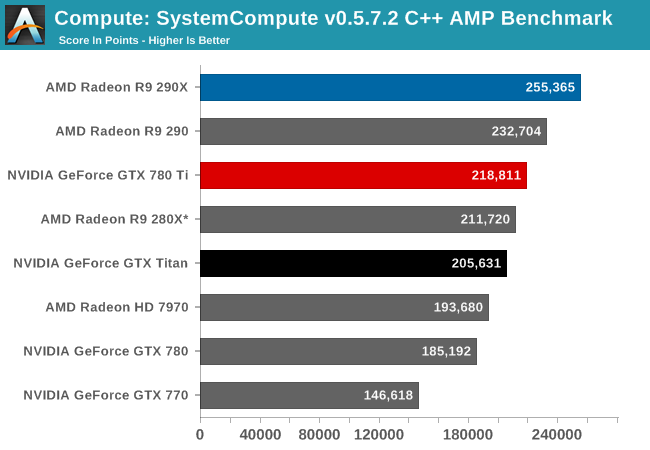
I'll have to assume that all the benches except for F@H are single precision, which is not Titans forte. That would explain why Titan performs somewhat slower than the Ti780.

Titan excels at FP64 but its FP32 performance (and generally the kepler family) is lacking.
It's still not bad for a GPU designed throughout 2010, with final silicon produced in mass quantity starting mid-2011.

People seem to forget how old the GK110 really is. It's honestly fairly impressive that it's still competitive with the brand-spanking-new Hawaii XT.

Edit: It also means Nvidia has had a long, long time to work on Maxwell with minimal distractions. I'm really curious to see what it can do.

Once those graphs are normalized by performance/watt, things start to make a bit more sense.

The AMD cards are still ahead, but not nearly as much. They're delivering more performance out of a single chip at the cost of overall efficiency. What this generally means for scientific compute applications is that AMD cards will be favorable when rack-space is at a premium, and nvidia cards will be favorable when the cost of electricity and cooling is at a premium.

Pick the right tool for the job, folks. That's pretty much what it comes down to.
 
Last edited:
For SP, the 780Ti is not gimped (ie same as Titan), and so 780Ti clock+cores = ~7% boost over Titan. Nothing surprising.
 

Whilst performance is good the issue of CPU utilization still exists, in that the 780 uses 10% low and 20% high of a single thread on a 3770k

A 7970 uses >1% low 4% high.

If NVIDIA fixed their OpenCL implementation in their driver then it would be amazing performance.

But at the moment it makes a thread unreliable, if you are using all threads then your application would need to wait for that one thread.
 
Once those graphs are normalized by performance/watt, things start to make a bit more sense.

The AMD cards are still ahead, but not nearly as much. They're delivering more performance out of a single chip at the cost of overall efficiency. What this generally means for scientific compute applications is that AMD cards will be favorable when rack-space is at a premium, and nvidia cards will be favorable when the cost of electricity and cooling is at a premium.

Pick the right tool for the job, folks. That's pretty much what it comes down to.

But that's the thing. One of the reasons that Nvidia's cards are more efficient in gaming is because they lack in the compute department. Remember Fermi, strong in compute and power hungry.
 
But that's the thing. One of the reasons that Nvidia's cards are more efficient in gaming is because they lack in the compute department. Remember Fermi, strong in compute and power hungry.
Uh... re-read my post. Gaming performance (and power efficiency while gaming) never entered into it.

Was strictly talking compute performance (and power efficiency while running GPU compute applications).

In that vein, the AMD cards deliver more per-GPU but also run hotter and draw more power while doing so. That's where the "right tool for the job" line comes in: sometimes AMD's cards will be ideal, sometimes Nvidia's cards will be ideal. It comes down to the situation (physical space, electrical costs, cooling costs, etc).

Edit: Also note, I'm speaking from the perspective of running server racks full of these things, not single-card workstations.
 
Last edited:
Yes, Nvidia is certainly stronger in that regard. I'm not sure what made AMD make such a step backwards with efficiency. Some say it is because they designed the card for the 20 nm that never came, but I don't think that is the (only) reason.

so which of these cards can do MadVR at max settings?

None, actually :)
 
Last edited:
They make some things easier to set up (like output video levels) and are a bit faster with OpenCL. Also, Nvidia has some buggy drivers and you have to revert to olders ones to get OpenCL features working.
 
I've checked Anand review of 750ti and those will be amazing cards for notebooks.
 
Most people who use MadVR prefer AMD, is it because of better OpenCL?

Over the past couple years, it's actually been the opposite. Most people who use madVR preferred NVIDIA, at least on Doom9. Something in the GTX 660 class of performance was the most common recommendation.

Historically, AMD cards have had superior shader performance in madVR, but their drivers have quite a few quirks which hurt reliability of certain features and settings.

Recently with the OpenCL & DirectCompute stuff, it's difficult to draw conclusions yet. AMD cards have a quite massive 10-15ms overhead from OpenCL <-> D3D9 interop, which seems to mostly if not completely negate any OpenCL compute performance advantage they have over NVIDIA in madVR. NVIDIA on the other hand, broke their extremely fast 1-2ms implementation of OpenCL <-> D3D9 interop with their recent drivers, but they are aware of the bug so hopefully this will get fixed. With DirectCompute, NVIDIA's compute performance in madVR increases a bit, while AMD no longer has the massive overhead it did with OpenCL.

At this point in time, NNEDI3 scaling looks like it is going to be OpenCL-only because of a mysterious 10x slowdown when ported to DirectCompute, while Error Diffusion dithering will use DirectCompute. For this reason, it so far is looking like OpenCL NNEDI3 will favors NVIDIA into the future (with functional older or bug-fixed drivers), while DirectCompute Error Diffusion dithering will favor AMD.

That said, if the new baby Maxwell are able to at least match the madVR performance of a GTX 660, they should turn out to be excellent HTPC cards. Just don't expect to use much of the compute stuff without compromises. Thankfully madVR now supports profiles, so you can fine-tune settings for such things.
 
I've checked Anand review of 750ti and those will be amazing cards for notebooks.

They would be amazing crossgrade/replacement GPUs for low-end desktops, too - other than SLI and DisplayPort, nothing is really missing. However, it does commit the same sin that GTX550 Ti (and GTS450) committed before it - mini-HDMI, not full-sized HDMI; that's an error that AMD's sub-mainstream GPUs don't make, as even HD34xx and HD54xx/55xx/6xxx all support full-sized HDMI. often, mini-HDMI to full-sized HDMI dongles tend to disappear from retail packaging.
 
I know this is the best forum to ask about MadVR but what does the new OpenCL error diffusion do? I turned on and watched the utilization rate on HD 4600 went from 20% to 95%, but I don't see any visual difference.
 
I just updated MadVR last weekend so I am pretty sure it's the latest. The New 750Ti looks like a nice upgrade to my HD 4600. But I am waiting for 850-870 that can handle nnedi3
 
I guess it's still in test versions only. You can find them in the madVR doom9 thread.
 
However, it does commit the same sin that GTX550 Ti (and GTS450) committed before it - mini-HDMI, not full-sized HDMI; that's an error that AMD's sub-mainstream GPUs don't make, as even HD34xx and HD54xx/55xx/6xxx all support full-sized HDMI. often, mini-HDMI to full-sized HDMI dongles tend to disappear from retail packaging.
Not really that big a deal, just get a mini-HDMI to HDMI cable and forget the adapters.

$7 for 6.5 feet
$8 for 9.8 feet

http://www.amazon.com/AmazonBasics-...5?s=electronics&ie=UTF8&qid=1392829366&sr=1-5
 
As an Amazon Associate, HardForum may earn from qualifying purchases.
None, unfortunately. Your best bet is to search for experiences with comparable cards in the madVR thread.
 
so it's somewhat confirmed that the higher end 800 series at the end of the year will be 20nm and not 28nm?
 
so high end Maxwell parts are only in Q4??...when did Nvidia switch to releasing low end parts first?...I thought it was always high end followed by mid range to mainstream?...or is this because they are waiting on 20nm for the high end?
 
so high end Maxwell parts are only in Q4??...when did Nvidia switch to releasing low end parts first?...I thought it was always high end followed by mid range to mainstream?
This isn't the first time they've released a mid-range part first.

Note that it's still labeled as a 7XX series card, not an 8XX series card. This isn't the launch of a new series, it's a test-part slipped in with the older cards.
 
A bunch of the first 40nm parts were lowend ASICs.
First 28nm parts were a mix of lowend and highend ASICs.
 
Back
Top