• Some users have recently had their accounts hijacked. It seems that the now defunct EVGA forums might have compromised your password there and seems many are using the same PW here. We would suggest you UPDATE YOUR PASSWORD and TURN ON 2FA for your account here to further secure it. None of the compromised accounts had 2FA turned on.
    Once you have enabled 2FA, your account will be updated soon to show a badge, letting other members know that you use 2FA to protect your account. This should be beneficial for everyone that uses FSFT.

Official Llano Benches

i like this part of the conclusion...

"It took AMD spending half the transistors of Llano on its GPU to deliver the sort of performance we've been asking for from integrated graphics for over a decade; the question I have is whether or not Intel is willing to make a similar sort of move in its architectures. Ivy Bridge has already been decided upon; it'll be faster but not a significant upheaval in performance. However Intel does have a history of building upon ideas that AMD introduced before their time (e.g. IMC, x86-64, Fusion), and with Llano we may be given a peek at what's to come in the future."
which is very true. AMD has always been the one to try something new only to have Intel and now in this case Nvidia(GDDR5 support) copy it and yes improve on it but even so AMD always gets left as the guinea pig willing to go the extra mile to try something different yet never gets credit for it.
 
i like this part of the conclusion...

"It took AMD spending half the transistors of Llano on its GPU to deliver the sort of performance we've been asking for from integrated graphics for over a decade; the question I have is whether or not Intel is willing to make a similar sort of move in its architectures. Ivy Bridge has already been decided upon; it'll be faster but not a significant upheaval in performance. However Intel does have a history of building upon ideas that AMD introduced before their time (e.g. IMC, x86-64, Fusion), and with Llano we may be given a peek at what's to come in the future."
which is very true. AMD has always been the one to try something new only to have Intel and now in this case Nvidia(GDDR5 support) copy it and yes improve on it but even so AMD always gets left as the guinea pig willing to go the extra mile to try something different yet never gets credit for it.
Shh! You don't want pxc to come in here, do you? Thou must not speakest any truth that may cast thine AMD in any positive manner, or thoust will receive 1000 lashes from the "others'.

Anyways, even though a lot of people, ones that are not actually testing, are panning Llano because "CPU performance is no where near SB levels, much less Nehalem", I feel that on a power consumption level, this is damn amazing! The majority of people who use a laptop mainly are fine with Atom-levels of performance.
 
Shh! You don't want pxc to come in here, do you? Thou must not speakest any truth that may cast thine AMD in any positive manner, or thoust will receive 1000 lashes from the "others'.

Anyways, even though a lot of people, ones that are not actually testing, are panning Llano because "CPU performance is no where near SB levels, much less Nehalem", I feel that on a power consumption level, this is damn amazing! The majority of people who use a laptop mainly are fine with Atom-levels of performance.

For most users CPU performance of Llano is more than adequate, in many cases more than you actually need. When it comes to mobile users who game it's the GPU and power consumption/heat holding everyone back. And lets not forget, Llano is significantly cheaper than the competition. Intel has to do some serious price cutting in their mobile market lineup.
 
For most users CPU performance of Llano is more than adequate, in many cases more than you actually need. When it comes to mobile users who game it's the GPU and power consumption/heat holding everyone back. And lets not forget, Llano is significantly cheaper than the competition. Intel has to do some serious price cutting in their mobile market lineup.


lol yeah thats like telling Nvidia they need to lower the price of the GTX 580, won't ever happen.
 
Two of these in parallel with a few custom tweaks for the next Xbox?

Just saying.
 
Llano is the reasonable next step...

Ala iPod / iPhone and then iPad TM.... style, with certain substance...

1. First punch is Radeon 48xx to salvage, turn around and sneak pass a certain barrier...

2. Second maneuver is the Bobcat-style air-drop into wild remote region.

3. Third evasive action is the incoming Llano to ...

Do not be overly concern with the above nonsense I wrote above. :) End of the day, many realize, better products that meet individual needs will have a place, irrespective of brands.
 
I would be very interested in these for my HTPC however AMD's drivers suck on linux. Although they are better then Intel's. Sadly nVidia is the only choice.
 
Intel has to do some serious price cutting in their mobile market lineup.
That's based on the assumption that GPU performance matters above all else, which isn't what seems to matter most for computers sales. Price is the top factor and battery life is way up there for laptops. Intel makes lower price point chips to address the lower end segments of the markets. I do see the raising of the floor for graphics performance on low end systems as a good thing, don't get me wrong. However, most users won't care about it.

GPU performance is certainly important to gamers, but not all computer buyers are gamers. The timing of high performance IGP releases isn't really optimal as it was in the past and AMD's emphasis on OpenCL and GPGPU is a symptom of that. The gaming market is shifting away from demanding PC specs, although old school games aren't going away any time soon. Some people were/are happy with HD4xxx level IGPs and HD Graphics 2000/3000. The 400SP Llano would be appealing to more of the low end in that way, but it is not the exclusive option that would work for many users.

Llano does seem to have many factors in favor for it, and performance while not exciting, is in the "more than good enough" range for many users. But it's also not the only product that could apply that label.

I don't think Intel will lower prices of existing chips any faster than it usually does, but will release new models instead. There do seem to be a couple of new OEM/tray products coming in weeks to counter Llano on the desktop: i3-2125/2130 (3.3/3.4GHz models) for under $140, and both are using HD Graphics 3000 which had not been available in the i3 series before. That IMO will force down Llano pricing from $170, and not touch i5/i7 pricing (a new i7 is also coming soon, so the 2500/2600 models should get a typical price drop or be discontinued).

Anyways, other than blind loyalists recommending systems, when someone is asked what similarly priced models are better for "general usage", it will be hard for an unbiased person to recommend Llano over SB for CPU performance at many price points. It's not that Llano has no chance, but there is limited gains to be had from low end gaming graphics included with it (A8-3500M gets 25fps in JC2, 1366x768 low settings... yeah massive appeal to gamers :p). Gamers are still going to prefer a discrete GPU.

Price wars have been very unfavorable to AMD in the past, and maybe you can explain who would be hurt more when it's Intel's 149mm^2 SB w/HD Graphics 3000 competing against a 228mm^2 Llano (dual core, quad core, 160SP, 240SP, 400SP... all the same die size) with hideously poor yields (so bad that AMD earlier this year switched to paying for good die instead of wafers). ;)
 
I would be very interested in these for my HTPC however AMD's drivers suck on linux. Although they are better then Intel's. Sadly nVidia is the only choice.

Hm, I run a 6850 on Mint 10 w/o issues....dual monitor even, no xinerama.

I've never been able to get > 2 monitors working on an nvidia card/Linux combo without xinerama (slow & hacky).

I am currently running the opensource driver with a firepro 4 monitor card w/o xinerama on Ubuntu 11.04 (classic interface).

YMMV of course, but I prefer ati/amd to nvidia on linux these days.
 
@ PXC

Intel still sells their C2D mobile CPUs for more than $200 a piece. While i5 and i7 sandy bridge are from $300 to $1000 a piece.

Price wars have been very unfavorable to AMD in the past, and maybe you can explain who would be hurt more when it's Intel's 149mm^2 SB w/HD Graphics 3000 competing against a 228mm^2 Llano (dual core, quad core, 160SP, 240SP, 400SP... all the same die size) with hideously poor yields (so bad that AMD earlier this year switched to paying for good die instead of wafers). ;)

This is contradicting of you. If they switched to paying for good die instead of wafers, low yields don't matter, it's GloFlo or TSMC who's eating the costs.

You yourself claim 228mm^2 Llano uses up the same die size no matter the GPU core count or CPU core count. Which means they are binned parts (parts which would otherwise count against the good yields).

However I am not so sure dual core Llano will be on the 228mm^2 die. I have not been able to find the confirmation of this, even Anandtech has a question mark on this (http://www.anandtech.com/show/4444/amd-llano-notebook-review-a-series-fusion-apu-a8-3500m/2). Besides Llano I think competes quite well against the Sandy i5+HD3000, which is 216mm2.

Even those who reviewed Llano agree with my point, that Llano laptops will be on average $100 less than the competition.
 
Last edited:
That's based on the assumption that GPU performance matters above all else, which isn't what seems to matter most for computers sales. Price is the top factor and battery life is way up there for laptops. Intel makes lower price point chips to address the lower end segments of the markets. I do see the raising of the floor for graphics performance on low end systems as a good thing, don't get me wrong. However, most users won't care about it.

GPU performance is certainly important to gamers, but not all computer buyers are gamers. The timing of high performance IGP releases isn't really optimal as it was in the past and AMD's emphasis on OpenCL and GPGPU is a symptom of that. The gaming market is shifting away from demanding PC specs, although old school games aren't going away any time soon. Some people were/are happy with HD4xxx level IGPs and HD Graphics 2000/3000. The 400SP Llano would be appealing to more of the low end in that way, but it is not the exclusive option that would work for many users.

Llano does seem to have many factors in favor for it, and performance while not exciting, is in the "more than good enough" range for many users. But it's also not the only product that could apply that label.

I don't think Intel will lower prices of existing chips any faster than it usually does, but will release new models instead. There do seem to be a couple of new OEM/tray products coming in weeks to counter Llano on the desktop: i3-2125/2130 (3.3/3.4GHz models) for under $140, and both are using HD Graphics 3000 which had not been available in the i3 series before. That IMO will force down Llano pricing from $170, and not touch i5/i7 pricing (a new i7 is also coming soon, so the 2500/2600 models should get a typical price drop or be discontinued).

Anyways, other than blind loyalists recommending systems, when someone is asked what similarly priced models are better for "general usage", it will be hard for an unbiased person to recommend Llano over SB for CPU performance at many price points. It's not that Llano has no chance, but there is limited gains to be had from low end gaming graphics included with it (A8-3500M gets 25fps in JC2, 1366x768 low settings... yeah massive appeal to gamers :p). Gamers are still going to prefer a discrete GPU.

Price wars have been very unfavorable to AMD in the past, and maybe you can explain who would be hurt more when it's Intel's 149mm^2 SB w/HD Graphics 3000 competing against a 228mm^2 Llano (dual core, quad core, 160SP, 240SP, 400SP... all the same die size) with hideously poor yields (so bad that AMD earlier this year switched to paying for good die instead of wafers). ;)

all you have to say is that facebook games will play better on it then the other and boom, everyone goes out and buys it.
 
Intel still sells their C2D mobile CPUs for more than $200 a piece. While i5 and i7 sandy bridge are from $300 to $1000 a piece.
Are you for real? (several edits because AMD does not release mobile pricing to the public, so I compared both as well as possible)

There is no desktop i7 Sandy Bridge CPU that costs over $317 list price. The unlocked i7-2600K 3.4/3.8GHz with HT holds that spot. Desktop i5 tops out at $216 for the unlocked i5-2500K 3.3/3.7GHz. http://files.shareholder.com/downlo...480-94AA-3C8184515E4B/May_29_11_1ku_Price.pdf There is one extreme SB mobile chip that costs $1000 and one lower mobile SB that costs over $500. Did you mean those? Hardly representative of what sells. Your statement is wrong anyways. Desktop i5 starts at closer to half the range you stated and mobile i5 starts a little more expensive. C2D mobiles start around $100, with Pentium and Celeron versions cheaper. SB starts in the $70 range. Those are just list prices. ASPs are often much lower.

It doesn't matter anyways because AMD has no mobile that is anywhere near SB i5 CPU performance. It probably wishes it did. ;)

C2D is dead, bro. Why do you bring up legacy chips in every conversation?* I can dig up AMD's expensive mobile 45nm chips which are still sold too, but they are irrelevant to the conversation. I would link to the AMD mobile price list, but AMD doesn't make it public like the desktop CPU price list. :p

*within Best Buy's 117 Intel-based laptops online, there are a handful of old discounted Pentium and Celeron laptops and I only saw 2 C2D models within a couple of pages. The large majority of laptops were Nehalem-based or SB-based.
 
Last edited:
Are you for real?

There is no i7 Sandy Bridge CPU that costs over $317 list price. The unlocked i7-2600K 3.4/3.8GHz with HT holds that spot. i5 tops out at $216 for the unlocked i5-2500K 3.3/3.7GHz. http://files.shareholder.com/downlo...480-94AA-3C8184515E4B/May_29_11_1ku_Price.pdf

C2D is dead, bro. Why do you bring up legacy chips in every conversation? I can dig up AMD's expensive mobile 45nm chips which are still sold too, but they are irrelevant to the conversation. I would link to the AMD mobile price list, but AMD doesn't make it public like the desktop CPU price list. :p

We were talking about mobile chips. They are still being sold. Apple's MBA for instance.

Why don't you see the prices for yourself "bro". http://en.wikipedia.org/wiki/Sandy_bridge#Mobile_processors

Those prices are insane, which sort of explains why AMD can't ship enough Llano due to crazy demand.

I especially like how Intel will charge you $190 more for a 100Mhz bump of the i7 2820QM ($568 CPU). Meanwhile Quad Llanos will be $110-170 and it will run both on desktop and laptop because AMD aren't dicks to use different sockets for the desktop version of the same CPU.

Also sort of proves Intel will do anything to screw over the consumer when left unchecked. Party is over, a decent inexpensive mobile CPU is here and it's way cheaper than anything Intel has to offer. And one demanding thing people do while on the go, Llano does better anyways.
 
Last edited:
We were talking about mobile chips. They are still being sold. Apple's MBA for instance.

Why don't you see the prices for yourself "bro". http://en.wikipedia.org/wiki/Sandy_bridge#Mobile_processors

Those prices are insane, which sort of explains why AMD can't ship enough Llano due to crazy demand. Also sort of proves Intel will do anything to screw over the consumer when left unchecked. Party is over, a decent inexpensive mobile CPU is here and it's way cheaper than anything Intel has to offer. And one demanding thing people do while on the go, Llano does better anyways.


arguing with PXC is like arguing with a brick wall.. just ignore him, its a waste of time.
 
We were talking about mobile chips. They are still being sold. Apple's MBA for instance.
That is odd because it would be a one sided comparison. AMD doesn't release mobile prices to the public anymore. BTW, the C2D MBA came out over a year ago. The refresh is using SB. You know that since we had this exact same conversation already when you were trying to create a sub 20W Llano out of thin air and dismissing the unsuitability of a 35W Llano to replace a 17W combo C2D+320M. ;) Want links to that convo?

I do know however that Turion II chip list prices (the closest analogue to your C2D comparison) would probably cause a tail to be tucked between legs, especially since it's slower and just as expensive as expensive legacy C2D mobile chips that haven't been used in new consumer designs in the past year. ;) The difference is that Turion II has been used in new consumer designs in the past year.
 
That is odd because it would be a one sided comparison. AMD doesn't release mobile prices to the public anymore. BTW, the C2D MBA came out over a year ago. The refresh is using SB. You know that since we had this exact same conversation already when you were trying to create a sub 20W Llano out of thin air and dismissing the unsuitability of a 35W Llano to replace a 17W combo C2D+320M. ;) Want links to that convo?

I do know however that Turion II chip list prices (the closest analogue to your C2D comparison) would probably cause a tail to be tucked between legs, especially since it's slower and just as expensive as expensive legacy C2D mobile chips that haven't been used in new consumer designs in the past year. ;) The difference is that Turion II has been used in new consumer designs in the past year.

You are referring to the conversation we had about Llano's viability over C2D+230M, and conversely 17w i3 for Apple's MBA.

We now finally actually have some benchmarks to quote:

http://www.tomshardware.com/reviews/a8-3500m-llano-apu,2959-22.html

Playing a 3D game never exceeded 25w on the A8-3500m (Quad Llano), while i5 almost hit 45w. I am sure a 2C Llano can manage sub 20w operation and will completely destroy C2D+230M or 17w i3's 3000 HD.
 
Last edited:
i like this part of the conclusion...

"It took AMD spending half the transistors of Llano on its GPU to deliver the sort of performance we've been asking for from integrated graphics for over a decade; the question I have is whether or not Intel is willing to make a similar sort of move in its architectures.

I hope both AMD and Intel realize that blowing 50% of the transistor budget on pretty 3D graphics is only appropriate for some buyers. I don't want to be paying for a "gaming capable" gpu every time I buy a cpu, not to mention the additional idle power used over the life of the machine. I would rather have those transistors used to increase IPC or not be there at all (lower TDP, cheaper).

I would be very interested in these for my HTPC however AMD's drivers suck on linux. Although they are better then Intel's. Sadly nVidia is the only choice.

I run the open source ATI driver named "radeon" on multiple machines. Zero problems for the past year. Multiple monitors, video, 3d, xrandr all work perfectly for me. Give it a try with a current kernel (for the KMS bit) and a recent, stable version of the open source "radeon" driver.

I started running the open source drivers back when they were in alpha. There were bugs in the very beginning, but as I said they've given me no problems in a long time.

Current ATI and Intel open source drivers are so good I won't buy anything Nvidia.
 
I am sure a 2C Llano can manage sub 20w operation and will completely destroy C2D+230M or 17w i3.
2c Llano is 35W, same as the low power 35W A8-3500M. The other mobile A8 processors are 45W. AMD has the model info up to the public if you want to look at it. What you insisted is that Llano would launch with 20W models, despite AMD never claiming such a thing.

Regressed graphics for some models (320M equipped ones) and lack of GPU accelerated OpenCL* on the next SB IGP equipped low end mini, MBA and MB is disappointing. But it didn't make Apple run to AMD as you had predicted.

* funnily enough, AMD's flagship video encoding APP used to demonstrate the power of a 400SP equipped APU, $5.4 billion spent to acquire ATI and 5+ years of work on Fusion... gives slightly slower performance than software-based CPU encoding on a dual core i5 mobile chip. Sad. Using the i5's built in QuickSync is 3x-4x faster than either one and it didn't cost $5.4 billion to add. ;) Intel has a CPU based OpenCL implementation that will have to do until Ivy Bridge is released.
 
I hope both AMD and Intel realize that blowing 50% of the transistor budget on pretty 3D graphics is only appropriate for some buyers. I don't want to be paying for a "gaming capable" gpu every time I buy a cpu, not to mention the additional idle power used over the life of the machine. I would rather have those transistors used to increase IPC or not be there at all (lower TDP, cheaper).

C2D level of performance is still fine for most users. Internet browsing, flash, office... The one time an average computer user runs into performance issues is when he or she attempts to play a game.
 
2c Llano is 35W, same as the low power 35W A8-3500M. The other mobile A8 processors are 45W. AMD has the model info up to the public if you want to look at it. What you insisted is that Llano would launch with 20W models, despite AMD never claiming such a thing.

Regressed graphics for some models (320M equipped ones) and lack of GPU accelerated OpenCL* on the next SB IGP equipped low end mini, MBA and MB is disappointing. But it didn't make Apple run to AMD as you had predicted.

* funnily enough, AMD's flagship video encoding APP used to demonstrate the power of a 400SP equipped APU, $5.4 billion spent to acquire ATI and 5+ years of work on Fusion... gives slightly slower performance than software-based CPU encoding on a dual core i5 mobile chip. Sad. Using the i5's built in QuickSync is 3x-4x faster than either one and it didn't cost $5.4 billion to add. ;)

You keep throwing this 20w figure which I never used. I mentioned 25watt TDP which is listed on the wikipedia (http://en.wikipedia.org/wiki/AMD_Fusion#Roadmap). So I didn't pull it out of my ass.

But in any case we have the real world benchmarks now, which show the actual real consumption. Manufacturers measure TDP differently. The only true figure is the actual measurement during benchmarks. And Llano APU destroys Sandy APU in power consumption/performance, by a factor of 2+.

Also I wasn't predicting Apple would go with Llano. I was arguing that it would make more sense if they did and I was willing to take a bet for giggles. It's a bit different. Anyways, thanks for the derailment of the thread.

edit: btw, found the post you keep referring to: http://hardforum.com/showpost.php?p=1037243190&postcount=12
 
Last edited:
I hope both AMD and Intel realize that blowing 50% of the transistor budget on pretty 3D graphics is only appropriate for some buyers. I don't want to be paying for a "gaming capable" gpu every time I buy a cpu, not to mention the additional idle power used over the life of the machine. I would rather have those transistors used to increase IPC or not be there at all (lower TDP, cheaper).
I agree, but there's always a tradeoff when implementing new technologies. Someone has to be first, and the first may not reap the rewards.

I was excited about the promise of the APU. Having a programmable coprocessor on die will one day be great. Software is just a long way from catching up. GPGPU certainly has many useful applications, just not for regular desktop users yet. It's not going to change next year when Intel finally releases a GPGPU capable processor (Ivy Bridge) supporting DirectCompute and OpenCL (technically Atom will get one first, but the PowerVR GPU is very low end for desktops/laptops and may not have OpenCL supported at all). But having basically all IGPs GPGPU capable will also help push it forward.

The seemingly unbalanced APU is Hector's and Dirk's folly. This Fusion strategy would probably not have been made with competent management, although integration with more system components was inevitable. Licensing would have been a better choice in hindsight.

It's time to dig up some old posts and laugh about how right and wrong some of us were about this. ;)
 
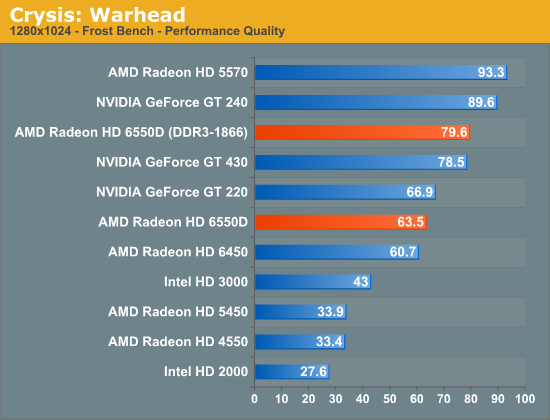
Ouch those benches suck.

I remeber I could comfortably play titles like ME1 and Witcher 1 on 2900pro in 1680x1050 and with lowered details at 1920x1200 and that card had 320 sp.

I expected it would be possible on this one too.

Hell look at this:
38843.png


Apu is bandwidth limited at 720p which is basic standard resolution for notebooks.
 
Dude, the GT220 was an awesome gaming card. Except that it wasn't. ;)

See that GT240 near the top? Oh yeah, my miniITX HTPC/TV gaming system gets nothing but the best single slot, slot powered $29AR video card available. (please AMD and Nvidia, release 28nm soon. i need an upgrade.)
 
So, not a bad mobile part for people who just want a dirt-cheap gaming laptop, and a marginal choice for everyone else. This is, of course, assuming AMD doesn't add an astronomical price premium that drives the price of a laptop over $500. Power consumption numbers look good, but I'd like to see if they hold-up in a shipping notebook configuration.

As I expected, they released only one part today: this is critical because it means nobody will have an easy chance to see how little 400 bandwidth-starved shaders adds to the equation (versus 240 or 320). This should bode well for value-oriented gamers: if the 320 performs roughly the same, they could score some dirt-cheap deals. But at the same time it's stupid for AMD to waste that kind of die space for something they could never hope to feed (especially when you commit to split your die space 50/50). It saddens me to see that they really have no fix for the bandwidth problem, and it seems likely that the memory controller is exactly the same as the Phenom II.

On the desktop, I see very little future for Llano, unless it's sold at price-parity with Phenom II at the same clock. Reason one: Llano has no L3 cache, so you'll likely lose %20 performance versus a Phenom II. Reason two: on the desktop, upgrading from integrated graphics is much cheaper/easier thanks to PCIe slots being so cheap to implement...so if the price/performance is not aggressive, nobody will bother to buy into "slightly faster" integrated graphics. If the top-of-the-line processor only clocks-in at 2.9GHz (and no Turbo), it's going to have a hard time competing with much less expensive quad cores, or even fast duals.
 
Last edited:
...Manufacturers measure TDP differently. The only true figure is the actual measurement during benchmarks..

This is a simple fact that keeps getting passed over. Intel's TDP is not equal to AMD's TDP. If I remember correctly, Intel's TDP measurement is 'typical', ranging from 60%-85% processor load, whereas AMD's TDP is measured at 100%. So, if we plug the numbers from Llano into Intel's TDP equation we get:

45W: 45x.65=29.25 ~ 30W, 45x.85=38.25 ~ 40W
35W: 35x.65=22.75 ~ 25W, 35x.85=29.75 ~ 30W
25W: 25x.65=16.25 ~ 17W, 25x.85=21.25 ~ 20+W

Now, if we convert Intel's TDP into AMD's (TDP/65x100 and TDP/85x100) equation we get:

17W: 17/85x100=20W, 17/65x100=26.153 ~ 25+W
25W: 25/85x100=29.411 ~ 30W, 25/65x100=38.461 ~ 40W
 
This is a simple fact that keeps getting passed over. Intel's TDP is not equal to AMD's TDP. If I remember correctly, Intel's TDP measurement is 'typical', ranging from 60%-85% processor load, whereas AMD's TDP is measured at 100%. So, if we plug the numbers from Llano into Intel's TDP equation we get:

45W: 45x.65=29.25 ~ 30W, 45x.85=38.25 ~ 40W
35W: 35x.65=22.75 ~ 25W, 35x.85=29.75 ~ 30W
25W: 25x.65=16.25 ~ 17W, 25x.85=21.25 ~ 20+W

Now, if we convert Intel's TDP into AMD's (TDP/65x100 and TDP/85x100) equation we get:

17W: 17/85x100=20W, 17/65x100=26.153 ~ 25+W
25W: 25/85x100=29.411 ~ 30W, 25/65x100=38.461 ~ 40W

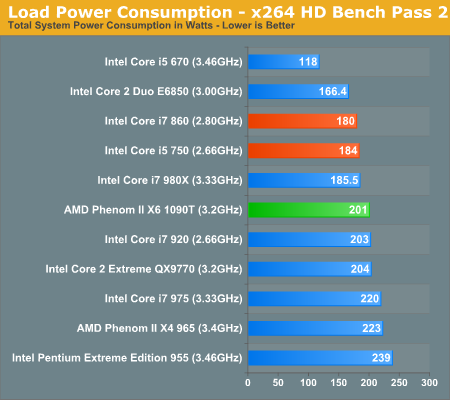
Somehow that doesn't seem to be the case in real life:

22638.png

1090T has 125TDP, i7 920 has 130W TDP
 
Somehow that doesn't seem to be the case in real life:

22638.png

1090T has 125TDP, i7 920 has 130W TDP

Yeah that's full system. Mobo, vid, HDD, and more then likely what is pulled from the wall, which could be as low a 80% efficiency at something like 200w. One CPU could be pulling only 90w and the other 95w, but we can't tell that looking at that slide.
 
If I remember correctly, Intel's TDP measurement is 'typical', ranging from 60%-85% processor load, whereas AMD's TDP is measured at 100%.
You don't. ;) Both AMD and Intel define TDP close to using the same terms after AMD launched Phenom I. The TDP isn't absolute and both have oddities where the same TDP value gives sometimes widely different power consumption numbers within a family (example: 2.5GHz vs 3.3GHz both "65W" can measure much less for the slower and closer to 65 for the faster). Nothing surprising really.

What system level power consumption tests typically shows for Nehalem and newer processors is that Intel's 95W uses less power than AMD's 95W and Intel's 125W uses less power than AMD's 125W under load in all cases, at least for the highest speed models at each TDP level.
 
(example: 2.5GHz vs 3.3GHz both "65W" can measure much less for the slower and closer to 65 for the faster). Nothing surprising really.

That actually isn't weird as there's only a few tdp levels for example if you had two chips one with tdp of 83 W and second one with 94W both would be branded as 95W TDP
 
I hope both AMD and Intel realize that blowing 50% of the transistor budget on pretty 3D graphics is only appropriate for some buyers. I don't want to be paying for a "gaming capable" gpu every time I buy a cpu, not to mention the additional idle power used over the life of the machine. I would rather have those transistors used to increase IPC or not be there at all (lower TDP, cheaper).

I agree with this, however there will always be a market for this type of system. On the idle power consumption side of things, look at the anandtech article on Llano, and look at the power gating portion. Power gating allows the entire CPU, GPU, APU whatever you want to call it, to be completely turned off when idle.
 
I think Llano should do well.

Good price, and relatively low combined GPU/CPU power envelope results in good battery life.

True, the CPU can't touch a Sandy bridge laptop, but who does CPU intensive work on a laptop anyway? As long as its fast enough to keep up with Browsing/email/Office/itunes and the occasional movie, it should be fine.
 
Once again folks here are moaning about a chip THAT ISNT DESIGNED FOR THEM!

And a mobile chip at that.

Also NO ONE IS FORCING YOU TO BUY ONE!

Sorry about the caps but really.......
 
I want a cheap netbook based on the A4.
A 12 inch EEEPC based on the LLano A4 for around $299 would be the perfect for me.
 
Last edited:
So, not a bad mobile part for people who just want a dirt-cheap gaming laptop, and a marginal choice for everyone else. This is, of course, assuming AMD doesn't add an astronomical price premium that drives the price of a laptop over $500. Power consumption numbers look good, but I'd like to see if they hold-up in a shipping notebook configuration.

As I expected, they released only one part today: this is critical because it means nobody will have an easy chance to see how little 400 bandwidth-starved shaders adds to the equation (versus 240 or 320). This should bode well for value-oriented gamers: if the 320 performs roughly the same, they could score some dirt-cheap deals. But at the same time it's stupid for AMD to waste that kind of die space for something they could never hope to feed (especially when you commit to split your die space 50/50). It saddens me to see that they really have no fix for the bandwidth problem, and it seems likely that the memory controller is exactly the same as the Phenom II.

On the desktop, I see very little future for Llano, unless it's sold at price-parity with Phenom II at the same clock. Reason one: Llano has no L3 cache, so you'll likely lose %20 performance versus a Phenom II. Reason two: on the desktop, upgrading from integrated graphics is much cheaper/easier thanks to PCIe slots being so cheap to implement...so if the price/performance is not aggressive, nobody will bother to buy into "slightly faster" integrated graphics. If the top-of-the-line processor only clocks-in at 2.9GHz (and no Turbo), it's going to have a hard time competing with much less expensive quad cores, or even fast duals.


I am not sure why a desktop llano is even in existence, except maybe for some htpc setup. Also, reading the anand article on the mobile llano,

http://www.anandtech.com/show/4444/amd-llano-notebook-review-a-series-fusion-apu-a8-3500m/3


I was left wondering how much bandwidth constraints were going to be an issue, at one point they seemed to suggest there was enough, but then the writer mentioned performance being lower do to sharing bandwidth with the 4 cpu cores, but what about the arbitration and gpu priority? I don't get whether this will be a limitation in practice or just in theory. If only the latter then I don't see a problem there.
 
Back
Top