I've been studing Heating and cooling at school for a few semesters now, and noticed a flaw in the new btx design. If you look into the history of furnaces, you will see they used to make them with the hottest point making contact with the coldest air. After years of research they realized it was most efficient to warm up the air gradualy. The warm part of the furnace made contact first, and the hottest point made contact last. This gave the greatest heat output , therefore giving the greatest efficiency. As you have probably already guessed where I am going with this, the btx design will not give the greatest heat output. Having the hottest point (the processor) make contact with the coldest air, and the reast the the components make contact last, is the LEAST efficient way to cool the computer. The current ATX setup is the most efficient way. Even though the processor gets cooled better (with btx), the fan will have to blow faster and louder to cool the rest of the system. The reason btx is being introduced is to have a quieter pc, but they are doing the oposite! Anyway just had to get that out of my system! Post your comments.
![[H]ard|Forum](/styles/hardforum/xenforo/logo_dark.png)
Navigation
Install the app
How to install the app on iOS
Follow along with the video below to see how to install our site as a web app on your home screen.
Note: This feature may not be available in some browsers.
More options
You are using an out of date browser. It may not display this or other websites correctly.
You should upgrade or use an alternative browser.
You should upgrade or use an alternative browser.
New btx cases are NOT efficent
- Thread starter LeftSide
- Start date
BLsibub666
Gawd
- Joined
- Apr 2, 2003
- Messages
- 1,023
well they are moving everything around b/c "the fan is at the botom, so we should move the cpu" wow, what an idea, just change everything in the case, and redo the mobo, just so the cpu will be closer to the fans....
oh shit, you could just move the fan, shit, why didnt i think of that b4
if people dont buy btx, they wont make btx anymore, (and im sure some company will make an atx board for the newer chips that are ment for btx)
oh shit, you could just move the fan, shit, why didnt i think of that b4
if people dont buy btx, they wont make btx anymore, (and im sure some company will make an atx board for the newer chips that are ment for btx)
Black Morty Rackham
Supreme [H]ardness
- Joined
- Jan 8, 2004
- Messages
- 4,728
Ummm...
In order to cool a computer as much as possible, you WANT as much heat "output" as possible. Constructing a computer like a furnace is a good idea, really. The goal of cooling is to turn as much cold air into hot air as possible, thereby removing heat from the parts that need cooling.
In order to cool a computer as much as possible, you WANT as much heat "output" as possible. Constructing a computer like a furnace is a good idea, really. The goal of cooling is to turn as much cold air into hot air as possible, thereby removing heat from the parts that need cooling.
Originally posted by Black Morty Rackham
Ummm...
In order to cool a computer as much as possible, you WANT as much heat "output" as possible. Constructing a computer like a furnace is a good idea, really. The goal of cooling is to turn as much cold air into hot air as possible, thereby removing heat from the parts that need cooling.
That is what I am saying... ATX cases will produce the most heat output. Whereas the BTX case will not. BTX will require faster and louder fans to get the same heat output from the exaust.
Black Morty Rackham
Supreme [H]ardness
- Joined
- Jan 8, 2004
- Messages
- 4,728
Originally posted by LeftSide
That is what I am saying... ATX cases will produce the most heat output. Whereas the BTX case will not. BTX will require faster and louder fans to get the same heat output from the exaust.
Oh, sorry, misread.

But still, like someone said... the CPU is the thing that needs the most cooling, so perhaps just trying to remove the maximum amount of heat from the case isn't the right approach... hm. But to be honest, I'd like to see "thermal zones" like in the G5 or something along those lines. It's much more efficient to cool the parts individually and have the air in/out openings as big as possible.
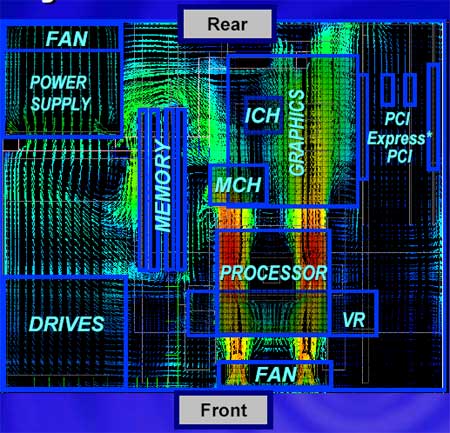
BTX is going to be somewhat different from ATX in the area of coolers. Instead of having just a heatsink and fan, it will have a "Thermal module". See this article at Tweak Town
(Be warned that a full page ad will load for about 5 seconds before it goes to the article, so you can't say you weren't warned.)
And according to the Inquirer
Intels BTX form factor will introduce passive heat sinks, and we can exclusively reveal that current prototypes weigh in at around a hefty one kilogram apiece!
That's about twice as heavy as the current heaviest ATX 'sinks on the market.
One thing that I couldn't understand about BTX, but was finally clued in on by an Intel guy at Broadband Reports is why the mirror image with the expansion cards at the top. He said:
As to *why* the flipped everything over, I think I found the answer to that as well - with the current layouts on ATX boards, all add-in cards (AGP, PCI, etc) have their component side facing down - so all the heat is below the card - hard to move the heat away from that. So by flipping the board over, your hot components are facing up - much easier to clear the heat off then.
(Be warned that a full page ad will load for about 5 seconds before it goes to the article, so you can't say you weren't warned.)
And according to the Inquirer
Intels BTX form factor will introduce passive heat sinks, and we can exclusively reveal that current prototypes weigh in at around a hefty one kilogram apiece!
That's about twice as heavy as the current heaviest ATX 'sinks on the market.
One thing that I couldn't understand about BTX, but was finally clued in on by an Intel guy at Broadband Reports is why the mirror image with the expansion cards at the top. He said:
As to *why* the flipped everything over, I think I found the answer to that as well - with the current layouts on ATX boards, all add-in cards (AGP, PCI, etc) have their component side facing down - so all the heat is below the card - hard to move the heat away from that. So by flipping the board over, your hot components are facing up - much easier to clear the heat off then.
The BTX form factor seems logical to me. It just makes sense to have the coolest air flowing across the component which produces the most heat, the CPU. Then the GPU, etc.
If you have a CPU at 150 degrees, having 70 degree outside air flowing over it will cool it much better than air which has already passed over several other components and is now at an elevated temperature of of say, 110 degrees.
The furnace analogy makes sense if what you are trying to do is make more heat, which is what you want a furnace to do.
The goal with computer is to prevent the heat from building up in the first place.
The cooler the air coming out the exhaust is, the better the cooling solution is performing.
If you have a CPU at 150 degrees, having 70 degree outside air flowing over it will cool it much better than air which has already passed over several other components and is now at an elevated temperature of of say, 110 degrees.
The furnace analogy makes sense if what you are trying to do is make more heat, which is what you want a furnace to do.
The goal with computer is to prevent the heat from building up in the first place.
The cooler the air coming out the exhaust is, the better the cooling solution is performing.
Originally posted by Sarge
The cooler the air coming out the exhaust is, the better the cooling solution is performing.
actually, the colder the air coming out the exhaust, the worse your cooling solution (assuming we're keeping flowrates constant). if cold air is coming out it means that you haven't taken any heat from the case. if the computer case was a simple heat exchanger you'd want the air leaving the computer to be the same temperature as the hottest component in the case.
This furnace idea makes no sense. The idea of a furnace is to get hot and keep it, which is the opposite idea of what cooling a pc is. BTX looks like it will be much more efficient than ATX. Place the cpu lower and closer to the intake will be much more efficient than the current layout.
Originally posted by HybridHB
This furnace idea makes no sense. The idea of a furnace is to get hot and keep it, which is the opposite idea of what cooling a pc is. BTX looks like it will be much more efficient than ATX. Place the cpu lower and closer to the intake will be much more efficient than the current layout.
It makes perfect sense silly. A furnace is designed to heat a house as efficiently as possible, so you want to take as much heat away from it as possible. In effect you're trying to cool it as effectively as possible and dump the exhaust in the house.
A computer is the same way, and this is an interesting observation about BTX.
chewygerble
Limp Gawd
- Joined
- Sep 16, 2003
- Messages
- 194
Cooling the other components shouldn't be a problem because most of the parts that are being designed for BTX are suposed to put off less heat than there ATX counter parts. Like with the new FBGA ram put off much less heat than normal TSOP chips, etc.
Actually no. The theory behind the furnace removing heat does not apply to pc cooling. Just because a furnace outputs more heat does not mean its removing more heat from the source. It is simply setup so the SAME air molecules gain more heat energy by already having some heat energy by the time it gets to the main heat source. Think about it, for a furnace, its LESS efficient when the hot source is put into contactt with the cold air first, why is this? The cold air does such a good job cooling the heat source the temperatures drop, making a FURNACE less efficient. That is exactly what we want to do for a PC right? COOL the source, not help it stay warm. To fully understand these problems, it will take differential equations im sure less than 10% of the people here can do.
I understand what you're saying here, but I think you may be misunderstanding what I'm trying to say.actually, the colder the air coming out the exhaust, the worse your cooling solution (assuming we're keeping flowrates constant). if cold air is coming out it means that you haven't taken any heat from the case. if the computer case was a simple heat exchanger you'd want the air leaving the computer to be the same temperature as the hottest component in the case.
I'm not saying the exhaust should be the same temperature as the intake, and I agree the temp should be the same as the hottest component. Ideally, you should have the coolest air flowing over the components which produce the most heat (which you don't seem to be disagreeing with) in order to keep them from getting too hot and adding additional heat to the case.
I'm saying the less heat you allow to build in the first place, the lower the exhaust temperature will be. Hence, my statement
That was in response to the furnace analogy referenced at the start of the thread, in which, one is trying to create more heat.The goal with a computer is to prevent the heat from building up in the first place.
The cooler the air coming out the exhaust is, the better the cooling solution is performing.
Originally posted by HybridHB
Actually no. The theory behind the furnace removing heat does not apply to pc cooling. Just because a furnace outputs more heat does not mean its removing more heat from the source. It is simply setup so the SAME air molecules gain more heat energy by already having some heat energy by the time it gets to the main heat source. Think about it, for a furnace, its LESS efficient when the hot source is put into contactt with the cold air first, why is this? The cold air does such a good job cooling the heat source the temperatures drop, making a FURNACE less efficient. That is exactly what we want to do for a PC right? COOL the source, not help it stay warm. To fully understand these problems, it will take differential equations im sure less than 10% of the people here can do.
take some heat transfer classes, i'm sure less than 2% of the people here have done that...
in both cases the idea is the same. you have a heat source, and you want to design your exchanger so that it moves heat from the source into the room as quickly as possible for a given flowrate. for that, a counterflow exchanger is more efficient than a parallel flow exchanger.
the main difference is that with the pc you care about the temperature of a specific component (cpu) and you're willing to sacrifice overall heat transfer efficiency for the sake of the temperature of that particular component
Actually no. The theory behind the furnace removing heat does not apply to pc cooling. Just because a furnace outputs more heat does not mean its removing more heat from the source. It is simply setup so the SAME air molecules gain more heat energy by already having some heat energy by the time it gets to the main heat source. Think about it, for a furnace, its LESS efficient when the hot source is put into contactt with the cold air first, why is this? The cold air does such a good job cooling the heat source the temperatures drop, making a FURNACE less efficient. That is exactly what we want to do for a PC right? COOL the source, not help it stay warm. To fully understand these problems, it will take differential equations im sure less than 10% of the people here can do.
That's what I was what I was trying to get across with my posts (although you beat me on the submit for my second one), but I wasn't able to frame it nearly as well.
When I first read the furnace analogy, it seemed to make sense. But after I thought about it, I knew it didn't apply to computers, unless you use your computer to heat your house.
Originally posted by Sarge
I'm saying the less heat you allow to build in the first place, the lower the exhaust temperature will be. Hence, my statement
That was in response to the furnace analogy referenced at the start of the thread, in which, one is trying to create more heat.
i think that's where our misunderstanding comes from then. the way i read things, the goal of the furnace is to transfer as much heat into the room as possible.
if we were looking at a pc case as a heat exchanger, we'd want the cool air entering at the coolest part and leaving at the hottest. that's how a counterflow exchanger works, and it's more efficient than a parallel flow.
basically what i'm saying is that people are disagreeing with the original poster for the wrong reasons.
So, what are you trying to say with your posts?the main difference is that with the pc you care about the temperature of a specific component (cpu) and you're willing to sacrifice overall heat transfer efficiency for the sake of the temperature of that particular component
Are you trying to say the BTX form factor is not more efficient for cooling than ATX? Or vice versa?
I think the BTX will work better. I don't know about all of the technical aspects of it, but it just makes sense to me.
Originally posted by fugu
i think that's where our misunderstanding comes from then. the way i read things, the goal of the furnace is to transfer as much heat into the room as possible.
if we were looking at a pc case as a heat exchanger, we'd want the cool air entering at the coolest part and leaving at the hottest. that's how a counterflow exchanger works, and it's more efficient than a parallel flow.
basically what i'm saying is that people are disagreeing with the original poster for the wrong reasons.
Well this goes back to my last post. If you have the cool air entering the cool spots first then going to the heat source last, the cool air would have gained heat energy by the time it gets to the heat source, therefore being LESS efficient. Though in this setup the exhaust WILL be hotter. I think thats where the confusion comes in. Just becuase the exhaust is hotter does NOT mean it has removed more heat. Think about it (again), in a BTX setup, the cool air will get to the heat source first therefore cooling it down, so that heat source is outputting less heat, therefore the exhausting air molecules will still feel cooler than that of the ATX or "furnace" setup.
Black Morty Rackham
Supreme [H]ardness
- Joined
- Jan 8, 2004
- Messages
- 4,728
Just becuase the exhaust is hotter does NOT mean it has removed more heat.
Actually, it does. The problem, however, is that it doesn't mean you've removed the heat from the parts that need cooling the most. The hotter the exhaust air is, the more energy is removed from within the case, and thusly the cooling is over-all more efficient. But cooling the case isn't the goal. The goal is to cool the individual parts...
A cooler case tends to lead to cooler parts, however most of the work recently has been spent trying to cool only specific parts. I would much prefer a compromise meant to focus some attention on both.
This is one reason ducting, or thermal zones can be nice. However they don't help much when heat builds up outside of them and causes everything to start to heat up too much.
BTX may work in part because it aims to separate some of the thermal troublespots from each other.
This is one reason ducting, or thermal zones can be nice. However they don't help much when heat builds up outside of them and causes everything to start to heat up too much.
BTX may work in part because it aims to separate some of the thermal troublespots from each other.
quantumdragon
n00b
- Joined
- Feb 11, 2003
- Messages
- 41
Tne BTX case is a loser to start with. If one is serious about reducing heat then several steps listed below can be taken.
Seperate duct for intake ais for processor
Side panel fans to remove hot air from PCI cards
Now the real kicker. At present there is no solution to attack the heatbuidup under the mobo. Correct this problem and there is no reason for a BTX board. MAybe special ducting to pull coller air from the bottom out thru the top of the case. Maybe a passive heatsin mounted to the back of the mounting plane where the cpu is located and extending outside of the case.
Seperate duct for intake ais for processor
Side panel fans to remove hot air from PCI cards
Now the real kicker. At present there is no solution to attack the heatbuidup under the mobo. Correct this problem and there is no reason for a BTX board. MAybe special ducting to pull coller air from the bottom out thru the top of the case. Maybe a passive heatsin mounted to the back of the mounting plane where the cpu is located and extending outside of the case.
finally, someone talking sense...Originally posted by Black Morty Rackham
Actually, it does. The problem, however, is that it doesn't mean you've removed the heat from the parts that need cooling the most. The hotter the exhaust air is, the more energy is removed from within the case, and thusly the cooling is over-all more efficient. But cooling the case isn't the goal. The goal is to cool the individual parts...
Black Morty Rackham
Supreme [H]ardness
- Joined
- Jan 8, 2004
- Messages
- 4,728
Originally posted by jagec
finally, someone talking sense...
I always talk sense.
Anyway, I think they messed up. I by no means consider Apple to be some kind of hardware design Gods, but a G5-type case is VERY efficient. Huge heatsinks on the CPUs, but not really a fan for just the CPU, etc etc. It's not perfect, but it's definitely a better approach than A/BTX.

Combine that with heat pipes and such for a bigger spread of the heat (meaning more hot metal comes into contact with cool air, meaning more heat is removed from the parts that need cooling).
I know this image doesn't really portray a well-built computer, but still, it goes to show how they're (ATX-cases, that is) not really designed with airflow in mind.

(Images from Apple.com. I could've found better ones, I know, but I'm too lazy to look.)
**edit: no, I'm not trying to make an Apple commercial. I just find it to be a new and rather efficient cooling approach.**
It makes sense to me:
the amount of heat dissipated by the components in a case with a stable load is a fixed amount.
Now, if with furnaces the most efficient way to get the produced heat to the place where it's needed is to gradually warm up the air by leading it over the coolest parts first, ending with the hottest parts, then we can conclude one thing, namely that if we've got two systems which are identical, except for the cooling solution. In both cases, the same amount of air is moved through them, but the air is forced to take a different route.
If the air moving through case 1 is raised in temperature by 7 degrees, and the air moving through case 2 by 5 degrees, then that means that the system in case 1 is cooled better.
In other words, if it is indeed correct that gradually warming up air is more efficient than going from the hottest to the coldest components, then BTX is a very lousy form factor.
Anyway, it seems to me that in the case of BTX, all components except the CPU will become hotter than in an ATX system, simply because they'll never get air moved over them with near ambient temperatures, making them more prone to failure.
Realize that a Prescott CPU manages to dump 103 Watt into the air around it, and an Opteron around 80 Watt. I definitely wouldn't that much energy in the form of heat moving through the case of my brand new PC.
I actually performed a mod on a couple of my systems: I put a duct over the CPU, with a fan sucking air over the HSF, through the duct and outside the case. It just made sense to me to get the most heat (from the CPU) out of the case as quickly as possible. It certainly improved the case temperature in every case, usually around 5 degrees or more.
the amount of heat dissipated by the components in a case with a stable load is a fixed amount.
Now, if with furnaces the most efficient way to get the produced heat to the place where it's needed is to gradually warm up the air by leading it over the coolest parts first, ending with the hottest parts, then we can conclude one thing, namely that if we've got two systems which are identical, except for the cooling solution. In both cases, the same amount of air is moved through them, but the air is forced to take a different route.
If the air moving through case 1 is raised in temperature by 7 degrees, and the air moving through case 2 by 5 degrees, then that means that the system in case 1 is cooled better.
In other words, if it is indeed correct that gradually warming up air is more efficient than going from the hottest to the coldest components, then BTX is a very lousy form factor.
Anyway, it seems to me that in the case of BTX, all components except the CPU will become hotter than in an ATX system, simply because they'll never get air moved over them with near ambient temperatures, making them more prone to failure.
Realize that a Prescott CPU manages to dump 103 Watt into the air around it, and an Opteron around 80 Watt. I definitely wouldn't that much energy in the form of heat moving through the case of my brand new PC.
I actually performed a mod on a couple of my systems: I put a duct over the CPU, with a fan sucking air over the HSF, through the duct and outside the case. It just made sense to me to get the most heat (from the CPU) out of the case as quickly as possible. It certainly improved the case temperature in every case, usually around 5 degrees or more.
Black Morty Rackham
Supreme [H]ardness
- Joined
- Jan 8, 2004
- Messages
- 4,728
Anyway, it seems to me that in the case of BTX, all components except the CPU will become hotter than in an ATX system, simply because they'll never get air moved over them with near ambient temperatures, making them more prone to failure.
BTX will decrease the temperature of the CPU (the part that needs the most cooling) and increase the temperature of every other part. Overall, the system is LESS efficient, however, it's not overall performance we want. It doesn't really matter if the PCI ports are at 30 or 50 degrees, as long as the cards aren't damaged by it. There, however, is the risk... hard drives, for instance, need to be cold otherwise they can fail quite badly. If BTX increases the temperature of the case (by making the overall cooling less efficient), it will increase HDD temperature, making them more prone to failures. That means you don't want BTX for servers or such things.
It just made sense to me to get the most heat (from the CPU) out of the case as quickly as possible. It certainly improved the case temperature in every case, usually around 5 degrees or more.
Yes, that's what I've been saying all along. A good mod, I'd say. If you want it even more efficient, add a duct from the side of the computer, to the CPU, and then immediately back out of the case again, so the air that cools the CPU is completely independant from the air in the case.
chewygerble
Limp Gawd
- Joined
- Sep 16, 2003
- Messages
- 194
Like i said in my other post, parts made for the BTX wont need all that much cooling because they are made to produce much less heat than there ATX counter parts. So they are just focusing on cooling the CPU because evey thing else really wont need to much cooling.
Black Morty Rackham
Supreme [H]ardness
- Joined
- Jan 8, 2004
- Messages
- 4,728
Engineers often drown in their own knowledge, so they won't see the optimal solotion.
Actually, it would seem to me that since the coolest components will heat the air the least it's best to cool those first, since the slight rise in temperature from those components will hardly affect the temperature of the CPU if it's cooled with this air.Originally posted by Black Morty Rackham
Overall, the system is LESS efficient, however, it's not overall performance we want. It doesn't really matter if the PCI ports are at 30 or 50 degrees, as long as the cards aren't damaged by it.
In all rackmounted cases I've seen, the air entering the case first flows over the HDDs, then it moves to the back where it cools the CPU and other components on the mainboard. The mere suggestion of redesigning rackmounted cases to squeeze a BTX system in them seems utterly ludicrous to me.There, however, is the risk... hard drives, for instance, need to be cold otherwise they can fail quite badly. If BTX increases the temperature of the case (by making the overall cooling less efficient), it will increase HDD temperature, making them more prone to failures. That means you don't want BTX for servers or such things.
Well, the idea is that the two fans in this system (HSF and PSU) suck in air through the front of the case, where it flows over the (vertically mounted) HDDs, then over the components on the mainboard and the PCI and AGP cards, to then leave the system through the HSF duct or the PSU.Yes, that's what I've been saying all along. A good mod, I'd say. If you want it even more efficient, add a duct from the side of the computer, to the CPU, and then immediately back out of the case again, so the air that cools the CPU is completely independant from the air in the case.
This way the heat from the CPU is removed immediately from the case, and I only need two (temperature-controlled) fans. In my (very humble, of course) opinion, this setup beats the sh*t out of the BTX formfactor (of which I've read the spec).
DDR SDRAM doesn't produce that much heat (not even close to what RDRAM produces, at least). The only components on a mainboard which do get hot are mostly voltage regulators and things like that. Those won't get much cooler anytime soon.Originally posted by chewygerble
Like i said in my other post, parts made for the BTX wont need all that much cooling because they are made to produce much less heat than there ATX counter parts. So they are just focusing on cooling the CPU because evey thing else really wont need to much cooling.
GPUs don't appear to get more conservative with the heat they dissipate either. They're already rivaling CPUs.
And you _do_ want to get cool air over those components (MOSFETs, coils, certain ICs, including the southbridge of particular chipsets), as this improves system stability, ability to overclock and longevity of the system's components.
Black Morty Rackham
Supreme [H]ardness
- Joined
- Jan 8, 2004
- Messages
- 4,728
Actually, it would seem to me that since the coolest components will heat the air the least it's best to cool those first, since the slight rise in temperature from those components will hardly affect the temperature of the CPU if it's cooled with this air.
Hmm, I don't really know. I guess it depends on how much the CPU temp is effected by the temperature of the air used to cool it. If it's not such a big deal, then the "furnace approach" is better.
On the other hand, rackmounts are generally not designed to keep the noise down... they often make quite a ruckus. And again, with rackmounts, you often want a VERY stable machine. By cooling the hard drives, you increase their speed and lessen the risk of failure, etc etc.In all rackmounted cases I've seen, the air entering the case first flows over the HDDs, then it moves to the back where it cools the CPU and other components on the mainboard. The mere suggestion of redesigning rackmounted cases to squeeze a BTX system in them seems utterly ludicrous to me.
Originally posted by Black Morty Rackham
Engineers often drown in their own knowledge, so they won't see the optimal solotion.
Whaaaa? lol.
Black Morty Rackham
Supreme [H]ardness
- Joined
- Jan 8, 2004
- Messages
- 4,728
Originally posted by HybridHB
Whaaaa? lol.
Ever notice how children sometimes come up with ingenious solutions that you would never, EVER, have thought of?
I had thought the drives were in their own "thermal module" with the power supply. Fresh air could be brought in over the drives to keep them cool and it would get pushed out through the powersupply. The power supply could also suck air from the rest of the case for more exhaust. Hard drives need to keep cool but they don't produce a ton of heat (unless you're talking 15k scsi).
Originally posted by Sarge
So, what are you trying to say with your posts?
Are you trying to say the BTX form factor is not more efficient for cooling than ATX? Or vice versa?
I think the BTX will work better. I don't know about all of the technical aspects of it, but it just makes sense to me.
i'm trying to say that BTX will probably lead to cooler processors at the expense of the efficiency of overall heat dissipation. it was also an attempt to correct some of the misconceptions about heat transfer in this thread
Black Morty Rackham
Supreme [H]ardness
- Joined
- Jan 8, 2004
- Messages
- 4,728
↑↑↑↑↑↑↑↑Originally posted by fugu
i'm trying to say that BTX will probably lead to cooler processors at the expense of the efficiency of overall heat dissipation. it was also an attempt to correct some of the misconceptions about heat transfer in this thread