![[H]ard|Forum](/styles/hardforum/xenforo/logo_dark.png)
Navigation
Install the app
How to install the app on iOS
Follow along with the video below to see how to install our site as a web app on your home screen.
Note: This feature may not be available in some browsers.
More options
You are using an out of date browser. It may not display this or other websites correctly.
You should upgrade or use an alternative browser.
You should upgrade or use an alternative browser.
New btx cases are NOT efficent
- Thread starter LeftSide
- Start date
leukotriene
2[H]4U
- Joined
- Sep 18, 2002
- Messages
- 2,664
Like i said in my other post, parts made for the BTX wont need all that much cooling because they are made to produce much less heat than there ATX counter parts.
Huh?
Do you have some information about BTX supporting chipsets running cooler?
I sincerely doubt that.
Same VRMs and the same componentry and PCI cards means the same amount of heat generation per board.
You could argue (correctly) that flipping the orientation of the peripheral cards makes the heat easier to remove, but this is altogether different from claiming they produce less heat.
TSOP versus ball grid array RAM modules is not a valid comparison because there is nothing inherent to the BTX form factor that makes it more suitable for BGA modules, which are of course currently used on ATX AGP cards.
There is no more incentive to manufacture parts on a smaller process due to the form factor of the board either. Manufacturers segue to smaller processes due to economic reasons.
So I see no reason to suppose that once the BTX form factor is introduced, manufacturers will magically start to make peripheral cards that put out less heat as a result of the form factor change.
Suppose that the air increases in temperature by 3 degrees before it reaches the HSF where it increases by another 9 degrees. Leading the cold air directly over the HSF would increase the temperature of this air by 10-11 degrees, after which it increases by another 1-2 degrees. This is because the ability of air (and water) to absorb energy ('heat') decreases as it absorbs energy.Originally posted by Black Morty Rackham
Hmm, I don't really know. I guess it depends on how much the CPU temp is effected by the temperature of the air used to cool it. If it's not such a big deal, then the "furnace approach" is better.
The above example would roughly correspond to ATX vs BTX. As becomes obvious, in the latter case, less heat is removed from the system. This is because when the air has the most potential to absorb heat it can cool the less hot (energy-poor) components quite efficiently, after which it is still very capable of absorbing a great deal of the energy of an energy-rich source (CPU), while if this situation were reversed, the CPU would be cooled even more, but at the cost of the ability to cool the other components with the efficiency displayed in the former case.
Black Morty Rackham
Supreme [H]ardness
- Joined
- Jan 8, 2004
- Messages
- 4,728
This is because the ability of air (and water) to absorb energy ('heat') decreases as it absorbs energy.
Duh.
Anyway....
while if this situation were reversed, the CPU would be cooled even more, but at the cost of the ability to cool the other components with the efficiency displayed in the former case.
Yes, that's what I've been saying for a while now.

What I want to know is how big a deal it is.
Originally posted by Black Morty Rackham
Ever notice how children sometimes come up with ingenious solutions that you would never, EVER, have thought of?
Then why don't see children engineers?
Less obvious may be the fact that the efficiency at which air absorbs heat decreases in a non-linear way.Originally posted by Black Morty Rackham
Duh.
It's hard to say without having a way to simulate it, like using a BTX-like setup to take measurements with temperature sensors.Anyway....
Yes, that's what I've been saying for a while now.
What I want to know is how big a deal it is.
Then again, I'm a proponent of getting heat away from a system's components as quickly as possible, without circulating already heated air over other parts of the system.
Heat is bad.
Intel has shot itself in the foot a few times over the last few years.
At first i thought "ahh ok, new pentiums if they call them that are going to be wattage eaters, so they want better cooling" Then i remembered that intel is going to be re-using their mobile core.(or so ive read)
They say its going to cool the proc better. In theory yea its a little better. Its not going to be earth shattering. (maybe a few degrees C, whoopteedoo)) But heres the kicker, most computers come from large oems, and most large oems use very cramped cases. So how they stop buildup around the processor? They usually add ducting. Is this ducting going to be harder to do with btx? No, but rather than route it out the rear which is with the current atx design, they would need to route it out the side. The problem is that instead of having one steady stream of arflow, youll end up with circulation going all differant ways. And all this effort for a few degrees C (if even), i think thats what people are forgetting. It cant be better than a fully open motherboard sitting on a table, and even that isnt that much better.
At first i thought "ahh ok, new pentiums if they call them that are going to be wattage eaters, so they want better cooling" Then i remembered that intel is going to be re-using their mobile core.(or so ive read)
They say its going to cool the proc better. In theory yea its a little better. Its not going to be earth shattering. (maybe a few degrees C, whoopteedoo)) But heres the kicker, most computers come from large oems, and most large oems use very cramped cases. So how they stop buildup around the processor? They usually add ducting. Is this ducting going to be harder to do with btx? No, but rather than route it out the rear which is with the current atx design, they would need to route it out the side. The problem is that instead of having one steady stream of arflow, youll end up with circulation going all differant ways. And all this effort for a few degrees C (if even), i think thats what people are forgetting. It cant be better than a fully open motherboard sitting on a table, and even that isnt that much better.
Wow I thought this thread was dead. Come back on monday and its all up again... Anyways, I like the debate that has gone on, and I agree that BTX will cool the cpu better. But is that worth the rest of the components stuck in hotter conditions. Hard drives are getting faster and hotter, and oems are starting to put 7200rpm drives in their cases. I'm not saying Im completely right, but I would bet money that intel redesigns btx after all the complaints their going to get.
There are some good things coming out of the new design, like more air under the mb, and the grafics card being face up instead of down, but I think it would be better if they just revised atx to have these changes.
There are some good things coming out of the new design, like more air under the mb, and the grafics card being face up instead of down, but I think it would be better if they just revised atx to have these changes.
Originally posted by Elledan
In all rackmounted cases I've seen, the air entering the case first flows over the HDDs, then it moves to the back where it cools the CPU and other components on the mainboard. The mere suggestion of redesigning rackmounted cases to squeeze a BTX system in them seems utterly ludicrous to me.
I have spent a lot of time in datacenters, and can attest to the fact that this design follows some of the ideas BTX is designing around. In a typical desktop machine, the CPU will be the component producing the most heat. In a typical rackmount file serve, the array of fast-spinning HDs will generate much more heat than the CPU(s). In the rackmount, as in (as I understand it) BTX, you are putting the cool air over the hottest components first.
Yes, but with a rackmount you dont care about noise. You can have as many fans as you want. With btx they are talking about 1 fan in the front over the cpu, and 1 fan exaust out of the psu. Im sorry but unless your fans are spinning realy fast like, the hd and vid card will get just to hot. Specialy with oems.

BlindedByScience
More Human than Human
- Joined
- May 26, 2000
- Messages
- 9,282
...hey, I resemble that remark....Originally posted by Black Morty Rackham
Engineers often drown in their own knowledge, so they won't see the optimal solotion.
Don't forget that many factors drive designs; manufacturability and cost being two of the things I get reminded about rather often.
The total win is a design that kicks butt, performance wise, is easy to build, and is cost effective. It's not as simple as it may appear, on the surface.......
Lucky indeed is the guy that gets to design cost no object, one of a kind hand built hardware.
Rock On - B.B.S.
- Joined
- Aug 11, 2000
- Messages
- 3,695
Originally posted by LeftSide
Yes, but with a rackmount you dont care about noise. You can have as many fans as you want. With btx they are talking about 1 fan in the front over the cpu, and 1 fan exaust out of the psu. Im sorry but unless your fans are spinning realy fast like, the hd and vid card will get just to hot. Specialy with oems.
Don't forget that lots of OEM's now only use 1 fan - the one in the power supply. (I'm not counting the the cooling fan directly on the HS because you need that no matter what). Some have an additional exhaust fan right behind the CPU with some ducting, but those are far and few between. OEM's will figure out the best and cheapest way to cool things with least heat buildup.
Very good points.Originally posted by Party2go9820
Don't forget that lots of OEM's now only use 1 fan - the one in the power supply. (I'm not counting the the cooling fan directly on the HS because you need that no matter what). Some have an additional exhaust fan right behind the CPU with some ducting, but those are far and few between. OEM's will figure out the best and cheapest way to cool things with least heat buildup.
Dell has fabulous thermal engineering. I have a 2 year old Dimension 4400 P4/2.6ghz, and the thing runs so quiet, I can barely hear it running. Two fans, one in the PS and the main system one, that's it. If anyone can figure a way to make BTX work it'll be Dell. But it will require a major redesign of their case, tight now there is absolutely no place for front mounted fan in their standard case design.
With rackmounted cases I think that the way they're designed has much more to do with the way they're use rather than because of attempts to optimize the cooling of the components.Originally posted by _wiggin_
I have spent a lot of time in datacenters, and can attest to the fact that this design follows some of the ideas BTX is designing around. In a typical desktop machine, the CPU will be the component producing the most heat. In a typical rackmount file serve, the array of fast-spinning HDs will generate much more heat than the CPU(s). In the rackmount, as in (as I understand it) BTX, you are putting the cool air over the hottest components first.
HDDs, CD/DVD-drives, FDDs, etc. are all in the front, because that's the only convenient way to insert and remove CDs, FDs, HDs in hot-swap cradles. Connectors for LAN, keyboard, USB, COM, etc. are in the back, because that's the only side which is left. Air is sucked in from the front and leaves the back, because it's kind of weird to have hot air blowing in your face every time you walk past a couple of rackmounted cases.
And as pointed out earlier, rackmounted cases are noisy. Many of them have loads of fans in them, just to force some air through the case.
One thing is for sure, it will be fun to see how manufactures redesign everything. I know my Antec case has the hard drives right at the front bottom of the case (the intake). Wonder where they are planning to put them now? Wonder if Antec has anything on what their new cases will look like? Has anyone found anything other than intel's designs???
then again, they don't run very cool...Originally posted by qdemn7
Very good points.
Dell has fabulous thermal engineering. I have a 2 year old Dimension 4400 P4/2.6ghz, and the thing runs so quiet, I can barely hear it running.
Originally posted by Wixard
So whats amd going to do about this? They dont seem to thrilled with going btx. From what ive read they dont plan to, maybe another rambus vs ddr type war.
For the time being, staying with atx should be the easy way, nothing to redesign & a large existing base of available hardware.
I think btx will silently die unless it either shows up to be unexpectedly nice, or it's pushed by enough big vendors. (Intel might do some pushing here, and Dell will bend over for them, so that's far from impossible.)
I must say I rank "btx taking over completely" somewhere near "Dell pushing AMD-based consumer computers and workstations", though.
Originally posted by LeftSide
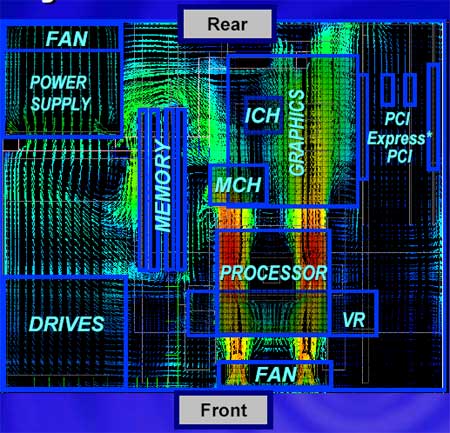
You know, if you swapped the CPU around to the back of the board and kept the duct effect, that'd be pretty neat, a nice efficient design. As it stands, I really don't like the thought of having the CPU up at the front of the board dumping its heat into the inside of the case. Maybe if it was a true straight-through duct with both intake and exhaust fans creating a wind tunnel. But the way the air dissapates with the current setup worries me. Another thing is with the way they're redesigning add-in cards to have the componants fliped around, wouldn't this stick the GPU HSF right into the hot air comming off the CPU?
Yes, it would. Just like the RAM, northbridge and all other components inside the case. Except for the CPU, which would be nice and cool.Originally posted by Atragon
Another thing is with the way they're redesigning add-in cards to have the componants fliped around, wouldn't this stick the GPU HSF right into the hot air comming off the CPU?
Anyone thinks that BTX is merely an attempt by Intel to compensate for their inability to come up with a CPU design that doesn't double as a space heater?
Black Morty Rackham
Supreme [H]ardness
- Joined
- Jan 8, 2004
- Messages
- 4,728
Originally posted by Party2go9820
Don't forget that lots of OEM's now only use 1 fan - the one in the power supply. (I'm not counting the the cooling fan directly on the HS because you need that no matter what). Some have an additional exhaust fan right behind the CPU with some ducting, but those are far and few between. OEM's will figure out the best and cheapest way to cool things with least heat buildup.
A friend of mine has a Dell (Dimension, I think)... one fan at the PSU (well, in a duct behind it, really) and one at the CPU. It makes an incredible ruckus. The processor fan has to run at insane speeds to cool it enough, I suppose. Not a good design. Plus how much of a hazzle changing anything inside it is... I wouldn't call it a good case design.
Originally posted by Black Morty Rackham
A friend of mine has a Dell (Dimension, I think)... one fan at the CPU (well, in a duct behind it, really) and one at the CPU. It makes an incredible ruckus. The processor fan has to run at insane speeds to cool it enough, I suppose. Not a good design. Plus how much of a hazzle changing anything inside it is... I wouldn't call it a good case design.
I have a Dimension 4100. It has no fan on the HS. It has a duct with a fan on it.
That fan ran low rpm until the temp in the room got over 100 f. Then the fan would kick up, and it was estremely noisy.
Since then, I have removed the fan and duct, and put a new HSF on the CPU. The Fan I was going to use broke, so I used a generic low RPM fan instead. It's a Volcano 9 on a PIII coppermine, 1 ghz. It's waaaay overkill, I know, even with the fan that moves so little air, it's practically not there. it's very effective, though. That heatsink has never gotten even warm to the touch.
I could care less about anything other than my chipset and CPU. My current main case has a massive fan blowing fresh, cool air in directly over my CPU fan and chipset fan. I could care less about the rest of my case. My Vid card never gets too hot. My hard drives even don't get too hot. I do have a pair of dedicated fans for the HDDs, just to keep air moving. Still air is bad air.
I'm not gonna use BTX. What a fucking waste. If it isn't interchangable with the rest of my computer systems, forget it. Since I am 100% ATX right now, BTX has no future for me. Unless ATX vanishes. In which case, I will have to conform.
- Joined
- Aug 11, 2000
- Messages
- 3,695
Originally posted by Black Morty Rackham
A friend of mine has a Dell (Dimension, I think)... one fan at the CPU (well, in a duct behind it, really) and one at the CPU. It makes an incredible ruckus. The processor fan has to run at insane speeds to cool it enough, I suppose. Not a good design. Plus how much of a hazzle changing anything inside it is... I wouldn't call it a good case design.
If its really that loud, it sounds like a hardware problem - maybe the fan is failing. Most OEM's - Dell's espicially - are extremly quiet.
Yes, a Dell should be very quiet. A noisy fan should be replaced if still under warranty.Originally posted by Party2go9820
If its really that loud, it sounds like a hardware problem - maybe the fan is failing. Most OEM's - Dell's espicially - are extremly quiet.
Originally posted by kronchev
its not a furnace, youre trying to get heat AWAY from something, not heat up air
I don't know, it kinda makes sense to me. You're trying to get heat away from a furnace too. Otherwise it won't heat the house (assuming air heat).
Originally posted by emorphien
I don't know, it kinda makes sense to me. You're trying to get heat away from a furnace too. Otherwise it won't heat the house (assuming air heat).
but the elements of a furnace can stay hot and thats OK, in fact thats probabily most desirable. there is only one really, really hot part of a computer, the CPU, and you want the CPU to have the best chance of dissapating heat
Originally posted by kronchev
but the elements of a furnace can stay hot and thats OK, in fact thats probabily most desirable. there is only one really, really hot part of a computer, the CPU, and you want the CPU to have the best chance of dissapating heat
I'm having an internal debate about which I think would be better. How big of a cooling boost would the CPU get with BTX over having some of the cold air coming in over other components that need cooling too
Having it come over them and hitting the CPU last pulls more hot air from the case, which in turn makes for a cooler case, which might have a bigger effect on dropping the CPU temp that we're thinking.
Personally I think they should have two ducting systems, one for the CPU and one for the other goodies to cool all of it in a very effective manner. Just use one 92mm fan for each and a duct and it would work quite well.
The reason why you want a furnace to work like that is because if it goes over the warm spots after the "hot" spot, the air will be (for simplicity) the same tempurature as the warm spot, therefore it will not increase the air temperature anymore. This will work great for a furnace.
For a computer we only really have one hot spot, therefore we don't want the air being partially heated before it gets to this, and for most part we don't care about keeping all the other spots "cold" except video card, and maybe northbridge.
If btx was setup to be northbridge infront of cpu then exhaust, sure the exhausted air will be warmer, but this means the cpu will also be warmer.
The btx setup with cpu infront will keep the cpu cooler then the above, and this is what we want. Sure there are other ways to accomplish this without switching to btx, but btx will be better then our current setup.
For a computer we only really have one hot spot, therefore we don't want the air being partially heated before it gets to this, and for most part we don't care about keeping all the other spots "cold" except video card, and maybe northbridge.
If btx was setup to be northbridge infront of cpu then exhaust, sure the exhausted air will be warmer, but this means the cpu will also be warmer.
The btx setup with cpu infront will keep the cpu cooler then the above, and this is what we want. Sure there are other ways to accomplish this without switching to btx, but btx will be better then our current setup.
Originally posted by emorphien
I'm having an internal debate about which I think would be better. How big of a cooling boost would the CPU get with BTX over having some of the cold air coming in over other components that need cooling too
Having it come over them and hitting the CPU last pulls more hot air from the case, which in turn makes for a cooler case, which might have a bigger effect on dropping the CPU temp that we're thinking.
Personally I think they should have two ducting systems, one for the CPU and one for the other goodies to cool all of it in a very effective manner. Just use one 92mm fan for each and a duct and it would work quite well.
itd give a bigger temp DIFFERENTIAL and the air comingo out would be hotter, but the main reason for cooling, the CPU, would not be cooler with this system.
a dual duct would be better, but this is the crap they decided on. beats the hell out of ATX (and looks like AT, anyone point that out yet?) but of course, could be better. they shouldve asked us first
seriously, if you think about it, they shouldve asked the community who KNOWS THIS STUFF. they look at keeping temps down as keeping the CPU stable, no matter the temp. we look at keeping everything as low as possible so it can be pushed as far as possible.Originally posted by emorphien
eh, I'm not prepared to cool the CPU at the expense of the other components.
And a cooler case means a happier case, this isn't making cases cooler.
CPU gets ten times hotter than anything else, except maybe the vid card. but if cooling there is a problem im sure that theyre going to get a FX-esque cooling system thatll work splended
Originally posted by emorphien
Hence I'd prefer two ducts, one for the CPU, one for everything else.
well, us modders will have our way with these and make them actually efficient for OCing i'm sure
Originally posted by kronchev
well, us modders will have our way with these and make them actually efficient for OCing i'm sure
That'd be an easy mod and one I'd definitely take a few hours out of my day to make sure I do it right.
BTX will keep the case nice and warm, while ATX will only have higher CPU temperatures with a poorly implemented cooling solution (re: ducts).Originally posted by Spearboy
would this be right to say. btx keeps the case at a more even temp, while atx keeps the case cooler but the cpu hotter?
Originally posted by Elledan
BTX will keep the case nice and warm, while ATX will only have higher CPU temperatures with a poorly implemented cooling solution (re: ducts).
agreed
Black Morty Rackham
Supreme [H]ardness
- Joined
- Jan 8, 2004
- Messages
- 4,728
Originally posted by m³ñ
I have a Dimension 4100. It has no fan on the HS. It has a duct with a fan on it.
Typo on my part
Meant PSU.I actually give a lot of credit to BTX. They make the quiet PC much easier to realize. By aligning all the hot components (except the power supply and hard drive) along a common airstream, it makes the most of those two fans that are needed, instead of "spot-cooling" of the CPU, GPU, and northbridge/southbridge areas. "Spot-cooling" is a great practice for overclockers and those who don't care about acoustic performance. Unfortunately, I'd say that overclockers weren't given much consideration here, which is probably why a lot of you are upset. The thing is that BTX didn't ruin your plans; you just have to add more fans like you always have. At least with this method, your power supply isn't being compromised by through-flow of hot air from the CPU area like in the ATX design.