• Some users have recently had their accounts hijacked. It seems that the now defunct EVGA forums might have compromised your password there and seems many are using the same PW here. We would suggest you UPDATE YOUR PASSWORD and TURN ON 2FA for your account here to further secure it. None of the compromised accounts had 2FA turned on.
    Once you have enabled 2FA, your account will be updated soon to show a badge, letting other members know that you use 2FA to protect your account. This should be beneficial for everyone that uses FSFT.

Leaked AMD Ryzen Benchmarks?

It's a no brainer to wait at this point. Ryzen is going to put the hurt on Intel.

That would be cool. I typically prefer intel myself (just have bad better luck with Intel systems over the years). I'll still consider Ryzen though. However, I'm most interested in AMD causing Intel to no longer be complacent and release something a bit more potent. All of their CPU's since Sandy Bridge have been pretty similar.
 
AMD's clock speeds are what they are 3.4 for the 8 core with boost, that is the pretty much air cooled top end. The serial number tells us the clock speed targets ;), so unless they have another respin..... They are what they are, and launch is coming up in 2 or 3 weeks.
Its going to come down to a price war, and Intel is planning for it.
I am talking more about the 4-Core models with regards to still being worked on, to me it feels like only the 8c/16 and 6c/12 have finalised clock rates ready for launch.
TBH I am assuming for now they would not be releasing the 4c models, and we have not seen any distributor price leaks with those appearing online only the 8c/16t models and maybe one of the 6c/12.
The 8c/16t seems to have reasonable clocks because its performance is up there albeit in synthetics and debatable build with all 8 cores being used and that is based upon the 1700x rather than 1800x (of course we need to see how different they behave in terms of performance-clocks).
The 3.4Ghz for the 8/16t is still lower than the top CPU at 3.6Ghz base 8c/16t that in theory is a pretty good clock for an 8/16 CPU with some built in overclocking ability.

Of course it may be finalised if going by the 4c serial/part in the leaked benchmark with its 3.2 to 3.4 (important to note this is the or one of the lowest 4c model), but if so it is still an improvement on the weaker-older I3 and i5 models, but it is interesting all the distributor price leaks/pre-order are for 6c and 8c.
And I would expect another iteration later on for that 4c as there are multiple models with various clocks (the higher ones are currently missing and I doubt we will see them for a little while if rumours-news about the challenges experienced cutting down from 8c are true).
Cheers
 
Last edited:
That would be cool. I typically prefer intel myself (just have bad better luck with Intel systems over the years). I'll still consider Ryzen though. However, I'm most interested in AMD causing Intel to no longer be complacent and release something a bit more potent. All of their CPU's since Sandy Bridge have been pretty similar.
Not entirely accurate. Performance per watt has essentially doubled since Sandy Bridge. Intel hasn't been feeling the pinch performance wise, it has been feeling the pinch in power consumption in the laptop and smaller mobile market, and on the server level in Data Centers.
 
Not entirely accurate. Performance per watt has essentially doubled since Sandy Bridge. Intel hasn't been feeling the pinch performance wise, it has been feeling the pinch in power consumption in the laptop and smaller mobile market, and on the server level in Data Centers.
Yeah.
And that is basically where Intel went with their development, laptops and server/HPC.
This is even more emphasised with Kaby Lake.
Cheers
 
Yeah.
And that is basically where Intel went with their development, laptops and server/HPC.
This is even more emphasised with Kaby Lake.
Cheers

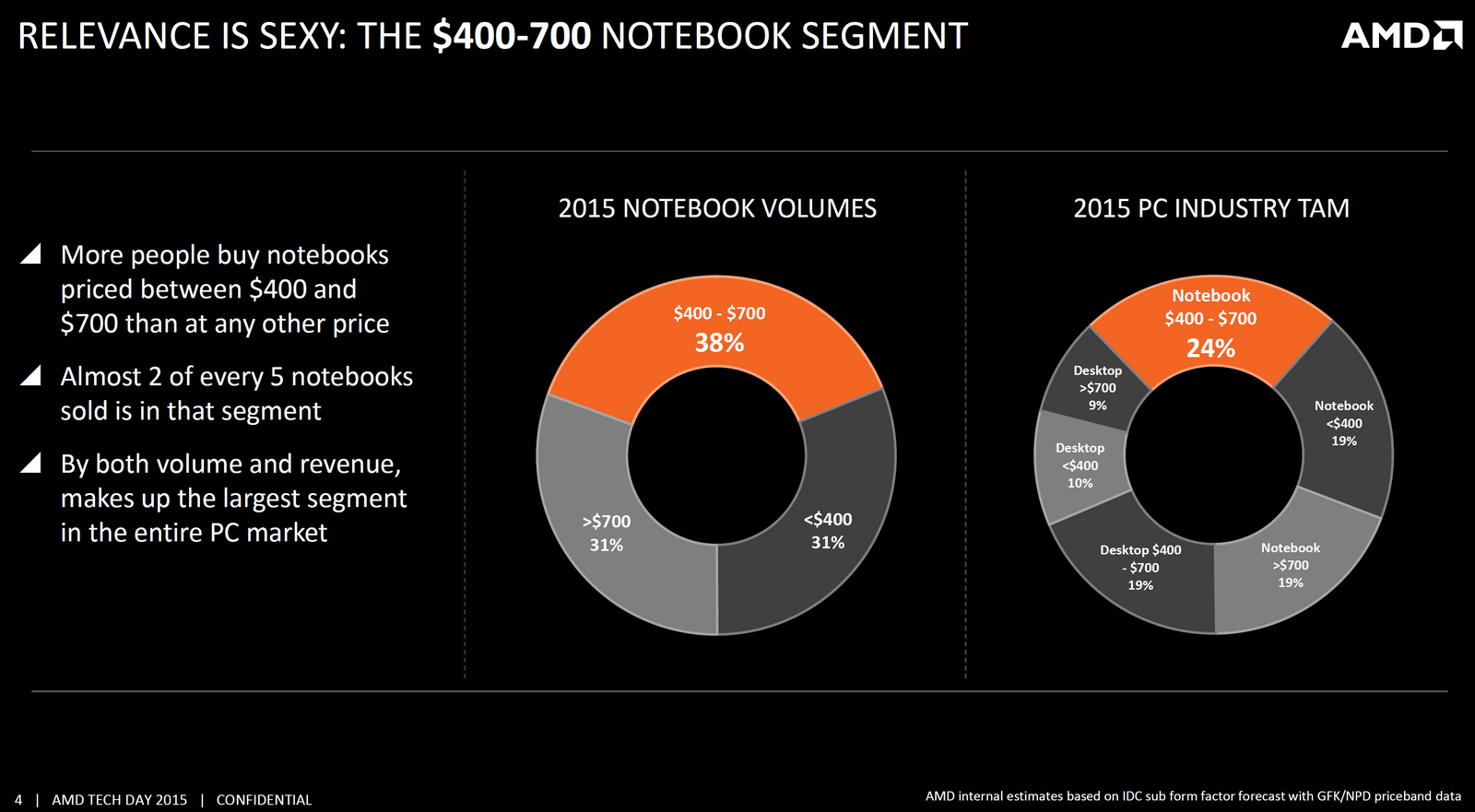
And with good reason. This slide today would just be even more focused on mobile over desktop.
Slide%204%20-%20TAM.png
 
Performance per watt has essentially doubled since Sandy Bridge.

From the leaks it seems AMD somehow has at least caught up and maybe even are better on Performance per watt although I am anxiously waiting for the NDA to be lifted and see some benchmarks.
 
Not entirely accurate. Performance per watt has essentially doubled since Sandy Bridge. Intel hasn't been feeling the pinch performance wise, it has been feeling the pinch in power consumption in the laptop and smaller mobile market, and on the server level in Data Centers.

That is a good point that i hadn't though about. Efficiency is definitely a great thing to continue working for. But if you look at my signature you'll probably notice that efficiency isn't my top priority but just an added bonus. Every generation has had slight refinement in feature sets as well but nothing to make me jump at upgrading. I would like to have 32+ PCIe lanes in my next setup though!
 
That is a good point that i hadn't though about. Efficiency is definitely a great thing to continue working for. But if you look at my signature you'll probably notice that efficiency isn't my top priority but just an added bonus. Every generation has had slight refinement in feature sets as well but nothing to make me jump at upgrading. I would like to have 32+ PCIe lanes in my next setup though!
Also when you start going towards 18 cores and more, it starts to matter heavily.
Has synergy in this regard with laptops and other mobile products in terms of efficiency-power demand-tdp.
Cheers
 
I am talking more about the 4-Core models with regards to still being worked on, to me it feels like only the 8c/16 and 6c/12 have finalised clock rates ready for launch.
TBH I am assuming for now they would not be releasing the 4c models, and we have not seen any distributor price leaks with those appearing online only the 8c/16t models and maybe one of the 6c/12.
The 8c/16t seems to have reasonable clocks because its performance is up there albeit in synthetics and debatable build with all 8 cores being used and that is based upon the 1700x rather than 1800x (of course we need to see how different they behave in terms of performance-clocks).
The 3.4Ghz for the 8/16t is still lower than the top CPU at 3.6Ghz base 8c/16t that in theory is a pretty good clock for an 8/16 CPU with some built in overclocking ability.

Of course it may be finalised if going by the 4c serial/part in the leaked benchmark with its 3.2 to 3.4 (important to note this is the or one of the lowest 4c model), but if so it is still an improvement on the weaker-older I3 and i5 models, but it is interesting all the distributor price leaks/pre-order are for 6c and 8c.
And I would expect another iteration later on for that 4c as there are multiple models with various clocks (the higher ones are currently missing and I doubt we will see them for a little while if rumours-news about the challenges experienced cutting down from 8c are true).
Cheers


Well as you stated 4 core Ryzen at launch looks to be 3.6 ghz base clock for the highest end one, so not sure if their are any ones above that. Not sure if later on they will come out with higher clocked parts, cause if they can't do it right now, by the time they will be ready with higher clocked cores, Intel might have a response. It seems like the process is holding back the clock speed, its unusual to see a half disabled chip or half the size chip not being able to clock more than the full chip. Seems like voltage limits are close. But it could be the architecture forcing those voltage limits too.

Oh forgot, AMD isn't selling Ryzen to OEM's yet at least for another quarter or maybe two, so either OEM's aren't going to pick up Ryzen because well diversifing product lines actually hurt sales in the same segment when market share of a particular product is extremely high or AMD is trying to get rid of old CPU stock, I think its a combination of both.
 
People that are penny pinching for systems, aren't going to be looking for new products that are going to cost them 1k to 2k , if they want performance close to a brand new lets say 4 core AMD Ryzen system, why not just upgrade their CPU with a 150 buck used ivy bridge, they might be what 10% slower with the clock difference they might actually end up being close when Ivy Bridge is overclocked.

That is AMD problems, who in the world is going to have a system that is oh greater than 5 years old and looking to upgrade......

When we start looking at software that makes sense for people to upgrade, the only ones have been in recent times been professional needs (or things done at home associated with professional needs, like video editing). Games haven't, OS's haven't (OS's have been going down the way of using less resources rather than more). Up until Haswell, software used the extra IPC, cores, etc. For the past 5 years, we have been sitting stagnant on software uses for regular home things.

Upgrade paths in the past for OS, Vista and 7 (7 to a lesser degree but still need for people with win xp systems) forced system resource needs Windows 10 didn't do that. Then we got games, after 4 core become the standard games started pushing 4 cores for 5 years now so. But only a few games came out that could take advantage of 6 core.

The need from a software side makes the need for the upgrade for a PC, for enthusiasts, its the same thing, if it wasn't for the fact I need to do 3d work on my system, I wouldn't be bothered with getting dual xeon's and all those goodies, I would be happy with my old haswell cpu that I use for my multi media machine as a gaming system. Why spend 4k on a system that won't give me benefits?

Typical gamers, have already decent systems for their needs lets look at steam survey for a bit.

http://store.steampowered.com/hwsurvey/cpus/


2 and 4 core CPU's are pretty much all of the users.

now the marketshare figures, actually mimic the JPR and Mercury figures for CPU's

http://store.steampowered.com/hwsurvey/processormfg/

So I think its safe to say most 2 core users are using i 3 right? Would they need to upgrade, if they haven't yet, why would they now?

What is their upgrade path?

I would think they would just rather get an i5 that will fit in their socket rather than get an entirely new system wouldn't you?

If at this point they want a new system why would they choose AMD instead of Intel (when Intel drops prices to stay in the same pricing brackets)? What benefits will they get. Are they using a system that doesn't have a discreet GPU, I-3's are fairly low end gotta ask that too. Intel's performance advantage for the past 10 years or so gave them brand recognition and market share, both of these gave them mind share. AMD needs to over come both brand recognition and turning mind share away from Intel (if prices are the same for competing products) to gain market share. That is not easy to do when products are competitive and in a market where people tend to buy every few years.

This is why its so damn hard when a company after losing ground more than 1 generation to come back to status quo with competitive products, let alone surpassing their competition.
A) How is it going to cost them 1k to 2K?
B) The cheapest Ivy I see is $250 new. Hell people on 1155 are probably the key targets. I'm on 1155 and already have a 6-core Ivy. Trust me I'm upgrading when I get a chance. I can never have enough cores.
C) An enthusiast will find an excuse to upgrade. I know I do. If I see a stutter in a video game or can't turn something to max I'm immediately thinking about it's replacement.
 
Well as you stated 4 core Ryzen at launch looks to be 3.6 ghz base clock for the highest end one, so not sure if their are any ones above that. Not sure if later on they will come out with higher clocked parts, cause if they can't do it right now, by the time they will be ready with higher clocked cores, Intel might have a response. It seems like the process is holding back the clock speed, its unusual to see a half disabled chip or half the size chip not being able to clock more than the full chip. Seems like voltage limits are close. But it could be the architecture forcing those voltage limits too.
Yeah, it could also be due to the node-fab and focus towards the 8-core version, AMD no longer control a fab directly and so an advantage for Intel in that regard.
Along with complications of cutting the various caches (especially the shared L3)/cores and the integral advance functions prefetch/'neural net' prediction/SMT/SenseMI.
It is not just seen with the 4 core but also the reduction in clocks with the cut 6 core but not as severe.
Their initial released 4 core is more of a budget one IMO until they can get the higher clocked ones out, which may be fine considering the price position of the 6 core between I5 and I7.
Cheers
 
A) How is it going to cost them 1k to 2K?
B) The cheapest Ivy I see is $250 new. Hell people on 1155 are probably the key targets. I'm on 1155 and already have a 6-core Ivy. Trust me I'm upgrading when I get a chance. I can never have enough cores.
C) An enthusiast will find an excuse to upgrade. I know I do. If I see a stutter in a video game or can't turn something to max I'm immediately thinking about it's replacement.


A) an entire new AMD system will cost 1 to 2 k cause unlike intel systems you need to get a graphics card, so lets add it up, 150 for the processor, 150 for the motherboard, 100 for the hard drive (and what ever else), 100 for the ram, 50 for the power supply, and 200 for the graphics card. 800 plus tax, around 900 bucks. Ok was a bit on the high side for a low end system.

B) ebay http://www.ebay.com/sch/i.html?_fro....H0.Xivy+bridge.TRS1&_nkw=ivy+bridge&_sacat=0 I see alot of cheaper ones there. Well I have 20 cores and yeah I need more cores too (only for my work though, don't' need them for anything else), but only when it price meets performance that I'm looking at. Even though I can easily spend 20k a year on CPU's alone I won't do it. not worth the money for the turn around time. I don't see a speed difference in outside of things I do for work comparing my 20 core machine vs my 4 core machine. And of course the occasional video stuff I do for friends and family. But seriously that's like what 3 times a year, don't need the 20 core machine for that.

C) That isn't an enthusiast. You can have enthusiasts that don't have the money to upgrade every year, but they still love their hardware. They might not be able to buy the best of the best, but still are enthusiasts.

I'm wasn't talking about the enthusiast segment in graphic cards or cpu sales demographics.

I was talking about people that love their hardware and are willing to spend a good deal of their yearly money on the best hardware they can buy. I should have been clearer about that, sorry.

AMD is targeting enthusiasts by their own admission, hence why they aren't going into OEM's yet, which I think is BS, cause reasoning is beyond logic. But the fact that there is no GPU in Ryzen for the time being, is going to hurt mainstream and value sales that is probably why OEM's didn't pick them up initially. But that also forces AMD to target enthusiasts specifically gaming enthusiasts, because of the need of a dGPU.
 
Last edited:
As an eBay Associate, HardForum may earn from qualifying purchases.
Yeah, it could also be due to the node-fab and focus towards the 8-core version, AMD no longer control a fab directly and so an advantage for Intel in that regard.
Along with complications of cutting the various caches (especially the shared L3)/cores and the integral advance functions prefetch/'neural net' prediction/SMT/SenseMI.
It is not just seen with the 4 core but also the reduction in clocks with the cut 6 core but not as severe.
Their initial released 4 core is more of a budget one IMO until they can get the higher clocked ones out, which may be fine considering the price position of the 6 core between I5 and I7.
Cheers


Yeah won't really know till we see more tests on it

Its not really a budget CPU when there is no APU.....

Also the way AMD split their SKU's doesn't seam to be room for more SKU's they line up with Intel SKU's, if they are to "replace" SKU's later on with higher end models due to frequency increases on the same node, That will cause some headaches for system builders. This might be another reason why OEM's didn't pick them up, but I think that is too many if's ;) foresight like that, AMD wouldn't share with OEM's.
 
Last edited:
My amd builds were around $450. $65 processor 860k, $65 motherboard a88x, $35 ram ddr3 2400, $40 1tb hard drive, $169 r9 380 2gb, $40 evga 500watt, $50 case. Hell, even my FX8320e was same price and i got a much nicer motherboard and cpu from microcenter. I dont even use integrated graphics when i use an APU like the a8-7600 i got for $60.
 
the new ryzen builds are going to be a bit more expensive then the bulldozer builds the lowest end Ryzen that is to be released is going for ~150 bucks
 
We have no idea how well the 4c Ryzen will overclock yet. Far as I know we only have seen the 8c.
 
Yeah, it could also be due to the node-fab and focus towards the 8-core version, AMD no longer control a fab directly and so an advantage for Intel in that regard.
Along with complications of cutting the various caches (especially the shared L3)/cores and the integral advance functions prefetch/'neural net' prediction/SMT/SenseMI.
It is not just seen with the 4 core but also the reduction in clocks with the cut 6 core but not as severe.
Their initial released 4 core is more of a budget one IMO until they can get the higher clocked ones out, which may be fine considering the price position of the 6 core between I5 and I7.
Cheers

I agree with your assessment. The only reason the 4 core clock speeds are low is they are made from less optimized cannabilized 8 cores right now. I expect within a couple of months new skus for 4 cores made in a dedicated 4 core process will roll out. meanwhile the AMD is emphazizing their 6 and 8core chips which have a greater profit margin. It has ABSOLUTELY nothing to do with process as the naysayers have suggested. The new skus will probably be led by an XFR chips with 3.8 GHZ- 4.0 GHZ base frequency. They will be highly competitive with Sky Lake and overrated Kaby Lake. The rantings of flawed process originate from Juanrga over at Toms Hardware, but the only flawed process is his subjectivity. 14 LPP is not merely a low power mode, it has extensive HP capabilities.
 
the new ryzen builds are going to be a bit more expensive then the bulldozer builds the lowest end Ryzen that is to be released is going for ~150 bucks

I've seen some conversions of the numbers go down as low as $125-130ish for the base model. But with a B350 motherboard potentially in the $80 range you're looking at $200-220 for an unlocked 4C/4T with motherboard that allows OCing (with a halfway decent stock cooler included based on Wraith results).

That's $15-35 more than just a new unlocked i5 without a motherboard or decent cooler.... and that i5 7400 clocks at 3ghz with 3.5ghz boost only.
 
I've seen some conversions of the numbers go down as low as $125-130ish for the base model. But with a B350 motherboard potentially in the $80 range you're looking at $200-220 for an unlocked 4C/4T with motherboard that allows OCing (with a halfway decent stock cooler included based on Wraith results).

That's $5-25 more than just a new unlocked i5 without a motherboard or decent cooler....


Depending on performance Intel will drop prices to stay competitive. No one needs to even think twice about that. Yeah I just used average numbers for estimation purposes.
 
Depending on performance Intel will drop prices to stay competitive. No one needs to even think twice about that. Yeah I just used average numbers for estimation purposes.

They're going to drop $50-60 or 30% of the cost off a baseline i5? I sincerely doubt that their shareholders will appreciate that.

So I wouldn't make that a foregone conclusion and wave your magic wand.
 
Intel wont lower a I5 to the Ryzen 4c prices. Intel will say the 6c is the equivalent to their quad core now with hyper-threading.
 
They're going to drop $50-60 or 30% of the cost off a baseline i5? I sincerely doubt that their shareholders will appreciate that.

So I wouldn't make that a foregone conclusion and wave your magic wand.

They have to, if their margins are going to drop 12% which is their estimate, 12% is on their end, retailers will drop X amount too as MSRP will now change.

The total price of the processor is not all Intel's, only about 40% of it is what Intel is making. The rest of it is from retailers, system builders and OEM's.

You think my IT deperatment buy's Xeons from Intel at full price on ark? Nope less than 50% of the cost, actually closer to less that 60% of the cost.

Why do you think if you buy a system through Dell, HP or whom ever OEM with an employee discounts ya get around 40% off the entire system? Guess what Those OEM's are still making 20% or more on each system, they need to ensure their overhead is still taken care of and additional profits.

So if Intel is dropping margins by 12%, more cuts will be on the lower end ranges, they probably will cut their individual SKU margins down to 45% i-3 to i-5's, which are volume sales. And this is where you get the over all 12-15% margin drop overall.

Intel would not have told in their financial calls that their margins are going to drop that drastically unless they are planning to cut prices by a large margin. That is a huge drop for one quarter with no new products to speak of.
 
Last edited:
They have to, if their margins are going to drop 12% which is their estimate, 12% is on their end, retailers will drop X amount too as MSRP will now change.

The total price of the processor is not all Intel's, only about 40% of it is what Intel is making. The rest of it is from retailers, system builders and OEM's.

You think my IT deperatment buy's Xeons from Intel at full price on ark? Nope less than 50% of the cost, actually closer to less that 60% of the cost.

Ok there we go:

upload_2017-2-15_15-36-18.jpeg


That's your answer. I'm talking lower end markets, not server parts that have enormous mark-ups.

Show me exactly how much a retailer like Newegg buys the i5 7400 for with some kind of proof before you try that nonsense.
 
I'm definitely buying an 1800X setup as soon as I can. I'm so confident I will even pre-order if given the opportunity, but Lisa Su did say there will be no supply issues at launch.
 
Ok there we go:

View attachment 17046

That's your answer. I'm talking lower end markets, not server parts that have enormous mark-ups.

Show me exactly how much a retailer like Newegg buys the i5 7400 for with some kind of proof before you try that nonsense.


Just look at the sales that newegg has on their CPU's end of year, or black friday, or EOL sales to get rid of stock then drop 20% off of that then you get what retails buy their stock for. Last year I picked up a Haswell I7 4770 for 200 bucks, just as Skylake came out, You think Newegg made a loss on that sale? No, no retailer would that that with these kinds of products.

There is no way HP has been giving 30% off coupons for their systems, if the retailer doesn't have that much and more profit on their systems. HP does this almost every month.

Dell used to too but in the last year I haven't seen much.

Lenovo still does as well.

Yeah, its that simple.
 
Just look at the sales that newegg has on their CPU's end of year, or black friday, or EOL sales to get rid of stock then drop 20% off of that then you get what retails buy their stock for. Last year I picked up a Haswell I7 4770 for 200 bucks, just as Skylake came out,

Yeah, its that simple.

I'm surprised you think their margins are that high to start with. EOL they're selling at cost or even below if they're desperate.
 
Just look at the sales that newegg has on their CPU's end of year, or black friday, or EOL sales to get rid of stock then drop 20% off of that then you get what retails buy their stock for. Last year I picked up a Haswell I7 4770 for 200 bucks, just as Skylake came out, You think Newegg made a loss on that sale? No, no retailer would that that with these kinds of products.

There is no way HP has been giving 30% off coupons for their systems, if the retailer doesn't have that much and more profit on their systems. HP does this almost every month.

Dell used to too but in the last year I haven't seen much.

Lenovo still does as well.

Yeah, its that simple.

I'm talking retail, not direct OEM sales... there is a difference between those industries.
 
I'm talking retail, not direct OEM sales... there is a difference between those industries.


OK that is a kinda presumption cause if you look at system upgrade prices in Dell, HP, etc, they charge the same amount for each component upgrade, minus the initial proc price.

Why the hell do you think, OEM's have had to drop margins! Cause now they have to go through retailers, there are three people making money, not two!

So for DELL, HP, Lenovo, people buying through then two companies are making money, but more sales are direct to consumer though stores (this is why Dell lost a lot of ground 10 years ago because the inet model didn't work anymore because of the increased overhead and competition by other dropping their margins to make up ground) So for those sales there are three companies that have to make money.

Over all, you are splitting that dollar very thin, so if anything, OEM's have less flexibility to drop cost.
 
OK that is a kinda presumption cause if you look at system upgrade prices in Dell, HP, etc, they charge the same amount for each component upgrade, minus the initial proc price.

Why the hell do you think, OEM's have had to drop margins! Cause now they have to go through retailers, there are three people making money, not two!

OEM's like HP, Dell, and Lenovo buy direct from Intel last I checked, no third party.

They make money on PCs that exact same way car manufacturers make money over base model vehicles, with those increasing costs of upgrades. Ever notice how RAM upgrades have historically been a bad deal when configuring a PC online? Same with accessories, just like a coke and fries at your local fast food joint, that's where they can make $$.

Base models are always bare minimum margins.
 
OEM's like HP, Dell, and Lenovo buy direct from Intel last I checked, no third party.

They make money on PCs that exact same way car manufacturers make money over base model vehicles, with those increasing costs of upgrades. Ever notice how RAM upgrades have historically been a bad deal when configuring a PC online? Same with accessories, just like a coke and fries at your local fast food joint, that's where they can make $$.

Base models are always bare minimum margins.


What about the retailers that selling those PC's?

What there is no retail sales, last I checked retail sales are much larger than inet sales.

Intel's 63% margins, most of that comes from i-5's ;), but all their CPU's have higher than 50% margins right now. Which is crazy amounts.

And no way can AMD put pressure on that, even if Intel has to drop prices to match AMD, their margins will still be higher.

That is why Intel is expecting 50% margins, and AMD Ryzen margins will only go up to 35% in the first 2 quarters of its full release.

If anyone read that article that I posted just a page or two ago, they would know exactly why Intel's margins are the way they are and why AMD can't do anything about it outside of hedging their bets or playing a war of attrition.
 
What about the retailers that selling those PC's?

What there is no retail sales, last I checked retail sales are much larger than inet sales.

Intel's 63% margins, most of that comes from i-5's ;), but all their CPU's have higher than 50% margins right now. Which is crazy amounts.

And no way can AMD put pressure on that, even if Intel has to drop prices to match AMD, their margins will still be higher.

That is why Intel is expecting 50% margins, and AMD Ryzen margins will only go up to 35% in the first 2 quarters of its full release.

Mobile market i5's like the one in my work laptop that are actually dual core which they charge more for than the true 4 cores of the desktop sphere.

That is the high profit area that they've been dominating for such high margins.
 
A) an entire new AMD system will cost 1 to 2 k cause unlike intel systems you need to get a graphics card, so lets add it up, 150 for the processor, 150 for the motherboard, 100 for the hard drive (and what ever else), 100 for the ram, 50 for the power supply, and 200 for the graphics card. 800 plus tax, around 900 bucks. Ok was a bit on the high side for a low end system.

B) ebay http://www.ebay.com/sch/i.html?_fro....H0.Xivy+bridge.TRS1&_nkw=ivy+bridge&_sacat=0 I see alot of cheaper ones there. Well I have 20 cores and yeah I need more cores too (only for my work though, don't' need them for anything else), but only when it price meets performance that I'm looking at. Even though I can easily spend 20k a year on CPU's alone I won't do it. not worth the money for the turn around time. I don't see a speed difference in outside of things I do for work comparing my 20 core machine vs my 4 core machine. And of course the occasional video stuff I do for friends and family. But seriously that's like what 3 times a year, don't need the 20 core machine for that.

C) That isn't an enthusiast. You can have enthusiasts that don't have the money to upgrade every year, but they still love their hardware. They might not be able to buy the best of the best, but still are enthusiasts.

I'm wasn't talking about the enthusiast segment in graphic cards or cpu sales demographics.

I was talking about people that love their hardware and are willing to spend a good deal of their yearly money on the best hardware they can buy. I should have been clearer about that, sorry.

AMD is targeting enthusiasts by their own admission, hence why they aren't going into OEM's yet, which I think is BS, cause reasoning is beyond logic. But the fact that there is no GPU in Ryzen for the time being, is going to hurt mainstream and value sales that is probably why OEM's didn't pick them up initially. But that also forces AMD to target enthusiasts specifically gaming enthusiasts, because of the need of a dGPU.
So you just decided that every upgrade needs a total replacement of all hardware? You don't think that's a little extreme?

As I said before sure you can get one used. Hell you could get a whole new system used. But I think for the vast majority people will buy new.
 
As an eBay Associate, HardForum may earn from qualifying purchases.
That is my plan as well. But no pre-order. I will get a better deal at Micro Center with motherboard - CPU bundle savings. FAR cheaper than Newegg.

I'm definitely buying an 1800X setup as soon as I can. I'm so confident I will even pre-order if given the opportunity, but Lisa Su did say there will be no supply issues at launch.
 
So you just decided that every upgrade needs a total replacement of all hardware? You don't think that's a little extreme?

As I said before sure you can get one used. Hell you could get a whole new system used. But I think for the vast majority people will buy new.


I would for things like power supply and hard drives, only because those are things that tend to fail in older computers. Moveable parts and high voltage capacitors are the most likely problem areas in PC's.

CPU's, ram, things like that, you can get used because those are solid state components, unless miss handled they are unlikely to fail (dropped, static shock are likely issues that will cause corruption). But hard drives and power supplies are the most probably components to fail over time vs, the other parts in a system.
 
So you just decided that every upgrade needs a total replacement of all hardware? You don't think that's a little extreme?

As I said before sure you can get one used. Hell you could get a whole new system used. But I think for the vast majority people will buy new.
I think in this situation much will be replaced but I would say some of the prices would be lower than what has been mentioned unless they are building enthusiast level.
The B350 mainstream motherboards have a price it seems in the range of $85 to $130.
DDR4 RAM will need to be purchased as they would be coming from older tech but that has some price flexibility although one ideally needs 16GB min.
GPU I think more budget mainstream will focus on price around $100 to $135, may buy 2nd hand.
PSU, may or may not upgrade but more chance they will if it is old.
Hybrid disk drive +ssd for OS or just a hybrid disk drive or already have the setup they want, depends upon the consumer.
Upgrade to Win10 may have cost considerations if they did not upgrade say their old Win 7 license (I am one who kept their old Win 7 license so this would affect me doh).

But then this all applies if upgrading to Skylake/Kaby Lake from an older gen.
Cheers
 
Last edited:
AMD's clock speeds are what they are 3.4 for the 8 core with boost, that is the pretty much air cooled top end. The serial number tells us the clock speed targets ;), so unless they have another respin..... They are what they are, and launch is coming up in 2 or 3 weeks.

Its going to come down to a price war, and Intel is planning for it.

You forgot about 3.6 GHZ base and 4.0 Boost for the 1800X??? Convenient loss of memory??? I sincerely hope your not on beta blockers or statins like me.
If you are implying the 1700X and 1800X can not function on air cooling you are dead wrong. A Cooler Master Maker 8 , a Noctua 15D, or a high-end Thermalright Silver Arrow cpu cooler will allow some reasonable overclocking. Personally I am using an Alphacool Eisbaer 360 . I already installed it in the top of a new case I bought, a Thermaltake Core V71. I expect to be able to overclock my Ryzen 1800x to 4.2 or 4.3 GHZ on all 8 cores.
 
Last edited:
Back
Top