• Some users have recently had their accounts hijacked. It seems that the now defunct EVGA forums might have compromised your password there and seems many are using the same PW here. We would suggest you UPDATE YOUR PASSWORD and TURN ON 2FA for your account here to further secure it. None of the compromised accounts had 2FA turned on.
    Once you have enabled 2FA, your account will be updated soon to show a badge, letting other members know that you use 2FA to protect your account. This should be beneficial for everyone that uses FSFT.

Intel Multi-Threaded Software Marketing Slides @ [H]

FrgMstr

Just Plain Mean
Staff member
2FA
Joined
May 18, 1997
Messages
58,500
Intel Multi-Threaded Software Marketing Slides - Have you spent a lot of money on an Intel multi-core processor computer system? Four cores with AMD or Intel is getting to be more and more of the norm now days, and we all know that multitasking on these systems is buttery smooth. But what software can really put your four or six core processor to work?
 
Last edited:
sweet....and interesting.....

answer to your question....F@H
 
"Once NVIDIA abandons its proprietary PhysX property and we see OpenCL or more likely DirectCompute finally take root in the GPU/CPU arena, game physics will truly start moving forward. I think PhysX has been holding back the entire industry and once NVIDIA accepts that the company will not "own" that section of the market we will all be better for it."

Yes because ATI has DONE SO MUCH to push forward Physics in gaming. ATI Has done SHIT to push game physics anywhere and Intel has done just as much.
 
"Once NVIDIA abandons its proprietary PhysX property and we see OpenCL or more likely DirectCompute finally take root in the GPU/CPU arena, game physics will truly start moving forward. I think PhysX has been holding back the entire industry and once NVIDIA accepts that the company will not "own" that section of the market we will all be better for it."

Yes because ATI has DONE SO MUCH to push forward Physics in gaming. ATI Has done SHIT to push game physics anywhere and Intel has done just as much.

Physx is free, anyone can develop for it, they just have to get a license. Not AMD, nor intel want to, don't blame nvidia for it.
 
Hey, I see NewTek listed in the slide. Are they the ones that make the amiga video toaster? I thought they dissapeared.
 
Yes because ATI has DONE SO MUCH to push forward Physics in gaming. ATI Has done SHIT to push game physics anywhere and Intel has done just as much.

I would suggest though that neither AMD or Intel's work has actually hindered that arena, which I think NVIDIA's actions have. That is my point.

Physx is free, anyone can develop for it, they just have to get a license. Not AMD, nor intel want to, don't blame nvidia for it.

That is not the way the business works sadly and is more of a red herring than anything else and NVIDIA knows that. And yes, I blame NVIDIA for using proprietary technologies that have held back gaming in this area.

I do however appreciate both your opinions and do understand the view you are coming from on both of them. Both your thoughts carry validity and certainly could be part of the issue. I just do not share your vision on those points though.
 
all i have to say is this:

imagine if OpenGL wasn't an open standard...we're just looking at the same thing with hardware phsyics - its just a much smaller problem. i think we can all agree that better graphics are more desirable to fancy physics effects.
 
Physx is free, anyone can develop for it, they just have to get a license. Not AMD, nor intel want to, don't blame nvidia for it.

You are missing the point. Nvidia is pushing this crap that only works with Nvidia GPUs. That is not free or open at all.

What we need is physics software that works with both Cuda and DC. You won't see Nvida, AMD, or Intel make a push in that direction.

What we need is a 3rd party to step in and handle this. It will happen. Right now the only company that seems to care is Valve. So far, they haven't needed needed a GPU to do this. Until they do, I'm afraid we will be left with stagnation.

AMD is pretty much talking shit here too. If they had a purchased a similar IP, they would do the exact same thing.

I'm not so sure dedicated physics processing is even really needed. Ghost Busters kinda proves that it isn't.
 
BTW looking at the slides I see several games with hundreds of objects, wouldn't they run faster using geometry instancing?. I think that's what they are using, I don' think the i7 has anything to do here.
 
You are missing the point. Nvidia is pushing this crap that only works with Nvidia GPUs. That is not free or open at all.

What we need is physics software that works with both Cuda and DC. You won't see Nvida, AMD, or Intel make a push in that direction.

What we need is a 3rd party to step in and handle this. It will happen. Right now the only company that seems to care is Valve. So far, they haven't needed needed a GPU to do this. Until they do, I'm afraid we will be left with stagnation.

AMD is pretty much talking shit here too. If they had a purchased a similar IP, they would do the exact same thing.

I'm not so sure dedicated physics processing is even really needed. Ghost Busters kinda proves that it isn't.

Since nvidia doesn't charge a dime for it YES its free.

It only works with nvidia gpus because not AMD nor intel have licensed it. Its hilarious that you can get physx effects on consoles but not in AMD gpus. And the 360 has an AMD gpu, go figure.

I read rumors that nvidia pitched physix and CUDA to MS for inclusion in DX11 but they refused, hence Direct Compute.
 
I think its kind of sad that nvidia takes the time and money to develop technologies that set trend, and then gets blamed for not making them open. ie nvidia shading language, cuda and physx.

What is even sadder is that NV invests all the money in those technologies to see them fail, CUDA excluded, as it is on a bit better trajectory. Even still ask the scientists at the GPGPU conference that NVIDIA put on last year and the biggest gripe is proprietary technologies, I did ask. :) And NVIDIA bought PhysX from AGEIA for $28 Million is what I heard, most of the other money spent on it has been trying to force it down everyone's throat.
 
And AGAIN, where are Intels and/or AMD/ATIs counter options to PhysX NO WHERE TO BE HAD OR SEEN!! Dont Blame Nvidia for the lack of something on the market, atleast THEY HAVE an option available and Devs are using it. It isn't Nvidia's fault Intel or AMD/ATI refuse to pick it up. They spent the money, they constantly keep it up to date, but the way you talk, you'd prefer they made it free to everyone. Well if they did that, then GPU based Physics wouldn't exist at all today Cause ATI SURE AS HELL AINT GONNA DO ANYTTHING ABOUT IT!

Well, Intel has Havok, which is used by more games on the market (by comparison of Havok's list and nVidia Physx games list).
 
Wow, you guys come across really angry. You keep saying the same thing over and over. We all got it the first time. :) I respect your opinion, please see it in your heart to respect mine.
 
Pushing OpenMP????? This is old tech by now, is it not? My god.....I was compiling hybrid OpenMP and MPI four years ago. We are testing it in games now???? Not when it was new, but now???

Lets start looking at functional programming and running threads on that. I don't expect bleeding edge to be everywhere, but wow....

I still think the single biggest floating point performance increase that could ever be hoped for (in terms of HPC), would have to come from GPUs. CPUs have too much logic that is not needed for embarrassing parallel operations. There is a bunch of wasted wafer real estate on a cpu.

Too bad Nvidia dropped the ball on Fermi....it really could have been a game changer for a lot of people.
 
I still think the single biggest floating point performance increase that could ever be hoped for (in terms of HPC), would have to come from GPUs.

I absolutely 100% agree with this. And it WILL come from GPUs. Just likely to be an open platform before it all truly takes hold.
 
The problem with Physx is that Nvidia would control the API if the other companies licensed it from them. That right there is the problem and why Intel/AMD won't license it.
 
Since nvidia doesn't charge a dime for it YES its free.

Free for developers to use, *not* free to create your own implementation.

In other words, it's free for Epic to use in Unreal, but illegal for ATI to create a Stream SDK version.

The free people mean when they say "open and free" is free as in speech, not free as in beer.

It only works with nvidia gpus because not AMD nor intel have licensed it. Its hilarious that you can get physx effects on consoles but not in AMD gpus. And the 360 has an AMD gpu, go figure.

It only works with Nvidia GPUs because it only works with CUDA - which is 100% Nvidia's "fault"

PhysX on the 360 and PS3 isn't GPU based, so it is irrelevant what GPU they have. It actually uses AltiVec SIMD instructions (think SSE for PPC). Oddly enough, PhysX on the CPU *isn't* using SIMD, it's using old busted (and *slooow*) x87 instead of SSE.
 
And AGAIN, where are Intels and/or AMD/ATIs counter options to PhysX NO WHERE TO BE HAD OR SEEN!! Dont Blame Nvidia for the lack of something on the market, atleast THEY HAVE an option available and Devs are using it. It isn't Nvidia's fault Intel or AMD/ATI refuse to pick it up. They spent the money, they constantly keep it up to date, but the way you talk, you'd prefer they made it free to everyone. Well if they did that, then GPU based Physics wouldn't exist at all today Cause ATI SURE AS HELL AINT GONNA DO ANYTTHING ABOUT IT!

Well, Intel's counter is Havok, which is pretty damn good. But why *should* they have a counter? I expect AMD/ATI and Intel to make CPUs and GPUs, not game libraries.
 
Well, Intel's counter is Havok, which is pretty damn good. But why *should* they have a counter? I expect AMD/ATI and Intel to make CPUs and GPUs, not game libraries.

If you concider preprogrammed, reused and recycled code of game physics action that is not truely reactionary GOOD, I feel sorry for us as a gaming community. when a machine gets yo the same result as an M1 Tank when shooting a wall, that is piss poor physics.
 
Free for developers to use, *not* free to create your own implementation.

In other words, it's free for Epic to use in Unreal, but illegal for ATI to create a Stream SDK version.

The free people mean when they say "open and free" is free as in speech, not free as in beer.


It only works with Nvidia GPUs because it only works with CUDA - which is 100% Nvidia's "fault"

PhysX on the 360 and PS3 isn't GPU based, so it is irrelevant what GPU they have. It actually uses AltiVec SIMD instructions (think SSE for PPC). Oddly enough, PhysX on the CPU *isn't* using SIMD, it's using old busted (and *slooow*) x87 instead of SSE.


Ah, FYI, PhysX can use OCL which ATI supports.
 
Not true, as of last year, the number of Titles across the board and on PC greatly favored PhysX, which has shown year over year increases of its use where as Havok has had a steady decline.

http://physxinfo.com/articles/?page_id=154

Now let's see the chart for how many of those titles were paid for by NVIDIA and how many had AAA title status....then let's see the same for Havok.....
 
multicore CPU's remain a solution in search of a problem

I'd prefer a single core 6 ghz CPU to a 24 core CPU w/ea core running at 4 - 5 ghz

in my 6th decade, I aint gonna live long enuff to see the code zombies dig us out of this hole
 
multicore CPU's remain a solution in search of a problem

I'd prefer a single core 6 ghz CPU to a 24 core CPU w/ea core running at 4 - 5 ghz

in my 6th decade, I aint gonna live long enuff to see the code zombies dig us out of this hole

I will agree with you to some extent. We were running 4.2GHz overclocks 7 years ago. Seems to have stalled out somewhat eh? :)
 
I think we are forgetting that with the game examples more cores = better graphics. This could be Intel priming the market to make Larrabee relevant again.
 
Ah, FYI, PhysX can use OCL which ATI supports.

No it can't. PhysX is CUDA *only*. It *could* use OCL, if Nvidia ported it. It's entirely Nvidia's fault that PhysX only runs on Nvidia GPUs.

If you concider preprogrammed, reused and recycled code of game physics action that is not truely reactionary GOOD, I feel sorry for us as a gaming community. when a machine gets yo the same result as an M1 Tank when shooting a wall, that is piss poor physics.

You missed the point entirely. I'm in favor of physics, I'm asking why ATI and Intel need to make physics engines? Why should ATI make one? That isn't their product, it isn't their focus, it isn't their expertise. Should Epic make video cards? Of course not, that is fucking retarded. So why should a *GPU* company make a *PHYSICS* engine?
 
Nothing should define what a company should or shouldn't do if they have the product to do or not do. Imagine where P&G would be if they had followed such strange logic.
 
Hmm.. personally I'd still prefer to see GPU-based physics, be it PhysX or any other means. We could do so much more with a massively parallel processor like the GPU, and leave the processor for other stuff like advance AI, having more AI team mates, etc... (I recall reading an FAQ about SWAT4 or SWAT3, it mention that the limited number of AI is due to hardware limitations. I suppose with modern multicore CPU, they could have come with with a more realistic SWAT team, if anyone still care to make another SWAT game)
 
It seems really quite stunningly obvious to me that PhysX, first and foremost, is intended by NVIDIA to be a stick with which to beat its competitors. It often surprises me that it is so vehemently defended by a sizeable portion of the community.

The cobblers about PhysX being openly available for ATI et al. to use is just that - cobblers. First of all, it's cobblers in the straightforward superficial way:

Even though I don't think PhysX - a proprietary standard - is the right way to go, despite Nvidia touting it as an "open standard" and how it would be "more than happy to license it to AMD", but [Nvidia] won't. It's just not true! You know the way it is, it's simply something [Nvidia] would not do and they can publically say that as often as it likes and know that it won't, because we've actually had quiet conversations with them and they've made it abundantly clear that we can go whistle.

(Source)

I mean, why do people so frequently take what a company says at face value? Especially when it costs them nothing to say it, there is no grounds for legal action or anything remotely like that. Specifically I am referring to NVIDIA with that comment but yes, fair enough, it applies to the ATI quote above as well.

But then there's the other side of it, and this again seems fairly obvious. How would things look if ATI said "OK, we'll try to implement PhysX in our GPUs from now on" (and NVIDIA actually let them)? Again, it would be used as a stick with which to hit ATI. It would (and who can blame NVIDIA for this, seriously) inevitably end up running faster on NVIDIA GPUs because it would be designed that way. New versions/revisions would be withheld for long enough to give NVIDIA a lead in implementing them in their own GPUs, etc etc etc. And ATI's adoption of PhysX would have endorsed this source of abuse.

It really is a shame that a more open, neutral physics API is not available yet in any substantial way*. But the absence of an open alternative does not magically make PhysX a good thing. They are two separate issues, in my view, because PhysX's main purpose is as a marketing weapon rather than a boon to the gaming community.

*Though at the moment, in my opinion, GPUs are being made to work harder than CPUs - or at least the 3rd and 4th cores etc. of CPUs - so it seems a bit, well, clumsy to be trying to run calculations on the graphics card at the same time as playing at 2560x1600 or above with AA turned on. I would still be happy to see a good GPU physics API out there though, since having the option of using some of your graphics resources that way is nice. I think the ideal thing, if it were possible, would be for a future physics API to run on either the CPU, GPU, or both - depending on which had available resources at the time. I imagine this would be difficult (at best) to implement. But writing that just now has reminded me of something else that annoys me about PhysX - it had the potential to run, at least half decently, on the CPU if it so wished as a toggle-able option in games' Settings menus. But again, PhysX's primary purpose is as a graphics card manufacturer's marketing weapon so it won't ever happen.
 
Last edited:
Too bad Nvidia dropped the ball on Fermi....it really could have been a game changer for a lot of people.

CUDA (and hence nVidia) with Fermi destroys floating point calculations. Sure, they may have sacrificed a bit of graphics power, but it is excellent for HPC, and I bet it helps physics a lot too. Yes, Fermi has yield, heat and power issues. Just don't ignore the raw power of that technology.

So why should a *GPU* company make a *PHYSICS* engine?

nVidia isn't a *GPU* company anymore. By introducing Fermi, it has moved into the realm of *PHYSICS*, *HPC*, and other things not just related to *GRAPHICS*. GPGPU
 
CUDA (and hence nVidia) with Fermi destroys floating point calculations. Sure, they may have sacrificed a bit of graphics power, but it is excellent for HPC, and I bet it helps physics a lot too. Yes, Fermi has yield, heat and power issues. Just don't ignore the raw power of that technology.

I get that.

Actually I sort of told a lie. In truth I don't care .02 cents about IEEE floating point performance....I care about IEEE double precision performance only, and that is what Fermi was designed to do. What most people here may not realize is that the biggest reason GPGPU technology has not made a bigger impact in HPC is not because of CUDA or any other language that does or does not exist. I am fully convinced that if the hardware and demand exist, then the languages (note the plural) will follow. If CUDA really started taking off, other companies would put more effort into development. I see that as a basic truism that does not need to be discussed.

It is the performance hit to DP that has kept GPGPU from really succeeding. Nvidia really attempted to address that with Fermi, and I really wish they would have succeeded.

I cannot imagine running NAMD or VMD on a Fermi card even now, but imagine if Nvidia hit their performance target? A full 512 cores with some very advanced features.....

Needless to say, the idea of it is a wet dream for people who constantly need more cores to get the job done.

With the heat and power requirements from Fermi, along with its horrible profit margins, I do not see Nvidia continuing down this line. Without gamers buying video cards, it is just not profitable for Nvidia to make these kinds of video cards. HPC devs NEED gamers to push the cutting edge of technology. I fear that Fermi was as good as it will ever get. I maybe wrong...but the message from gamers to Nvidia seems to be clear...

Make video cards that are cheap, and low power and out perform the competition.

Sure, there will be advances in gpus and cpus and things will get faster. Now the scientific community will simply have wait longer than they would have had Fermi succeeded.
 
I don't understand why Intel would not want to make a physics engine? If Nvidia makes/buys a physics engine, sells more graphic cards because of it, why wouldn't that be the same for Intel? Make a multi-threaded physics engine, pimp it to developers, sell multicore CPU's. Pretty obvious if you ask me. Or you can sit on your arse, not develop an engine and hope Intel/Nvidia optimises it's engine for your (G/C)PUs.

p.s. Open is nice, but it doesn't pay the bills. That's why you don't see any AAA open source games with beautiful graphics. (At least we have Id donating it's old engines, otherwise open source would probably still = 2D)
 
I'd like to watch those slides on my iphone but something with the hardocp image viewer makes iphone crop the image.

hardocp_image_viewer_iphone_cropped.jpg


Why do I insist on reading the web on my phone? becasue it is very relaxing to sit with it in my sofa than sitting infront of my noisy PC with its huge, bright screen. Anandtech reviewed the ipad discovering the same thing. :D
 
imagine if OpenGL wasn't an open standard...we're just looking at the same thing with hardware phsyics - its just a much smaller problem. i think we can all agree that better graphics are more desirable to fancy physics effects.
It's the other way, better physics are more desirable to fancy texture effects. 3D acceleration have up until recently been fillrate, T&L and pixel blending. The CPU had to do every single scene interaction. Fillrate and pixel blending are easy to improve and support. Add more texture mapping units, more raster operators, add support for higher resolutions and you have better graphics, and possible more immersible games.

But only on one level. You won't get more interactive environments, interesting effects, physics to play around with or evil monsters with interesting and cooperating AI. So far this 3D graphics world have mostly have NVIDIA, ATI and Matrox at the helm, and they have steered us in the easiest direction.

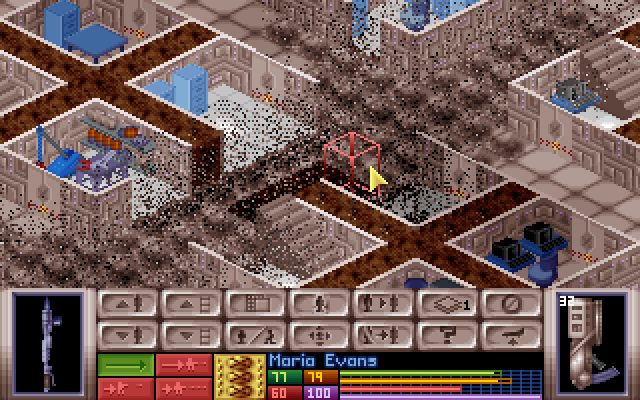
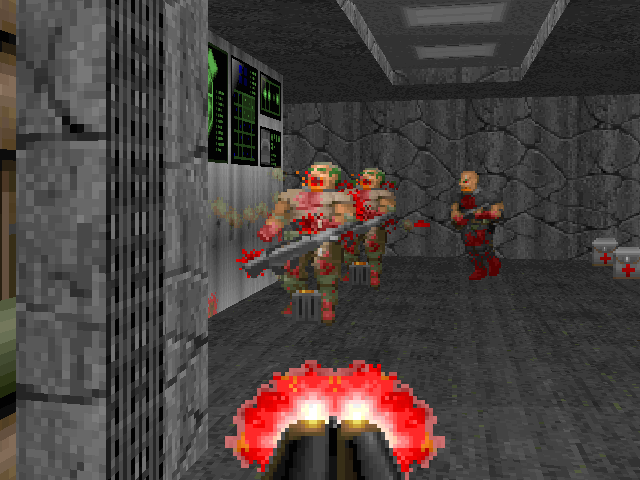
When Ageia touted their PhysX product, and Valve showed off those early HL2 videos people suddenly realised how fun a more interactive game was. I still love to shoot every wooden box in HL2, and especially the level where you have to hide behind rubble to survive a helicopter attack. Cellfactor had cloth and real polygon blood instead of that sprite puff in every quake and unreal game. Doom 1 and 2 actually had more splashy blood as it consisted of about four pixels :p

XCom_UFO_what_went_off_here_640.png


Doom2_pixellated_blood.png
 
i looked over all the slides, all I see are video encoders, audio encoders, picture processing (photoshop), and some games. (oddly enough, no mention of protein folding and the like).

So, am I missing something? I thought there was new and surprising info in those slides, but all I saw is the same old.

Well, I guess for some its new and surprising that games are multi threaded nowadays... but I upgraded my gaming machine to quad core way back when Mass Effect 1 came out (too much micro-stutter on dual core core2duo E8400 wolfdale... solved by going to Q6600).
 
Yes because ATI has DONE SO MUCH to push forward Physics in gaming. ATI Has done SHIT to push game physics anywhere and Intel has done just as much.
Well because fools like you have bought into the PhysX marketing scam so it's a little hard to break through into a niche market that's already popluated.

I enjoyed the pop shots at Nvidia in this article. It made my day as a matter of fact.
 
Well because fools like you have bought into the PhysX marketing scam so it's a little hard to break through into a niche market that's already popluated.

I enjoyed the pop shots at Nvidia in this article. It made my day as a matter of fact.

Nothing, and I mean nothing, is stopping ATI/AMD from going to writers of any of the physics programs, save intel/nvidia owned, and saying hey, let use help you open source this to OCL for GPGPU support. The fact they haven't speaks volumes.
 
Back
Top