Arm Takes Aim at Laptops: Cortex-A78C Processor for PCs Introduced

Are amazon graviton 2 server service really an edge case (or non competitive) ? Considering the marketshare of 60% and how much of the world run on that market.

No they are fine servers. We have limited metrics on their performance and only a marginal porting of applications. If they are at 60% market share I am very surprised and need to check on that.
 
No they are fine servers. We have limited metrics on their performance and only a marginal porting of applications. If they are at 60% market share I am very surprised and need to check on that.
I think the graph I saw was making a little trick:
https://p2zk82o7hr3yb6ge7gzxx4ki-wpengine.netdna-ssl.com/wp-content/uploads/pasted-image-0-7.png

60% was of the market share of the Amazon/Microsoft/Google part of the market.

Still it is the biggest player on one that imagine one of the biggest market outhere, Netflix and a lot of the most common computing of very regular day to day life is powered by Amazon.
 
Although a good step still a total nothing. I'm getting really tired of ARM getting a pass for future performance without producing a competitive platform in anything but edge cases.

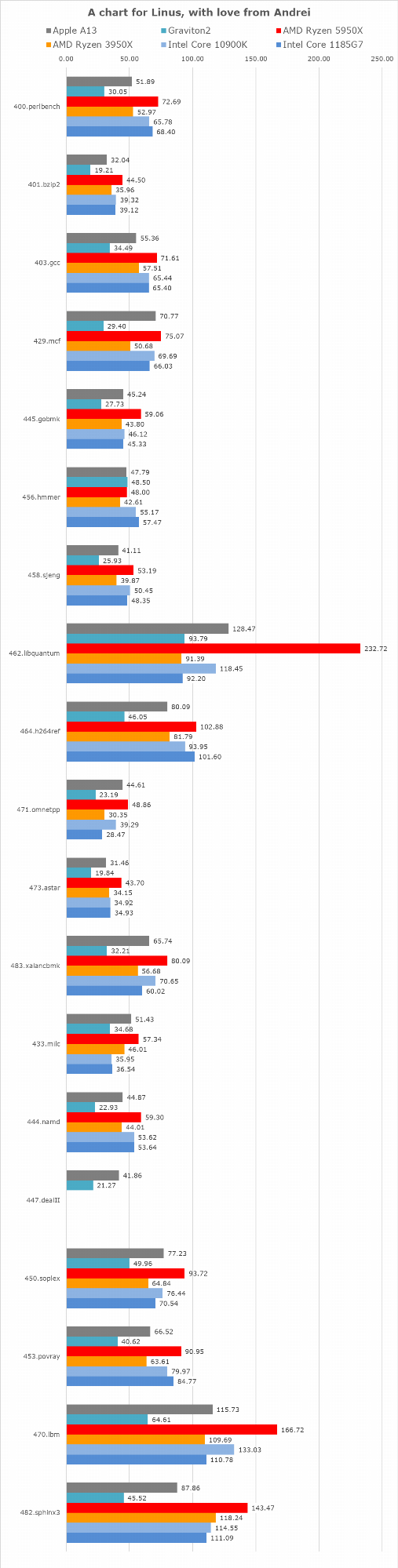
ARM holds the performance crown from phones to supercomputers. Only place where x86 still wins is in the HEDT desktop, but this will change with Apple. In fact, the mobile A13 is already able to match the single thread performance of R9 3950X


EmS4PGzWEAY9Ang?format=png&name=small.png
 
Last edited:
Well it'll also depend on what ARM can offer. If their chip isn't significantly faster, or more efficient or cheaper then it is likely to end up being not that popular. While many ARM fans take it as an article of faith that ARM can make a chip so much better than x86, this has yet to be proven. The idea that "It is RISC so it will be better," has long since been disproven by the past 30 years of RISC (Power, MIPS, etc). The ISA just doesn't allow for magically faster chips. So I remain a skeptic until ARM produces something and we get some real benchmarks to see how it performs and we see what the street price will be.

Remember that Apple isn't switching to ARM because it is so much better, they are switching to ARM because they want to control everything. They've long had Not Invented Here syndrome really bad, and they want to work on unifying their MacOS and iOS product line. So while this doesn't mean that their ARM chips will be bad, don't think they are doing it because they are going to get some major gains. They are doing it for control and to have their own thing, any improvements are secondary.

With Windows (and even Linux) the trick isn't for ARM to just be competitive, it has to be better and by enough of a margin to make it worth switching. Otherwise the view of most is going to be "Why bother?" Once something gets entrenched as a standard, dislodging that standard takes more than just competing, you have to be not just a little better but better enough that people, companies, and so on say "Ok, this is worth changing." Otherwise they just stick with what they already have because it is "Good enough."

I agree with you ARM on its face isn't faster. What makes ARM more interesting and probably in the long run faster... is the number of companies developing it. x86 has a development problem. Yes yes Intel has more money then anyone can fathom... yet still they are falling behind their ONLY competitor, proving its not the size of the bank account that matters.

ARM (as long as Nvidia doesn't fuck up the liberal licensing) will see 10 fold the development funds over the next decade vs x86. Its not just Apple. Competition breeds innovation... and ARM has multiple server chip plays, multiple super computer companies designing chips, and even multiple companies designing ARM desktop chips right now. Long term I would rather have an ISA with 5 or 6 or even more if where lucky players in the game. And who knows what Nvidia is perhaps planning to do with ARM. It would be best if they leave the licensing alone... but on their own front I'm sure they are going to be updating their own ARM cores. NV has made some decent ARM cores in the past... it would be interesting to see what they might try and do with a full 8+ big core type chip. If Apples play does work... I can see Nvidia trying to sell a high end SOC with ARM+GPU+AI for windows versions of the macbooks. I also still don't think its crazy for AMD to dust off their own ARM design. It would need updated but a 8 core ARM + 10-20 RDNA2/3 cores could be very interesting.

Summing up though ya I agree with you... ARM isn't on its face better then x86 by much if at all. There are things x86 does better, fixed function CAN be faster. ARM can be more efficient, however ARM is not what it started as either Modern ARM chips are not as efficient as they where. IMO its a business issue. Of course Apple wants to build machines using 100% their own hardware.... but they are hardly the only ones. Nvidia has the same dream clearly.... probably the reason they bought ARM. x86 consists of 2 companies.... ARM is basically everyone else that wants to be a chip company. (and the number of major players looking to be chip players seems to grow every year)
 
If it weren't for AMD, I was estimating x86-64 would be dead in less than a decade.
AMD is making competition for ARM on nearly all fronts except mobile (x86-64 is garbage here), and is the only company keeping that legacy ISA alive at this point.

People said the same thing about m68k, PA-RISC, MIPS, POWER/PowerPC, SPARC etc. back in the 1980s and 1990s - yet here we are.
SPARC64 and Power ISA is still alive and well in servers, but they are non-existent outside of those markets and ecosystems.
Yep, people is using now the same arguments against ARM that the old RISC guys used against x86.
 
Well it'll also depend on what ARM can offer. If their chip isn't significantly faster, or more efficient or cheaper then it is likely to end up being not that popular. While many ARM fans take it as an article of faith that ARM can make a chip so much better than x86, this has yet to be proven. The idea that "It is RISC so it will be better," has long since been disproven by the past 30 years of RISC (Power, MIPS, etc). The ISA just doesn't allow for magically faster chips. So I remain a skeptic until ARM produces something and we get some real benchmarks to see how it performs and we see what the street price will be.
That ARM chips are better has been proved in phones, laptops, servers, and supercomputers.

People is not promoting ARM because it is RISC. PowerPC, MIPS, and SPARC are also RISC, and any modern x86 core is internally a RISC engine.

People is promoting ARM64 because it is a modern and superior ISA than x86, PowerPC, MIPS, and SPARC.

Remember that Apple isn't switching to ARM because it is so much better, they are switching to ARM because they want to control everything.
Fujitsu didn't switched from SPARC to ARM because they want to control everything.

Also Apple is not controlling "everything". They make the chip, but the ISA isn't made by them.
 
Yep, people is using now the same arguments against ARM that the old RISC guys used against x86.

Except back then it was desktop vs desktop with RISC struggling to gain market share. This time ARM has a market share, a massive market share - Globally Android is the most popular OS running mostly on ARM based devices.

Personally, I'm interested to see what ARM can pull out of their hat and find the premise of a desktop not dominated by x86/64 quite exciting.
 
ARM holds the performance crown from phones to supercomputers. Only place where x86 still wins is in the HEDT desktop, but this will change with Apple. In fact, the mobile A13 is already able to match the single thread performance of R9 3950X


View attachment 297277

Low and high are both edge cases as I said before. Only HEDT? x86 has everything but the low end desktop replacements (LEDT?) and you can't even customize the ARM systems. Arguing for this is similar to arguing for intel atom systems taking over the desktop market.

Spec2006 is a decades old benchmark with quantum problems. Did you see what the 32mb cache did to it? If that doesn't show you the flaws in it as a metric you are blinded.

Just grant the same rules you gave intel the past 10 years and reality will fall into place. Stop moving the goal posts.
 
The notion that x86 will always dominate the mainstream is pretty short-sighted. Just because it's better in some circumstances now doesn't mean ARM won't advance, or that x86 won't struggle. Intel certainly has.

I'm reminded more than a little of how phone vendors dismissed the iPhone when it was introduced. People will always want phones with physical keyboards! There's not much interest in smartphones outside of business! Our platforms don't really need to change! In both cases, it's confusing the way things are with the way things will (or should) be.

This isn't a guarantee that ARM computers will be faster than equivalent x86 systems, but we also haven't seen great attempts at ARM on PCs so far -- just some low-end Chromebooks and a few Windows PCs based on Qualcomm's half-hearted chips. Let's see how more serious efforts fare, like the Cortex-A78C and Apple's silicon, before we rule things out.

We should want the architecture that makes the most sense for our computing needs, not the one we've always used. And in a world where laptops dominate, ARM might have a significant advantage.
 
We should want the architecture that makes the most sense for our computing needs, not the one we've always used. And in a world where laptops dominate, ARM might have a significant advantage.
With keeping an open mind to the competitive advantage giant software developer with money for custom chips gain over newcomers/open source group and so on.

Possible that the very general (with all the waste that come with it) X86 has is advantage over much better architecture for our computing need.
 
Apple has taken their SOC from a garbage mobile chip to a chip that can rival Intel i7’s
Serious question--what real-world examples do you have of this? That is, don't show me geekbench scores, show me an ipad beating an i7 on (say) single-core handbrake transcoding, so we can see, core-to-core, which one really is faster (the two chips running on the same number of cores, n > 1, is fine, too). Ditto something like compiling a really large program. All I really ever see people quote are things like GB, but I admit I haven't paid a lot of attention.
 
Serious question--what real-world examples do you have of this? That is, don't show me geekbench scores, show me an ipad beating an i7 on (say) single-core handbrake transcoding, so we can see, core-to-core, which one really is faster (the two chips running on the same number of cores, n > 1, is fine, too). Ditto something like compiling a really large program. All I really ever see people quote are things like GB, but I admit I haven't paid a lot of attention.

Exactly. It's all theoretical at this point.

When the ARM macs are alunched we may know more, but as of yet I haven't seen much that is reliable.

Sure there are some server workload benchmarks from industry, but server workloads are generally not as concerned with per thread performance as desktop loads.

I have no doubt ARM can do well in perf/watt scenarios, but that is not really what most of us are interested in.
 
Serious question--what real-world examples do you have of this? That is, don't show me geekbench scores, show me an ipad beating an i7 on (say) single-core handbrake transcoding, so we can see, core-to-core, which one really is faster (the two chips running on the same number of cores, n > 1, is fine, too). Ditto something like compiling a really large program. All I really ever see people quote are things like GB, but I admit I haven't paid a lot of attention.
Are those valid (4k video transcode in Adobe rush) ?
https://wccftech.com/ipad-pro-video-editing-performance-3x-faster/

The Ipad has 8 core too, (4 performance, 4 general) but it is more than 3 time faster.
 
With keeping an open mind to the competitive advantage giant software developer with money for custom chips gain over newcomers/open source group and so on.

Possible that the very general (with all the waste that come with it) X86 has is advantage over much better architecture for our computing need.
Remember, though: we don't really know if x86 will be better in the long run, and there are factors besides architecture to consider (manufacturing processes and costs, most notably).

I suspect it'll be harder for ARM to crack the high-end desktop market, but that's only a tiny slice of the pie. Intel and AMD don't have to worry about ARM superceding their chips in every category — they have to worry that enough of the market moves to ARM that there isn't much of an audience for x86, which could lead to companies ditching x86 in remaining categories out of pure pragmatism.
 
This doesn't pass the smell test. There is something very wrong here. I'm not quite sure what it is, but I'm not buying it.

I'm leaning towards "not apples to apples encode settings" or something like that.


Did some more googling. Looks like this may have utilized the A12X's new HEVC hardware encode, which hardly makes it a worthwhile comparison for general workloads.

Also, it is unclear if the ASIC encoded with the same quality settings as the software used on the laptops.

We know dedicated ASIC's can do specific tasks faster than general purpose computing.

Some might argue that this is the future, more ASIC's for various tasks embedded on package or on die, and they might be right, but this hardly speaks to the capabilities of ARM. A chipmaker who so desires can add dedicated video encode ASIC functionality to any CPU of any architecture.
 
Serious question--what real-world examples do you have of this? That is, don't show me geekbench scores, show me an ipad beating an i7 on (say) single-core handbrake transcoding, so we can see, core-to-core, which one really is faster (the two chips running on the same number of cores, n > 1, is fine, too). Ditto something like compiling a really large program. All I really ever see people quote are things like GB, but I admit I haven't paid a lot of attention.

There are tons of real world examples to compare, but different applications due to the platforms... for example the Apple SOC has been shown editing multiple 4K streams in realtime which an i7 has no hope of doing alone. The benefits of bespoke architecture tailored for workloads such as HEVC...

Affinity Photo and Photoshop has equally been shown matching i7 performance or better and that is with far less resources...

I love how the arguments are always the same... people seem to forget you are comparing an actively cooled x86 chip vs a passively cooled ARM chip with vastly less power consumption. When Apple scale their chips up to use active cooling and more power, the gloves are well and truly off. They have already shown they can be competitive with far less resources.

and all that is before we even get to the fact of Intel being a processor with a GPU tacked on while in Apples case you are dealing with a SOC. Intel flat out have no provisions for secure enclave, neutral engine etc... SOC is designed to handle everything, x86 handle general processing and maybe light GPU work... hence mainboard chipsets etc...
 
iPad’s A12Z has slightly better single core performance than the Ryzen 3 3100 and the Ryzen 9 4900HS

Not really that impressive. Throw in Ryzen current gen and tack on another +20% on top of that for x86/64.

Not that impressive that a chip with no cooling and only a 4W TDP on big cores can keep pace with much larger x86 chips all the while packing in every other system chip including graphics that would normally reside on mainboards or graphics cards. Give me a break...

The A12Z will also never be used in consumer Mac, the actual consumer chip launches tomorrow and is bespoke new design around the form factor.

The Apple SOC will also crush even desktop class systems when it comes to high efficiency workloads it was build around like video editing.

https://wccftech.com/apples-first-arm-product-mac-mini-a12z-bionic-not-for-sale/

The old days of brute forcing workloads with generic, inefficient processing are dead. Build your chips around real world workflows and make them highly efficient at specific tasks.
 
Last edited by a moderator:
Not that impressive that a chip with no cooling and only a 4W TDP on big cores can keep pace with much larger x86 chips all the while packing every other system chip except wireless and faster graphics into 1 chip? Give me a break...

The A12Z will also never be used in consumer Mac, the actual consumer chip launches tomorrow and is bespoke new design around the form factor.

The Apple SOC will also crush even desktop class systems when it comes to high efficiency workloads it was build around like video editing.

https://wccftech.com/apples-first-arm-product-mac-mini-a12z-bionic-not-for-sale/

The old days of brute forcing workloads with generic, inefficient processing are dead. Build your chips around real world workflows.
Give yourself a break.. As already stated above, purposeful built asic is not general compute. Throw around "efficiency" a few more times. It's been covered. What is at root is the ARM architecture outperforming the X86/64. Not efficiency, not "System on a Chip" watts. In order for the ARM to eclipse the x86/64, it will have to overcome x86 in general compute power. Yes, ARM is getting closer - but not nearly close enough yet in this respect. General Compute is not dead, that is truly a preposterous statement. Apple went to ARM so they could control the hardware, not because ARM is a better, faster CPU than X86. That's just how Apple is - Control. Not every company is Amazon and can build and/or customize their chips and/or codebase. Not even close, the rest of the world is still on x86/64. ARM is still relegated to mobile and niche until it eclipses the x86/64 in sheer performance and it still has a long way to go.
 
Last edited:
The old days of brute forcing workloads with generic, inefficient processing are dead. Build your chips around real world workflows and make them highly efficient at specific tasks.

This is highly optimistic, and sad if it is true. The beauty of a general purpose design is that you can apply it to everything and anything you need.

It will be really disappointing if computers architectures need specialty ASIC's for every little task they do. Firstly you have to hyper specialize, picking the arch for the task rather than being flexible, and secondly, as soon as a new format for anything comes out, guess what, all of your hardware is obsolete.

It's a hardware manufacturers wet dream. You thought a $3000 Mac every 5-10 years was bad?

If groups of ASIC's attached to low power SoC's is the way forward, well, then the way forward really fucking blows.
 
X86 chips are already asics to a degree. All that bloat that makes x86 is there to accelerate software functions. Practical ARM chip add the same bloat to help out with certain workloads as well. I would be intrested to see a raw risc or basic cisc chip with a decent fpga on die that can handle some of the extra extentions as well as emulation of unsupported instructions. That could allow for a push away from x86 as we know it and would give software devs far more freedom. For arm chips to effectively run many programs today its beneficial to add in quite a few of the extentions used by x86 and then what your left with isnt all that differnt from other complex cisc chips
 
Did some more googling. Looks like this may have utilized the A12X's new HEVC hardware encode, which hardly makes it a worthwhile comparison for general workloads.

Also, it is unclear if the ASIC encoded with the same quality settings as the software used on the laptops.

We know dedicated ASIC's can do specific tasks faster than general purpose computing.

Some might argue that this is the future, more ASIC's for various tasks embedded on package or on die, and they might be right, but this hardly speaks to the capabilities of ARM. A chipmaker who so desires can add dedicated video encode ASIC functionality to any CPU of any architecture.

The problem with x86 is its bulky silicon wise. AMD could probably create some sort of co processing chiplet. In general however... x86 costs a lot of silicon for its core. The idea of sandwiching a bunch of other stuff on the silicon is basically a non starter. Intel has toyed with it but its not efficient enough to really compete with ARM. (in terms of transistor count.)

Yes ARM doesn't need to win hands down in all general compute. The smaller ARM core, allows for additional ASICs without talking about insane transistor counts and die sizes. For 99% of general computing, general compute CPUs are not being taxed at all. The taxing things like encoding, photoshop filters ect are better done by ASIC. x86 can't afford the silicon to do that... ARM cores tend to be small enough to allow more space for ASICs.

No doubt Apples new macbooks are going to have some overhyped "AI" bits... beyond the hype though, yes they are probably going to be used to accelerate things like Blurs ect in programs like photoshop. I have little doubt Apple will show off ARM photoshop with Accelerated filters finishing in a couple seconds compared to their old Intel machines taking 30. I expect GPU accelerated type performance without the extra power draw. Does that make ARM faster then x86.... no. It will make the package faster at specific things. The reduced core die space of a ARM core... is the win. x86 has a lot of baggage. Probably why Intel is trying to create some form of big.Little x86 with alder lake. x86 needs those small cores if they are going to be able to build x86 versions of whatever accelerators apple has cooking.
 
Low and high are both edge cases as I said before. Only HEDT? x86 has everything but the low end desktop replacements (LEDT?) and you can't even customize the ARM systems.

I can.

Spec2006 is a decades old benchmark with quantum problems.

The problem with the libquantum subtest is that it is cheated by both the Intel compiler and the AMD compiler. But, for the review, Andrei used CLANG compiler, which does not cheat.

Amazing that you complain about using an 'old' benchmark when there is still ancient 32bits code in the Windows software.

SPEC2017 draws a similar picture. E.g. the gap between Graviton2 and the R7-2700X is 38% in SPEC2017 and 30% in SPEC2006.

Serious question--what real-world examples do you have of this? That is, don't show me geekbench scores, show me an ipad beating an i7 on (say) single-core handbrake transcoding, so we can see, core-to-core, which one really is faster (the two chips running on the same number of cores, n > 1, is fine, too). Ditto something like compiling a really large program. All I really ever see people quote are things like GB, but I admit I haven't paid a lot of attention.

Pg3TORT.png
 
I can.


The problem with the libquantum subtest is that it is cheated by both the Intel compiler and the AMD compiler. But, for the review, Andrei used CLANG compiler, which does not cheat.

Amazing that you complain about using an 'old' benchmark when there is still ancient 32bits code in the Windows software.

SPEC2017 draws a similar picture. E.g. the gap between Graviton2 and the R7-2700X is 38% in SPEC2017 and 30% in SPEC2006.


View attachment 297647
That's nice. Got any "how fast can you compile Chrome"-type benchmarks, or comparisons that are not apple-to-apple by use of custom ASICs?
 
I would be intrested to see a raw risc or basic cisc chip with a decent fpga on die that can handle some of the extra extentions as well as emulation of unsupported instructions.

so like .... oh maybe ... Power10 ?
 
That's nice. Got any "how fast can you compile Chrome"-type benchmarks, or comparisons that are not apple-to-apple by use of custom ASICs?

There's a very detailed review at phoronix, which doesn't show what juanrga is trying to pitch, which is why he never uses it when this discussion comes up. Just more of the same, unsourced screenshots with any data contrary to his preferred view left out.

https://www.phoronix.com/scan.php?page=article&item=epyc-vs-graviton2&num=1

How about some estimated benches from a canceled part?

https://hardforum.com/threads/windo...mulate-x64-apps-soon.2001988/#post-1044777373

393766_MarvellTX3_18~2.jpg
 
Give yourself a break.. As already stated above, purposeful built asic is not general compute. Throw around "efficiency" a few more times. It's been covered. What is at root is the ARM architecture outperforming the X86/64. Not efficiency, not "System on a Chip" watts. In order for the ARM to eclipse the x86/64, it will have to overcome x86 in general compute power. Yes, ARM is getting closer - but not nearly close enough yet in this respect. General Compute is not dead, that is truly a preposterous statement. Apple went to ARM so they could control the hardware, not because ARM is a better, faster CPU than X86. That's just how Apple is - Control. Not every company is Amazon and can build and/or customize their chips and/or codebase. Not even close, the rest of the world is still on x86/64. ARM is still relegated to mobile and niche until it eclipses the x86/64 in sheer performance and it still has a long way to go.

Why ?

Why does ARM have to overcome x86 in general compute ?

General compute is mostly useless. All ARM needs to do general compute wise is perform well enough to run basic general compute stuff.... UIs, and other basic software. The truth is 99% of the time everyones general compute cores are sitting idle. I can pull my Linux boxes up any time and tell you exactly how untaxed the general compute cores are at all times. Yes games require some horsepower.... but as we all know we already run very powerful ASICs for ALL gaming in the form of our GPUs. Games haven't run on general compute cores alone since the days of Quake. Games are a great example... it was the first computation area where the industry said... General compute sucks lets build something better.

Video and photo editing... the big names have all had GPU acceleration for years now. Cause GC CPUs suck at dealing with massive amounts of data.

ARM doesn't have to = x86 in general compute performance. Cause frankly general compute performance is over hyped. Don't get me wrong yes it matters for specific loads. Yes gamers would notice the difference between a 10 year old x86 chip and a Ryzen 3. However I dare you to plunk any non gamer in front of a computer for almost any other task and get them to notice the difference.... between GC CPUs on the same platform. (obviously 10 year old machines lag in terms of Ram and general IO performance) Average users are not going to see any difference between a 6 core and 16 core Ryzen when their browsing the web, editing a office document... or doing all the other things people ask their GC CPUs to do. The type of things where the CPU sits idle 90% of the time... with the odd spike to 30% usage.

If ARM in general (and Apple right now) can provide 8 cores that are fast enough to feed our current level of IO.... and handle those spike GC work loads... while also giving us built in GPU like acceleration for the data intense things CPUs suck at anyway. They will have a winner. If they can manage that while also delivering something super power efficient for laptop users, its going to be a massive win. The number of actual desktops continues to decline... and if Apple starts selling decently priced ARM macbooks that show off days of battery life, and accelerated performance in stuff like photoshop. They are going to move a lot of units.

If Apple does move lots of ARM (and there planning to) whatever acceleration bits they add are likely to become a standard. Lets just hope Apple doesn't CUDA up the next gen of non GC computing. There is an evolutionary step coming for GPU compute.... and it will probable involve some form of GPU like core being split off from the actual graphics unit for compute.
 
Why does ARM have to overcome x86 in general compute ?

General compute is mostly useless.


Completely wrong. General compute is everything.

It is the end all of computing.

Otherwise you need to have dedicated hardware for every little task, which cannot be tweaked in software, so you are locked in to whatever configuration decisions are made when the ASIC is created.

General computing IS computing. Everything else is just special purpose appliance garbage.

ASIC's are a terrible hack which should only be used if absolutely necessary.
 
ASICs and FPGAs are great for covering some bases. They are not a substitute for competent general purpose computing. I don't know why everyone's frothing at the mouth for any single family of CPU technology to take over the world; diversity's better, and I feel a little uneasy at the fact that ARM and x86 have overtaken so much and left others to claw at the margins.
 
Completely wrong. General compute is everything.

It is the end all of computing.

Otherwise you need to have dedicated hardware for every little task, which cannot be tweaked in software, so you are locked in to whatever configuration decisions are made when the ASIC is created.

General computing IS computing. Everything else is just special purpose appliance garbage.

ASIC's are a terrible hack which should only be used if absolutely necessary.

So GPUs should not exist ? I'm not following your logic.

We can do "generalized" type stuff on Asics (GPU compute can be used for many applications)... but one bit of silicon doesn't have to do everything. General compute is good at nothing really. Of course we always need some general compute... but it doesn't have to be a big honking chip we use for everything.

The ship has sailed on general compute. GPUs already accelerate all heavy data loads. ASICs already handle video compression... we don't use software modems. (joking on that one... but point holds for modern networking gear running it on a GC CPU is the domain of the cheap crap) Point is yes fixed bits of silicon are nothing new. Of course you can make a general compute CPU do all of those things... which is why they are general. However its the least efficient way of doing things.

We don't need monster general compute power. Anything that needs a ton of computation should be using some form of ASIC compute. Be that GPU compute, a transcoder or whatever else is in our systems. Even for traditional GC CPU Only workloads like say 3D ray tracing... all of that has been moving to GPU compute. GPUs have progressed to a point where there simplified cores are good enough. Sure Pixar will still render on a CPU for max precision... but 99% of everything else even amature stuff on blender is using GPU compute, cause its many times faster. If your doing final renders via the GPU... and rendering workspace with the GPU, all workload on the General compute CPU is greatly reduced, to a point where the difference between CPUs starts to be come hard to notice.

ARM doesn't have to smash x86 in Cinebench... cause no either platform renders in general happen on a GPU.
 

You're saying if you have a few SATA drives, a nvme, a video card, and say a custom capture device. You can stick it in an ARM system and roll? Shenanigans

The problem with the libquantum subtest is that it is cheated by both the Intel compiler and the AMD compiler. But, for the review, Andrei used CLANG compiler, which does not cheat.

The problem with libquantum is they wrote it in row order with sparse references. If converted to column or channel even the simplest processor can chew it up. It does do something. It tests the memory and cache system in a very unorthodox way.

As much as I'm against compiler cheating, I'm more against bad metrics as a measure of performance.

Just imagine for a second if we measured game performance with 2006 games. Did you see the COD 3 results on zen3? AMAZING!!!

Amazing that you complain about using an 'old' benchmark when there is still ancient 32bits code in the Windows software.

Personally I want my processors to run all code well. But go ahead show us where this 32bit code affects performance of any benchmark. If not, red herring.

SPEC2017 draws a similar picture. E.g. the gap between Graviton2 and the R7-2700X is 38% in SPEC2017 and 30% in SPEC2006.

Are you so willing to compare a server class processor with 8-channel memory with a desktop class 2-channel? Your bias is showing.
 
Last edited:
so like .... oh maybe ... Power10 ?

Exactly and its worth noting power 10 chips have the power to virtulize a x86 os with decent efficiency. Now throw a fpga near a power 10 die and I will be first in line
 
You're saying if you have a few SATA drives, a nvme, a video card, and say a custom capture device. You can stick it in an ARM system and roll? Shenanigans

I am saying you that your claim one "cannot customize ARM systems" is plain wrong.

The problem with libquantum is they wrote it in row order with sparse references. If converted to column or channel even the simplest processor can chew it up. It does do something. It tests the memory and cache system in a very unorthodox way.

As much as I'm against compiler cheating, I'm more against bad metrics as a measure of performance.

Just imagine for a second if we measured game performance with 2006 games. Did you see the COD 3 results on zen3? AMAZING!!!

All the benches have issues. That is why reviewers tests a lot of applications and why suites as SPEC have dozens of different benchmarks. Games have evolved, for instance, increasing the number of threads thanks to new APIs and so. This is not a problem with SPEC2006, which scales to hundred of threads.

Are you so willing to compare a server class processor with 8-channel memory with a desktop class 2-channel? Your bias is showing.

In reality I was comparing SPEC2006 and SPEC2017 and showing why your claim that SPEC2006 cannot be used to make hardware comparison was baseless. Moreover, I am using single-thread results, so the number of memory channels is irrelevant.
 
I am saying you that your claim one "cannot customize ARM systems" is plain wrong.

Link please. The apple thingy is darn closed. Other than high end custom servers that you basically can't buy. There is no ARM motherboard. Certainly not a desktop replacement. (HEDT or LEDT)

All the benches have issues. That is why reviewers tests a lot of applications and why suites as SPEC have dozens of different benchmarks. Games have evolved, for instance, increasing the number of threads thanks to new APIs and so. This is not a problem with SPEC2006, which scales to hundred of threads.

This is a problem. A fixed function from a time long long ago is a skewed result. Running multiple instances of single threaded programs is not a good measure of computing scale. (for server maybe a bit) So no, it does not scale to 100s of threads. Even less relevant to properly threaded games.

Learn to semaphore.

In reality I was comparing SPEC2006 and SPEC2017 and showing why your claim that SPEC2006 cannot be used to make hardware comparison was baseless. Moreover, I am using single-thread results, so the number of memory channels is irrelevant.

Funny. You demonize 32bit code and lord over single thread code. Choose your legacy metrics wisely.

Memory channels are always relevant, as are cache sizes and interconnects.

Unless you are only arguing for single thread performance?
 
So GPUs should not exist ? I'm not following your logic.
The fact that General computing is the very essence of computing, does not mean that more specialized hardware can't be useful for some workloads.

GPU's, while more specialized that CPU's are still fairly general purpose computational devices (as long as your workload is highly paralellized.

This is not really the same as an ASIC which is designed for a very specific task.

That would be like having to buy a special dedicated GPU for every game you play.

ASIC's can add value in addition to general purpose computing, but they should never replace competent and powerful general purpose CPU's.

It's just like the mpeg2 addon boards they used to sell to accelerate watching DVD's. Not a bad idea.

If they started saying "now that we have this addon board, we no longer need a CPU that is as fast", that is when it becomes a bad idea.
 
In reality I was comparing SPEC2006 and SPEC2017 and showing why your claim that SPEC2006 cannot be used to make hardware comparison was baseless. Moreover, I am using single-thread results, so the number of memory channels is irrelevant.

None of the SPEC (or Specviewperf or whatever) canned garbage benchmarks have ever been worth shit.

Garbage like SPEC and SYSMark are why I stopped reading paper PC Magazines in the 90's.

If its a benchmark suite it isn't worth anything at all.

PassMark, Geekbench, 3DMark, BapCo SYSmark, SPEC, it does not matter. They are all useless.

The only benchmark that matters is YOUR workload and/or game, and if you have to abstract because your specific workload and/or game have not been bemnchmarked, abstract it to something as close as possible to your workload and/or game. Not canned garbage nonsense or theoretical bullshit like the above, or Sisoft Sandra.
 
I am saying you that your claim one "cannot customize ARM systems" is plain wrong.
Glad to know I can take the SoC out of my busted Galaxy S20 and put it in my 2020 Galaxy J3. Oh, wait.

Glad to know I can swap the Microchip ATSAMD21 in my Arduino for a faster STM32F Arduino. Oh, wait.

Glad to know I can ask Microchip to give me an ATSAMD21 with 64K RAM. Oh, wait.

E2A: Glad to know I can replace the garbage GPU in a Helio SoC with an Adreno 640. Oh, wait.

Glad to know I can drop an SSD into my [any phone]. Oh, wait.
 
The fact that General computing is the very essence of computing, does not mean that more specialized hardware can't be useful for some workloads.

GPU's, while more specialized that CPU's are still fairly general purpose computational devices (as long as your workload is highly paralellized.

This is not really the same as an ASIC which is designed for a very specific task.

That would be like having to buy a special dedicated GPU for every game you play.

ASIC's can add value in addition to general purpose computing, but they should never replace competent and powerful general purpose CPU's.

It's just like the mpeg2 addon boards they used to sell to accelerate watching DVD's. Not a bad idea.

If they started saying "now that we have this addon board, we no longer need a CPU that is as fast", that is when it becomes a bad idea.

There is still general compute performance. The only point was... you don't need a Ferrari of a CPU to handle UIs.... menu functions... basic copy commands and 99% of the things people do with computers. Latency matters more then raw computation power. If your asking the CPU to crunch all the math then ya x86 wins. But even in the x86 pool no one anywhere askes the CPU to crunch everything anymore. GPUs are just the obvious answer. Offloading things like h265 encoding and decoding and the like to ASICs is where consumer devices are heading. Building one big chip with massive x86 cores... vs one big chip with 1/3 of the die being general compute ARM, the rest of the space free for better integrated GPU cores, a super fast HVEC codec ASIC, Tensor flow cores... heck even image processors for cameras and or other sensors.

By this time next year... AMD is going to perhaps be the last hope for big x86 metal. Intel is getting ready for Alder Lake and I really don't think there going to back track now. Intel is going big.Little cause they recognized the issue they are going to need to add ASICs to offer compelling consumer devices (including desktops) which means we get to look forward to Intel chips with 4 big cores, and 4 Atom style x86 cores. They need to find the space on the die to slap all the compute things the industry and consumers are going to be looking for.

We keep waiting for Intel to make a move to catch up to AMD... but frankly I'm not so sure they are playing the same game right now. Intel may just be releasing rocket lake to keep it close, or at a point where fan boys can argue either way. The end of the desktop market as we know it is coming. Intel knows if there going to keep the windows ecosystem at all they need a more ARM like package.
 
Back
Top