![[H]ard|Forum](/styles/hardforum/xenforo/logo_dark.png)

Cov
Gawd
- Joined
- Dec 3, 2007
- Messages
- 917
CPU / Frequency / Multiplier
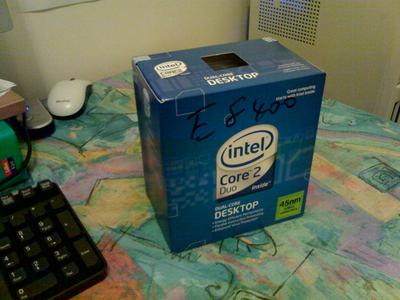
E8200 / 2.66 GHz / 8
E8300 / 2.83 GHz / 8.5
E8400 / 3.00 GHz / 9
E8500 / 3.16 GHz / 9.5
All have 6MB L2 cache.

Date: 16th March 2008
E8200 / 2.66 GHz / 8
E8300 / 2.83 GHz / 8.5
E8400 / 3.00 GHz / 9
E8500 / 3.16 GHz / 9.5
All have 6MB L2 cache.
This new Core micro-architecture provided a leap in performance as well as power efficiency
The E8000 series is sporting 410 million transistors on only 107 mm². An E6000 processor has 291 million transistors, but measures 143 mm².
Another advantage of 45nm technology is that it allows Intel to produce more dies from one wafer. This reduces production cost and should (theoretically) lead to lower retail prices.
In a nutshell: The new E8000 has a 25% smaller die, 40% more transistors, 6 MB L2 cache instead of 4 MB, a few internal execution tweaks, consumes less power and boasts 47 new SMID instructions.
With a BIOS voltage setting of 1.425v resulting in an actual voltage of around 1.385v, and additional MCH voltage as well, we could push the E8500 up to 9.5 x 452 MHz = 4294 MHz. This was still with the retail HSF. The CPU temperature was above 70C when running Prime95.
At this stage we changed to water cooling ... we settled for 9.5x490 MHz = 4655 MHz. With a processor voltage of 1.525 volt, resulting in an actual load voltage of 1.48v ... The required voltage to get the E8500 stable at 4655 MHz was therefore a hefty 30% above default.
At 4655 MHz we recorded impressive performance gains: The multi-CPU score in Cinebench R10 went up 41%, compressing a 90 MB file with WinRAR was done 46% faster, and when gaming with Lost Planet we got 38% more frames per second compared with the default speed of 3160 MHz.
It seems our E8000 overclocking results are not exceptional. We have seen similar results reported in our Intel forum and other enthusiast sites. For example Dinos22 in this thread is enjoying 5675MHz from his E8500.
Intel has been ramping up 45nm production for almost half a year now. Intel CEO Otellini has stated at the beginning of March that their fabs have already shipped more than 4 million 45nm processors since November 2007 and are currently putting out 100,000 such processors a day. The supply problem should therefore be solved in the near future.
Source: http://www.overclockers.com.au/artic...?id=662024&P=4... these processors do not cost more than previous generation E6000 CPUs but offer better performance, lower power consumption, and better overclocking potential. Nonetheless we would like to mention that the Penryn family of E8000 and Q9000 processors is only a transitional product. Intel is preparing a completely new micro-architecture, a new socket, and new chipsets for the beginning of 2009. In less than 10 months we will have a new, probably even more powerful processor and chipset generation available. For the time being we recommend the 45nm based E8000 dual-core and Q9000 quad-core series without reservation. These products offer excellent value for the mentioned prices, and are currently without a competitor, when it comes to performance.
Date: 16th March 2008