Volcanic Islands 2.0 rumors

They all have a roadmap... Following it and being capable of following it is the hard part! ;)
 
http://www.overclock.net/t/1488641/next-r9-r7-graphics-to-use-hbm

Well I guess this can help put the stuff about Pirate Islands to rest for now. Was starting to wonder if AMD had any response to Maxwell 28nm coming later this year (supposedly).

Looks like AMD will be taking a similar route as Nvidia.

You are spinning things making it sound like AMD is following Nvidia lol. You are incorrect.
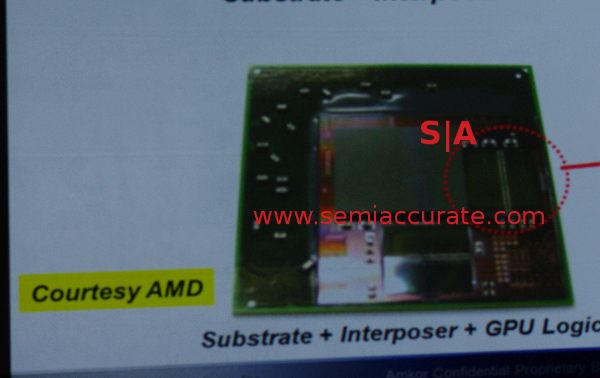
AMD has been ahead of the game for a long time, they showed a working stacked silicon APU back in 2011. In fact Nvidia will use the stacked memory tech that AMD developed in partnership with Hynix for their 2016 GPUs. You will see an AMD product with stacked memory long before Nvidia releases one.

http://semiaccurate.com/2011/10/27/amd-far-future-prototype-gpu-pictured/

AMD_Interposer_SemiAccurate.jpg


I posted about HBM like a year ago as well and AMD has been evangelizing the industry that stacked memory and XPU's are coming.

http://hardforum.com/showthread.php?t=1797191
http://electroiq.com/blog/2013/12/amd-and-hynix-announce-joint-development-of-hbm-memory-stacks/

Further reading:
http://www.microarch.org/micro46/files/keynote1.pdf
ShR5yca.jpg
 
Last edited:
You will see an AMD product with stacked memory long before Nvidia releases one.
Can you give me a summary of what the benefits are, without having me go through some PDF's?
Last time AMD was "ahead of the curve" was when they were working on the original Phenom processors and claiming that being "native quad cores" would give them the advantage, and it didn't.

I don't know what to expect from stacked memory so I have no reason to be hyped for it. Seeing as how AMD is going crazy for it and I don't have any memories of Nvidia mentioning it, why should I trust AMD on this one?

What I'm asking is, if it's so great then why does Nvidia not seem to care?
Just based on the leaks we have now I don't see any reason to be excited for Hawaii 2.0 compared to Maxwell.

You are spinning things making it sound like AMD is following Nvidia lol. You are incorrect.
I mean AMD is pushing out another 28nm card this year.
 
Stacked memory offers High Bandwidth Memory. If is tangible to us now we will soon find out maybe, supposedly we can get better bandwidth on fewer traces.
 
Did it ever occur to you that Nvidia is simply not capable of developing the technology?
Like I mentioned above they will be using AMD developed memory tech for their 2016 GPUs, and don't forget AMD had a hand in the developement of GDDR and were the first to implement it in graphics cards.

The main benefits of HBM are higher performance using less power. The memory is on the same package as the die so the traces to the GPU are short and thus require considerable less power. Go look at your video card and follow the traces from each memory module to the GPU, the longer the trace the more power it will need.
b8K97rQ.jpg
 
Correct me if I'm wrong, but I thought one of the benefits from this stacked memory was that part of the controller logic was to be moved to the stack itself and connect to the GPU with a high speed serial link of some sort. In effect, achieving more bandwidth with fewer traces and the potential for lower latency since the controller logic is closer to the memory.
 
Did it ever occur to you that Nvidia is simply not capable of developing the technology?
Why would this occur to me?
I can't think of any instance where AMD was capable of doing something that Nvidia wasn't... Except maybe Mantle.

Maybe if AMD started leading in the hardware industry again, then I wouldn't have to be such a pessimist. As for now, part of me still believes Nvidia wants nothing to do with this but I suppose time will tell.

AMD has mislead me before, many times. I don't have any reason to believe them on this one but I hope it works out well.

The pendulum swings two directions...
 
So no 20nm until next year? Damn that sucks, but whatever, hopefully both AMD and NVIDIA can pull more performance with 28nm.
 
HBM technology is very interesting indeed. It's been quiet in the general news, but I guess now the marketing machine should be starting to get going shortly.
 
Can you give me a summary of what the benefits are, without having me go through some PDF's?

I don't know what to expect from stacked memory so I have no reason to be hyped for it. Seeing as how AMD is going crazy for it and I don't have any memories of Nvidia mentioning it, why should I trust AMD on this one?

What I'm asking is, if it's so great then why does Nvidia not seem to care?
Just based on the leaks we have now I don't see any reason to be excited for Hawaii 2.0 compared to Maxwell.


I mean AMD is pushing out another 28nm card this year.

So rather than read the documentation and educated yourself and make your own decision on how this technology will
impact the industry you want someone else to do it for you? That way you can keep dismissing the value of this tech.
Then you proceed to argue that because Nvidia isn't talking about it, even though Jen-Hsun briefly did mentioned it and
the fact that the product the will be launching the tech on has been delayed, means that Nvidia has no interest in it.
The fact is Nvidia is at least 1-2years behind in having this implemented on their GPUs.


Why would this occur to me?
I can't think of any instance where AMD was capable of doing something that Nvidia wasn't... Except maybe Mantle.

Maybe if AMD started leading in the hardware industry again, then I wouldn't have to be such a pessimist. As for now, part of me still believes Nvidia wants nothing to do with this but I suppose time will tell.

AMD has mislead me before, many times. I don't have any reason to believe them on this one but I hope it works out well.

Well not all of us have such short term memories...
GDDR4?
early GDDR5?
early nodes?

The fact that you can't differentiate from marketing/forum hype for an unproven/untested CPU and data sheets/whitepapers for a new type of DRAM, doesn't give much value to any of your "insight" on the industry.
 
So rather than read the documentation and educated yourself and make your own decision on how this technology will
impact the industry you want someone else to do it for you? That way you can keep dismissing the value of this tech.
AMD's marketing hype is far from how this tech will impact the industry.
And I'm not dismissing the tech, I'm dismissing AMD.
 
AMD's marketing hype is far from how this tech will impact the industry.
And I'm not dismissing the tech, I'm dismissing AMD.

OK I'll bite, what has AMD hyped so badly and not delivered on the GPU front?

Every release since the 2900 series has been good IMO, only 2 hiccups I can remember.

1) 5800 series CF scaling
2) 7900 drivers being late / CF Stuttering .
 
I'm surprised it took NV as long as it did for them to announce 3D-IC plans. We've been talking about it in the industry as a major inflection point for a good while...
 
I'm surprised it took NV as long as it did for them to announce 3D-IC plans. We've been talking about it in the industry as a major inflection point for a good while...

Pure speculation, but that probably has to do with where they were in their R&D multi-year product development cycle and how much work they (nvidia) would have had to scrap and delay new products as a result.

Smells like an executive decision, not engineering. Net result is they now appear to be very much behind the industry curve and probably are in catch-up mode.
 
AMD was a full generation ahead at GDDR5 with the HD 4870. looks like the same situation repeats at HBM. AMD goes to HBM across their GPU product stack in late 2014/early 2015 and Nvidia follows in mid-late 2016.
 
Back
Top