• Some users have recently had their accounts hijacked. It seems that the now defunct EVGA forums might have compromised your password there and seems many are using the same PW here. We would suggest you UPDATE YOUR PASSWORD and TURN ON 2FA for your account here to further secure it. None of the compromised accounts had 2FA turned on.
    Once you have enabled 2FA, your account will be updated soon to show a badge, letting other members know that you use 2FA to protect your account. This should be beneficial for everyone that uses FSFT.

Vega Rumors

You got banned cause you were derailing every thread in the AMD cpu forum and ranting, also your responsible for your own actions no one made you act that way. Trying to convince people that your right on the internet is a futile task tho, not everyone is reasonable. As for Vega features being used, it all depends on how easy they are to add. Also a FULL GENERATION BEHIND is hyperbole as it cant meet the 1080ti in performance but can meet the 1080 and 1070, you could say that if it could not do that. When you say stuff like that it's hard to take you seriously. I am still looking forward to seeing how it does in reviews, even tho I am not in the market for a card.

wrong.jpg
 
The Problem. Marketing well before the product is ready. NVidia says essentially nothing about Volta until there is product.

AMD encouraged a feeding frenzy for a mediocre product. It would be annoying enough even if it was a great product.

Spot on.
 
Look stop arguing amongst yourselves and look at these "leaked" numbers. This is one of the websites that has a ton of advertising like a video playing, full screen ad, etc. I braved that sh*t to find this!
http://www.tweaktown.com/news/58635...-leaked-benchmarks-gtx-1070-killer/index.html


All those games are already favorable to AMD hardware, and these tests are most likely all DX12 and Vulkan. The Civ test definitely tells us that right off the bat.

COD: IW rx 480 has a 20% lead over the gtx 1060
Doom we all know about that one
Civilization 6 DX12 was in favor of AMD, don't think anything will change there (not only that it gets to a cpu bottleneck even at 2k at times)
BF1 yeah we know all about that, AMD uses it just like it uses Doom as a poster boy for their hardware.

At the end its probably going to end up right around the 1070 and faster in specific games that were favorable to AMD to begin with.
 
If RX 56 would be 20~30% faster than GTX 1070 @ $399 would at least make me consider picking one up although I think the average will be quite significantly lower than this when it's not about "cherry picking" only. ~15% faster avg is roughly my border for consideration as long as noise & heat isn't totally through roof.
 
Also, AMD marketing statements regarding performance are conservative?
Marketing statements can only reflect the current reality without falling to false marketing. Showing where they expect to be in the future isn't an option.

DSBR was already active in the FE for pro applications, and it still didn't compare favorably. DSBR is also active in the RX Vega benchmarks performed by AMD whose data was presented in their slides.
Except it wasn't and even selectively being enabled doesn't mean it is fully tuned. Tweaking tile sizes can make a significant difference and take time.

Poster makes outrageous performance claims about upcoming product based solely on hope.
If by hope you mean based on research papers and empirical evidence then yes you would be correct. Just a lot of people around here in denial or simply not understanding what some of these features do. Keeping consumers ignorant is the goal of some companies.

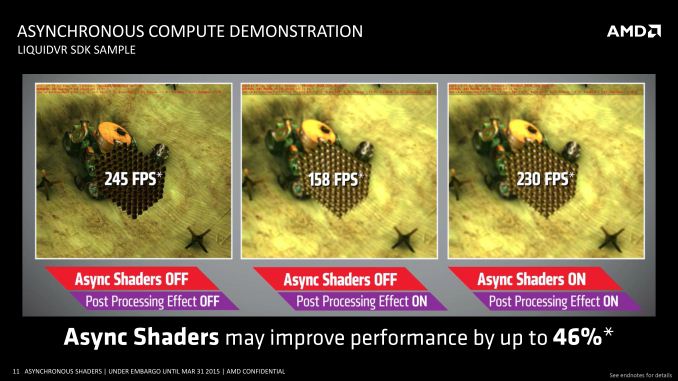
Yep remember this wonderful demo on 'Async Compute':

Async_Perf_575px.jpg
I like how they said up to! Definitely some nice gains coming from async and it does make the life of game devs so much easier.

AMD fanboys are already claiming Pascal is obsolete and that Titan Xp won't just get beaten by Vega in a year's time, but it won't even be capable of running games at high settings. I don't think it's physically possible for them to get any more enthusiastic about Vega
Based on features it is obsolete. Even async is problematic and a nightmare for devs to handle on Nvidia hardware. A few features might be impossible with Pascal's level of conservative raster. So yeah may not be able to max out all the settings. Handful of others that can adversely affect performance, so even if running max settings performance may not be stellar.

No one on here said Vega was going to outperform 1080Ti but you when you say an AMD fan on here said it.
I made that claim and backed it up with research. Only question being how far along the drivers were and if it would be there at launch. On paper it is technically superior in a number of ways.
 
I think the Tweaktown stuff could very well be fake since the cards aren't being sampled at this time. :) I saw it and figured it was rumor material. I did NOT think it is true. But I think it is worthy of discussion for fun.
Not sampled, but they were handing out Nanos, which don't exist, at Capsaicin so hardware is out there. Don't have to be a reviewer to have early access to hardware and possibly newer drivers either.
 
Marketing statements can only reflect the current reality without falling to false marketing. Showing where they expect to be in the future isn't an option.

marketing's main job it to create and maintain consumer expectations. AMD does none of that

Except it wasn't and even selectively being enabled doesn't mean it is fully tuned. Tweaking tile sizes can make a significant difference and take time.

TIme doesn't matter, when launched its there or not, most people buy products based on INTIAL reviews of a product, not months or a year down the road with expectations of it performing better.

If by hope you mean based on research papers and empirical evidence then yes you would be correct. Just a lot of people around here in denial or simply not understanding what some of these features do. Keeping consumers ignorant is the goal of some companies.

I like how they said up to! Definitely some nice gains coming from async and it does make the life of game devs so much easier.

Based on features it is obsolete. Even async is problematic and a nightmare for devs to handle on Nvidia hardware. A few features might be impossible with Pascal's level of conservative raster. So yeah may not be able to max out all the settings. Handful of others that can adversely affect performance, so even if running max settings performance may not be stellar.

LOL really, and I must have shot them all down with my own "proof", no you didn't use papers or anything like that, you hypothesized based on what AMD had stated, which you don't use that as a starting point to make a hypothesis, cause AMD is marketing a product, that should never be used to figure out the underlying performance possibilities. I even stated this to your DSBR sentiment. nV is on its 2nd (actually 3rd or 4th if you consider tegra) implementation of their tiled rasterizer, you can't expect AMD to get the same benefits out of their DSBR as nV gets in there. And AMD shows that they are not getting that much benefit in games from it. 5% to 30 % most like 10%-15% bandwidth savings. So if an application isn't bandwidth constrained will it get more performance? The answer is no. So how many games are bandwidth constrained? Now you know why they told Techreport, they will only turn it on via drivers when certain situations are there, they specifically stated bandwidth contained situations. This was pointed out several times as well. Which you just ignored in your hypothesis. Looks like you need a refresher about what AMD stated

http://techreport.com/review/31224/the-curtain-comes-up-on-amd-vega-architecture/3

The draw-stream binning rasterizer won't always be the rasterization approach that a Vega GPU will use. Instead, it's meant to complement the existing approaches possible on today's Radeons. AMD says that the DSBR is "highly dynamic and state-based," and that the feature is just another path through the hardware that can be used to improve rendering performance. By using data in a cache-aware fashion and only moving data when it has to, though, AMD thinks that this rasterizer will help performance in situations where the graphics memory (or high-bandwidth cache) becomes a bottleneck, and it'll also save power even when the path to memory isn't saturated.

And this is why I stated we don't know the real ramifications of using a titled rasterizer, at that point. Pascal presentations told us some things about the bandwidth savings, but that works we have seen it work. Pascal/Maxwell get away with less bandwidth than AMD counterparts. Power wise we have no damn clue how much power it saves. On AMD's architecture unless AMD releases on/off comparisons, we won't either. Most likely it doesn't save power at all, that is why they aren't keeping it on at all times, it could actually increase power usage when bandwidth isn't the bottleneck, even though AMD stated the contrary, there has to be a reason for turning it off, it could be it has adverse performances in titles? I don't know pick and choose between em, but there must be something going on with AMD's version.

I made that claim and backed it up with research. Only question being how far along the drivers were and if it would be there at launch. On paper it is technically superior in a number of ways.

yet those claims now haven't materialized, and they won't. So does your research hold up? NOPE. again using AMD's marketing material as a starting point is bad news.
 
Last edited:
I think the Tweaktown stuff could very well be fake since the cards aren't being sampled at this time. :) I saw it and figured it was rumor material. I did NOT think it is true. But I think it is worthy of discussion for fun.

Indeed, though I do think Vega 56 probably trade blows with the GTX 1070, but as usual, wait for reviews.
 
Marketing statements can only reflect the current reality without falling to false marketing. Showing where they expect to be in the future isn't an option.


Except it wasn't and even selectively being enabled doesn't mean it is fully tuned. Tweaking tile sizes can make a significant difference and take time.

It actually is enabled in the driver version they used in those benchmark slides. Go check the driver versions. You're wrong. Whether or not it is active in the games tested is totally irrelevant

They have resorted to false marketing before, dual 480s being more efficient than a 1080.... How is that not false marketing lol an rx480 draws almost as much as a 1080 on its own
 
Vega is pure win.

Supports all the latest standards, runs cooler, is more efficient and provides the user with the latest technology. Something, a competitor can only offer in a $8k product.

Rx Vega will outperform the higher priced 1080, in modern games.


1501481674403m5pkzqq_1_48_l.jpg


Nothing to really argue.
And if you need something more, then wait for dual-gpu soc. But as it stands, to get dx12.1 and latest standards, not to mention lower latency gaming, Vega is the easy choice for Gamers.
 
Certainly we don't need to argue about who was too optimistic *months* ago

.

Aww god, no man, that will be the best of the best part after VEGA launch.. who will have to eat some delicious crows, you know the humiliation of admitting to being VERY wrong.. certainly gona enjoy that situation after some delusional guys as the above poster.. =).
 
"Outperform" does seem to lend itself to quite a bit of enthusiastic marketing embellishment. I guess "trading blows with" or "just as good as" didn't have quite the same catchy marketing ring to them... :D

If I'm going to dump $500 into a graphics card upgrade, it's really not that much more of a stretch to just say F-it and dump a couple hundred more in for a 1080Ti that would raise the bar a good bit higher as to overall performance.

Now had this card come in at a $399 price point, then it would have turned a few heads.
 
Vega is pure win.

Supports all the latest standards, runs cooler, is more efficient and provides the user with the latest technology. Something, a competitor can only offer in a $8k product.

Rx Vega will outperform the higher priced 1080, in modern games.


1501481674403m5pkzqq_1_48_l.jpg


Nothing to really argue.
And if you need something more, then wait for dual-gpu soc. But as it stands, to get dx12.1 and latest standards, not to mention lower latency gaming, Vega is the easy choice for Gamers.
So not intrested in the idea Vega will beat a 1080 as I highly doubt that, but am perfectly okay with waiting till the 14th to find out. But what I can not understand is this delusion that dual-gpu is going to magically be a real thing that will work real well. Here is the thing unless AMD finds a magical way to get the driver to treat dual GPU as one GPU resource it is going to be as usefull as all the other dual gpu/sli/crossfire setups. That is not even getting into the power and heat consumption of a dual-gpu soc running VEGA.
 
So not intrested in the idea Vega will beat a 1080 as I highly doubt that, but am perfectly okay with waiting till the 14th to find out. But what I can not understand is this delusion that dual-gpu is going to magically be a real thing that will work real well. Here is the thing unless AMD finds a magical way to get the driver to treat dual GPU as one GPU resource it is going to be as usefull as all the other dual gpu/sli/crossfire setups. That is not even getting into the power and heat consumption of a dual-gpu soc running VEGA.


Not just the dual GPU delusions he is having wet dreams about Vega.

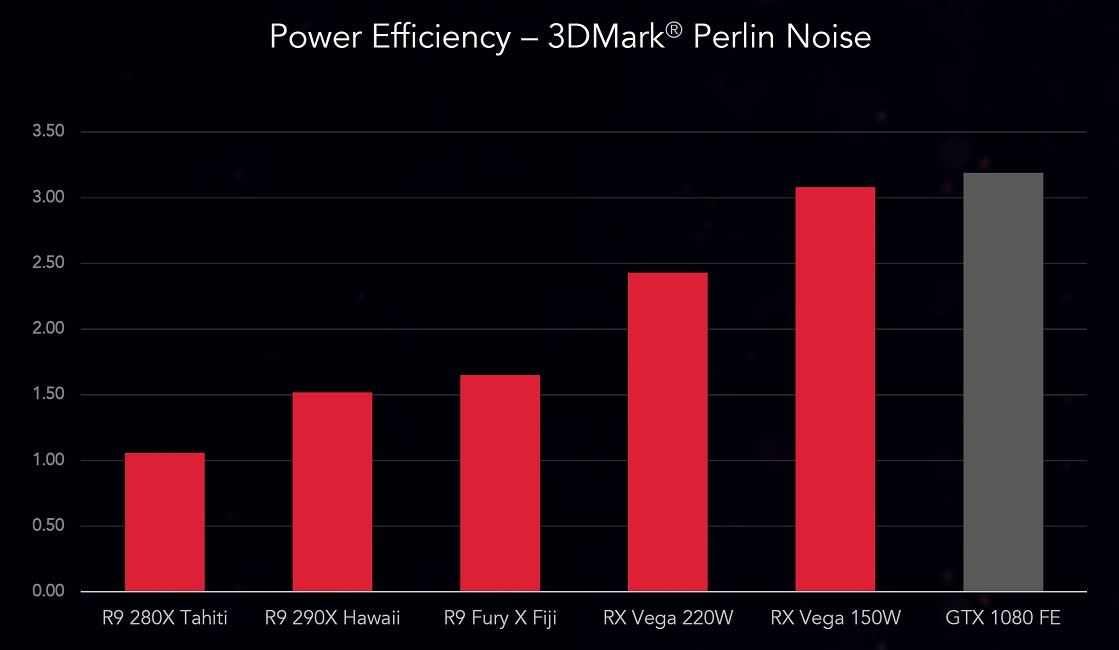
Even by AMD's own graphics Vega doesn't beat the gtx 1080 in efficiency, yet he comes out with its more efficient lol

arch-38.jpg


now why didn't they use 300 watts which is RX Vega 64? it would look too bad......
 
I don't care what anyone says, I'm excited!

I have been on 290 performance since late 2013 with the r9 290 (which I spent around 500 dollars for due to the mining spikes), I ONLY side graded to the rx 480 because the displayport to hdmi 2.0 adapter did not work with the displayport output on my 290 (it did with the rx480 but was a moot point since it had hdmi 2.0 already) and then I could output to my 4k tv/monitor. The rx 480 was a side grade from the 290 though, so I have had no meaningful performance jumps since 2013 !!!!!!!!!! I never wanted to get a Furyx or fury with that little memory, and of course my fanboyism made nvidia out of the question. So at long last, the drought of a real upgrade in performance will end. I will actually be able to run games at native 4k.

If only my tv was oled, but that seems like it will take another 5 years for lg to give a damn about making a 43 inch oled tv/monitor. They seem content like other display makers of offering meager 30 inch and 34 inch displays with sub 4k resolutions or some other tradeoffs for over a thousand dollars.

The pc display market is the one market in the US where I feel like one of you Euros or other foreigners that have higher prices for scraps.
 
I don't care what anyone says, I'm excited!

I have been on 290 performance since late 2013 with the r9 290 (which I spent around 500 dollars for due to the mining spikes), I ONLY side graded to the rx 480 because the displayport to hdmi 2.0 adapter did not work with the displayport output on my 290 (it did with the rx480 but was a moot point since it had hdmi 2.0 already) and then I could output to my 4k tv/monitor. The rx 480 was a side grade from the 290 though, so I have had no meaningful performance jumps since 2013 !!!!!!!!!! I never wanted to get a Furyx or fury with that little memory, and of course my fanboyism made nvidia out of the question. So at long last, the drought of a real upgrade in performance will end. I will actually be able to run games at native 4k.

If only my tv was oled, but that seems like it will take another 5 years for lg to give a damn about making a 43 inch oled tv/monitor. They seem content like other display makers of offering meager 30 inch and 34 inch displays with sub 4k resolutions or some other tradeoffs for over a thousand dollars.

The pc display market is the one market in the US where I feel like one of you Euros or other foreigners that have higher prices for scraps.
Screen burn in and pixel degradation is the real issue behind oled monitors. The other thing is a smaller OLED moitor or TV would be incredibly expensive to produce. I would love to see the tech come down in price as I have had a real bad experiance with my Samsung QLED monitor. I bought one in March and am on the third one and it is in with Samsung for repairs.
 
Screen burn in and pixel degradation is the real issue behind oled monitors. The other thing is a smaller OLED moitor or TV would be incredibly expensive to produce. I would love to see the tech come down in price as I have had a real bad experiance with my Samsung QLED monitor. I bought one in March and am on the third one and it is in with Samsung for repairs.


damn that sux, knew OLED's had issues but really 3 times?
 
damn that sux, knew OLED's had issues but really 3 times?
Yeah I am on the 3rd monitor. First one went back to Amazon for white cloudy blotches all over the screen as well as horizontal white lines. Second one just went past the 30 days and it had the same faint white vertical lines sent it for repairs to samsung came back working, two weeks later had a verticle line of pixels running across the screen convinced Samsung to replace it which took two months and then 10 days after getting the third brand new monitor it started to get a verticle line of pixels that ran the entire screen. I don't know if it is the QLED fault or if it is an issue with verticle alignement panels. When they work the color is amazing and the refresh rates or great.
 
Yeah I am on the 3rd monitor. First one went back to Amazon for white cloudy blotches all over the screen as well as horizontal white lines. Second one just went past the 30 days and it had the same faint white vertical lines sent it for repairs to samsung came back working, two weeks later had a verticle line of pixels running across the screen convinced Samsung to replace it which took two months and then 10 days after getting the third brand new monitor it started to get a verticle line of pixels that ran the entire screen. I don't know if it is the QLED fault or if it is an issue with verticle alignement panels. When they work the color is amazing and the refresh rates or great.

Wait a minute I thought QLED was completely different than OLED.
 
Wait a minute I thought QLED was completely different than OLED.

It is, it's still an lcd display, just a fancier name (to mirror OLED) with quantum dots. They still use leds with local dimming to light the display. They are working on future version where current can be applied to the quantum dots to release light, but that is not here yet and so the only emissive display tech in the consumer market is still OLED.

QLED tvs from samsung still get a lot brighter than oled displays, and as a consequence should be able to offer much brighter highlights and volume of color before everything turns into a white blob with lost detail.
 
Vega is advanced uArch.
Volta is closer to RX Vega's NCU, than Pascal. But NCU is more sophisticated due to AMD's advanced tech.

Setting up the front end, Vega can be any type of compute card. This is the future. When "set up" for games, it can be quite efficient.

1501481674403m5pkzqq_2_54_l.jpg


You can read more about it, if you want. Or just wait until reviews.
 
Vega is advanced uArch.
Volta is closer to RX Vega's NCU, than Pascal. But NCU is more sophisticated due to AMD's advanced tech.

Setting up the front end, Vega can be any type of compute card. This is the future. When "set up" for games, it can be quite efficient.

1501481674403m5pkzqq_2_54_l.jpg


You can read more about it, if you want. Or just wait until reviews.
That is some nice marketing speek and all. We all know AMD cards take 3 to 4 years to bake in and finnaly be great at playing 3 to 4 year old games, but what confuses me here is why use this chart for Radeon Chill?
 
That is some nice marketing speek and all. We all know AMD cards take 3 to 4 years to bake in and finnaly be great at playing 3 to 4 year old games, but what confuses me here is why use this chart for Radeon Chill?


Because raw performance data will show otherwise lol. Radeon chill isn't that great anyway, who moves in a straight line or stands still?
 
Because raw performance data will show otherwise lol. Radeon chill isn't that great anyway, who moves in a straight line or stands still?
If I am playing Overwatch i want more than 60fps as well which negates the whole way Chill works. NVIDIA MAXGO whatever thing for their laptop gpu is the exact same thing. Controll power consumption by locking the framerate and lowering all performance and power to that level.
 
Vega is advanced uArch.
Volta is closer to RX Vega's NCU, than Pascal. But NCU is more sophisticated due to AMD's advanced tech.

Setting up the front end, Vega can be any type of compute card. This is the future. When "set up" for games, it can be quite efficient.

1501481674403m5pkzqq_2_54_l.jpg


You can read more about it, if you want. Or just wait until reviews.

Wow, I have to say power consumption is the last thing I expected AMD to draw attention to with Vega...

You can't claim a card that fails by every metric is advanced.
 
Last edited:
I suppose they tested using a 720p monitor or something with a Radeon Chill cap @ 60fps.
That's just it. i can drastically reduce heat and power consumption on my GTX 1080 by using VSYNC at 60hz and running in 1080p. This is just a driver level implementation so it can be a simple switch on the Radeon Crimson control panel.
 
That's just it. i can drastically reduce heat and power consumption on my GTX 1080 by using VSYNC at 60hz and running in 1080p. This is just a driver level implementation so it can be a simple switch on the Radeon Crimson control panel.
It does more than simply cap the framerate. But the drastic numbers from that infographic are 100% cheesed.
It's mostly a mobile feature, anyway.
 
It does more than simply cap the framerate. But the drastic numbers from that infographic are 100% cheesed.
Sure it also throttles the clock and controls power draw which is only useful in say a laptop: I was being overly reductionist on purpose. No one is really going to do that on a desktop unless heat becomes a serious issue with Vega.
 
Vega is pure win.

Supports all the latest standards, runs cooler, is more efficient and provides the user with the latest technology. Something, a competitor can only offer in a $8k product.

Rx Vega will outperform the higher priced 1080, in modern games.


1501481674403m5pkzqq_1_48_l.jpg


Nothing to really argue.
And if you need something more, then wait for dual-gpu soc. But as it stands, to get dx12.1 and latest standards, not to mention lower latency gaming, Vega is the easy choice for Gamers.


Woah woah woah.

How is it more efficient exactly? Performs like a 1080, draws almost double the power. Half as efficient if anything
 
Woah woah woah.

How is it more efficient exactly? Performs like a 1080, draws almost double the power. Half as efficient if anything
It is very efficient at doing efficient things sufficiently. In fact the closer you get to Vega efficiency you beguine to approach an efficiency quotidian that makes all other efficient GPUs look less efficient than other efficient GPUs.
 
Back
Top