• Some users have recently had their accounts hijacked. It seems that the now defunct EVGA forums might have compromised your password there and seems many are using the same PW here. We would suggest you UPDATE YOUR PASSWORD and TURN ON 2FA for your account here to further secure it. None of the compromised accounts had 2FA turned on.
    Once you have enabled 2FA, your account will be updated soon to show a badge, letting other members know that you use 2FA to protect your account. This should be beneficial for everyone that uses FSFT.

The 285k is embarrassing

vjhawk

Gawd
2FA
Joined
Sep 2, 2016
Messages
671
Intel’s latest 285k chip loses to its older 14900k and it costs a hefty $629 on Newegg right now. Not only that but it loses even more to the 7800x3d in gaming, a chip that costs $150 less.

IMG_4776.png


Needless to say the new 9800x3d which is 10% faster than the 7800x3d, laps both the 285k and 14900k easily.

IMG_4773.jpeg


Surely testing dead last for cyberpunk is not where a flagship cpu wants to be yet here it is.
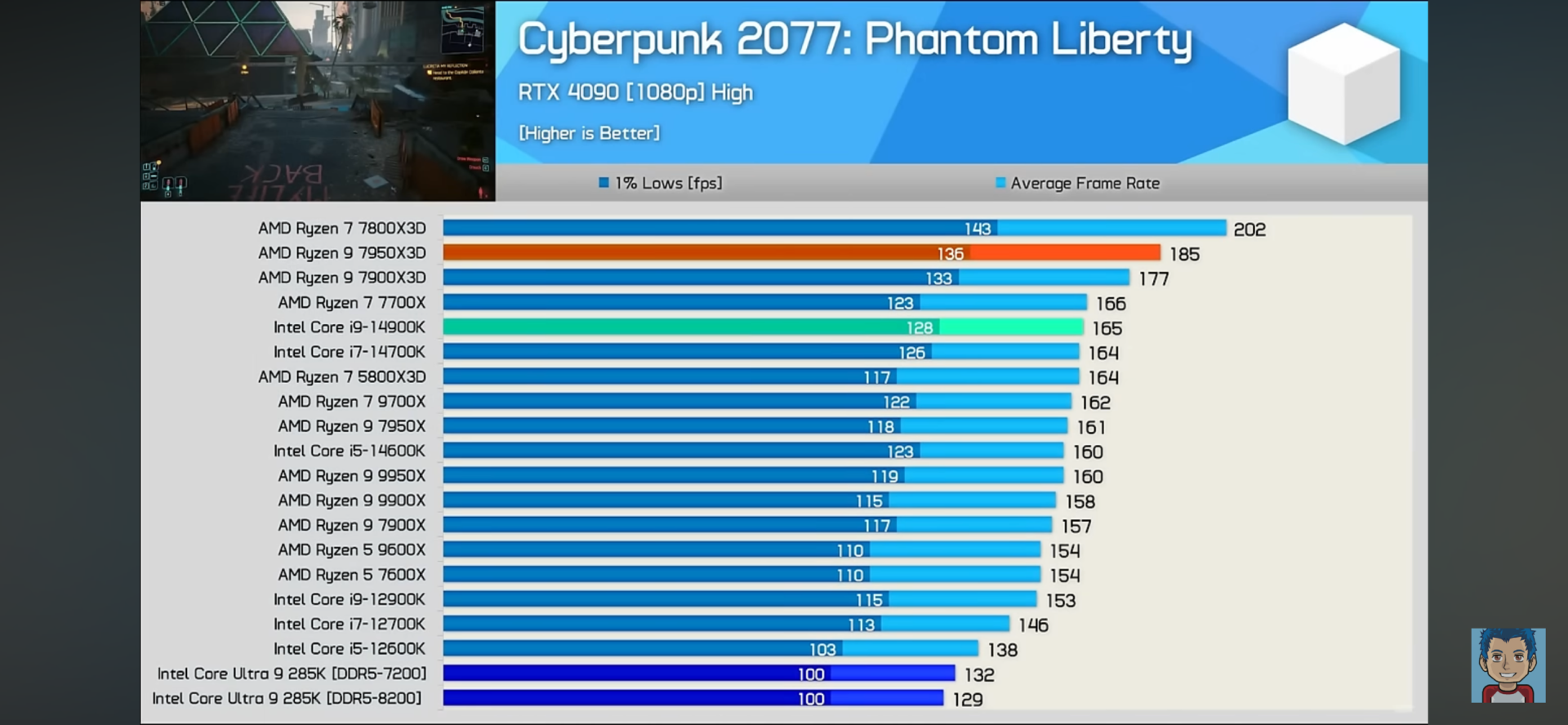
IMG_4778.png


What is intel doing? Even their chips are unstable unless you have new bios that lowers their speed to keep them from crashing. Intel has become a joke with their 15th gen chips. Pathetic. When will they turn this sinking ship around?
 
Last edited:
I wonder how well a 14900K would run by letting TSMC do a node shrink on it and lowering the power level. Would that even be possible?
 
The 285 would be good at 300 dollars at best. 250 would be a good deal. At the price it is right now is beyond delusional. It was rushed and an utter disappointment as far as gaming performance. It's interesting how AMD and Intel on on opposite ends so far apart. Similar to AMD and Nvidia so far apart.
Intel has lost it's way so much it's sad. I hate E cores and wish they just made a 10 performance core CPU like the 14900k with the cores a bit more spaced out for better heat management and like 250watt max. I think that would have saved so much bullshit with e core schedule nonsense,trying to make a gaming and productivity chip all in one jack of all trades master of none and that's exactly what they ended up with. Meanwhile AMD delivering Master of one chips nice and organized and giving games what it needs fast cache processing.
I mean it's a combination of AMD hitting the lottery and Intel shooting themselves in the foot and here we are lmao
 
I actually like the direction that they are going with their new CPUs. The path they had taken with the 13 and 14-series, toward unrealistic power consumption and heat output, was not sustainable. The 285k not a CPU that I would choose for my personal computer but I think that Arrow Lake CPUs are still mostly fine CPUs for a typical multi-usage pre-built computer. And I hope that they can build upon this and make future generations more competitive for gaming.
 
I actually like the direction that they are going with their new CPUs. The path they had taken with the 13 and 14-series, toward unrealistic power consumption and heat output, was not sustainable. The 285k not a CPU that I would choose for my personal computer but I think that Arrow Lake CPUs are still mostly fine CPUs for a typical multi-usage pre-built computer. And I hope that they can build upon this and make future generations more competitive for gaming.

Going towards unrealistic power consumption and heat seems like that is exactly what're going to do again though. In one of the interviews, the Intel guy said that they have "headroom to grow into" because Arrow Lake has managed to reduced the power consumption vs Raptor Lake. That tells me that they plan to increase performance with future generations by juicing up the power again. Basically if they managed to give Raptor Lake performance while using half the power, now they can go past Raptor Lake performance by giving it even more power until it's back to 300+ watts again.
 
Going towards unrealistic power consumption and heat seems like that is exactly what're going to do again though. In one of the interviews, the Intel guy said that they have "headroom to grow into" because Arrow Lake has managed to reduced the power consumption vs Raptor Lake. That tells me that they plan to increase performance with future generations by juicing up the power again. Basically if they managed to give Raptor Lake performance while using half the power, now they can go past Raptor Lake performance by giving it even more power until it's back to 300+ watts again.

In that interview I did not get the impression that he was talking about power usage. On the contrary, they have tremendous incentive to keep power consumption low because that is the direction that the industry is headed, with more devices slowly shifting over to other architectures such as ARM, in a large part due to power efficiency.

This would be similar to the shift they made from Netburst (Pentium 4, Pentium D, etc) to Core (Core2Duo, Core2Quad, etc), but in this case, without a process node advantage. Imagine if, back then, they weren't on a roll with new process nodes, and the first generation of Core2Duo CPUs was actually slower than the dual-core Pentium D CPUs that existed immediately prior (which also consumed a lot of power for their time). Intel ended up doing great things with the Core architecture, that didn't involve simply increasing power consumption. I feel like that's where they are again now.
 
In that interview I did not get the impression that he was talking about power usage. On the contrary, they have tremendous incentive to keep power consumption low because that is the direction that the industry is headed, with more devices slowly shifting over to other architectures such as ARM, in a large part due to power efficiency.

This would be similar to the shift they made from Netburst (Pentium 4, Pentium D, etc) to Core (Core2Duo, Core2Quad, etc), but in this case, without a process node advantage. Imagine if, back then, they weren't on a roll with new process nodes, and the first generation of Core2Duo CPUs was actually slower than the dual-core Pentium D CPUs that existed immediately prior (which also consumed a lot of power for their time). Intel ended up doing great things with the Core architecture, that didn't involve simply increasing power consumption. I feel like that's where they are again now.

He specifically mentioned power consumption in the context of having future headroom to grow into though. But if they can make big gains without doing so then that would certainly make everyone happy. I wouldn't want AMD to be the only option for gamers, more options is always better.
 
The 285k is actually compelling if you have productivity workloads and need IO, through the Z890 platform, because the X870 platform sucks and the X870E platform is way way more expensive. Also, the 285k can handle 4x DIMMS at 5200 MT/s whereas the 9950X will drop to 3600 in the same configuration. A lot better if you need lots of memory, and not something I've seen mentioned in any reviews. God forbid we see reviewers exploring these aspects instead of all piling on the same gamer talking points.

I guess it's disappointing for ricer enthusiasts trying to buy $500 gaming motherboards for $500 gaming CPUs with RGB everywhere.

I'd be less salty about it all if all the negative press translated into me being able to buy one, but I still can't.
 
The 285k is actually compelling if you have productivity workloads and need IO, through the Z890 platform, because the X870 platform sucks and the X870E platform is way way more expensive. Also, the 285k can handle 4x DIMMS at 5200 MT/s whereas the 9950X will drop to 3600 in the same configuration. A lot better if you need lots of memory, and not something I've seen mentioned in any reviews. God forbid we see reviewers exploring these aspects instead of all piling on the same gamer talking points.

I guess it's disappointing for ricer enthusiasts trying to buy $500 gaming motherboards for $500 gaming CPUs with RGB everywhere.

I'd be less salty about it all if all the negative press translated into me being able to buy one, but I still can't.
Not to mention 285K is the 1st chiplet architecture from Intel without Hyperthreading. The experience is similar to when AMD first introduce 5800X3D, plagued with several issues that were patched afterward.
 
It's always a 1-way street with the AMD fanbois. The 9000 series were embarrassing... but look, a Windows update improved the performance! Except it improved performance for the 7000 series as well (not sure about the 5000 series). The Core Ultra series were embarrassing, but look, a Windows update will improve the performance in gaming! <crickets>

Topic headline? Intel CPU is embarrassing! Missing headline? AMD CPU is embarrassing!

The level of AMD fanbois is unprecedented, and really deters me from ever wanting another AMD CPU again. Intel's never had better marketing.
 
It's always a 1-way street with the AMD fanbois. The 9000 series were embarrassing... but look, a Windows update improved the performance! Except it improved performance for the 7000 series as well (not sure about the 5000 series). The Core Ultra series were embarrassing, but look, a Windows update will improve the performance in gaming! <crickets>

Topic headline? Intel CPU is embarrassing! Missing headline? AMD CPU is embarrassing!

The level of AMD fanbois is unprecedented, and really deters me from ever wanting another AMD CPU again. Intel's never had better marketing.
The point where Intel fans don't want to replace their 13900k/14900k/14700k with the new 285k because it doesn't offer better gaming performance, isn't it clear enough how "good" the Core Ultra is? Yeah, they won't get on the x3D train, but they'll end up staying with the current platform until the next one.
 
Last edited:
The point where Intel fans don't want to swap their 13900k/14900k/14700k with the new 285k because it doesn't offer better gaming performance. Yes, they won't get on the x3D train, but they'll end up staying with the current platform until the next one. Isn't that clear enough how "good" the Core Ultra is?
Seems sensible. I don't think anyone with a 7000 series should upgrade to get a 9000 series, or a 13th or 14th gen to get a Core Ultra series. The performance jump is minimal. I upgraded from a 3930K, and I would say to save money and get a 13600K or 5800X if you wanted to upgrade now. If you're an overclocker, the 13600K, if you're not, the 5800X.
 
Seems sensible. I don't think anyone with a 7000 series should upgrade to get a 9000 series, or a 13th or 14th gen to get a Core Ultra series. The performance jump is minimal. I upgraded from a 3930K, and I would say to save money and get a 13600K or 5800X if you wanted to upgrade now. If you're an overclocker, the 13600K, if you're not, the 5800X.
That's your opinion :)
I jumped from 7000 to 9000 and if I have to I will do it again, the performance is there for those , which is looking for it.
 
That's your opinion :)
I jumped from 7000 to 9000 and if I have to I will do it again, the performance is there for those , which is looking for it.
That's your opinion :)
From the Backstreet boys to the 1-street boys, red vs blue, if you prefer one hue, you've got no clue.
 
Not to mention 285K is the 1st chiplet architecture from Intel without Hyperthreading. The experience is similar to when AMD first introduce 5800X3D, plagued with several issues that were patched afterward.
Except AMD delivered the patches. We’re yet to see if the 285k gets any meaningful patches that fix its issues.
 
In reality, if you buy a ~$600 CPU. You probably.. hopefully have a GPU to match and are playing games at 1440p +. In which case you'd be GPU bound anyway. (Not discounting the point of testing at 1080p so lets not have that discussion again lol)
 
In reality, if you buy a ~$600 CPU. You probably.. hopefully have a GPU to match and are playing games at 1440p +. In which case you'd be GPU bound anyway. (Not discounting the point of testing at 1080p so lets not have that discussion again lol)
There are plenty of games that are CPU bound at 1440P with a 4090. And quite a few that are CPU bound at 4K (but not nearly as many).

Shitty game optimizations abound.
 
Not to mention 285K is the 1st chiplet architecture from Intel without Hyperthreading. The experience is similar to when AMD first introduce 5800X3D, plagued with several issues that were patched afterward.
I'm genuinely interested to see what the 285k patch is going to do.
 
Got my 285k. Not slower than my 5950X. Nice. Slightly more power hungry (but that’s with limits off, and the 5950X is still one of the most efficient chips AMD ever hade). Code compiles are faster. x265 encoding is much faster, but handbrake sometimes segfaults. Possibly related. Still stoked with it so far!

Gaming at 4K on my RTX 3090 is not… worse. Or different at all. I’d have to spend a pretty penny for a markedly (noticeably) different gaming experience (new monitor to start with), so who cares.

Best part? My motherboard has shitloads of IO and cost $200 less than what I’d have spent on X870E.

I’m going to play with the NPU to see if it can do anything fun.

If the 9950X3D is juicy enough I’ll get one of those too. (I’m an adult with no children.) Still cheaper than threadripper 😔
 
Last edited:
Does it keep a room warm in the winter though? Gotta think about the possible side benefits.

Can't help myself:

At least when AMD did this trick a decade ago and the TDP was above 250w the chips didn't burn out.

My 9590 is still running... um.... since 2014.
 
IMHO not only ARL is disappointing but the whole LGA1851 just sucks and is not worth it.
Intel already dropped plans to have processors with more cores and 8+16 is likely all we are going to see. Prospects of upgrading CPU don't exist on this platform. And it doesn't even support AVX512 because again Intel didn't put any effort to make E-cores support it so it is completely disabled.

And then they will change socket for no good reason.
It is not like they do any tests and validation to make users avoid issues. Windows doesn't have patches, microcode is apparently again broken, boards again ship with wrong settings... oh come on!

And more interestingly Intel has "chiplets" now but the way they made these chiplets doesn't make any sense. Instead of having ability to scale number of CPU tiles all they did is cut CPU in to smaller pieces and ruin latency while doing that. If that was not the case we would see 16+32 CPUs. Or ideally they would make P and E cores separate and release more interesting configurations like e.g. 32 P cores. Nothing like this even seem possible with their current approach.

So the question I have is: why even bother with it?
It looks like the money spend on developing it would be better spend to make sure RL isn't burning up or develop actually competing core design.
 
Instead of having ability to scale number of CPU tiles all they did is cut CPU in to smaller pieces and ruin latency while doing that. If that was not the case we would see 16+32 CPUs. Or ideally they would make P and E cores separate and release more interesting configurations like e.g. 32 P cores. Nothing like this even seem possible with their current approach.

They can make 64 p-core cpu:
https://www.intel.com/content/www/u...essor-320m-cache-1-90-ghz/specifications.html

Or 144 e-core cpu:
https://www.phoronix.com/review/intel-xeon-6780e-6766e

The distinction between cutting a cpu in smaller piece with chiplets vs ability to scale how much you have because of it, for cpu far away from the reticle maximum, it is almost all about cutting cost (can become a little bit easier heat management with multiple hot spot), that why you do not make just a giant 600-700mm monolithic like Apple do, to cut cost, AMD style is really good at it because it make you cut cost twice, very reusable design-cheaper chips to make.

And I feel like intel core count on personal computer cpu is far to be an issue for them, 24 cores is already a lot, 20 on a 265k has well or 14 on the 245k entry level... So I am not sure the way they cut the cpu not aimed at ramping up core count is an issue, AMD could easily to it and never did past 16c on personal computer, because there is little demand for more than 20-24 threads machine there.

So the question I have is: why even bother with it?
All about how much saving that approach think they can have, reusable tile would be much cheaper than making a cpu for every scenario, smaller tile much cheaper than a single one smaller size but ability to pick advanced node for the compute part and cheaper one for the rest, maybe the approach is not good at scaling cores but I am not sure it is an issue, for the moment they have more than enough of them.
 
IMHO not only ARL is disappointing but the whole LGA1851 just sucks and is not worth it.
Intel already dropped plans to have processors with more cores and 8+16 is likely all we are going to see. Prospects of upgrading CPU don't exist on this platform. And it doesn't even support AVX512 because again Intel didn't put any effort to make E-cores support it so it is completely disabled.

And then they will change socket for no good reason.
It is not like they do any tests and validation to make users avoid issues. Windows doesn't have patches, microcode is apparently again broken, boards again ship with wrong settings... oh come on!

And more interestingly Intel has "chiplets" now but the way they made these chiplets doesn't make any sense. Instead of having ability to scale number of CPU tiles all they did is cut CPU in to smaller pieces and ruin latency while doing that. If that was not the case we would see 16+32 CPUs. Or ideally they would make P and E cores separate and release more interesting configurations like e.g. 32 P cores. Nothing like this even seem possible with their current approach.

So the question I have is: why even bother with it?
It looks like the money spend on developing it would be better spend to make sure RL isn't burning up or develop actually competing core design.
I agree being a gamer i just want a p core focused version with low latency I've had it up to here with all the e core bullshit for years lol
 
Anyone know why they don't make a higher P-core count CPU? It's been stuck at 6 P-Cores since the get-go. I could see an 8 P-Core, 10 P-Core, and 12 P-Core with or without E-Cores being pretty popular.
 
I could see an 8 P-Core
That what the 12900k-13900k-14900k-285k have been, if you are not talking exclusively about a no e-core cpu (for that 6 p-cores), but none come to mind.

The I can take advantage of more than 8 cores but do not prefer a ton of them via the e-core could be a limited market, one they could prefer to serve via the xeon line:
https://www.nextplatform.com/2024/0...apids-xeon-6-into-the-datacenter/?form=MG0AV3

Who would have been the in-between target, gamers are ok with 8 pcores, people that want lot of cores tend to love e-core...
 
Who would have been the in-between target, gamers are ok with 8 pcores, people that want lot of cores tend to love e-core...

Not me. I don't want tasks to "get stuck" on an E-Core and "wait" for the scheduler to move it over, if ever.
 
Not me. I don't want tasks to "get stuck" on an E-Core and "wait" for the scheduler to move it over, if ever.
Are you gamers that is not ok with 8 cores (so would not consider a 9800x3d) or someone that often launch 30+ threads task but would prefer to have 10 pcore-no ecore instead, loosing a lot of performance just to avoid that scenario ?
 
Are you gamers that is not ok with 8 cores (so would not consider a 9800x3d) or someone that often launch 30+ threads task but would prefer to have 10 pcore-no ecore instead, loosing a lot of performance just to avoid that scenario ?

The latter is effectively what I do. I think a 14900 might be a little faster for me when I only compile and link one file (single-core speed) until the 9950x3d comes out. But I didn't like my only Alder Lake computer, and in any case I want full ECC support, which requires special mainboards with Intel and are not available at all for Arrow Lake.

I also have a 48-core machine that is still not threaded out by some of my compilation tasks. Just the Linux kernel has huge parallelism.
 
Is there any new 285k benchmarks after Intel's latest solutions of Windows, bios, and microcode updates?
 
I went to Falcon Northwest website and they are not even selling the 285k lol. No one is buying that cpu lol
 
Intel in the CPU world is like AMD in the GPU world. "Going to try to beat us?" No.
 
I'd buy it if the Core Ultra 5 245K was selling at $150 (not $319), and if a solid LGA 1851 motherboard was selling under $90. Except, it's not gonna happen. We have no clue as to how Panther Lake will be. If they're doubling down on NPU's, no thanks. I could care less about NPU's. They could also put their own version of 3D V-cache like AMD, but they won't. Intel's gone bonkers.
 
The main microcode update isn't out yet as a full BIOS release, for most boards.
last I checked the bios microcode was out but the management engine firmware driver wasn't which meant it still didn't do anything yet
 
last I checked the bios microcode was out but the management engine firmware driver wasn't which meant it still didn't do anything yet
I haven't checked every board. But, from what I have seen (as of the last couple days): the BIOS with the 0X114 microcode and ME version 19.0.0.1854V2.2, are either not available at all, or only in BETA release. (my board has a beta release since December 26th, and doesn't improve FF14 benchmark performance, at all. which is one of Arrowlake's worst cases.)

I don't expect magic. But, I do expect the final BIOS to have some improvement. Because the BETA BIOS was way ahead of the release schedule which Hallock talked about. What I mean is, I am sure there are changes which Intel is still working on with vendors, for the intended release.

Robert Hallock didn't say anything about an MEI driver being required, for the 0X114 microcode to be effective. And the MEI driver hasn't been updated since July. I think that maybe you are thinking about the ME version above. Which is part of the CPU's microcode or firmware. Not an OS driver.
 
Back
Top