• Some users have recently had their accounts hijacked. It seems that the now defunct EVGA forums might have compromised your password there and seems many are using the same PW here. We would suggest you UPDATE YOUR PASSWORD and TURN ON 2FA for your account here to further secure it. None of the compromised accounts had 2FA turned on.
    Once you have enabled 2FA, your account will be updated soon to show a badge, letting other members know that you use 2FA to protect your account. This should be beneficial for everyone that uses FSFT.

Question on routing cooling lines

Monkey34

Supreme [H]ardness
2FA
Joined
Apr 11, 2003
Messages
5,141
All the systems I've seen have one loop - no matter how many components are cooled. A friend of mine has one loop for cpu, two memory blocks, two raptor HDD's, and gpu. He's concerned it isnt very efficient, and came up with this idea:

He was thinking of changing it to a tee setup. Cooled from the rad, it would branch to the cpu and gpu individually, then re-combine into a second rad to cool again, then out to tee to the Hdd's and memory individually again, and back to the pump and first rad.

The price of parts is'nt an issue, he's got a closet full of parts.....niether is the tubing nightmare - there's plenty of room. Here's the case:

Question is: Will it really make a difference?
 
Well, I know TECHNICALLY it's really one loop, but each component would receive it's own cooled supply instead of coolant that has already been warmed by the component before it.
 
Water, like everything else, travels as lazily as possible.

Parallel loops give water many ways to travel, which reduces the overall flowrate in the loop.

Now, say you have 3 possible routes for the water to flow in... Most of it will go through the route that has the least amount of restriction... leaving the other 2 routes starved for water.

Is it going to hurt your temps THAT much? Maybe, maybe not. It might even help them... But it certainly creates way more routing mess, uses a ton more water, and adds many more points of failure to the loop.
 
+ the real bummer, water is such a good conductor of heat, no matter how many branches etc. very quickly the entire system will come up to some stable temp and you will not be able to measure any significant difference in coolant temp anywhere.
 
+ the real bummer, water is such a good conductor of heat, no matter how many branches etc. very quickly the entire system will come up to some stable temp and you will not be able to measure any significant difference in coolant temp anywhere.

I don't think so....please explain.
 

Why not? :p

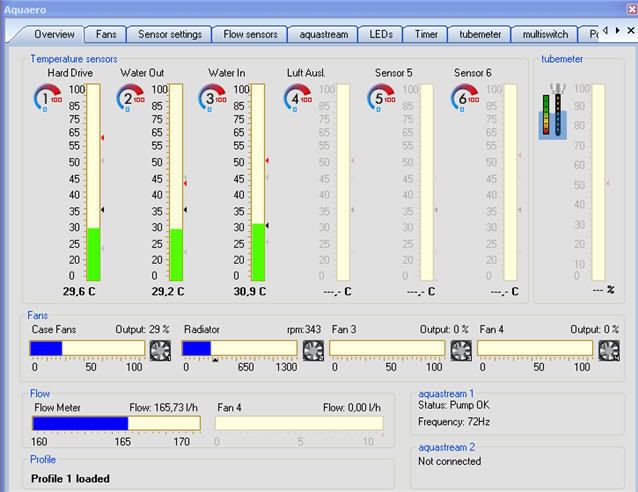
This is one of the myths of water cooling. If this were the case then what would be the point of having a radiator in the system? Here is my system and you can see a definite change in coolant temps (this was after running the computer for several hours) between the radiator input and output. If I were to put temp sensors inbetween my blocks you would also see changes there as well.


aquaero061507.jpg
 
What is the accuracy of your sensors in +/- deg C and when where they last calibrated ( I will accept an ice bath as calibration).
 
What is the accuracy of your sensors in +/- deg C and when where they last calibrated ( I will accept an ice bath as calibration).

I have a Crystalfontz setup. My sensors are in the water lines at the inlet and outlet of each of my rads. They all read within 1°C of each other, which is about the accuracy of the sensors when I tested them at 3 temp points. Points were at ice bath, room temp water, and hot water.

My loop: Res > pump > rad > CPU > rad > GPU > res. So I agree (from my observations) that, yes, the temps seem to stabilize thru the loop.

And, yes, I would agree with Arcygenical that parallel loops would follow the path of least resistance. Even if the flows were equal thru the loops, one is still cutting flow thru 2 parallel loops in half. Probably not a good idea just from that perspective.
 
What is the accuracy of your sensors in +/- deg C and when where they last calibrated ( I will accept an ice bath as calibration).

Now that is a good question as I have been trying to get that information for a while. However, I think that this would do better as a separate thread so I am going to start one.
 
I have a Crystalfontz setup. My sensors are in the water lines at the inlet and outlet of each of my rads. They all read within 1°C of each other, which is about the accuracy of the sensors when I tested them at 3 temp points. Points were at ice bath, room temp water, and hot water.

My loop: Res > pump > rad > CPU > rad > GPU > res. So I agree (from my observations) that, yes, the temps seem to stabilize thru the loop.

And, yes, I would agree with Arcygenical that parallel loops would follow the path of least resistance. Even if the flows were equal thru the loops, one is still cutting flow thru 2 parallel loops in half. Probably not a good idea just from that perspective.

I accept your results and TN's (TN I am feeling no pain and was just messing with you a bit, apologies - I was bad, but I knew what you were going to post before you did and it just tickled me so much that I guessed right, I couldnt resist) The key word was significant.

Nice work on the sensor calibration, too many assume they are accurate and take the readings as the word of a higher being.
 
Why not? :p
If I were to put temp sensors inbetween my blocks you would also see changes there as well.


This is where I've done tests myself... Between each of my 100w die simulators I saw a temperature rise of less than 0.3c. A full 300w load rose the temperature of the coolant .8c.

Since I was simply measuring a delta, calibration was not needed :D
 
The beauty of water is not necessarily the way it moves heat around, but the immense amount of heat it takes to make the temperature of water rise.

Most loops will run at flow rates between 2-4 LPM. At those flow rates, 100W of energy would raise your water temperature by .8-.4 degrees celsius (the higher difference at the lower flowrates). The faster your flowrate, the less that difference will be. Just about any loop will be hard pressed to find differences larger than 2-3C throughout the ENTIRE loop. Even TN's low flowing and long loop only shows 1.7C difference.
 
Even TN's low flowing and long loop only shows 1.7C difference

If the 2 sensors have the common tolerance (assumed) of +/- 1 deg C that number would be meanless as it is within the (assumed) margin of error. (one sensor reading 1C high other reading 1C low)
 
If the 2 sensors have the common tolerance (assumed) of +/- 1 deg C that number would be meanless as it is within the (assumed) margin of error. (one sensor reading 1C high other reading 1C low)

Except for the fact that the numbers make sense given her flowrate and heat output....
 
Water, like everything else, travels as lazily as possible.

Parallel loops give water many ways to travel, which reduces the overall flowrate in the loop.

Now, say you have 3 possible routes for the water to flow in... Most of it will go through the route that has the least amount of restriction... leaving the other 2 routes starved for water.

Is it going to hurt your temps THAT much? Maybe, maybe not. It might even help them... But it certainly creates way more routing mess, uses a ton more water, and adds many more points of failure to the loop.

The flowrate drop has already been discussed, and a new pump is already in mind (although he has thought about a second small one at the second rad as support). Hose diameters are also being thought on.

After some more thought, I think his biggest issue as you mentioned, will be keeping flowrates even in the parallel lines.
 
The flowrate drop has already been discussed, and a new pump is already in mind (although he has thought about a second small one at the second rad as support). Hose diameters are also being thought on.

After some more thought, I think his biggest issue as you mentioned, will be keeping flowrates even in the parallel lines.

If your getting a second pump the best way to do it is definitely two separate loops, stop screwing around with all those T's.
 
Back
Top