NVIDIA RTX50 series doesn’t support GPU PhysX for 32-bit games

TangledThornz

[H]ard|Gawd
2FA
Joined
Jun 12, 2018
Messages
1,628
So apparently PhysX isn't supported with the new RTX 50 series cards. This is disappointing af for me :banghead:😡 Batman: Arkham City is one of my all time favorite games that I like to replay every couple of years so I guess I'll just have to hold onto my RTX 2060 for long term I guess.

I'd be nice if nVidia provided a solution for PhsyX to work via the CPU but doubt it'll happen.

https://www.dsogaming.com/news/nvidia-rtx50-series-doesnt-support-gpu-physx-for-32-bit-games/

EDIT: It's been confirmed that 64-bit PhysX (eg Arkham Knight) games work on RTX 50 series.

https://www.reddit.com/r/nvidia/comments/1irs8xk/rtx_50_series_silently_removed_32bit_physx_support/
 
Last edited:
I do not imagine many studio will care enough to make an update.... (depending on what other library the game use.... 32->64 bits can be good work even if there was limited pointer math on your side of things, having doing it for large enough projects recently)

I'd be nice if nVidia provided a solution for PhsyX to work via the CPU but doubt it'll happen.
I think it already fallback to cpu, that why they say:
As such, you will no longer be able to enjoy older GPU PhysX games at high framerates. you’ll have to rely on the CPU PhysX solution,

This was announced on cuda 12 launch in 2022 I think, no one realized the implication it seem.
 
So apparently PhysX isn't supported with the new RTX 50 series cards. This is disappointing af for me :banghead:😡 Batman: Arkham City is one of my all time favorite games that I like to replay every couple of years so I guess I'll just have to hold onto my RTX 2060 for long term I guess.

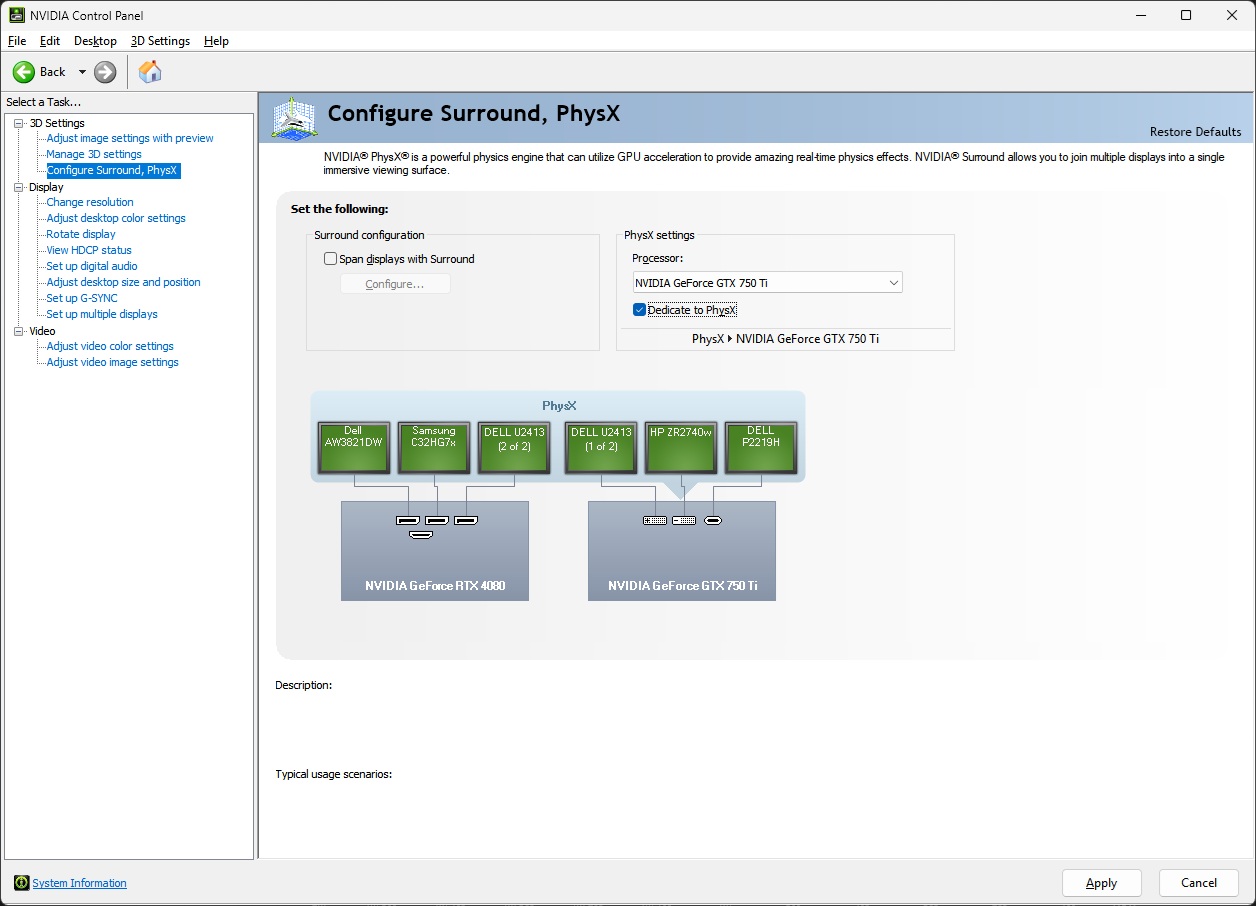
You could put a 2nd older GPU in your system and assign PhysX to that GPU. I have a GTX 750Ti in my system, just to support extra monitors (my RTX 4080 only supports 4 on it's own), but I could assign PhysX to it if I wanted:

750tiPhysX.jpg


I'd be nice if nVidia provided a solution for PhsyX to work via the CPU but doubt it'll happen.

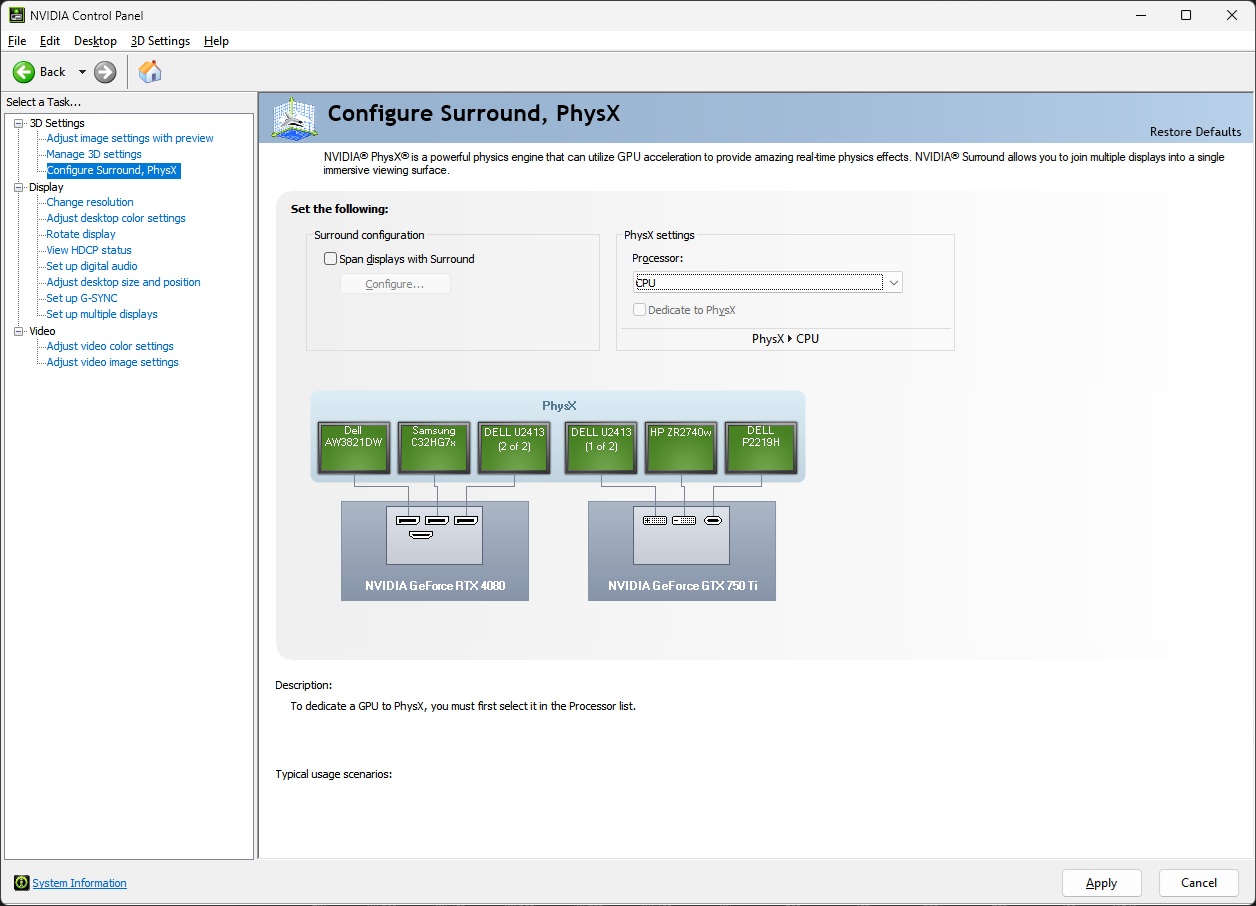
This solution has already been in the drivers forever. You absolutely CAN assign PhysX to the CPU:

CPUPhysX.jpg
 
Hmm, My old ageia physx card might have some use after all. :LOL: If i upgrade my 3060ti to a 5060 ti this year. or any other Blackwell card.
 
As I understand it, you cannot install different drivers for each Nvidia GPU. So, the second GPU would have to be supported by the GPU driver of the main card.

With that said, it looks like I'll be keeping a 30 or 40 series card for "retro" gaming. LMAO!
 
Reading some of the reaction, good luck Intel simplifying legacy x86 support in significant way ;) if it break anything.... that some optional extra in video games.. (most still work but slowly for now...., cpu of the future should be ok), imagine versus the average legacy program running on CPUs...
 
You could put a 2nd older GPU in your system and assign PhysX to that GPU. I have a GTX 750Ti in my system, just to support extra monitors (my RTX 4080 only supports 4 on it's own), but I could assign PhysX to it if I wanted:


This solution has already been in the drivers forever. You absolutely CAN assign PhysX to the CPU:

True however let us know what your FPS results are when using CPU for PhsyX ;)
 
As I understand it, you cannot install different drivers for each Nvidia GPU. So, the second GPU would have to be supported by the GPU driver of the main card.

With that said, it looks like I'll be keeping a 30 or 40 series card for "retro" gaming. LMAO!
This is correct. It's actually a PIA for me because I run 8 monitors and need more than one GPU. Fortunately the 1080ti still works with the latest drivers.
 
So apparently PhysX isn't supported with the new RTX 50 series cards. This is disappointing af for me :banghead:😡 Batman: Arkham City is one of my all time favorite games that I like to replay every couple of years so I guess I'll just have to hold onto my RTX 2060 for long term I guess.

I'd be nice if nVidia provided a solution for PhsyX to work via the CPU but doubt it'll happen.

https://www.dsogaming.com/news/nvidia-rtx50-series-doesnt-support-gpu-physx-for-32-bit-games/

EDIT: It's been confirmed that 64-bit PhysX (eg Arkham Knight) games work on RTX 50 series.

https://www.reddit.com/r/nvidia/comments/1irs8xk/rtx_50_series_silently_removed_32bit_physx_support/
There is a workaround. You need to plug a 4000 series or older and use it specfically as the PhysX card.

But yes Nvidia is subtracting some gaming specific features in favor of more AI and Framegen in the 5000 series.

It looks like PhysX was niche and has no 64 bit version... as of yet and so this was the feature Nvidia decided to cut.

"The only way now to run PhysX on RTX 50 series GPUs (or newer) is to install a secondary RTX 40 series or older graphics card and slave it to PhysX duty in the Nvidia control panel."

Article: https://www.msn.com/en-us/news/tech...9&cvid=ab580499d0c94e1db69e0e613078e7f2&ei=31
 
It looks like PhysX was niche and has no 64 bit version... as of yet and so this was the feature Nvidia decided to cut.
PhysX had a 64 bits version, that why more recent title can still have their PhysX gpu acceleration work on the 5000 series.

But yes Nvidia is subtracting some gaming specific features in favor of more AI and Framegen in the 5000 series.
This is an a bit of strange way to look at it, 32 bits cuda support was on its way out for a very long time and CUDA was and still is extremely non-gaming specific, that what run a lot of the world AI.

"The only way now to run PhysX on RTX 50 series GPUs (or newer) is to install a secondary RTX 40 series or older graphics card and slave it to PhysX duty in the Nvidia control panel."
There is 3 way, you can use the 64 bits version of PhysX, fallback on the cpu or use an older GPU if you do not want to compile a 64 bits version of your program.
 
What? Really?
How does it even make any sense?
Wouldn't actual API for PhysX between 32-bit and 64-bit be exactly the same?
I don't get it...

Maybe it is some kind of driver bug or omission rather than actual direction Nvidia is taking things in the future?
Was this Blackwell nor supporting PhysX confirmed by Nvidia or was it only an observation?

I hope its the latter because it would kinda suck to not have PhysX.
I didn't have it on AMD and didn't miss it much but still - it is nice to have such features if I do decide to play older game with PhysX...

------------------------

I have 3090 dangling off side of my computer connected via PCI-e 3.0 1x to act as LLM accelerator and to run desktop on it with otherwise RTX 4090 used for gaming. I mean why bother 4090 with all the desktop stuff like Chrome and bunch of other apps which use GPU. Especially RTX Video Super Resolution is quite taxing on GPU and in this setup I can use it while playing game with no performance loss. PCI-e speed is enough to play 8K 60fps HDR videos without dropped frames.

Anyways, I ran Cryostatis demo to benchmark it and test if PhysX is working with newest drivers 572.42

RTX 4090 Game + PhysX
avg 283.5 min 133.1 max 531.1
avg 281.7 min 130.8 max 553.9


RTX 4090 Game + RTX 3090 PhysX
avg 215.6 min 109.5 max 523.7
avg 214.9 min 105.8 max 520.0

In the case of 3090 I got lower performance. 3090 was utilized 100% while 4090 did barely anything while with 4090 doing PhysX it still wasn't utilized 100% and card ran at 250W.
And funnily enough computer is quieter running everything on 4090.
I wonder if PCI-e performance is a limiting factor here or not. I cannot improve or degrade it but I will in time do some more testing with OCing 3090 to see if performance improves.

So... 3090 is an option if anyone is in to running local LLMs.
I mean its cool to have "abliterated" fully private ChatGPT-alikes and all and you kinda need two 24GB GPUs to even run 32B models with proper context length like 32K (note: I was able to squeeze num_ctx of 55296 for qwen2.5-32B so quite good actually) or run 70/72B models. Otherwise 32B model can fit in 24GB GPU and with 32GB GPU you could increase context lenght quite a lot and/or use better quantization than 4bit.

Having two GPUs is however not all roses.
For one to really do it like I did you need to have two monitors like gaming + desktop and use dekstop with secondary GPU.
Otherwise big issue is that some games are quite stupid and might choose to run on slower GPU even if primary monitor is connected to faster GPU and application was specifically told by OS to run on faster GPU.
For now the only game I ran which has this issue is Fortnite - but as you can guess this is quite irritating.
What I need to do is to disable 3090 in device manager before running Fortnite and then I can re-enable it. Some applications might crash. Chrome/Firefox etc. will switch to 4090 in this case so to really have any benefit from this setup I need to close web browser and open it again. Otherwise its even worse running these apps on faster GPU and transferring to slower GPU - though in this case impact isn't that big since I only really can transfer so much from 4090 to 3090 which limits performance impact.

Of course if older card was used solely for PhysX it could be just enabled the moment PhysX game is being ran thus avoiding all these issues.
From test results I don't think however performance will be that great if too old/slow GPU is being used. I would definitely not expect something like 750Ti to do an amazing job.

On the other hand it will definitely do better job than CPU.
With CPU PhysX Nvidia screwed us because it doesn't even use multiple cores. It's almost like Nvidia deliberately made CPU PhysX run as slow as it can to make having GPU supporting PhysX a necessity.
Otherwise I guess on 13900KF with its 24 cores and 32 threads I could get quite decent performance. Probably not as good as even with 3090 but still at least playable.
 
Hmm, My old ageia physx card might have some use after all. :LOL: If i upgrade my 3060ti to a 5060 ti this year. or any other Blackwell card.
Nope
Agieia PhysX had incompatible API and actually quite a bit more effects than at least Nvidia PhysX had at the beginning - not sure later.
Vision of Ageia was to really push physics simulation to the next level. Nvidia's vision was to have exclusive feature to increase market share and Nvidia had to balance how much GPU power these effects could steal otherwise people would be like with RT - complaining its useless feature that tanks performance.

In either case Ageia PhysX is really useful in bunch of very old games and cannot be used in anything designed for Nvidia PhysX.
 
Wouldn't actual API for PhysX between 32-bit and 64-bit be exactly the same?
I don't get it...

Maybe it is some kind of driver bug or omission rather than actual direction Nvidia is taking things in the future?
Was this Blackwell nor supporting PhysX confirmed by Nvidia or was it only an observation?
It is not PhysX in particular, it is CUDA 32 bits at large, old 32bits game with physX happen to be a use case of 32 bits cuda and a rare one that would have been on 32 bits application that were never updated since, cuda acceleration compute/acceleration tend to be on the type of application that switch on 64bits to use more than 4gb of system ram/vram.

Cuda 32 bits not supported for gpu from now on was announced in 2022, the decision that it would happen was announced more than 10 years ago.

Ability for a cpu to run 16-32-64 bits instruction is not automatic, we had 32 bits cpu not able to run 8 bits program of the 8080 era natively, there some 64 bits cpu that do not run 32 bits natively today (In the Mac world for example, since 2019 complete drop of native 32 bits, everything 64 bits), if you can assume the instruction and memory adress will be a certain-predefined length it open the door to hardware optimization.

Running very old cuda 32 bits (you will not see much of it for things that started in 2012, Kepler with their Tesla-Quadro-Titan had more than 4GB of vram, could Nvidia make some translation/emulation hardware on their gpu to support old 32bits cuda (assuming the lack of support is in part hardware, not just compiler-driver side), maybe, but it has been more than 10 years they were clear to everyone to not use it for anything long term and removed it from their compiler/sdk, there could be virtually nill demand for it and if it slow down cuda gpu acceleration to run in virtual/translated remove it reason to exist vs simply running on the cpu or people making a 64 bits bridge between the application they do not want to update and physX.
 
  • Like
Reactions: XoR_
like this
True however let us know what your FPS results are when using CPU for PhsyX ;)
I doubt it would even impact the FPS using a CPU from 15 years ago for PhysX, let alone anything modern.
We are almost 20 years out from Core 2 and Phenom processors where CPU-only PhysX would have had any noticeable impact.
 
I doubt it would even impact the FPS using a CPU from 15 years ago for PhysX, let alone anything modern.
You would not say that about running 2010 game in software raster on modern CPU instead of an old gpu, those old GPUs still had thousands of cuda "cores" and could run a lot of similar operation in parallel in ways even CPU of 2028 will have an hard time to do.

Made for CPU in mind PhysX sure (that was Unreal 4 for a while I think) vs made for GPU (and made to be a tech demo a little bit) running in CPU fallback mode that different, if we trust youtube type of benchmark about it, running Physx high on a Ryzen 7700x can push old title under 60 fps.

Witcher 3 type of use of PhysX made for the CPU was more reasonable on what they tried to do or better coded for a cpu.
 
I doubt it would even impact the FPS using a CPU from 15 years ago for PhysX, let alone anything modern.
We are almost 20 years out from Core 2 and Phenom processors where CPU-only PhysX would have had any noticeable impact.

Here is a video with PhysX OFF, PhysX CPU (Ryzen 7700X) and PhysX ON showing the FPS difference. In the below screenshot the FPS drops severely during heavy PhysX action. Interestingly you can't use the CPU for PhysX in Arkham Knight which is also safe in the RTX 50xx series.


View: https://www.youtube.com/watch?v=mJGf0-tGaf4&t=30s
 

Attachments

  • Screenshot 2025-02-19 12.23.00.png
    Screenshot 2025-02-19 12.23.00.png
    2.3 MB · Views: 0
I doubt it would even impact the FPS using a CPU from 15 years ago for PhysX, let alone anything modern.
We are almost 20 years out from Core 2 and Phenom processors where CPU-only PhysX would have had any noticeable impact.
Cryostasis GPU vs CPU is such a massive difference the game is unplayable with CPU PhysX on modern 24 core CPU and RTX 4090 at merely 30fps average - with drops below that when there is more PhysX stuff happening.

The issue is that CUDA running on CPU only really uses single thread - therefore out of all these fancy cores/threads we use only one.
As you can imagine - and probably what you think is the case - if it was actually optimal implementation modern CPUs would rip through PhysX just fine. Maybe worse than modern GPUs can but enough to get decent frame rates. And especially if Nvidia further optimized CUDA CPU to use things like AVX2, AVX512, etc. Instead we get only something which was made to show how terrible CPUs are compared to GPUs and why CPU PhysX is unusable even for older games from 15 years ago. Maybe some games which had barely any effects will run just fine but some more heavy titles like Cryostais not so much.
And even for lighter games - do you really want sudden frame rate drops each time you have some particles to calculate physics of?
 
It is not PhysX in particular, it is CUDA 32 bits at large, old 32bits game with physX happen to be a use case of 32 bits cuda and a rare one that would have been on 32 bits application that were never updated since, cuda acceleration compute/acceleration tend to be on the type of application that switch on 64bits to use more than 4gb of system ram/vram.

Cuda 32 bits not supported for gpu from now on was announced in 2022, the decision that it would happen was announced more than 10 years ago.
Oh I see... so it is official then.

Running very old cuda 32 bits (you will not see much of it for things that started in 2012, Kepler with their Tesla-Quadro-Titan had more than 4GB of vram, could Nvidia make some translation/emulation hardware on their gpu to support old 32bits cuda (assuming the lack of support is in part hardware, not just compiler-driver side), maybe, but it has been more than 10 years they were clear to everyone to not use it for anything long term and removed it from their compiler/sdk, there could be virtually nill demand for it and if it slow down cuda gpu acceleration to run in virtual/translated remove it reason to exist vs simply running on the cpu or people making a 64 bits bridge between the application they do not want to update and physX.
I assume its artificial limitation and hardware differences do not exist.
I mean what could it be if you are pushing data to/from GPU through PCI-e bar. I mean it could be a difference if we talked necessary ReBar support for CUDA to operate at all but the moment you can do without ReBar we are talking tiny 256MB window to send/receive data and no ability to do direct addressing. In this case dropping 32-bit CUDA seems like totally artificial limitation. Its not like there are any differences between 32-bit and 64-bit CUDA...

...that said are there any API differences?
And that said is ReBar necessary on 50 series to use CUDA?
If both are not the case then Nvidia could just as well still supported 32-bit CUDA and therefore 32-bit PhysX on Blackwell.
 
I'm surprised PhysX stuck around for as long as it did.

I kinda thought it would die when CPUs started getting more and more cores and thus finally games, primarily single threaded, suddenly had a really good use for all these extra cores. More cores more physics! and by being on the CPU it can properly affect the gameplay as well! The future looked bright!

Dunno what happned, that dream never came true. Destructable buildings etc. are no longer a thing, at all. It's all about reflections being processed by ray tracing. :rolleyes:
 
I'm surprised PhysX stuck around for as long as it did.

I kinda thought it would die when CPUs started getting more and more cores and thus finally games, primarily single threaded, suddenly had a really good use for all these extra cores. More cores more physics! and by being on the CPU it can properly affect the gameplay as well! The future looked bright!

Dunno what happned, that dream never came true. Destructable buildings etc. are no longer a thing, at all. It's all about reflections being processed by ray tracing. :rolleyes:
Yup, the more things change the more they stay the same - with indestructible solid granite maps and hardly any physical simulations.

PhysX itself was terrible tech locked to one GPU brand with terrible CPU optimization using single core - the only reason why we saw it in games was because Nvidia spend their own money to add it in to games to give people reason to stick with their cards.
I guess for Blackwell GPUs missing 32-bit PhysX isn't such a big issue but Nvidia could at least try to make CPU version run decent by using more cores and vector extensions - if that was the case it wouldn't be any issue with today's CPUs.
 
Here is a video with PhysX OFF, PhysX CPU (Ryzen 7700X) and PhysX ON showing the FPS difference. In the below screenshot the FPS drops severely during heavy PhysX action. Interestingly you can't use the CPU for PhysX in Arkham Knight which is also safe in the RTX 50xx series.


View: https://www.youtube.com/watch?v=mJGf0-tGaf4&t=30s

Yeah running PhysX on CPU looks brutal. Nvidia deliberately designed it so you would need a GPU for playable framerates. And now they remove the feature out of nowhere. Good luck getting support for PhysX when playing older games without plugging in a 2nd graphics card if you have a 50XX card or newer.
 
I'm surprised PhysX stuck around for as long as it did.

I kinda thought it would die when CPUs started getting more and more cores and thus finally games, primarily single threaded, suddenly had a really good use for all these extra cores. More cores more physics! and by being on the CPU it can properly affect the gameplay as well! The future looked bright!

Dunno what happned, that dream never came true. Destructable buildings etc. are no longer a thing, at all. It's all about reflections being processed by ray tracing. :rolleyes:
Thank you. I am so over Ray tracing and DLSS and shooting for 8K textures. I have never been more dissappointed in gamers and games. Were in 2025 and physics in games have never been more boring and simplistic. Same with AI. All anyone does is buy nvidia cards as overpriced as they are for "muh ray tracing". Yes I have a 4090, I bought it a discount and only have it because I need the VR 3D Vision mods becuause I crave immersion in games. Nvidia left 3D Vision which to me to this day is the best leap in immersion we've had. VR is too cumbersome.. Not staring at ray tracing on a flat 2D screen. If it wasn't for the modding community, I'd be on AMD and just call it a day. Fuck this
 
And now they remove the feature out of nowhere.
It was announced in 2022 that Lovelace would be last to support 32 bits CUDA and they started to tell everyone to not have long plan aorund 32 bits cude for more than a decade.

The feature is still overall there, it is just requiring to use the 64 bits version, all those game are free to do so.

but Nvidia could at least try to make CPU version run decent by using more cores and vector extensions
The Witcher 3 used the CPU version to good effect and performance, a lot of Unreal 4 title as well. I am not sure how much PhysX was made to only run well on gpu (maybe at first) versus sponsored game making version that ran well only on GPU to make a bit of a showcase out of it.
 
The Witcher 3 used the CPU version to good effect and performance, a lot of Unreal 4 title as well. I am not sure how much PhysX was made to only run well on gpu (maybe at first) versus sponsored game making version that ran well only on GPU to make a bit of a showcase out of it.
It depends on number of effects and precision
Also I would assume some games might detect CPU PhysX and downgrade effects.
For example Cryostasis runs very slowly without GPU PhysX. On my system about order of magnitude less frames per second.
 
I am glad I don’t play old games…

I'm kinda like that with much older games however when I crave BATMAN action the Arkham series is the absolute best for it, plus the gameplay looks spectacular with PhysX enabled. It'd be nice if they were officially remastered with updated textures, ray-tracing and PhysX/CPU support. There is rumors Arkham Knight may get remastered but that was ages ago.
 
There is rumors Arkham Knight may get remastered but that was ages ago.
Lol I wonder why that one? It’s the only one I’ve yet to finish because half the game is a tank simulator. It’s also the newest and probably the least in need of a graphical overhaul.

Why not remaster Asylum and/or City… :confused: City is many people’s favorite anyway.
 
I am glad I don’t play old games…
Many of us do, and in fact, it's one of the best things about buying a new gpu. The ability to go back and play your old games with even much better fps and settings. This is once again a slap in the face of pc gamers by Nvidia. I don't have any real options this generation but should I ever upgrade my RTX 4080 I will hopefully go with AMD next generation. Im done with Nvidia....PERIOD!
 
Last edited by a moderator:
I am glad I don’t play old games…
Sarcasm? And some of these games are not really all that old and they all still play great today. In fact I had just put several hours into Batman Arkham Asylum a couple weeks ago. The hardware level physx such as interactive fog/smoke really add a lot to that game. Nvidia not keeping those effects around is quite a shitty move on their part.
 
Why should hardware company continue the support of old software? It should be the other way around. The software should be updated to run with newer hardware.
 
Why should hardware company continue the support of old software? It should be the other way around. The software should be updated to run with newer hardware.
The hardware node is the same as the 40 series (hence the lackluster performance uplifts).

From what I can gather, it was a software decision from Nvidia - most likely as a cost savings for future driver development.
 
Quite odd really. I notice huge performance uplifts over my 4090. I no longer require DLSS or FG to run 4k max settings in 90% of the games. I think Cyberpunk is the only game I've switched them on for.
I suppose it's relative. ~30% uplift for ~30% more money (LMAO, if you can get it MSRP), and pretty heavily increased stock wattage. Further down the stack, it's not the case. The 4090 is faster than a 5080, which is a first, and the lower SKUs aren't much better relative to their similarly priced 40 series predecessors.

I mean, a 4070 Ti Super is just as fast, and sometimes faster, as a missing ROPs 5070 Ti. Ooof size large.
 
I suppose it's relative. ~30% uplift for ~30% more money (LMAO, if you can get it MSRP), and pretty heavily increased stock wattage. Further down the stack, it's not the case. The 4090 is faster than a 5080, which is a first, and the lower SKUs aren't much better relative to their similarly priced 40 series predecessors.

I mean, a 4070 Ti Super is just as fast, and sometimes faster, as a missing ROPs 5070 Ti. Ooof size large.
It's more than 30% uplift.
I got it for MSRP.
I don't care about wattage.
I have no interest in a 5080 or why you're mentioning it to me?

Are you done having your internet upset over someone else's hardware?
 
It's more than 30% uplift.
I got it for MSRP.
I don't care about wattage.
I have no interest in a 5080 or why you're mentioning it to me?

Are you done having your internet upset over someone else's hardware?
I guess you could check the first part of the sentence, keyword is "relative." And yeah, I was generous stating a 30% uplift.

Either way, have a great day and a lot of fun!
 
That link shows a 35 percent uplift at 4k.
Holy shit balls. 1080p, 1440p, and 4K.

I get that people want to hyper focus, but fuck me. Relative encompasses more!

EDIT - regardless, the 50 series doesn't have 32 bit CUDA support any longer. That's a choice made by Nvidia. Again, likely to save a bit of money with their driver development.
EDIT 2 - isn't 74% as fast only a 26% difference? Math was never my strong suit (4K relative performance chart), but that's what my calculator is showing (100-74=26). Math! (not my strong suit) - https://www.calculatorsoup.com/calculators/algebra/percentage-increase-calculator.php
 
Last edited:
https://www.phoronix.com/news/ZLUDA-Q1-2025
"The ZLUDA project hopes to have PyTorch up and running on it this year along with eyeing 32-bit PhysX support since NVIDIA has dropped support upstream for the 32-bit PhysX libraries with the recent RTX 50 Blackwell launch."
"PhysX on the modern ZLUDA hasn't been a big focus but since NVIDIA dropping support for 32-bit PhysX with the GeForce RTX 50 / Blackwell GPUs, that thinking changed slightly. There's a belief that ZLUDA can 'rescue' the 32-bit PhysX support to get it working for both AMD and NVIDIA GPUs."
 
Back
Top