Nvidia delays Blackwell GPUs

EVGA went out of the videocard business due to their own issues and financials.

I got 20% back and $30 on each of my GTX 970 purchases. I was ultimately satisfied, but disappointed they lied about the specs upfront.

I too like Nvidia products, and have always picked vendor based on warranty. Evga had a great one that was ultimately too costly alongside their step up program for them. :)
EVGA wasn't forced out. Graphics cards don't have enough margin to make the level of support EVGA affords their customers profitable. They decided to stick with power supplies and accessories as the margins are much higher. EVGA actually cares about their clients, and if that means no graphics cards but they stay in business I support it. My prior build had an EVGA power supply and an EVGA 3080. My current build only has an EVGA power supply.

I will vote with my wallet and support companies that take care of their customers. Just the way I see it. If AMD completely tanks and I have to use Nvidia, ok, I'm a gamer, I'll do what I have to do. But for now I can get what I need from vendors and have a *bit* more respect for their customers than Nvidia does.
 
Considering how many financial media journalists still call the company “Nuh-vidia”, I wouldn’t rely on that as an accurate guideline regarding which specific products are impacted by the delay. Bloomberg calling a GPU an “AI chip” is basically like your mom calling every console you ever owned a “Nintendo” regardless of the brand.
Lol, yeah.

But the AI chip usage is the primary one that businesses care about, it's where most of the money is.

I still think that the video card chips will be less-affected, as production of the single die blackwell gpu's are not affected by the issue. The affected process is the assembly of 2 dies' into 1 into via the new interposer technology. So it makes sense that the single die chip production be moving full speed ahead at this time. There may even be extra chips available initially for use on video cards.

We should know in a few months.

100%, but the gaming business is still worth several billions per year in revenue for Nvidia. AI is now beginning to dwarf it, but it still matters.

Technically, we should know. The other possibility is that Nvidia might want to wait and flush the channel of 4000 series cards anyway, so delaying a few months might not even be a problem for them and they're fine waiting to release everything at once. It's not as if they're particularly threatened by AMD at this point, based on the number the Radeon division just reported a few weeks ago.
 
“Update 2:
SemiAnalysis's Dylan Patel reports in a message on Twitter (now known as X) that Blackwell supply will be considerably lower than anticipated in Q4 2024 and H1 2025. This shortage stems from TSMC's transition from CoWoS-S to CoWoS-L technology, required for NVIDIA's advanced Blackwell chips. Currently, TSMC's AP3 packaging facility is dedicated to CoWoS-S production, while initial CoWoS-L capacity is being installed in the AP6 facility.
View attachment 670267
Additionally, NVIDIA appears to be prioritizing production of GB200 NVL72 units over NVL36 units. The GB200 NVL36 configuration features 36 GPUs in a single rack with 18 individual GB200 compute nodes. In contrast, the NVL72 design incorporates 72 GPUs, either in a single rack with 18 double GB200 compute nodes or spread across two racks, each containing 18 single nodes.”

From TPU source linked above
The 5090 will use GB202 silicon. Which is not mentioned in any of the news about delays. So more weight to the theory that the Packaging tech that is having problems only applies to the AI chips GB200 and NV36, and does not affect the Gaming GPU's GB202.
 
The 5090 will use GB202 silicon. Which is not mentioned in any of the news about delays. So more weight to the theory that the Packaging tech that is having problems only applies to the AI chips GB200 and NV36, and does not affect the Gaming GPU's GB202.
Delay is only for the server stuff

Gaming stuff will be a business decision. AMD competitor is 18 months away
 
Delay is only for the server stuff

Gaming stuff will be a business decision. AMD competitor is 18 months away
There is also a pretty big downturn in gaming desktop components, there isn't exactly a rush.
Nvidia needs to half the price of the 4060 components and drop the remainder of the 4000 series to be price/performance relative to whatever AMD is offering up in Oct and they are good with the existing parts.
AMD isn't bringing anything new to the table feature-wise, and I doubt Nvidia is bringing anything new that will be hardware-locked to the 5000 series.

Nvidia has nothing rushing them to put new cards on the shelves and has only been offered a strong incentive to slash prices that are already considered way too high.

Sadly the only thing AMD is rumored to deliver coming up is price cuts, which I am all for but we all know Nvidia can play this game with the best of them, they have the margins to easily bankroll that.
 
so rtx 5090 delayed ? +- when it can be released?damn i was ready to buy or im ready ;)
 
If this is true:

https://www.techopedia.com/news/amd-rdna-4-release-date
Navi 48
  • Rasterization performance roughly between the RX 7900 XT and RX 7900 XTX
  • Die Size estimated at 300-350mm2
  • 256-bit memory controller
Navi 44
  • Rasterization performance above the RX 7600 XT, but below the RX 7800 XT
  • Dize size below 210mm2

4070ti has 294mm-192 bit and is 10% slower than the 7900xt
4060ti is at 188m, 17% faster than a 7600xt

If they keep that ability to charge a good 10% more for the same performance, they would need to find a hole in the stack for nvidia to be in any trouble.
 
Maybe. The same arguments were put out when 4xxx was coming and there really was a huge overstock on 3xxx cards.

So I don't expect any major delay. Possibly limited supplies, but I think Nvidia knows they will sell, and will launch some this year.
 
Calling the GPUs AMD is rumored to be releasing "competitor" is very generous of you.
I mean there is a serious possibility that the competitor to the AMD lineup is the 5060 lineup. A 5060ti performing similar to a 4070ti would be a fairly tame generational uplift.
 
The 5090 will use GB202 silicon. Which is not mentioned in any of the news about delays. So more weight to the theory that the Packaging tech that is having problems only applies to the AI chips GB200 and NV36, and does not affect the Gaming GPU's GB202.
Which was already mentioned on the first page. The server, compute, and AI products are using MCM packaging. Gaming products are still monolithic.
 
Nvidia has nothing rushing them to put new cards on the shelves and has only been offered a strong incentive to slash prices that are already considered way too high.
Sales data indicates that the current pricing is great. Cards are still selling well.

Sadly the only thing AMD is rumored to deliver coming up is price cuts, which I am all for but we all know Nvidia can play this game with the best of them, they have the margins to easily bankroll that.
AMD doesn't have much room to wiggle on price. Their non-console gaming business already operates for a loss. Their gaming product is going to be 2 generations behind Nvidia's forthcoming Ada refresh (5000 series). By the time the 6000-series launches with an updated architecture (2026 maybe?), AMD is going to have to be producing consumer cards that are literally 2-3x the performance of their current flagship in order to remain close enough behind that people even think they're still in the race.

It's sad, but AMD's current business plan is to simply stay afloat for long enough to see the Fed Gov and EU take legal actions to keep them alive. Their only hope in the GPU market is for governments to give them handouts and impose monopoly-related penalties against Nvidia.

Hopefully Nvidia throws AMD a bone here and allows them to keep their console business. Without that, AMD's out of the GPU game.
 
Sales data indicates that the current pricing is great. Cards are still selling well.
It depend what one mean by well and how good the data we have are

unnamed.png


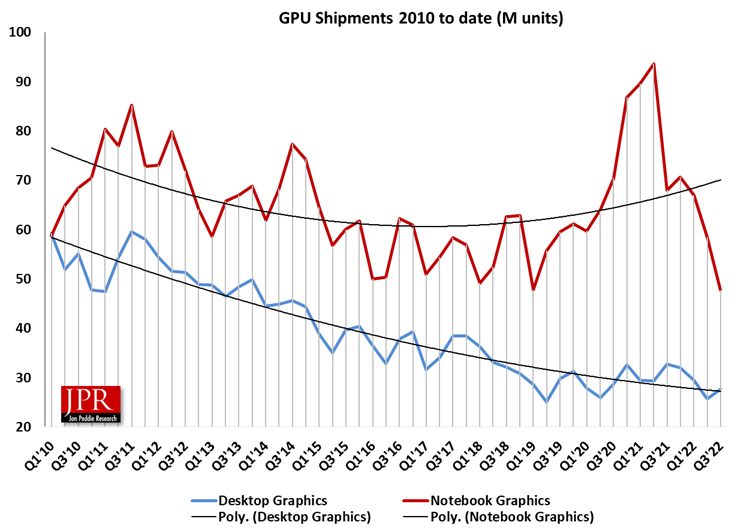
This is unit, so not what actually matter (money), but outside crypto burst used market surge quarter like q1 2023, q1 2024 could have been the lowest selling Q1 units wise since gpu became a thing in the 90s ?

Considering the trend since 2010, lowest but not by much could be considered good, stabilization maybe being even unexpected pre-covid:
GPU_Dev_graph_01.png


And the high average price, it is maybe indeed going well for NVIDIA (for who the market share exploded lately)
 
Sales data indicates that the current pricing is great. Cards are still selling well.
Sales data indicates it’s the lowest volume of desktop cards sold to date and the market still has ample supply of chips from the previous generation with the next gen parts around the corner.
Sales are down with massive overstock yet prices remain high.
 
Paywalled arricle

Screenshot_20241018-103107_Opera.jpg


Nvidia and TSMC’s Lucrative AI Alliance Shows Signs of Stress​


Nvidia’s Blackwell chip troubles, revealed in August, hurt relations with manufacturing partner TSMC, leading Nvidia to consider having Samsung make its latest gaming GPUs (non-AI related chips), The Information reports. Nvidia engineers testing initial Blackwell chips found they failed during some common data center usage, possibly from a design flaw.

But one early media report blamed TSMC’s advanced packaging process. Unnamed TSMC engineers said Nvidia rushed TSMC through the Blackwell production process, causing strain, as there was less time to work kinks out.

Note: Nvidia has used Samsung as a manufacturing partner for gaming GPUs before, so it's not that strange to turn to them now.

https://www.theinformation.com/articles/nvidia-and-tsmcs-lucrative-ai-alliance-shows-signs-of-stress

https://x.com/dnystedt/status/1847063385332240540
 
While this revelation sounds sensational there’s a much simpler and boring reason Nvidia may want to shop around for a different node for the consumer parts.

Those server parts have a 12 month wait list, taking 2-3 months off that production to bang out gaming parts is akin to burning money.

Given AMD has bowed out and isn’t releasing anything Nvidia can’t directly compete against with their existing product stack they can easily take a month or 3 to tweak their design for a Samsung or hell, an Intel node.

Either would be willing to cut them a hell of a deal right now given how their fab businesses are being dragged through the mud.
 
My 4090 consumes marginally more power than my 3080 10g did so I certainly,y hope it’s TSMC moving forward. At least for their 90 sku
 
While this revelation sounds sensational there’s a much simpler and boring reason Nvidia may want to shop around for a different node for the consumer parts.

Those server parts have a 12 month wait list, taking 2-3 months off that production to bang out gaming parts is akin to burning money.

Given AMD has bowed out and isn’t releasing anything Nvidia can’t directly compete against with their existing product stack they can easily take a month or 3 to tweak their design for a Samsung or hell, an Intel node.

Either would be willing to cut them a hell of a deal right now given how their fab businesses are being dragged through the mud.
Nvidia is not in a position of strength to demand much from TSMC, Nvidia needs them more than TSMC needs Nvidia. TSMC could easily sell all the production to others that Nvidia is currently using and the story makes sense as others have complained about working with Nvidia. Samsung or Intel would be a significant step down from what TSMC can build. They push this relationship too hard they may create their own fall.
 
Nvidia is not in a position of strength to demand much from TSMC, Nvidia needs them more than TSMC needs Nvidia. TSMC could easily sell all the production to others that Nvidia is currently using and the story makes sense as others have complained about working with Nvidia. Samsung or Intel would be a significant step down from what TSMC can build. They push this relationship too hard they may create their own fall.
That is exactly my point, is Nvidia going to go "Hey TSMC, you gotta pump this shit out faster you're falling behind schedule here man!"
Or is Nvidia going to tell them "Hey you're booked out the ass right now, and we're just going to let you keep on doing what your doing with this, let's not mess up your flow, we're just going to move these parts over here for a bit"

TSMC isn't out any money, they don't have room in their N4P schedule to take on extra work, and the gaming silicon is probably only a 3-month run for the year anyway. Since the Blackwell parts are already behind by that much they shift the gaming parts out of the rotation at TSMC and by year-end they are back on schedule.
TSMC is fully booked on N4P for the year, so the only thing TSMC loses in this deal is the work involved in retooling between the BN100 chips and the BN102s.
 
It’s a mutually beneficial partnership. Nvidia and Apple are TSMCs largest and most consistent customers. Id argue it’s actually easier for Nvidia to switch to Samsung than it is for TSMC to secure a bunch of small fish to make up for the big fish that just jumped ship. As a business owner I can tell you I’d do a whole lot more to make my two largest clients happy than 5 or 20 smaller clients.
 
More delays ???

Nvidia's data center Blackwell GPUs reportedly overheat, requiring rack redesigns and causing delays for customers​

News
By Anton Shilov
published 7 hours ago
Nvidia redesigns NVL72 servers to tackle overheating problems.

These machines are expected to consume up to 120kW per rack.

https://www.tomshardware.com/pc-com...rack-redesigns-and-cause-delays-for-customers


Nvidia’s new Blackwell AI chips are overheating in servers designed to hold 72-chips, The Information reports, causing some customers to worry about potential delays as Nvidia has already changed the server design several times due to the issue.

Nvidia said it is working with cloud clients and that “engineering iterations are normal and expected.”

https://x.com/dnystedt/status/1858319722829566071


The chipmaker has asked its suppliers to change the design of the racks several times to resolve overheating problems, according to Nvidia employees who have been working on the issue, as well as customers and suppliers with knowledge of the issue, the report said without naming the suppliers.

"Nvidia is working with leading cloud service providers as an integral part of our engineering team and process. The engineering iterations are normal and expected," a company spokesperson said in a statement to Reuters.

https://www.reuters.com/technology/...ating-servers-information-reports-2024-11-17/
 
Shouldn't cause delay's for video cards. Hell the 3090/4090 were engineered to be a 600W cards with the huge heatsinks plus the fan R&D Nvidia put into the FE's... They've been ahead of the curve.
 

Blackwell GPU reportedly takes 3X to 4X longer to test than Hopper — more complex designs lead to skyrocketing test requirements​


According to the Financial Times, citing Doug Lefever, the chief executive of Advantest, it takes three to four times longer to test Blackwell data center GPUs than Hopper data center GPUs because each unit has to be tested dozens of times on different tools before shipping.

https://www.tomshardware.com/pc-com...dly-takes-3x-to-4x-longer-to-test-than-hopper

An Nvidia Blackwell B100/B200 GPU consists of two compute chiplets packing 104 billion transistors alongside eight HBM3E memory chiplets interconnected using an interface enabled by TSMC's CoWoS-L packaging technology. This contrasts Nvidia's Hopper H100 GPU, which has one 80-billion transistor chiplet and six HBM3 memory stacks.​
​
Typically, as the transistor count grows, test complexity grows almost exponentially, as chips require more test patterns and longer test times. Test protocols must cover high-speed interconnects, stress conditions, thermal conditions (which, in the case of the B200, are extreme), and multiple operational modes (Blackwell adds FP4 support). Since Blackwell involves two highly complex chiplets with new features and higher thermals, it is natural that testing them takes more than twice as long.​
​
There's more to this. TSMC's CoWoS-L 2.5D packaging techniques introduce additional test steps (and sometimes multiple test phases) to ensure that each component in the package is functioning correctly and that interconnects are reliable.​
​
With Blackwell, one has to test compute chiplets and memory chiplets separately (though DRAM makers test HBM3 stacks) and then test the GPU multiple times as these chiplets are added to their RDL interposer. We do not know the exact number of times that Nvidia's Blackwell B100 and B200 GPUs and modules are tested during packaging and assembly. Still, these GPUs undergo considerably more testing iterations than Hopper H100 GPUs.​
The interconnects between the chipsets in the CoWoS-L packaging process aren’t just copper traces they are processors with transistors all of their own so the process itself adds a whole other layer of testing these cards are’t like anything that has really come before and it’s insane what Nvidia and TSMC are pioneering with them.
 
Back
Top