• Some users have recently had their accounts hijacked. It seems that the now defunct EVGA forums might have compromised your password there and seems many are using the same PW here. We would suggest you UPDATE YOUR PASSWORD and TURN ON 2FA for your account here to further secure it. None of the compromised accounts had 2FA turned on.
    Once you have enabled 2FA, your account will be updated soon to show a badge, letting other members know that you use 2FA to protect your account. This should be beneficial for everyone that uses FSFT.

newer generation SSD with SAS interface?

vr.

Supreme [H]ardness
2FA
Joined
Mar 30, 2010
Messages
4,892
After coming across this link in another post on [H]

http://gdamore.blogspot.com/2010/08/why-sas-sata-is-not-such-great-idea.html

I did a quick search online for vendors of SAS based SSDs and have yet to come across new generation models that are not SATA... do SAS SSDs exist anymore?

Anyone using SATA based SSDs in or out of RAID in production environments for things like Terminal Server and MS Office? I'm thinking of trying a couple M4's or OWC models and curious if they're "ready for prime time" yet?
 
I've had one of the Hitachi SLC SAS SSDs in my desktop for a few months now. If you have any questions about it, I can try answering them. If you are looking to buy one, when I received mine, there was next to no information on them or anywhere to purchase one. If you somehow do manage to find one, they will not be cheap. Performance however can't really be matched by anything else.
 
I've had one of the Hitachi SLC SAS SSDs in my desktop for a few months now. If you have any questions about it, I can try answering them. If you are looking to buy one, when I received mine, there was next to no information on them or anywhere to purchase one. If you somehow do manage to find one, they will not be cheap. Performance however can't really be matched by anything else.

benchmarks, preferably as-ssd if possible.
 
benchmarks, preferably as-ssd if possible.
I can do that, but there's one problem. All 3 of the drives I got are currently being utilized, so it won't exactly demonstrate the full speed...I also didn't bother with alignment. With that said however, I can still run it for you and post the results...just keep in mind that there's more to these things than benchmarks. There's a reason they're used in enterprise environments and cost so much even if some SATA SSDs have better benchmark results.
 
yes i would love to see some benchies as well, that would truly be very beneficial.
 
I've only found one vendor for that Hitachi SLC online so far... $6K? Really?
 
I've only found one vendor for that Hitachi SLC online so far... $6K? Really?
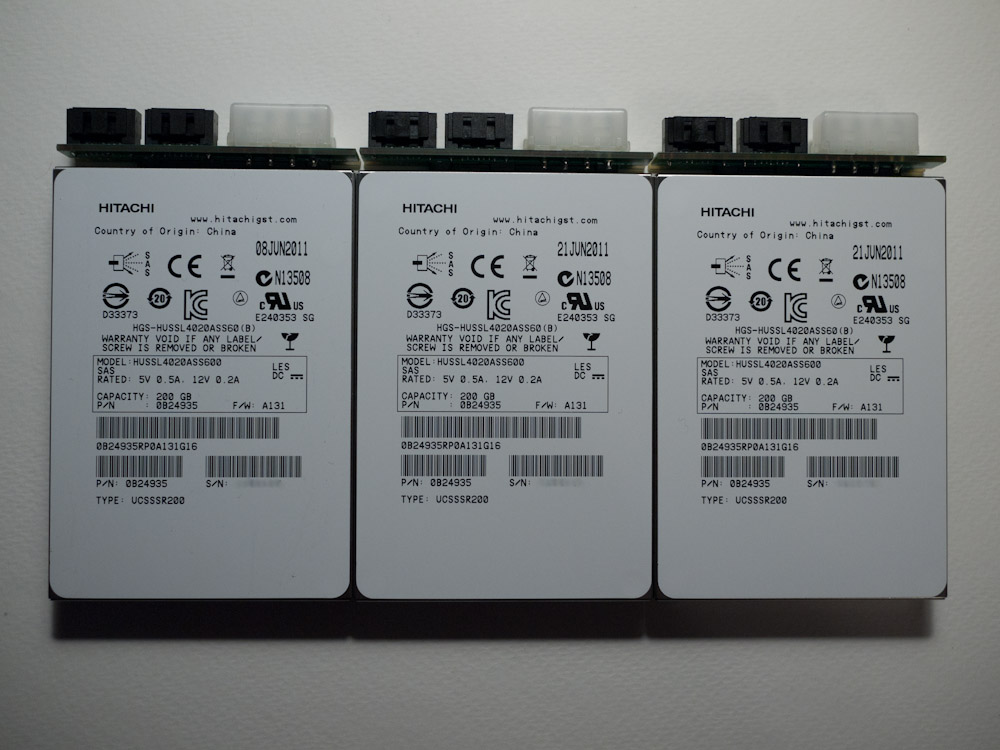
...wasn't expecting nearly that much. Guess I'm probably the only one here with one of these then. Well, here's a picture of the lot I got until I post some benchmarks:

P1000788.jpg
 
we have some of the intel SSD's in some dell PE 1950 servers, 3 in raid 5, not sure if i could test them to a useful level.. i think they may be SATA though.
 
I tried looking for the 100gb drives but I couldn't find anything but $6k 400gb drives.
 
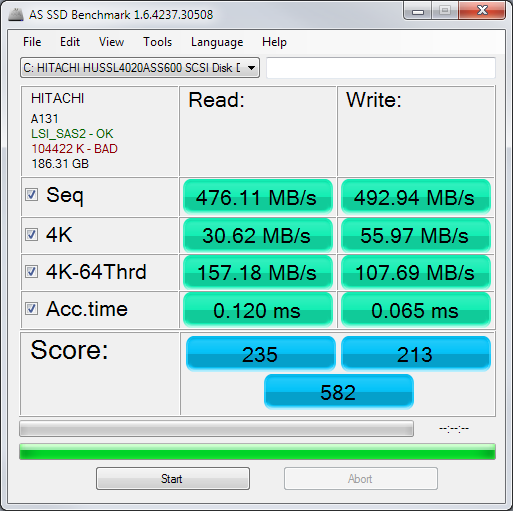
Alright, ran the benchmark tool. Just please keep in mind that the drive is being used for other things at the same time and I had quite a few programs open. One thing to also point out is the write endurance on these things. The 400gb model can sustain 35PB in random writes...that's over 19TB in random writes a day for 5 years straight.

hussl4020ass600.png
 
Alright, ran the benchmark tool. Just please keep in mind that the drive is being used for other things at the same time and I had quite a few programs open. One thing to also point out is the write endurance on these things. The 400gb model can sustain 35PB in random writes...that's over 19TB in random writes a day for 5 years straight.

hussl4020ass600.png

I am... what is the term... extremely jelly your setup. it's not even aligned... it still pulls out 492 sequential write. :eek: while running other programs. madness. a 4k qd1 of 30mb/s to boot.
 
SLC or MLC 6GBs SAS SSD = make sure you bring a fistful of $$$ & I'm not talking about 1 dollar bills!

Expensive toys, these are big boys toys. Unless you score a deal like BlueFox did on his 3 Hitachi SAS SSDs
 
Computurd, do you still have those on loan?

Are those Pliant drives? What's with the heat sinks?

If I may ask, what were you doing with those SSDs?
 
I still think RAIDed SATA SSDs have merit:

3 x 256GB Crucial M4 RAID 0 SATAII setting


2 x 256GB Crucial RAID 0 SATAIII setting:

 
What is the advantage of a SAS SSD over simply using SATA SSDs on that same SAS controller? SAS was intended to be compatible with SATA drives exactly for reasons such as this, wasn't it?
 
Burner's got some screaming stuff! :eek:

Why do your arrays not show the full capacity of your drives?

Overprovisioning?
 
Burner's got some screaming stuff! :eek:

Why do your arrays not show the full capacity of your drives?

Overprovisioning?

Ding Ding Ding Ding!!!!!!! Give that man a prize!!!!!! LOL

Until the 11.0 OROM for my mobo has been released and the 11.5 IRST driver (that enables TRIM for RAIDs) is available - I am forced to overprovision.
 
EMC sells samsung SSD's but I'm not sure whether they are SATA or SAS. I'll get a look at one at the office on monday.
 
In that case I can see you did the overprovisioning the correct way.

Nice job! :)
 
...wasn't expecting nearly that much. Guess I'm probably the only one here with one of these then. Well, here's a picture of the lot I got until I post some benchmarks:

snip

Of course Blue Fox would have these.
Since when does Blue Fox not have the most sexy hardware this forum has ever seen?
 
What is the advantage of a SAS SSD over simply using SATA SSDs on that same SAS controller? SAS was intended to be compatible with SATA drives exactly for reasons such as this, wasn't it?

No, SAS *may* be backwards compatable with SATA, if the controller designer wishs it to be. But SAS runs at double the voltage levels, to allow longer cable lengths, and the protocols aren't compatable at all. Why you have to use SATA Tunnelling Protocol, to do SATA over SAS.

The main gains from sas though, is that the harddrive isn't designed to out think the controller, and allows multipathing.
 
What is the advantage of a SAS SSD over simply using SATA SSDs on that same SAS controller? SAS was intended to be compatible with SATA drives exactly for reasons such as this, wasn't it?

It was meant for many-user traffic, not just one or two users, since SAS is full duplex and SATA is only half duplex.

There is a reason SAS is preferred in enterprise environments over SATA, aside from being much more robust in high-usage scenarios.

For a single-user environment, it is totally unnecessary and SATA-II/III is more than enough.
 
for things like ZFS l2arc, sata is also fine as it is mostly reading.

i imagine sas would be superior for zil devices but ssds are inherently inferior to ram based devices anyway. if you're really concerned about performance of the zil you're looking to ddrdrives or acard 9010s anyway.
 
hmm, sata performance is just find for a zil, as it's write only. The limitation for the zil is normally the write speed, or write latency.

For l2arc, I see about 90% reads and 10% writes.
 
ZILs receive and send data, how do you think data gets from the zil to the drives? in theory SAS would do a better job than sata as a ZIL but real world i doubt there is ever a difference.
 
ZILs receive and send data, how do you think data gets from the zil to the drives? in theory SAS would do a better job than sata as a ZIL but real world i doubt there is ever a difference.

The ZIL is a software layer.

Writes come into a zfs server and are first written to RAM and any log devices.

The data is then flushed to the zpool every few seconds. Log devices are only read from after a crash.
 
ZILs receive and send data, how do you think data gets from the zil to the drives? in theory SAS would do a better job than sata as a ZIL but real world i doubt there is ever a difference.

Easy, ZIL drives are NEVER READ from, except after a reboot, otherwise it's also in ram. the ONLY purpose of a zil drive is for sudden reboot, caused from crash, power loss, ...
 
In that case I can see you did the overprovisioning the correct way.

Nice job! :)

I have also considered redoing my array "the correct" way.

any tips on this? I'm guessing it's just hop into hdparm and knock each of my 60gb drives down to 50gb and call it a day? that would be sweet if it's that easy AND reversible in case I ever decide to sell these.

edit:

if any of you champions are using OCZ talos drives, PLEASE post benchmarks. I have looked *everywhere* and cannot find anyone using them. I really want to convert to sas ssds one day, but I can never find any benchmarks!!
 
Back
Top