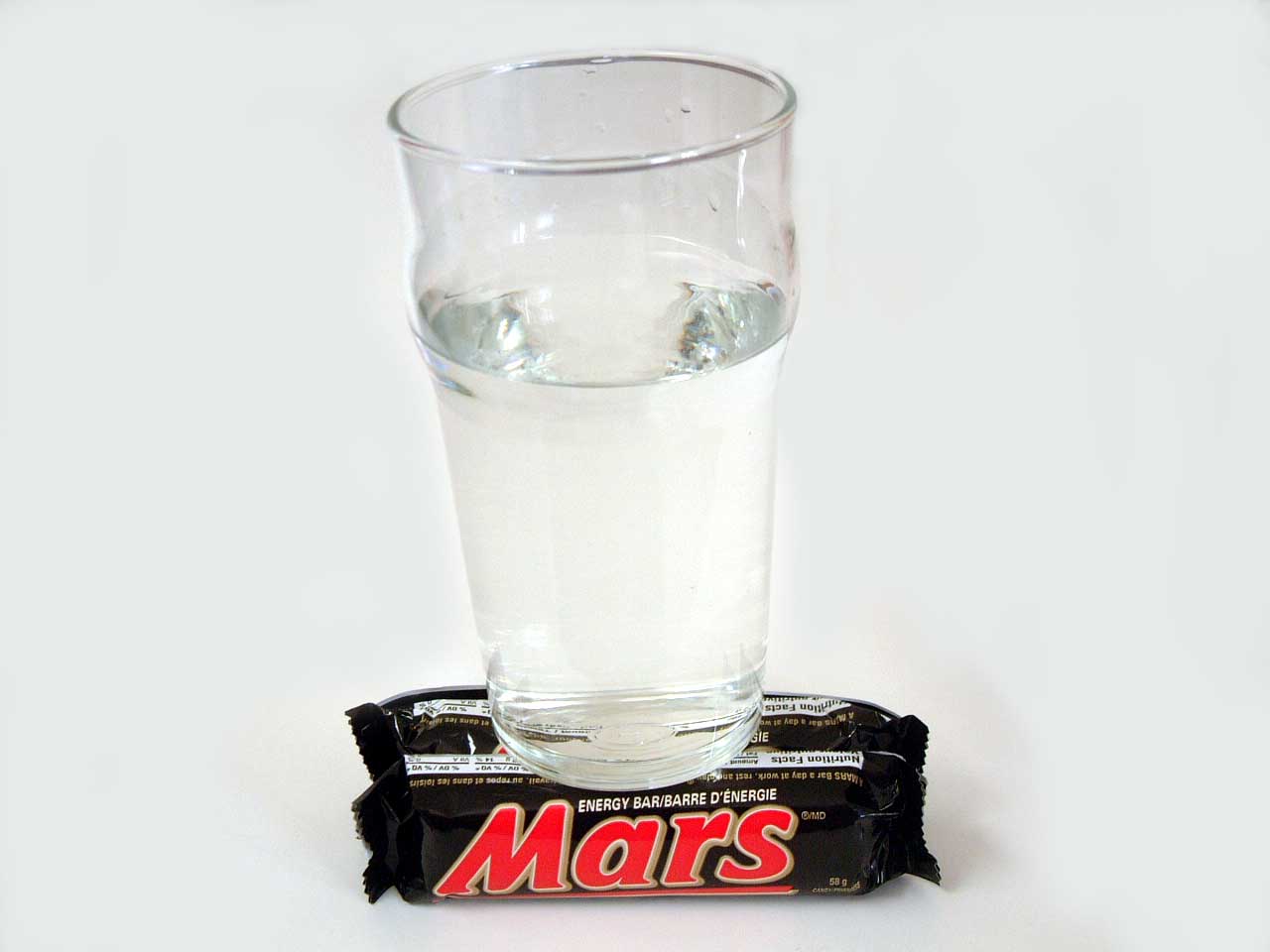
Mars Probe Landed On Ice?

Outside of scientific outposts and crazy gazillionaries, why would we both the spend that many resources to make a civillian base in America?

Maybe not 100% the same, but expansion is vital to our survival as a species. Think of how different life would be if we never left Europe.

As a species life wouldn't be diffrent at all. Native americans might have become more techonologically advanced than the Europe and invaded and taken over (highly doubtful), but eventually they would have bumped into each other and one would dominate the other. As a species it makes no difference.

"We" spent the resources to build a base in america so "we" could plunder the resources of america. It was a venture capital project. What resources are you going to plunder from Mars? Iron rich soil? There isn't any special martian metals.

And exactly why do we have to expand to survive as a species? Space invaders? Our Sun is going to go boom in 20 billion (trillion?) years? We might kill our selves with a nuclear war?
 
Actually, it is worth it to go to the moon. It could be a docking place or makeshift base for storing equipment and supplies to go on future missions to mars. Refueling and assembly could take place there as well.
 
Actually, we need a moon base to harvest Helium-3. There's enough up there to power the earth via fusion reactors for hundreds of years. Helium-3 is a prime fuel for fusion reactors because of the limited radiation penetration that causes damage to proposed fusion reactor designs.

Right, once we build fusion reactors that can run on He-3.

Can someone explain to an idiot like me why there are no color pictures? There must be a reasonable explanation but I can't figure it out. I keep thinking all that state-of-the-art tech and no color camera? Sorry if the answer is obvious..

That would probably be a result of the "all color astronomy photos are faked" theorem. :D

Seriously though, we take a lot of pictures through various filters using a photometric CCD, and then combine them in a computer after the fact with data from other filters later to generate color astronomy pictures. When they're not "false color" to start with. The trick used in photography cameras to take three different colors at once and combine them into the color image you're used to being presented with makes the data less useful for scientific purposes, particularly the efficiency is reduced and the error in the data is greatly increased. So NASA would not be likely to launch a "color camera" into space very often for any mission.
 
Once again, we confront the legacy of a certain group who regard all this space shit as just silly wasted money.

Meantime now we need a recovery probe to go get samples and BRING THEM BACK to the space station (NOT EARTH) for research.

We will also need an isolation lab on the space station to research samples, so get to work. :eek::rolleyes::p

As for Enceladus, our goal should be to knock it out of orbit, and use Saturn's gravity to hurl it on a collision course with Mars. Path being to come up slowly behind Mars and effectively LAND on it. That would deliver enough water to get things rolling. Next is to pick another small moon with N2 and CO2 and O2 that can also be bumped onto a collision course.

It may be within our ability soon to be able to knudge moons. Just something to think about and come up with some ideas on. But even if we do this and terraform Mars, because it has no magnetic filed to protect it, the atmoshpere will be under constant attrition from the solar wind. And life on the surface would always have a radiation cancer risk far greater than UV gives us here on earth.
 
Right, once we build fusion reactors that can run on He-3.
Obviously? ... but they are very serious about it. There was a huge special on the Discovery Science channel and the NASA channel about it. There's scientists all around the world interested in it that are developing various fusion reactor designs. Take a look into it. You'll find it pretty interesting. A viable and ideal fuel is one of the big hurdles for the application, and Helium-3 solves that aspect of it.
 
As for Enceladus, our goal should be to knock it out of orbit, and use Saturn's gravity to hurl it on a collision course with Mars. Path being to come up slowly behind Mars and effectively LAND on it. That would deliver enough water to get things rolling. Next is to pick another small moon with N2 and CO2 and O2 that can also be bumped onto a collision course.

All engineering obstacles aside: what's the escape half-life for those gases on Mars?
 
Obviously? ... but they are very serious about it. There was a huge special on the Discovery Science channel and the NASA channel about it. There's scientists all around the world interested in it that are developing various fusion reactor designs. Take a look into it. You'll find it pretty interesting. A viable and ideal fuel is one of the big hurdles for the application, and Helium-3 solves that aspect of it.

The two big fusion projects right now are NIF (laser implosion) and ITER (magnetohydrodynamic containment). To my knowledge, neither is using He-3 yet. I think most of it is still focusing on deuterons for p-p fusion. Yeah, there's theoretical work being done, and a lot of interest, but it's not something that will be available soon. And by not soon, I mean 40-50 years might be a tad optimistic.
 
heh.. that would be nice, but very highly unlikely. The mars atmosphere would have to undergo a monumental change. Monumental is an understatement.

However, small experimental colonies or research labs could be possible. Still that would be the largest task ever taken up in the history of man. Just to get people to mars it would take several deployments of multiple rockets, hundreds of tons more in payload than what was needed for the moon. It would need totally new designs and means of transporting people with gravity enabled rotating sections of the craft. Getting all the equipment there to start building things from the raw materials of mars is a whole other challenge.

The biggest problem is the size of Martian core. Its too small to support a sustainable magnetic field. The weaker magnetic field is more susceptible to solar weather and radiation. We would die during the first solar storm. We could, however, Terraform the planet if there was indeed water, but I'm afraid there's not a whole lot we can do about its inadequate iron core.

Size really does matter.
 
The two big fusion projects right now are NIF (laser implosion) and ITER (magnetohydrodynamic containment). To my knowledge, neither is using He-3 yet. I think most of it is still focusing on deuterons for p-p fusion. Yeah, there's theoretical work being done, and a lot of interest, but it's not something that will be available soon. And by not soon, I mean 40-50 years might be a tad optimistic.
Correct. And obtaining He-3 is very hard on earth. As far as I know, you can get it from fast breeder reactors, but those are used in nuclear weaponry development, not something that is looked upon too well. Even then, only very small amounts can be obtained, not enough for a civilian fusion power plant.
 
Our currency is worthless there though. You'll need to find something else to pay for property and it seems that water may not be that thing :)

Give it another year and it will be worthless here too.
 
I didn't know we had so many keyboard scientists and physicists on this forum. (Aside from Wiretap, which most of us know where he works).
 
I don't even know that much, lol. Just a little inside info here and there.
 
Can someone explain to an idiot like me why there are no color pictures? There must be a reasonable explanation but I can't figure it out. I keep thinking all that state-of-the-art tech and no color camera? Sorry if the answer is obvious..

Color photos do indeed exist, and aren't enhanced artificially.

The robotic arm's camera is the high-tech tool of Horst Uwe Keller, who is in Tucson from Germany's Max Planck Institute for Solar System Research. The camera, Keller said, can use its light-emitting diodes to illuminate the ice surface for highly accurate full-color stereo images, and Keller said even the first black and white images show that the bright slab beneath the lander is much brighter than any of the surrounding soil.

http://www.sfgate.com/cgi-bin/article.cgi?f=/c/a/2008/05/31/BAUR1117NC.DTL

Bottom of the article. :eek:
 
Go to the NASA Image Exchange (NIX). There's a bunch of awesome mars pictures and panoramas. =D
 
Once again, we confront the legacy of a certain group who regard all this space shit as just silly wasted money.


Not sure if this was directed at me but I'll answer it...

I specifically said...
Outside of scientific outposts

There is lots of "spin-offs" to be gained from the space program. We would be dumb to stop funding it.

Personally I see the practicallity of expanding to Mars for regular people about as realistic or as profitable as building a condominium on Antartica.
 
No V, it wasn't aimed at you.... it was aimed at a particular political party whose first act was to slash NASA's budget and re-structure it, because all this "manned" shit was such a waste of money. Remember the original plan was for alot more than 5 shuttles.

So shuttle replacement research went out the door. The long range booster program bit the dust.... you know, so that probes could fly straight to jupiter/saturn/etc...was replaced by OH lets do gravity flinging, thats fun and sooo much less expensive.

I could go on, but the NASA of Apollo was gutted like a pig and replaced by pod people. And no effort to maintain the skill pool was made, because the people in charge deep down do NOT believe in science at all. Science is an annoyance that keeps proving thier psycho religious beliefs are just voodoo doodoo. :eek::rolleyes::p

The time has come to build out the space station... we need MANUFACTURING facilities in space. Time has come to build and field the replacement for the Hubble.... s KECK level device, to vastly extend our range and clarity. The time has come to build a giant radio telescope in a crater on the dark side of the moon, out of earth noise range. The time has come to build an interplanetary transport with ion engines to make the trip to Mars a matter of a couple weeks not years, provide simulated gravity, and carry large loads around the solar system.

Nothing like now dropping 20 probes with return buckets to go get Mars samples and bring them back to an orbital lab for research. Go out and grab a few asteroids for live testing of methods to deal with the threat... comets too. Or deploying a huge planetary warning system constisting of hundreds of small radar satelites between Earth and Mars orbit, in a sphere, so any object flying will be seen soon enough to take action to address (no surprise asteroids cause no amateur astronomer was lucky enough to spot it in time.).

In other words, time to grow the fuck up.
 
Only if we use less energy going to titan, extracting the methane, and delivering it back to earth than we get from the methane itself. By the time we do have a means of getting a net gain in energy, we would probably not need the methane anyway.

mehh... how much energy does it really take to get across the solar system? isnt more of it used during launch then it is in travel? why not put large tanks in space and pump it straight down to earth? they could use the pipes as structure for those retarded elevators they keep talking about hahaha :D
 
Outside of scientific outposts and crazy gazillionaries, why would we bother to spend that many resources to make a civillian base on mars when we havn't bothered to make a base on the moon?

mars has 1/3 the gravity of earth. it *should* be just enough for the human body to deal with indefinitely. on the moon we wouldnt last very long before our muscles fail... we need gravity too keep the same balance that millions of years of evolution has compensated for.
 
As for Enceladus, our goal should be to knock it out of orbit, and use Saturn's gravity to hurl it on a collision course with Mars. Path being to come up slowly behind Mars and effectively LAND on it. That would deliver enough water to get things rolling. Next is to pick another small moon with N2 and CO2 and O2 that can also be bumped onto a collision course.

It may be within our ability soon to be able to knudge moons. Just something to think about and come up with some ideas on. But even if we do this and terraform Mars, because it has no magnetic filed to protect it, the atmoshpere will be under constant attrition from the solar wind. And life on the surface would always have a radiation cancer risk far greater than UV gives us here on earth.

cool idea but theres enough already on mars to cover the entire planet about 15ft deep i think it was.... the amount of water is not a problem, its just getting it melted with an atmosphere that will at least hold oxygen and stuff. the uv problems wont be that bad i dont think... people will just have to wear full clothing and the outside will look pretty much like the arizona desert. all 'outdoor' places people will go will be protected by uv resistant domes... im smoking weed again huh?
 
I didn't know we had so many keyboard scientists and physicists on this forum. (Aside from Wiretap, which most of us know where he works).

I have several keyboards, but I don't think that's what you meant. :D

Physicist, I suppose I am. I just feel odd using the appellation when "doctor" isn't also merited.

mehh... how much energy does it really take to get across the solar system? isnt more of it used during launch then it is in travel? why not put large tanks in space and pump it straight down to earth? they could use the pipes as structure for those retarded elevators they keep talking about hahaha :D

The problem with clearing the Earth is that you start out really damn close to a large source of gravity. However, the Earth's orbit also has an associated escape velocity. It's relatively easy to move out of the Earth's orbit, but the total energy to leave (or cross) the solar system can still be quite large. But you don't need to carry all of it as fuel. For a simple example, a small enough particle will experience enough pressure from solar radiation that it will exceed the pull of the Sun's gravity and be shoved right out of the system. Likewise, if you make a solar sail, which exploits this effect through trying to create a very high surface area to mass ratio (for the small particles, this is achieved by just having a very low mass, resulting from the surface area to volume ratio problem that keeps you from having giant ants). You could exploit environmentally available energy in other ways - gravity assists from planets, solar panels, or having magnetron satellites that shoot plasma beams. Orbit calculations can be pretty messy between all the factors to be optimized for, since the shortest trip doesn't always use the least fuel.
 
Just a note, and probably a bit more scientific than most of you would like. Mars has no molten core and thus, no magnetic field to keep you safe from cosmic radiation. Water or no, we wont be setting up shop there. And no we can't bring the water back here. Hell, we can hardly manage to send a little robot there much less ferry who knows how many gallons of water to and fro.
 
I always wonder why probes are always sent to the moon or Mars. We need to plunge a few probes into other planet too...you know, just for funsies.
 
WaterOnMars2_gcc_big.jpg
 
Just a note, and probably a bit more scientific than most of you would like. Mars has no molten core and thus, no magnetic field to keep you safe from cosmic radiation. Water or no, we wont be setting up shop there. And no we can't bring the water back here. Hell, we can hardly manage to send a little robot there much less ferry who knows how many gallons of water to and fro.

Thats why you build elaborate shielding. There are ways to do it with current technology. The only real issue anymore is money. All you really need to do is generate an external magnetic field. Not that hard. The only real issue is viable energy sources.
 
You guys should watch Mars Rising on the Discovery Science Channel. It's very informative of the current subject being discussed.
 
I always wonder why probes are always sent to the moon or Mars. We need to plunge a few probes into other planet too...you know, just for funsies.

I'd list a few, but it's a huge list.

The Moon and Mars are high priority targets for a number of reasons, though. Convenience for one. But the Moon is tied to Earth's own formation and to certain problems about its current state, and Mars...well...start thinking through the list of other planets around and the list of recent Mars missions, and tell me which of those are even plausible on an alternative target. Of the inner planets, Venus is a nightmare to actually land anything on, and Mercury is governed largely by being really damn close to the Sun. Then going out you have gas giant, gas giant, gas giant, gas giant, oversized protoplanet.

A few recent probes included sample return missions (!!!) to grab particles out of the solar wind and from a comet. We do plenty of other stuff. Mars is partly a good target, and partly one that grabs lots of media attention and helps NASA keep the doors open, so it gets lots of attention. But we do plenty of other stuff too.
 
You guys should watch Mars Rising on the Discovery Science Channel. It's very informative of the current subject being discussed.

God, lets all just go get information from "futurist" from the discovery channel. :rolleyes: The few of them I've seen have been absolutley horrid.
 
God, lets all just go get information from "futurist" from the discovery channel. :rolleyes: The few of them I've seen have been absolutley horrid.
The show (6 parts?) was done with NASA, Russian Space Agency, and top scientists around the globe working on aerospace projects coordinating and planning for the future manned missions. It was hardly a Dirty Jobs type presentation. Don't have a hernia with your attitude man, we're just having a friendly discussion. :p
 
God, lets all just go get information from "futurist" from the discovery channel. :rolleyes: The few of them I've seen have been absolutley horrid.

Some of them are just plain silly while others are fairly well done. It's a field that depends very much on engaging public interest, so they try, but not every attempt is worth tying up broadcast time with. The futurists they get on the various programs are usually much more grain of salt territory, but there's a lot of scientists on there too, and they usually do at least a half decent job of explaining things - especially keeping in mind that they're writing primarily for a non-scientist audience.

I always get giggles watching them, either because of the abbreviated explanations or because I see a former professor of mine on there explaining their project. :D
 
obviously the first thing they need to be sure and take over are the chainsaws. everyone knows you can't survive on mars without a chainsaw... and for the love of god, get some decent flashlights!!


Awww man I just spit cherry coke out my nose.
 
I can only hope that in my lifetime I will be able to see a successful Mars and Moon colony.
 
I am my own "Futurist", I don't need some dipshit with a Bush-league degree from whatsamatta U telling me how the future will play out. I have infinitely more imagination than the shlubs Ive seen on Discovery/Science/etc channel.

I Bow down to HG Wells, Jules Verne, Tesla, Asimov, Hawking, and Roddenberry... and no other. :eek::rolleyes::p

Ok, back to designing that Impulse engine :cool:
 
If only it said oil found on mars so that we would have more and not worry about the oil company's saying they are running out.

And so we dont gotta pay 4 bucks a gallon for cheapo unleaded regular.
 
If only it said oil found on mars so that we would have more and not worry about the oil company's saying they are running out.

And so we dont gotta pay 4 bucks a gallon for cheapo unleaded regular.

Oil. On Mars.

o_O
 
Back
Top