![[H]ard|Forum](/styles/hardforum/xenforo/logo_dark.png)
Navigation
Install the app
How to install the app on iOS
Follow along with the video below to see how to install our site as a web app on your home screen.
Note: This feature may not be available in some browsers.
More options
You are using an out of date browser. It may not display this or other websites correctly.
You should upgrade or use an alternative browser.
You should upgrade or use an alternative browser.
Kill the Password?
- Thread starter HardOCP News
- Start date
This is BS, at least from a practical standpoint.
I'm co-admin on another forum, and while I don't know much about security from what I heard he gained access to all our passwords in "hash" format or something to that effect, posted those on another hacker forum for assistance cracking the passwords from it including mine, and they were able to provide seven of the accounts according to the thread but not mine because it was really long and a completely random combination of upper/lower case, numbers, and special characters.
I'm co-admin on another forum, and while I don't know much about security from what I heard he gained access to all our passwords in "hash" format or something to that effect, posted those on another hacker forum for assistance cracking the passwords from it including mine, and they were able to provide seven of the accounts according to the thread but not mine because it was really long and a completely random combination of upper/lower case, numbers, and special characters.

- Joined
- May 7, 2007
- Messages
- 13,443
The only problem I see is how hackable and broken Windows is.
Seriously, use a different OS, and see how fast you don't get hacked.
Seriously, use a different OS, and see how fast you don't get hacked.
Godmachine
[H]F Junkie
- Joined
- Apr 7, 2003
- Messages
- 10,472
It's so easy to blame eveyone but yourself for your mistakes.
I have been a Hotmail user ever since the beginning. Not once have I been hacked.
This.
If you use one easy to remember password for ALL of your accounts I feel zero empathy for you when you get hacked (and you will).
Here is a crazy to embrace concept .. make unique passwords with capitals and numbers for every account you need to for whatever service you want and buy a $2 journal pad from the supermarket and just WRITE ..them down.
I know , I know CRAZY idea. Its not like you couldn't store that pad in a physical safe with a simple code that can only be accessed by you on site in person.
Sarcasm aside , I've been making unique passwords for decades now and writing them all on journal style pads and simply hiding them or more recently (well recent as in the last 5 years) store them in a safe in my room. I never have to worry about my journal pad getting "hacked" and I don't have to remember any of them if I don't want to.
Pretty old story, can't believe the guy is still ranting about the same event... As others alluded to, passwords didn't fail him, bad policies on Amazon/Apple's part (and badly trained phone support staff) failed him, plus the fact that he had zero local backups. The "hackers" just played tricks on phone support and it turned into a slippery slope from there, and phone support wasn't even doing their job properly.
He wants to overhaul cyber security because the LEAST technical aspect of the services he uses failed him? lol Security's all about attrition and redundancy anyway, nothing's impenetrable (online or otherwise). You're just trying to put as much friction between you and the thief/hacker. Same principles as w/car alarms/security systems/clubs or home security (alarms, bars, locks, deadbolts, etc).
As for passwords, it's not hard to create two or three strong base passwords and then simply hash them w/some of the characters for the service/site you're using them for, thus avoiding using the same one everywhere but not having to remember dozens or rely on a single-point-of-failure password locker (tho mathematically that approach is probably safer).
For instance, if one of my base passwords is pal3ontol0gist, I could add y-a-h (or h-a-y if you wanna get clever) when using it on Yahoo... Insert the letters in between the existing ones rather than appending them and you get pal3ontol0gihsaty. Easy to remember system for you (and easy to type on anything w/arrow keys, sorry iOS users), but unintelligible for anyone else.
Voila, you've got unique passwords for everything based off a sub-set of a couple of base passwords.
He wants to overhaul cyber security because the LEAST technical aspect of the services he uses failed him? lol Security's all about attrition and redundancy anyway, nothing's impenetrable (online or otherwise). You're just trying to put as much friction between you and the thief/hacker. Same principles as w/car alarms/security systems/clubs or home security (alarms, bars, locks, deadbolts, etc).
As for passwords, it's not hard to create two or three strong base passwords and then simply hash them w/some of the characters for the service/site you're using them for, thus avoiding using the same one everywhere but not having to remember dozens or rely on a single-point-of-failure password locker (tho mathematically that approach is probably safer).
For instance, if one of my base passwords is pal3ontol0gist, I could add y-a-h (or h-a-y if you wanna get clever) when using it on Yahoo... Insert the letters in between the existing ones rather than appending them and you get pal3ontol0gihsaty. Easy to remember system for you (and easy to type on anything w/arrow keys, sorry iOS users), but unintelligible for anyone else.
Voila, you've got unique passwords for everything based off a sub-set of a couple of base passwords.
wtburnette
2[H]4U
- Joined
- Jun 24, 2004
- Messages
- 3,580
Viruses only enter your computer from 3 sources. Porn, junk mail, or torrents. If you use something decent like Gmail, junk mail is pretty rare, and you'd have to be stupid to click on it. Majority of it is Viagra. Torrents says you have to have some intelligence, so we can rule that out. That leaves porn, and I doubt you're the purist that you make yourself out to be.
Not true. You can easily have your system compromised via infected ad servers. You can go to ANY site that has ads and if the ad server that is sending those ads is infected, you can be infected by going to the site. No intelligence, or lack of, needed.
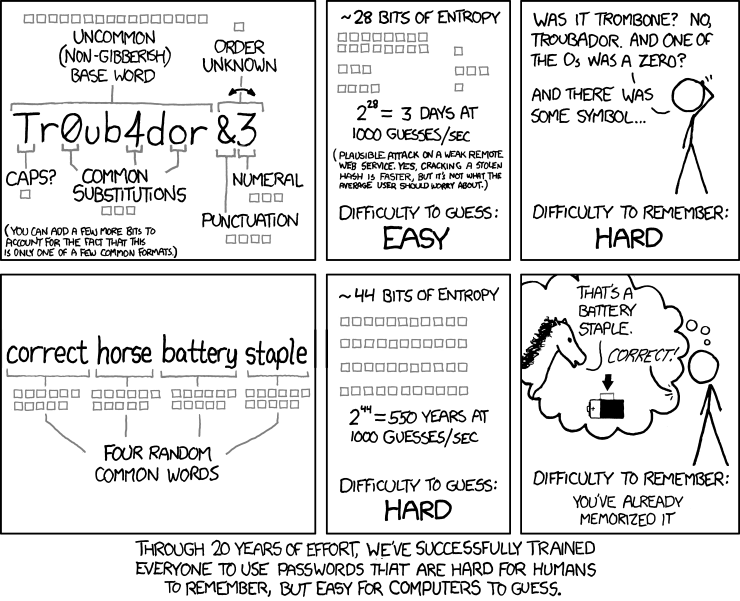
Obviously he missed this comic
As others above said, the dude made poor choices and bought way too far into the security of Apple products lol.
He should retire into a hermit, for his e-shame is great.
Problem with that is most systems don't allow dictionary words. I know why they do that, because most people would use one common word and a number and be done with it. Personally, I would prefer to use 4 random words, plus a number, plus uppercase and lower case, plus a special character and know I'm very well protected, but instead I have to use something like S0m30n3% because dictionary words aren't allowed

In most implementations, a password is just a shortcut to an encryption key. I like the idea of cutting out the middle man and just keeping keys on a thumb drive. The problem is preventing unauthorized electronic access to the keys. I envision some sort of software mechanism that works with a physical mechanism on the thumb drive to quarantine the keys from one another and control electronic access.
After working support for 16 years and now working security, I can say that wouldn't work because thumb drives are too easily lost or stolen. Again, the best thing is to use 2 or 3 factor authorization.
Myself, I use random characters for security questions, and store the answers in Lastpass. My primary email address requires two factor, and the backup email for it is a random address. Each site has a different password.
Is it possible to hack? Sure, but they'll more likely go after someone else.
Is it possible to hack? Sure, but they'll more likely go after someone else.
"People willing to trade their security for temporary convenience deserve neither and will lose both." Tom Jefferson, 2009 - South BrooklynIn short, people will almost always trade security for convenience only to bitch about when it finally bites them in the ass.
theproject
Weaksauce
- Joined
- Feb 12, 2008
- Messages
- 88
wtf this guy is retarded... its not that his ubber passwords were hacked and his digital life was obliterated... ONE PASSWORD was hacked and it was linked to everything else. how about being less lazy and typing in every user/password EVERY TIME he logs into anytyhing? onoes guis my facebook was haxxed and now... oh... wait... thats all they got? ***reset fb password*** and i'm done.
now i am aware of how "easy" it is for some to crack/brute force their way into something, but use some online sense and dont link everything like the wired guy did. that was just stupid coming from any self proclaimed tech savvy individual.
now i am aware of how "easy" it is for some to crack/brute force their way into something, but use some online sense and dont link everything like the wired guy did. that was just stupid coming from any self proclaimed tech savvy individual.
"People willing to trade their security for temporary convenience deserve neither and will lose both." Tom Jefferson, 2009 - South Brooklyn
and we shall never forget it.. ever
http://www.emptyage.com/post/28679875595/yes-i-was-hacked-hard

- Joined
- Sep 26, 2008
- Messages
- 9,315
password generators/managers are good

Retsam
2[H]4U
- Joined
- Sep 2, 2005
- Messages
- 3,911
Or just dont be a moron and use the same password over and over on every site. My parents do that stupid shit too.
password generators/managers are good
Recommendations?
Recommendations?
depends which extreme you want to push it to
Retsam
2[H]4U
- Joined
- Sep 2, 2005
- Messages
- 3,911
Password generators are overkill. I mean come on. Do you really want to spend 5 minutes trying to retype a password in lol.
Just use a combination of different things in your password and dont make a simple word that is all lower case letters lol.
Just use a combination of different things in your password and dont make a simple word that is all lower case letters lol.
depends which extreme you want to push it to
I dunno. Something normal? Don't exactly know how to phrase it. I've had the same password on my online account for a very long time. Too long I suppose.
When I set it up the bar moved to "very strong", then recently I set it as my Amex password. I figure two hard passwords for my finances and it rated at medium strength now. I know it was two different sites, but it was also many years after.
infojunkie
Limp Gawd
- Joined
- Feb 11, 2012
- Messages
- 344
Obviously he missed this comic
As others above said, the dude made poor choices and bought way too far into the security of Apple products lol.
He should retire into a hermit, for his e-shame is great.
Hackers have been keeping their own dictionary for common words used for passwords, like love, cupid, jesus, password, john, mike etc.
It's much easier to crack the words itself than random bs jibberish. The cartoon is outdated.
I dunno. Something normal? Don't exactly know how to phrase it. I've had the same password on my online account for a very long time. Too long I suppose.
When I set it up the bar moved to "very strong", then recently I set it as my Amex password. I figure two hard passwords for my finances and it rated at medium strength now. I know it was two different sites, but it was also many years after.
i was thinking more along the lines of dual vpn's with triple 512 bit encrypted sessions that are destroyed at the end of every session