![[H]ard|Forum](/styles/hardforum/xenforo/logo_dark.png)
Navigation
Install the app
How to install the app on iOS
Follow along with the video below to see how to install our site as a web app on your home screen.
Note: This feature may not be available in some browsers.
More options
-
A Great friend to the HardForum with a great kid that he is trying to get a scholorship to continue his schooling. Please give hime a vote! Only 24 hours left! Thanks.
If you have an VOTE FOR KEENAN!
You are using an out of date browser. It may not display this or other websites correctly.
You should upgrade or use an alternative browser.
You should upgrade or use an alternative browser.
Ivy Bridge Maximum Overclock Potential
- Thread starter aphexcoil
- Start date
Even if it were true only .00008% of the entire human race is going to have the skills or hardware or both to clock these chips that high.
LN2 + Lots of money and supportive equipment = maybe they can hit 60x multi. Chances are the multiplier wall will never be hit. It will be a combination of as high multi as possible coupled with some form of base clock overclocking as they had to do with Bulldozer.
AMD spent ten's of thousands upon ten's of thousands to clock dozer to 8,x whatever it was to set the world record.
So that is not even important to factor into a buying decision in my opinion. Unless of course you, Aphexcoil, are a superstar overclocker and I will definitely give you my support.
And to answer your question:
No, not by any normal air or liquid cooling measure out. You are going to need a minimum of phase change or LN2.
We dont know though if 22nm tri-gate will be adversely affected by subzero temperatures as low as -320f such as provided by boiling LN2. Phase change can get no where near this cold. So I am gonna rule that out as far as maxing the 63x if in fact that is true.
LN2 + Lots of money and supportive equipment = maybe they can hit 60x multi. Chances are the multiplier wall will never be hit. It will be a combination of as high multi as possible coupled with some form of base clock overclocking as they had to do with Bulldozer.
AMD spent ten's of thousands upon ten's of thousands to clock dozer to 8,x whatever it was to set the world record.
So that is not even important to factor into a buying decision in my opinion. Unless of course you, Aphexcoil, are a superstar overclocker and I will definitely give you my support.
And to answer your question:
No, not by any normal air or liquid cooling measure out. You are going to need a minimum of phase change or LN2.
We dont know though if 22nm tri-gate will be adversely affected by subzero temperatures as low as -320f such as provided by boiling LN2. Phase change can get no where near this cold. So I am gonna rule that out as far as maxing the 63x if in fact that is true.
Do you think Ivy Bridge Chips will have a higher overclock potential than Sandy Bridge? Possible to get to 6+ Ghz?
Presumably it will have better overclocking than SB, die shrinks normally do. As for 6+, not with any real-world cooling.
drescherjm
[H]F Junkie
- Joined
- Nov 19, 2008
- Messages
- 14,933
I do not think 6GHz will be possible (under normal cooling) from the Intel's graphs on what 3D transistors bring. It seems you get a combination of performance and lower power however once you raise the voltage significantly over 1.0V both 32nm Planar and 22nm Tri-Gate appear to converge. Intel did not provide that part of the graph so we do not know for sure exactly where or what advantage 22nm Tri-Gate has at 1.X V.
Edit: Here is what I am talking about:
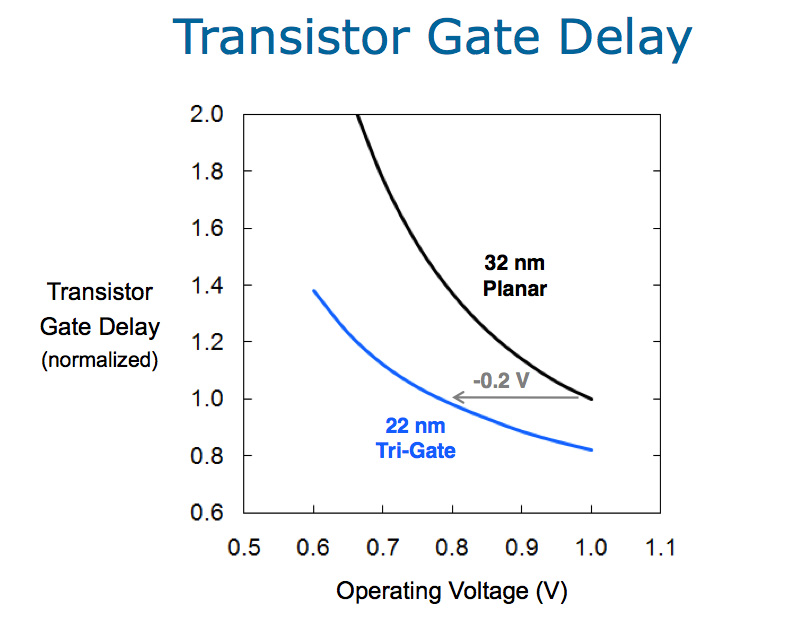
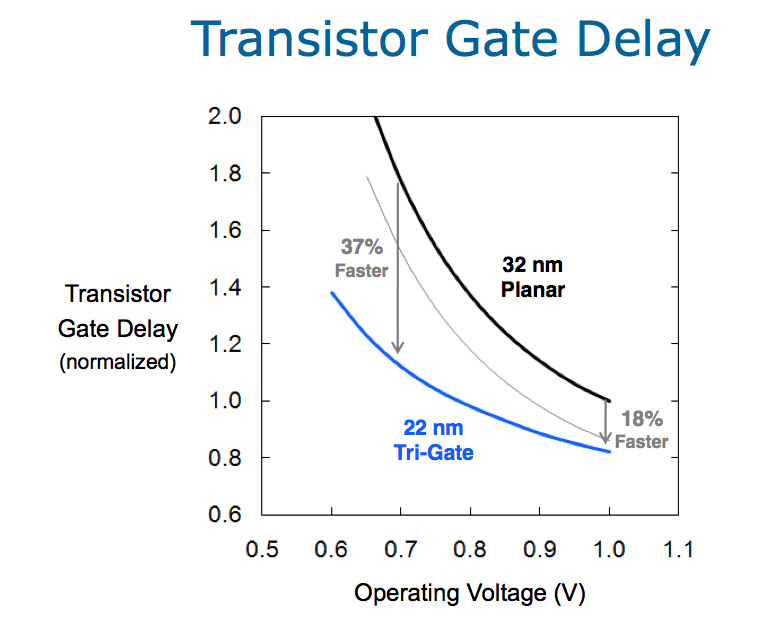
Edit: Here is what I am talking about:
Last edited:
Do you think Ivy Bridge Chips will have a higher overclock potential than Sandy Bridge? Possible to get to 6+ Ghz?
Some SNB chips have hit 6GHz so to be better than SNB it would have to be 6++ unless you mean 24/7 clocks.
Besides being able to run at that high a multi it also depends on what the BIOS limits it to. SNB has already been run with 59x multi and that is IMO likely a BIOS limit with SNB having a real limit of 63x.Also, is it true that Ivy has a x63 max multiplier setting compared to Sandy's x57?
SixFootDuo
Supreme [H]ardness
- Joined
- Oct 5, 2004
- Messages
- 5,839
Im guessing that 5.2 to 5.5Ghz will be normal.
![Zarathustra[H]](/data/avatars/m/9/9298.jpg?1723407683)
- Joined
- Oct 29, 2000
- Messages
- 42,420
I do not think 6GHz will be possible (under normal cooling) from the Intel's graphs on what 3D transistors bring. It seems you get a combination of performance and lower power however once you raise the voltage significantly over 1.0V both 32nm Planar and 22nm Tri-Gate appear to converge. Intel did not provide that part of the graph so we do not know for sure exactly where or what advantage 22nm Tri-Gate has at 1.X V.
Edit: Here is what I am talking about:
Yeah, this pretty much confirms that Intel's focus with IB was to lower power consumption. Any performance benefits that come a long with it are mostly a side effect.
drescherjm
[H]F Junkie
- Joined
- Nov 19, 2008
- Messages
- 14,933
When it comes to the hardware side, we were shown that the processor excels in performance. We saw the samples of Core i7-3770K going from 3.5 GHz to a massive 7.06 GHz clock. By raising voltage to 1.889 Volts, using 63x multiplier and 112.11 MHz and using dry ice - the 22nm beast passed 7000 MHz.
Not sure if that is any more useful than the 8.X GHz AMD demo.. I mean 1.89 volts for a 1.0V to 1.2V chip. Not like you will be running at that speed 24/7.
Last edited:
Not sure if that is any more useful than the 8.X GHz AMD demo.. I mean 1.89 volts for a 1.0V to 1.2V chip. Not like you will be running at that speed 24/7.
Not much point, although I do wonder if that was with all 4 cores active. If so, that's a lot more impressive than the single core AMD demo.