How I’d Hack Your Weak Passwords

HardOCP News

[H] News
Joined
Dec 31, 1969
Messages
0
There is some really good information here. Yeah, I know you guys probably know this stuff already but your friends and family (the people that need to know this) don’t, so pass the word…on passwords.

If you invited me to try and crack your password, you know the one that you use over and over for like every web page you visit, how many guesses would it take before I got it?
 
Not bad, under his guidelines, It'd take him:
2.10 centuries
1,899 millennia
180,365 millennia
17,184,705 millennia
1,627,797,068 millennia

To crack my most commonly used passwords.
 
The article mentioned Roboform and that thing is just awesome. Saves so much time and adds security, huge fan. It sure beats post it notes on the wall/monitor that many of you have seen people (other people of course) use.
 
On principle alone, I would never take any sort of advice from a moron who posts crap like this on his blog:

Let’s say you buy a movie on BlueRay disc, but want to take it to Mom’s house and play it back on her DVD player. Well, since a DVD player can’t play a BlueRay you slap it in your PC to convert it over, but wait! Vista says NO! It doesn’t matter that you legally own a copy of that content.
 
Nice to know it'd take him months to crack even my most basic password to things I care nothing about and hundreds or thousands of years for anything that matters.
 
This article is actually a great one for 90% of most computer users. Hes right in that they use one password for every account they have. And telling them that hackers would go to the least secure accounts to gain them passwords to access the tough ones is something they wouldn't think of like hacking email to get your bank to send login information to your hacked email account.
 
Some guy I know has like a 30-40 character "passphrase" that he uses for everything... Seems really excessive.

But then again, it'd be hard for someone else to figure out... without something like a keylogger...
 
websites I dont care about have a simple password. I have a utility password 8+ numbers and letters thats randomized code at the end that all my friends know for shared websites and tools and My work password is 16+ with numbers and letters mishmashed and has to change every couple weeks. Yeah if you know something very specific about me you could get into a couple things, but I'm kinda random so itd be hit and miss.
 
The first part of the article reminded me of the movie hackers when "Mr. The Plague" was lecturing the board members about passwords.
 
anyone that uses roboform know how to auto fill the password fields? its kind of a pain to remeber 50 intrent pages that it saves that all use the same password
 
Some guy I know has like a 30-40 character "passphrase" that he uses for everything... Seems really excessive.

But then again, it'd be hard for someone else to figure out... without something like a keylogger...

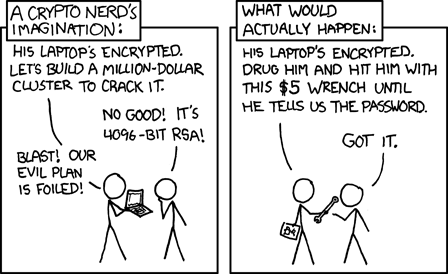
Reality's a bitch

security.png
 
I don't know about you, but my bank would never send anything like that to a e-mail address. I have to physically go to my bank to change or get any login information and if there are 3 unsuccessful attempts to log into the account you have to physically go to the bank to reset it.
 
Reality's a bitch

http://imgs.xkcd.com/comics/security.png[IMG][/QUOTE]

Haha, honestly I doubt he has anything anyone would even want... but I just find it funny...

I think he said he changes it every couple of weeks too or something. He's one smart guy though, one of the smartest kids at our school.
 
Assuming the hacker has a reasonably fast connection and PC here is an estimate of the amount of time it would take to generate every possible combination of passwords for a given number of characters. After generating the list it’s just a matter of time before the computer runs through all the possibilities – or gets shut down trying.

It's safe to say that anyone trying to brute force attack a bank using 1 million different passwords for the same account would get shut down in seconds.

I'm guessing that after trying some reasonable number of times, like 10, your bank account online would be frozen and they'd notify you that someone was attempting to access it.

From what I understand, THIS IS NOT HOW PASSWORDS ARE HACKED.

Instead, they plant keyloggers on the computers of people who download various viruses or trojans, and get into accounts that way.

Or, if they want to hack a particular account, they go after the security question, not the password. After all, even most people who have a password like lzk37zjh8d3 will have a security question and answer like, "What is your mother's maiden name? Smith".
 
My passwords are just me pounding on the keyboard to produce a random garble of letters and numbers, and then I click "remember this password" :D
 
Just try to crack my 51 character passwords! Muahahahahah! :p

Actually, someone was once bragging about a 52 character password. I cracked it with a lucky guess

abcdefghijklmnopqrstuvwxyzabcdefghijklmnopqrstuvwxyz
 
when i was little i used to make up piano melodies, and play them really really fast. all of my passwords are based on those.

my banking password is 27 characters long and i can play it in under 3 seconds. i have no idea what my password is. it includes several caps lock presses.
 
Assuming the hacker has a reasonably fast connection and PC here is an estimate of the amount of time it would take to generate every possible combination of passwords for a given number of characters. After generating the list it’s just a matter of time before the computer runs through all the possibilities – or gets shut down trying.

It's safe to say that anyone trying to brute force attack a bank using 1 million different passwords for the same account would get shut down in seconds.

I'm guessing that after trying some reasonable number of times, like 10, your bank account online would be frozen and they'd notify you that someone was attempting to access it.

While he acknowledges that, he assumes other websites will lack the same security. Fair enough, but even if they do, what makes you think they won't interpret 10,000 or 100,000 login attempts coming from the same IP faster than a human could manage as an attack? Because they will, and your future connection attempts will get blocked very quickly.

From what I understand, THIS IS NOT HOW PASSWORDS ARE HACKED.

Instead, they plant keyloggers on the computers of people who download various viruses or trojans, and get into accounts that way.

This. I'm not really aware of any major instances of accounts being broken into via brute-force over the internet. Locally? Sure. If you've got the password hash to play with locally you've got all the time in the world to brute force it, nobody will ever know unless and until you're successful.

Social engineering trumps "cracking" every time. EVERY time.
 
My favorite is when friends and family are too lazy to type in the 4 digit pass-code on their cellphones to check voicemail. They say "well, they'd need my phone to get into my voicemail" They couldn't be more wrong. All you need is their phone number and you're in (steps omitted). I also love the people that do stupid codes, like 1111 or 1234. I know people using those as their home alarm codes and garage codes. Tisk Tisk...
 
You could never guess mine. It means only something to me and in the most obscure way possible. Thanks for playing.
 
The author ignores the fact that there are plenty other ways to brute force or crack passwords (two different topics if you ask me). His example fits for some boyfriend trying to "crack" into his ex-girlfriend's web-based email account.

But I guess there's no real need to get all down and dirty and detailed on those inaccuracies.


I think lots of people overplay the security of their banking institutions and other web sites that take login credentials. Most rely on captchas or other code-related throttling, but otherwise no one ever gets alerted let alone follows up on any investigations. There is more of a "head-in-the-sand" approach to security at many orgs than you'd be comfortable knowing. Let alone the economics of it.


Anything automatically filling in passwords on a web page is a bad idea. I don't care what you say.


I agree with some posters here (and the author) who play up the social engineering aspect, or other side channels to snagging credentials. For instance that con you went to and used the open wireless network on to check your email or log into your forums? Yeah, you want to change your passwords. There are ways to sniff not only the actual logins, but also the cookies. There are ways to inject code into web pages and plenty of IE and Firefox holes to leverage for local root. There are ways to MITM SSL connections, and despite the browser warnings, many people click through them especially when they're on a free network where they think that's just part of the service.

Those security questions where you put obvious answers in to protect your account or allow password resets? GG there, too. Those strange PDFs you open and Flash ads you accept from everywhere? Bad news.

And so on...

And none of that is going to care whether your password is 4 characters or 26 random chars. That really is one of the important points he makes: don't reuse the same password everywhere. I wish that point didn't get lost in his discussion on cracking and choosing complex passwords.
 
This is why I used my own made up words coupled with random number strings.
 
when i was little i used to make up piano melodies, and play them really really fast. all of my passwords are based on those.

my banking password is 27 characters long and i can play it in under 3 seconds. i have no idea what my password is. it includes several caps lock presses.

It'd be horrible typing that on say an iPhone or something :D I had to change my Apple password because my fingers knew on a regular keyboard where the keys were for my password, but I had no idea what they actually were so I had to change it to something that I knew and not just what my fingers knew.
 
Back
Top