• Some users have recently had their accounts hijacked. It seems that the now defunct EVGA forums might have compromised your password there and seems many are using the same PW here. We would suggest you UPDATE YOUR PASSWORD and TURN ON 2FA for your account here to further secure it. None of the compromised accounts had 2FA turned on.
    Once you have enabled 2FA, your account will be updated soon to show a badge, letting other members know that you use 2FA to protect your account. This should be beneficial for everyone that uses FSFT.

Dota 2 update increases performance for Ryzen

CAD4466HK

Supreme [H]ardness
2FA
Joined
Jul 24, 2008
Messages
5,360
Looks like Valve is giving some much needed love to Ryzen.

http://store.steampowered.com/news/28296/

Before and after from a poster on Chiphell(FWIW).

https://www.chiphell.com/thread-1717769-1-1.html
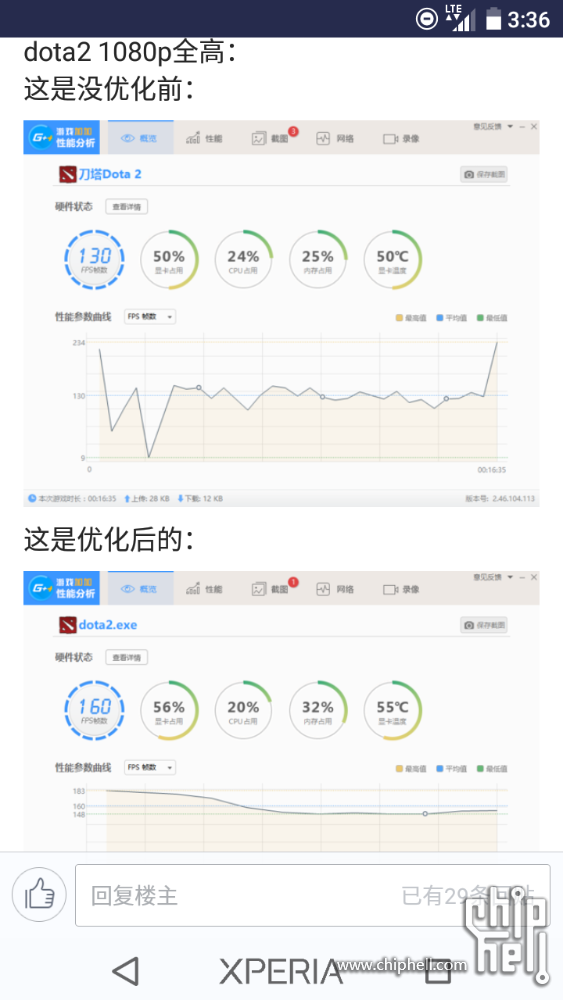
Screenshot_20170321-153638.png
 
That is nice, hopefully more developers do that, must not have been too hard for them to modify it.
 
Interesting. I didn't find a site where somebody had tested SMT On vs Off on Dota 2. I wonder if this is one of those few games where SMT On was significantly worse than off and this addressed that. The wording of the patch note makes me kinda think so.
 
I still really wish we had an SMT on/off comparison on this from before. I'm really curious if this was full on optimization, or if SMT was bugged (possibly due to them specifically assigning threads around Intel's hyperthreading model).

At any rate, nice to see some devs making improvements.
 
so much for no such thing as ryzen optimizations lol

Well you know it was unfixable and no one would try for that small % that AMD has in PC computing...

That is not what he said. He said that one can expect specific title optimizations, but not a magic patch that will fix overall gaming performance.
 
That is not what he said. He said that one can expect specific title optimizations, but not a magic patch that will fix overall gaming performance.
That was never a problem to begin with it was just that certain titles suffered from it.

Overall gaming performance is fine (in more then one resolution) except for some titles.
 
That was never a problem to begin with it was just that certain titles suffered from it.

Overall gaming performance is fine (in more then one resolution) except for some titles.

Overall game performance is about 20% behind Broadwell-E clock-for-clock. And increasing in some specific titles. Patches and optimization for specific titles can improve performance but it will not solve the general gaming problem. That was his point.

I would also like to see what amount of the gains reported in the OP are really specific to RyZen and what amount affects to other chips (if it does).
 
The new Eteknix review of the ryzen 1800 vs 7700k using a gtx 1080ti showed some interesting results, putting ryzen in a pretty good light although I'm not entirely sold his charts are accurate. Some of the benchmarks in rise of the tomb raider show lower minimum framerates on the intel cpus after overclocking which makes no sense. The Ryzen scores in the same game are also much higher than ive seen in other reviews. Again, this is just one review with a limited number of games. I'm looking forward to more sites going back and retesting with the upcoming r5 launch.

http://www.eteknix.com/ryzen-vs-int...ted-more-resolutions-overclocks-games-tested/
 
The reason gaming performance was confusing with Ryzen is that it was very good outside of gaming. Usually when a CPU sucks at gaming, it sucks elsewhere too. There have been exceptions. The K6 line was famously pretty good outside of gaming, and somewhat lackluster for gaming. But this was due primarily to poor FPU performance (something AMD later rectified with the original K7).

For Ryzen, it does appear to be a combination of things. Part of the problem is a rushed released. Things like the power profile in Windows should have been solved before release. I can attest, changing to high performance profile definitely speeds up the Ryzen considerably. To be fair, Microsoft and AMD are working on a more permanent fix for that, however. Not a big deal.

Second, we have Ryzen's SMT implementation, which actually seems to be very good. Can't remember where I saw it, offhand, but I saw comparisons in content creation with SMT on and SMT off, for both the Intel chips and the Ryzen lineup. Ryzen benefited *more* from SMT than Intel's lineup did. Yet in gaming, SMT hurts Ryzen often times, sometimes very badly. This is where I think optimization can help. Existing titles probably won't see much, though kudos to DOTA's devs for doing it, but future titles will probably see improvement.

Third, the general trend is toward more threads, even in games. This can't be helped, as IPC and clock speed improvements are nearing a wall, and we all know it. More threads and cores are the way forward, like it or not, so expect more multi-threading in the future. Ryzen will benefit from this more than most quads will. There was a great set of benchmarks I saw where Ryzen 6-core parts (really a Ryzen 7 with 2 cores disabled) were compared against the Intel lineup in games. As expected, the 7700k won... but what was more interesting as that the Ryzen 1600X would, on occasion, dominate the 7600k in some particular benchmarks, probably ones where the 7700k's hyperthreading and the 1600X's 6 cores/12 threads was a benefit. And the poor 7350k Kaby Lake part would, in such titles, absolutely tank. 2 cores are not enough anymore. And even 4 cores without SMT are starting to show age.

Today, right now, the sweet spot in gaming is 4c/8t. Tomorrow it could be 6 cores, or 8 cores. But it certainly won't be less. So IMHO, you're not going to suffer with a Ryzen buy. But, for now, the 7700k remains the gaming king.
 
The reason gaming performance was confusing with Ryzen is that it was very good outside of gaming. Usually when a CPU sucks at gaming, it sucks elsewhere too. There have been exceptions. The K6 line was famously pretty good outside of gaming, and somewhat lackluster for gaming. But this was due primarily to poor FPU performance (something AMD later rectified with the original K7).

For Ryzen, it does appear to be a combination of things. Part of the problem is a rushed released. Things like the power profile in Windows should have been solved before release. I can attest, changing to high performance profile definitely speeds up the Ryzen considerably. To be fair, Microsoft and AMD are working on a more permanent fix for that, however. Not a big deal.

Second, we have Ryzen's SMT implementation, which actually seems to be very good. Can't remember where I saw it, offhand, but I saw comparisons in content creation with SMT on and SMT off, for both the Intel chips and the Ryzen lineup. Ryzen benefited *more* from SMT than Intel's lineup did. Yet in gaming, SMT hurts Ryzen often times, sometimes very badly. This is where I think optimization can help. Existing titles probably won't see much, though kudos to DOTA's devs for doing it, but future titles will probably see improvement.

Third, the general trend is toward more threads, even in games. This can't be helped, as IPC and clock speed improvements are nearing a wall, and we all know it. More threads and cores are the way forward, like it or not, so expect more multi-threading in the future. Ryzen will benefit from this more than most quads will. There was a great set of benchmarks I saw where Ryzen 6-core parts (really a Ryzen 7 with 2 cores disabled) were compared against the Intel lineup in games. As expected, the 7700k won... but what was more interesting as that the Ryzen 1600X would, on occasion, dominate the 7600k in some particular benchmarks, probably ones where the 7700k's hyperthreading and the 1600X's 6 cores/12 threads was a benefit. And the poor 7350k Kaby Lake part would, in such titles, absolutely tank. 2 cores are not enough anymore. And even 4 cores without SMT are starting to show age.

Today, right now, the sweet spot in gaming is 4c/8t. Tomorrow it could be 6 cores, or 8 cores. But it certainly won't be less. So IMHO, you're not going to suffer with a Ryzen buy. But, for now, the 7700k remains the gaming king.

7700k is king is today's game engines (mostly). However, 2 years from now, the trend looks like the Ryzen will be better - so the question is do you buy a 7700k now and have the best performance in today's games (which are generally not cpu limited), or buy the Ryzen now and 2 years from now have better performance in the more demanding games that will start to hit cpu limits? Along with the ability to cheaply upgrade when those limits hit as AMD has much longer socket life?

If you build a new system very couple of years, go 7700k, sure. But, if like a lot of people now, you only build one every 5-7 years I think the Ryzen is in the sweet spot, at least until Intel responds. I have no doubt they will, probably doubling core count on the i3/i5/i7 to match Ryzen and, with their higher clocks, move back ahead on all fronts (except price, probably).
 
But, if like a lot of people now, you only build one every 5-7 years I think the Ryzen is in the sweet spot, at least until Intel responds. I have no doubt they will, probably doubling core count on the i3/i5/i7 to match Ryzen and, with their higher clocks, move back ahead on all fronts (except price, probably).

I doubt Intel will double core count. My bet is in a year, we see some 6 core parts filter in as "mainstream parts" as opposed to them being tied more to the ultra high end. I figure we'll see a lineup like 4c/4t i3s, 4c/8t i5s, and 6c/12t i7s. With Intel still having the IPC and clock speed advantage, a 6 core Kaby Lake should be in the same neighborhood as an 8 core Ryzen in multi-threaded performance, and probably win in single thread scenarios.

But, being as this is Intel we are talking about, expect to pay more for it.
 
Overall game performance is about 20% behind Broadwell-E clock-for-clock. And increasing in some specific titles. Patches and optimization for specific titles can improve performance but it will not solve the general gaming problem. That was his point.

I would also like to see what amount of the gains reported in the OP are really specific to RyZen and what amount affects to other chips (if it does).
 
But time and time again these chips can't game, yet a little software patch and its night and day.

I get tired of hearing this over and over about the chip sucks at gaming sigh ...
 
I doubt Intel will double core count. My bet is in a year, we see some 6 core parts filter in as "mainstream parts" as opposed to them being tied more to the ultra high end. I figure we'll see a lineup like 4c/4t i3s, 4c/8t i5s, and 6c/12t i7s.

This has been on the leaked Intel roadmaps for over a year.
 
I don't expect Intel to make any serious change from this roadmap. They will not have an 8C / 16T CPU in the mainstream till at least the 7nm process. Maybe even later than that. And in my opinion there is no need for it either.
 
I don't expect Intel to make any serious change from this roadmap. They will not have an 8C / 16T CPU in the mainstream till at least the 7nm process. Maybe even later than that. And in my opinion there is no need for it either.

Probably true. Though I think "need" is a relative term. There's definitely a user who'd benefit from it, but I suspect for business/marketing reasons, it might be a bad play for Intel to do that anyway. They make a huge margin on their content creation parts, and the 4c/8t parts are a volume seller right now. So they get heaps of profit from both ends. A part in between both segments would only crib from one or the other. Intel gains nothing from doing this. Well, they would have gained ME as a customer again, but for the most part... no big gains.

For AMD, however, 8c/16t was the perfect play. It was a space where they could compete better. They couldn't quite get the clocks or the IPC of Kaby Lake, so they weren't going to take the gaming crown, and I'm sure they knew that. But they were close enough that slapping on some more cores meant they could make a very interesting middle-ground case between the volume seller Intel part and the content creation Intel part. So good move for AMD to do that.

But with superior IPC and clocks, all Intel would need to do is stick with their existing roadmap, anyway, as a 6c/12t Kaby Lake would easily stand in with a Ryzen 8c/16t part in content creation anyway, and beat it in gaming. AMD will need to make sure Zen+ releases on time, and incorporates either a clock speed increase or an IPC increase (or both) to stay competitive with that scenario.

Still, all to the good. Finally the CPU market is interesting again :).
 
The new Eteknix review of the ryzen 1800 vs 7700k using a gtx 1080ti showed some interesting results, putting ryzen in a pretty good light although I'm not entirely sold his charts are accurate. Some of the benchmarks in rise of the tomb raider show lower minimum framerates on the intel cpus after overclocking which makes no sense. The Ryzen scores in the same game are also much higher than ive seen in other reviews. Again, this is just one review with a limited number of games. I'm looking forward to more sites going back and retesting with the upcoming r5 launch.

http://www.eteknix.com/ryzen-vs-int...ted-more-resolutions-overclocks-games-tested/

If they're using a straight min fps, it's not super unusual to see weirdness like that. One random spike, for who knows what reason that you may not even be able to repeat, and you end up with a strange min fps result. It's why we're seeing more and more sites using a percentage of lowest instead.

But yeah, those results in general seem better than I remember seeing from other reviews.
 
7700k is king is today's game engines (mostly). However, 2 years from now, the trend looks like the Ryzen will be better - so the question is do you buy a 7700k now and have the best performance in today's games (which are generally not cpu limited), or buy the Ryzen now and 2 years from now have better performance in the more demanding games that will start to hit cpu limits? Along with the ability to cheaply upgrade when those limits hit as AMD has much longer socket life?

If you build a new system very couple of years, go 7700k, sure. But, if like a lot of people now, you only build one every 5-7 years I think the Ryzen is in the sweet spot, at least until Intel responds. I have no doubt they will, probably doubling core count on the i3/i5/i7 to match Ryzen and, with their higher clocks, move back ahead on all fronts (except price, probably).

to be fair i think both processors are perfectly fine for the next 7 years if you look at the rate of game development.. it's taken them 6 years to get game developers to move from dual core to quad core support, other than a hand full of high performance games out there that don't have a thread cap limit generally most games aren't even close to fully using a ryzen or 8 thread intel processor. so i don't think there's really a wrong choice from anyone right now. cost and overall use are going to continue to be the primary purchasing reasons for a while.

i mean come on i survived 8 years with a phenom II x4 940 playing all the same games everyone else is playing with 60+ fps @1200p. cpu's are no where close to becoming the limiting factor in gaming performance.
 
But time and time again these chips can't game, yet a little software patch and its night and day.

I get tired of hearing this over and over about the chip sucks at gaming sigh ...
You arent making sense.
If there is no problem how can it become a night and day difference?
Its posts like yours that are tiring.
 
You arent making sense.
If there is no problem how can it become a night and day difference?
Its posts like yours that are tiring.

sarcasm in written form is hard, lol. but yeah i think his first sentence was suppose to be a sarcastic remark.
 
sarcasm in written form is hard, lol. but yeah i think his first sentence was suppose to be a sarcastic remark.
There was no sarcasm, he stated his intent specifically

"I get tired of hearing this over and over about the chip sucks at gaming sigh ..."
 
The reason gaming performance was confusing with Ryzen is that it was very good outside of gaming. Usually when a CPU sucks at gaming, it sucks elsewhere too. There have been exceptions. The K6 line was famously pretty good outside of gaming, and somewhat lackluster for gaming. But this was due primarily to poor FPU performance (something AMD later rectified with the original K7).

For Ryzen, it does appear to be a combination of things. Part of the problem is a rushed released. Things like the power profile in Windows should have been solved before release. I can attest, changing to high performance profile definitely speeds up the Ryzen considerably. To be fair, Microsoft and AMD are working on a more permanent fix for that, however. Not a big deal.

Second, we have Ryzen's SMT implementation, which actually seems to be very good. Can't remember where I saw it, offhand, but I saw comparisons in content creation with SMT on and SMT off, for both the Intel chips and the Ryzen lineup. Ryzen benefited *more* from SMT than Intel's lineup did. Yet in gaming, SMT hurts Ryzen often times, sometimes very badly. This is where I think optimization can help. Existing titles probably won't see much, though kudos to DOTA's devs for doing it, but future titles will probably see improvement.

Third, the general trend is toward more threads, even in games. This can't be helped, as IPC and clock speed improvements are nearing a wall, and we all know it. More threads and cores are the way forward, like it or not, so expect more multi-threading in the future. Ryzen will benefit from this more than most quads will. There was a great set of benchmarks I saw where Ryzen 6-core parts (really a Ryzen 7 with 2 cores disabled) were compared against the Intel lineup in games. As expected, the 7700k won... but what was more interesting as that the Ryzen 1600X would, on occasion, dominate the 7600k in some particular benchmarks, probably ones where the 7700k's hyperthreading and the 1600X's 6 cores/12 threads was a benefit. And the poor 7350k Kaby Lake part would, in such titles, absolutely tank. 2 cores are not enough anymore. And even 4 cores without SMT are starting to show age.

Today, right now, the sweet spot in gaming is 4c/8t. Tomorrow it could be 6 cores, or 8 cores. But it certainly won't be less. So IMHO, you're not going to suffer with a Ryzen buy. But, for now, the 7700k remains the gaming king.
Multi-threading might be beneficial for the biggest of the AAA games and CPU heavy multiplayer games. But the vast majority of the games already released and some still being released, as evidence in Ryzen benches. Prefer better ST IPC performance than simply throwing more cores at the problem.
Yeah... so maybe AMD wasn't bullsh*tting when they said optimizations will fix things. I mean, that's night/day different right there.
Good luck seeing that for anything more than new games coming later and the most popular existing ones though.

Won't help the games that will never be patched.
 
Multi-threading might be beneficial for the biggest of the AAA games and CPU heavy multiplayer games. But the vast majority of the games already released and some still being released, as evidence in Ryzen benches. Prefer better ST IPC performance than simply throwing more cores at the problem.

Good luck seeing that for anything more than new games coming later and the most popular existing ones though.

Won't help the games that will never be patched.

I dont think it matters much. I havent seen any benchmarks from existing games that I would consider unplayable. Does it really matter much if an older title gets 150 fps on an I7 and 120 fps on ryzen? Im just concerned with how performance looks going forward. Whatever I upgrade into has to last me for 4 years or so.
 

From your link

The bad
  • Gaming performance is weak compared to Intel, particularly in modern titles
  • Specialised AVX applications will perform better under Intel
The ugly
  • A higher-clocked quad-core chip like the Intel i7-7700K or 7600K is still the best choice of processor for no-compromise gamers

But, yes the new excuse are those patched games are coming and will change everything. LOL
 
Multi-threading might be beneficial for the biggest of the AAA games and CPU heavy multiplayer games. But the vast majority of the games already released and some still being released, as evidence in Ryzen benches. Prefer better ST IPC performance than simply throwing more cores at the problem.

Good luck seeing that for anything more than new games coming later and the most popular existing ones though.

Won't help the games that will never be patched.

Exactly. AMD will pay to patch some titles, surely the ones that see real benefit, and the rest will remain unchanged, which means average gaming performance for RyZen will change in the low single digit percent.

It must be also technically interesting to see how many of the optimizations in those patched games translate to non-RyZen chips.
 
Phoronix is Linux gaming, stop stretching the truth. All 1% of the world gives a damn about Linux gaming. All your doing is trying to distort the truth and your really bad at it, I dont even think Linux fully supports Ryzen yet anyway last I heard. Plus in windows it was getting 160 fps now after the DOTA 2 patch which is faster then the 7700K was getting in Linux. Your lies are just bad, your arguments weak and your spin is easy to see through. Ryzen games just fine and if more games get patched, clinging to that "7700K games better" will get even harder.
 
Last edited:
I dont think it matters much. I havent seen any benchmarks from existing games that I would consider unplayable. Does it really matter much if an older title gets 150 fps on an I7 and 120 fps on ryzen? Im just concerned with how performance looks going forward. Whatever I upgrade into has to last me for 4 years or so.

Yeah, I'm with this guy. I don't give a f*ck about a few FPS in some of today's games (I'm also not a purist gamer either, though -- I don't game nearly as much as I used to, so take it with a grain of salt). My worry was strictly for the future. Remember, one of the big reasons for low res gaming tests is to intentionally stress the CPU instead of the GPU, in an effort to understand how well the CPU will perform in the future.
 
Back
Top