
Does anyone have experience with "In-Band ECC"?

Zarathustra[H]

Extremely [H]
2FA
Joined
Oct 29, 2000
Messages
42,494
So, I am considering using an embedded Intel N97 mini-PC for a purpose that would be a real nuisance if there were unplanned downtime.

In order to reduce this likelihood I am interested in using ECC.

IN googling whether or not the system supports ECC, I discover it does, but only something called "In-Band ECC" which I was not previously familiar with. Apparently it is something Intel has been officially supporting, but only for embedded systems.

Anandtech briefly talks about it here (in a review for different hardware than I plan on using).

It sounds as if instead of using traditional extra bits in the interface for ECC, it stores ECC data in a reserved space in main RAM, and kind of hacks it somehow.

The performance penalty is apparently pretty severe (25%?), but I am OK with that. Performance here is not particularly important. Or at least not as important as uptime.

I guess my question is, what kind of RAM do I need for this? The system takes DDR5 SO-DIMMS. Do I buy ordinary DDR5, or unregistered ECC DDR5 SO-DIMMS?

Appreciate any input.
 
In-band ECC works with regular ram. That's the magic. (Not surprising that the performance hit is large though).

I haven't seen a detailed review, but I'd be kind of surprised if it doesn't support reporting? It's happening in the memory controller, so it should be able to throw a machine check exception to report errors.

As opposed to the DDR5 on-die ECC which does have no means of reporting. IMHO, that doesn't make it useless; the correction should lower the rate of errors, but without reporting, you can't replace faulty ram before it returns corrupted data and when it does, it will be more corrupt.
 
haven't seen a detailed review, but I'd be kind of surprised if it doesn't support reporting? It's happening in the memory controller, so it should be able to throw a machine check exception to report errors.

I did see a patch to Linux, from some dude @intel.com that was adding support for memory MCEs on one of the lake processors for in-band ecc. You might want to check if there's support listed for alder lake-n in your OS of choice. It's way more useful with reporting afterall.
 
I did see a patch to Linux, from some dude @intel.com that was adding support for memory MCEs on one of the lake processors for in-band ecc. You might want to check if there's support listed for alder lake-n in your OS of choice. It's way more useful with reporting afterall.

I'm not well read on Inte';s various generations of low power and embedded platforms, so the product names in this link are somewhat like Greek to me, but it sounds like IN-band-ECC started being patched in to the 5.11 kernel in 2020.

https://www.phoronix.com/news/Intel-IGEN6-IBECC-Driver
 
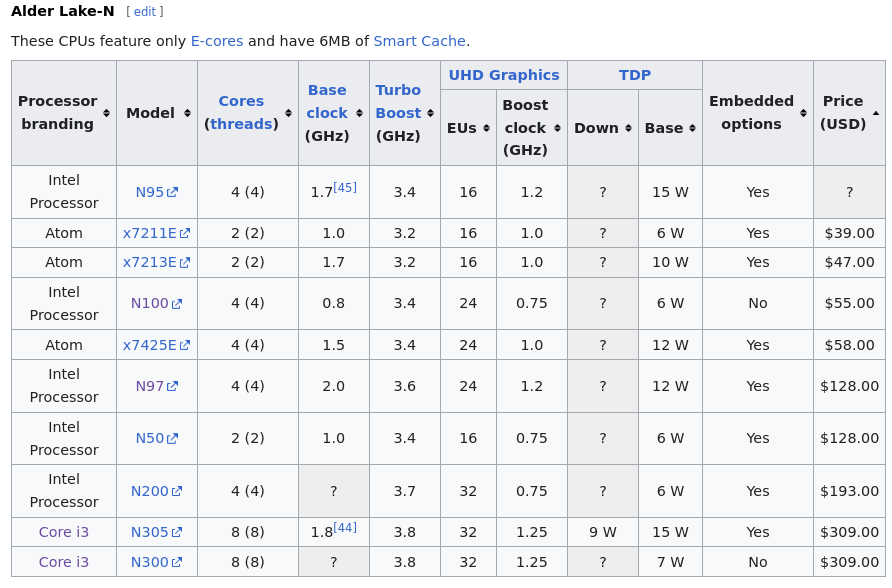
Also, Intels naming conventions for Alder-Lake-N seems really messed up and confusing.

1720389844062.png


N97 seems like a way higher end part than N100 (unless you need less max TDP)

...and "Intel Processor"? Seriously? It's like they forgot to name it.

Either they just gave up and stopped trying or they are intentionally trying to confuse people so they have no idea what they are buying.

I know, these are embedded parts that aren't necessarily intended to have customer facing specs, but still.
 
Last edited:
I have about a dozen of those n100 boxes deployed as surveillance camera video walls. Even running windows they run for MONTHS between any type of reboot, usually power related. Even when that happens they happily auto power back up and launch my client. They have plenty of power, make no noise and pretty much just disappear behind the 55" panels they are pushing 24/7/365. I wouldn't over complicate the memory situation. If this is something truly mission critical then you're looking at the wrong products. Downtime will be because some idiot unplugged something or plugged the wrong something in, not because a cosmic flare reflected off a cyber truck doing a barrel roll and flipped a bit on your ram.

Set the BIOS to auto power back on and setup your service to automatically start on boot. You'll be good.
 
Back
Top