• Some users have recently had their accounts hijacked. It seems that the now defunct EVGA forums might have compromised your password there and seems many are using the same PW here. We would suggest you UPDATE YOUR PASSWORD and TURN ON 2FA for your account here to further secure it. None of the compromised accounts had 2FA turned on.
    Once you have enabled 2FA, your account will be updated soon to show a badge, letting other members know that you use 2FA to protect your account. This should be beneficial for everyone that uses FSFT.

Conroe debunked

Status
Not open for further replies.
Mav451 said:
So would the E4000's be the "Durons" of the Conroe line? E.g. nerfed cache and bus, but wholly the same (hopefully) OC-ability? Though for $150, it's not quite Duron pricing yet =D.

Please note, that $150 is MSRP, not trey of 1000 price. They are not Duron or Celerons in the true sense. We're talking still talking about a processor that will still be faster than current Yonahs, not by as much as the E6xxx but still faster than the current processors.

1.6GHz might not be like the 1.6GHz P4 and do 2.4GHz i.e.a 50% overclock but who knows how much ROOM Intel leave for them. Also note there 1.8 and 2GHz model 4xxx as well. Then there are Preslers that are doing much better than anyone ever thought, just the opposite of Prescott. Then there's Cedar Mill for the lower end, I mean damned for about $241 you'll be able to get 3.6GHz Dual Core that will do about 4.2GHz on air, hehehehe!
 
(cf)Eclipse said:
regardless, what i said was that K7 caught up to netburst in it's later days before K8 came out. K8 did NOT launch in 2000. that's all i really wanted to point out, the semantics on K7/K75 doesn't really matter :p

As I corrected what I said, K75 was the first shipped with On-Die Cache and this time I'm sure that's the way it went. K7 died at 1GHz. TBird is K75 unless I just totally forgot. I'm not an expert but if I blew it, I'll eat my crow and again move on.
 
(cf)Eclipse said:
regardless, what i said was that K7 caught up to netburst in it's later days before K8 came out. K8 did NOT launch in 2000. that's all i really wanted to point out, the semantics on K7/K75 doesn't really matter :p
More like K7 fell behind NetBurst at the latter days of it's life,

It was ahead at first then became even, then was edged out, then fell behind was what I saw of it anyway...
 
Donnie27 said:
As I corrected what I said, K75 was the first shipped with On-Die Cache and this time I'm sure that's the way it went. K7 died at 1GHz. TBird is K75 unless I just totally forgot. I'm not an expert but if I blew it, I'll eat my crow and again move on.

I thought Tbird's were their own family.
http://www.cpu-collection.de/?l0=co&l1=AMD&l2=Athlon#A0700MPR24BA

Looks from here that K75 is right before Tbirds.
 
coldpower27 said:
So yes additonal safety measures are placed to provide another layer of protection against overclocking in additon to Intel crippiling it's processor to the degree it has? Your point???
My point is that both intel and AMD systems are crippled in BIOS to prevent overclocking, not just the intel systems. Just thought you were implying that this is only evident to intel based systems:


coldpower27 said:
Yes, I agree, with the use of intel motherboards that are the mainstream or value series there aren't any overclocking options in thr BIOS's to begin with if they strictly use the intel motherboards.
 
DejaWiz said:
My point is that both intel and AMD systems are crippled in BIOS to prevent overclocking, not just the intel systems. Just thought you were implying that this is only evident to intel based systems:
ok. then, I wasn't trying to imply you could overclock on OEM AMD systems.

However that means the DIY crowd can easily achieve full Athlon performance through the third party motherboards while you still can't even with third party Intel chipsets..

So it's the OEMS that limit overclocking performance for AMD, while for Intel's it's both it and it's OEM partners. I get it.
 
coldpower27 said:
More like K7 fell behind NetBurst at the latter days of it's life,

It was ahead at first then became even, then was edged out, then fell behind was what I saw of it anyway...

Yeah, I'm pretty certain that's the case.

K7-derived cores at first could out-perform the Willamette series if I'm not mistaken (as well as the P3). Once Intel switched to Northwood however, they slowly began taking the lead, and I think you're right that they did increase that lead slowly over time (moreso in some applications, such as decoding/encoding, gaming, etc., while the XPs were able to usually be equal or greater at business tasks and such - if I recall correctly).

Willamette was total crap imo. But Northwood was awesome. ( I've actually had more Intel processors than AMD processors, with my trusty 500mhz P3 slot-process still going strong :p).
 
coldpower27 said:
However that means the DIY crowd can easily achieve full Athlon performance through the third party motherboards while you still can't even with third party Intel chipsets..


I have to seriously disagree. Look at the intel section on Extreme Sys.....or, check out my sig.

Or, look at people with monster overclocks on the P920 D.

Motherboards from Asus are a prime example of motherboards that overclock and also run quite stable.

Saying that even 3rd party Intel motherboards do not overclock to the same degree as their AMD counter parts is not only empirically unfounded, it just sounds stupid.
 
Warmonkey said:
I have to seriously disagree. Look at the intel section on Extreme Sys.....or, check out my sig.

Or, look at people with monster overclocks on the P920 D.

Motherboards from Asus are a prime example of motherboards that overclock and also run quite stable.

Saying that even 3rd party Intel motherboards do not overclock to the same degree as their AMD counter parts is not only empirically unfounded, it just sounds stupid.
I guess you didn't have enough information to reach the right conclusion but I am talking about Celeron D's getting Pentium level performance not lower end Pentium's like the 805/506/517/524 getting the level of normal Pentium's.
 
The only hitch with the Celeron D's is the Cache deprevation. Other than that they're almost identical to their Pentium counterparts.
 
Well I just read that intel MIGHT postpone the conroe till Oct.
IF SO that is more bs.

their stock is down 38% and the only thing I can figure is they want
to get rid of their 900 inventory.

(I keep thinking that both amd and intel are dumber than dirt) only for different
reasons

sparks
 
sparks said:
Well I just read that intel MIGHT postpone the conroe till Oct.
IF SO that is more bs.

their stock is down 38% and the only thing I can figure is they want
to get rid of their 900 inventory.

(I keep thinking that both amd and intel are dumber than dirt) only for different
reasons

sparks

Link please
 
DejaWiz said:
My point is that both intel and AMD systems are crippled in BIOS to prevent overclocking, not just the intel systems. Just thought you were implying that this is only evident to intel based systems:
i was thinking more along the lines of intel's budget CPUs are more 'crippled' than AMD's

also sparks, that is an interesting development that doesn't make sense at all.. i too would like a link ;)

edit: we have contradicting info.
http://www.tgdaily.com/2006/04/19/intel_to_ship_core_inq3_2006/
"Otellini indicated that Intel is gearing up for mass production of its Core architecture at this time; if Intel will be able to keep its Q3 promise, the company may be shipping Woodcrests, Conroes and Meroms for revenue as early as in June or July of this year."

though Q3 is a while, and might end up being later in Q3 ;)
 
Donnie27 said:
Here, here, WFS!

The majority of complaints about the Netburst series (three different Northwoods, and Prescott in S478 alone) were, in the case of the 478s, entirely at the beginning and end of the core grouping, and neither had anything to do with Netburst itself. In the case of the *original* Northwoods, they were *too slow* and still largely dependent on RDRAM (in short, this was a *chipset* failure; at the time, Intel was still in bed with Rambus and the horribly expensive RDRAM). In the case of Prescott, the issue was *heat*, and lots of it. Neither the Northwood-B (the first 800 MHz FSB mainstream Intel CPUs) or the Northwood-C (the HT Northwoods; the sole exception being the 3.06 GHz P4 HT, which was a B and used a 533 MHz FSB, unlike the Cs, which all ran with an 800 MHz FSB and included HT). That's why you see lots of Northwoods (especially the Killer Cs) still in service today.
 
(cf)Eclipse said:
i was thinking more along the lines of intel's budget CPUs are more 'crippled' than AMD's

also sparks, that is an interesting development that doesn't make sense at all.. i too would like a link ;)

edit: we have contradicting info.
http://www.tgdaily.com/2006/04/19/intel_to_ship_core_inq3_2006/
"Otellini indicated that Intel is gearing up for mass production of its Core architecture at this time; if Intel will be able to keep its Q3 promise, the company may be shipping Woodcrests, Conroes and Meroms for revenue as early as in June or July of this year."

though Q3 is a while, and might end up being later in Q3 ;)

That's not just contradictory; Otellini flat-out *denied* that Conroe would ship late.

In the same interview, he acknowledged higher-than-usual inventories of both 90 nm and 65 nm processors; however, he stated pretty much categorically that Intel has no intent whatever of slowing things down. He stated that Intel has three fabs cranking out 65nm in volume right now, and plans, if anything, to *increase* 65 nm production.

I smell a *swamping*.

From the comments of Otellini (and those of Andy Bryant in that conference call with investment houses), Intel plans on absolutely *drowning* AMD in a sea of Core processors of all types. If anything, Intel may *fire-sale* and retire early the 90 nm inventory to clear the decks for Core. (Presler has already taken its first casualty: the Pentium-D 920 will be EOL'd next week, a month early, with the P-D 930 replacing it.)

By the end of Q3, the only Smithfield left standing (other than the lone EE) could well be the EL P-D 805, with most of the Presler series dying off in Q4 (again, clearing the decks for yet more Core).

Things are about to get Seriously Ugly (for Intel and AMD, that is; we consumers will be the real winners with lower prices).
 
ok I got the info from my friend that is not a fan and doesn't lie...I asked for a link
this is what he read.

http://www.tgdaily.com/2006/04/19/intel_to_ship_core_inq3_2006/

I think that he he taking it a little to seriously. As usual they are stating as early as june
or july with some to follow as late as november.
So if you take this literally they are saying june to october and hoping for june.
BUT they do not give any definate dates.

I hope june. SO it will be october LOL


sparks
 
DejaWiz said:
My point is that both intel and AMD systems are crippled in BIOS to prevent overclocking, not just the intel systems. Just thought you were implying that this is only evident to intel based systems:

Some small VARs sold overclocked systems as well. They (Intel or AMD) weren't worried about the end users, it's the sellers that cause more problems. The second half of the 90's saw a lot of that crap going on. At one time processors use to be unlocked. As far as I know, that's also why CPU ID apps came about.
 
sparks said:
ok I got the info from my friend that is not a fan and doesn't lie...I asked for a link
this is what he read.

http://www.tgdaily.com/2006/04/19/intel_to_ship_core_inq3_2006/

I think that he he taking it a little to seriously. As usual they are stating as early as june
or july with some to follow as late as november.
So if you take this literally they are saying june to october and hoping for june.
BUT they do not give any definate dates.

I hope june. SO it will be october LOL


sparks

I tried to get them to do a poll. It would go something like; When will Conroe Launch? ;) I still say July and that Intel isn't worried about 9xx and 6xx Processors.

According to Otellini, Intel will be using the second quarter time frame to "reset" its business a lay the foundation for the launch of Core, which he described as "the most compelling product lineup in years." During 2007 he plans to thoroughly analyze and improve the overall efficiency of the company - a process that Intel has not seen in about 20 years.

Intel did almost this same thing when 800MHz FSB Northwoods launched. As kick ass as they were, A and B Northwoods continued to sell. Intel lost market share that 1st quarter as folks waited for Northwood C and then took back even more after Northwood C launched. It even brought DOWN the priced of DDR at that time.

Now get any of these smart guys to google that LOL!
 
Emission said:
The only hitch with the Celeron D's is the Cache deprevation. Other than that they're almost identical to their Pentium counterparts.

Same problem Durons suffered. Try to push it instead of doing only one thing at a time?
 
Donnie27 said:
I tried to get them to do a poll. It would go something like; When will Conroe Launch? ;) I still say July and that Intel isn't worried about 9xx and 6xx Processors.


Intel did almost this same thing when 800MHz FSB Northwoods launched. As kick ass as they were, A and B Northwoods continued to sell. Intel lost market share that 1st quarter as folks waited for Northwood C and then took back even more after Northwood C launched. It even brought DOWN the priced of DDR at that time.

Now get any of these smart guys to google that LOL!

What happened with the Northwood B and C also happened even earlier (back in the Halcyon Days of the P6 architecture, actually) when the Pentium II-350 launched. Almost immediately, it cut the legs from under the P-II 333 (at the time, Intel's fastest CPU) in a major way. Not only was it faster than the 333, but it actually cost *less*. (Even though it required a motherboard based on the 440BX chipset, the price difference between BX and LX boards was smaller than the price difference between the 333 and 350, making it pretty much a wash. Even better, the BX had better performance than the LX, not to mention you could actually upgrade to a faster processor later.)

With the B/C Northwood issue, Intel set itself up for that with the first HT processor, the P4 3.06. No HT Northwood-Bs (which all used the 800 MHz FSB, unlike the original Northwoods) ever hit retail, but people didn't want to pay an arm and a leg for HT, either. Hence the move that *everyone*, apparently, was waiting for, the all-HT Northwood-C series. Every single CPU in this subseries had two things in common: 800 MHz FSB support (200 MHz quad-pumped) and HT support. The only differences were speeds and prices. Of course, they sold like lemonade in Dallas in July. Then, when the heat issues that the Prescott planned successor had came to light, even *more* Northwood-Cs sold.

Segue to now, and to Core. This time, the victim isn't just the 6xx series, but both Smithfield (8xx) and Presler (9xx) as well. With the dual announcement from Otellini and Bryant, Intel is once again saying "I know I have a ton of 90nm stock sitting in warehouses, but that was actually *planned*. Instead of slowing down, we're putting the fabs into overdrive." Basically, Intel is *eating its children* again. Intel has *at least* two of the three 65 nm fabs dedicated to Core (for all I know, all *three* may be dedicated to Core). All three are running full-steam ahead. Even though sales of Intel Macs are running higher than expectations, there is no way that Apple can eat *that* much production! That means that a good half (or more) of the Core production is headed to non-Apple hardware. The reasoning *I* got from that piece: if it's 90nm and from Intel, it's going to die.
 
PGHammer said:
The majority of complaints about the Netburst series (three different Northwoods, and Prescott in S478 alone) were, in the case of the 478s, entirely at the beginning and end of the core grouping, and neither had anything to do with Netburst itself. In the case of the *original* Northwoods, they were *too slow* and still largely dependent on RDRAM (in short, this was a *chipset* failure; at the time, Intel was still in bed with Rambus and the horribly expensive RDRAM). In the case of Prescott, the issue was *heat*, and lots of it. Neither the Northwood-B (the first 800 MHz FSB mainstream Intel CPUs) or the Northwood-C (the HT Northwoods; the sole exception being the 3.06 GHz P4 HT, which was a B and used a 533 MHz FSB, unlike the Cs, which all ran with an 800 MHz FSB and included HT). That's why you see lots of Northwoods (especially the Killer Cs) still in service today.

Less get something straight first. I replaced Crashlon with a Willy and for awhile never looked back. My Epox KX-133 sucked, my Abit K7A 133A Sucked and I all but gave up and POS Asus A7M. So plead that case to someone else? Don't blame Asus or ABit because I have an ABit IC7-G, Had an Asus P4T-E, the wife's computer still has a GB i850E and willy 1.7 and 512MB of RAMBUS, 4 128MB sticks that sold for $28 each.

RAMBUS prices stayed high because Micron and other fought its developement tooth and nail. Again, they were found guilty of Cheating=P

1

2

3

Then compare this to the anti RAMBUS crap-o-la?
 
PGHammer said:
What happened with the Northwood B and C also happened even earlier (back in the Halcyon Days of the P6 architecture, actually) when the Pentium II-350 launched. Almost immediately, it cut the legs from under the P-II 333 (at the time, Intel's fastest CPU) in a major way. Not only was it faster than the 333, but it actually cost *less*. (Even though it required a motherboard based on the 440BX chipset, the price difference between BX and LX boards was smaller than the price difference between the 333 and 350, making it pretty much a wash. Even better, the BX had better performance than the LX, not to mention you could actually upgrade to a faster processor later.)

Northwood A, B, and C knocked AMD back from 22% of the market down to like 15% and NONE of Intel products were harmed in the process. Even Tualatins sold like crazy.

P6? Yet many folks hung onto their 166 to 233MHz computers. Intel still clobbered AMD sales wise. Look up these numbers, in 1999 Intel built 119 million Processors and AMD built 18 million, your point? 1998 was worse for AMD as they couldn't RAMP UP K6-2 on time. Meanwhile Intel moved from Slot-1 to Sc-370 without a hitch.

With the B/C Northwood issue, Intel set itself up for that with the first HT processor, the P4 3.06. No HT Northwood-Bs (which all used the 800 MHz FSB, unlike the original Northwoods) ever hit retail, but people didn't want to pay an arm and a leg for HT, either. Hence the move that *everyone*, apparently, was waiting for, the all-HT Northwood-C series. Every single CPU in this subseries had two things in common: 800 MHz FSB support (200 MHz quad-pumped) and HT support. The only differences were speeds and prices. Of course, they sold like lemonade in Dallas in July. Then, when the heat issues that the Prescott planned successor had came to light, even *more* Northwood-Cs sold.

:confused: P4 3.06 was the first P4 with HT but the first Northwood C's ALL HAD Hyperthreading, what you talking about? There were no 800MHz FSB none Cs to way the hell latter and those are Prescotts.

I paid $239 for my first 2.6C and $208 (same price as my Current 3500+) the 2nd. I actually paid less. A bud saw the first one running at 3.26GHz at stock voltage, thought was fluke. To prove it wasn't I sold it to him for $250 and bought my current proc, that overclocks a little better stock voltage for that $208.

Segue to now, and to Core. This time, the victim isn't just the 6xx series, but both Smithfield (8xx) and Presler (9xx) as well. With the dual announcement from Otellini and Bryant, Intel is once again saying "I know I have a ton of 90nm stock sitting in warehouses, but that was actually *planned*. Instead of slowing down, we're putting the fabs into overdrive." Basically, Intel is *eating its children* again. Intel has *at least* two of the three 65 nm fabs dedicated to Core (for all I know, all *three* may be dedicated to Core). All three are running full-steam ahead. Even though sales of Intel Macs are running higher than expectations, there is no way that Apple can eat *that* much production! That means that a good half (or more) of the Core production is headed to non-Apple hardware. The reasoning *I* got from that piece: if it's 90nm and from Intel, it's going to die.
[/QUOTE]

There wasn't a large enough RAMP UP of 8xx to bother Intel. Again, 9xx and 6x1 is doing better. Unlike AMD, Intel has high yields making them cheaper anyway. Conroe will not be cheap because Intel loves us or because they will not sale, it's simply cheaper for them to make and test=P They'll still make a wad of cash without the X2/FX like price Markups? Intel will still sale tons of Preslers and Cedar Mills IMHO.

There wasn't a danged thing wrong with 90nm from Intel. IBM and AMD had all the issues. Prescott's Layout was bad, not 90nm as again, Pentium M rocked on 90nm. Lessons learned also made 65nm whatever kick-ass right out the door.

Only AMD followers, mad that Apple's choice Intel over AMD, thought that their sales would slide. Stevie Boy might be a lot of things, but I'd bet he saw Conroe coming? Now everyone knows why he went with Intel. Let's keep scale in mind here? 40% of Intel Production equals about 2 times as many AMD Processors. Intel still builds 80% of the world's Processors.
 
Donnie27 said:
Less get something straight first. I replaced Crashlon with a Willy and for awhile never looked back. My Epox KX-133 sucked, my Abit K7A 133A Sucked and I all but gave up and POS Asus A7M. So plead that case to someone else? Don't blame Asus or ABit because I have an ABit IC7-G, Had an Asus P4T-E, the wife's computer still has a GB i850E and willy 1.7 and 512MB of RAMBUS, 4 128MB sticks that sold for $28 each.

RAMBUS prices stayed high because Micron and other fought its developement tooth and nail. Again, they were found guilty of Cheating=P

Then compare this to the anti RAMBUS crap-o-la?

Rambus also wanted MUCH higher royalty fees than they were willing to pay. Also, the Micron/Infineon case was *not* about DRAM pricing, but Compact Flash (the DRAM case was, in fact, dismissed).

DRAM pricing (both standard SDRAM and DDR) either stayed constant or actually *dropped* during the entire period under review. What's more, the drop has pretty much stayed constant ever since. Compact Flash pricing (which is what the two folks from Infineon pled guilty to fixing) was apparently kept abnormally *high*. That was why Infineon, Samsung, and Micron were investigated. Testimony from the two pleaders from Infineon led to the pleas of two from Samsung, who are now in jail.

In short, the four guilty pleas were NOT about so-called *predatory pricing* (as you allege) but price-fixing (an entirely different beast), and specifically in the CF (not DRAM) marketplace. The investigation, in fact, had nothing to do with Rambus at all (it had already had the DRAM case tossed); it was brought about by the allegations that Apple had gotten high-capacity CF modules (used in the iPod Shuffle and nano) under cost. What Rambus is alleging is that because both Infineon and Samsung are guilty (by pleas) of price-fixing in CF, they are likewise guilty of the same thing in DRAM. Basically, Rambus is calling the judge that tossed out the original lawsuit against Micron a liar.

When I called the problems concerning Intel a *chipset failure*, I was referring to high prices for RDRAM and the lack of an Intel chipset alternative that was viable. (In short, I blamed Intel.) VIA took up the slack (and got itself out of a major jam in the process) by releasing the Apollo Pro 133A chipset (a fixed version of the SDRAM-based Apollo Pro 133). Both the Tyan Trinity 400 (and the ABIT VP6 I replaced it with) used this chipset.
While both motherboards used the same chipset, they were radically different from each other.

1. The Trinity could use either Slot 1 or Socket 370 processors; the VP6 was strictly S370.

2. The VP6 was also a *workstation* motherboard (intended primarily for Windows 2000, not 9x or ME); it also supported SMP.

3. The VP6 also supported Tualatin (the P-IIIS variant) and could tag-team two of them in SMP action; the Trinity did NOT support the P-IIIS.

Are you THAT much of an RDRAM !!!!!! that you would believe Rambus over independent reportage (in this case, from someone without an axe to grind against Rambus)?
 
PGHammer said:
Are you THAT much of an RDRAM !!!!!! that you would believe Rambus over independent reportage (in this case, from someone without an axe to grind against Rambus)?

No, I just go by whats real and not by whats made up or make believe. I still have both DDR1 and RAMBUS as i said. IMHO, the whole market is sleazy and they're about the same. RAMBUS did nothing more than the rest of the market, maybe less according to some folks. It's simple, When Northwood C launched and RAMBUS couldn't supply the goods, I moved to PC-3200=P No hard feelings or anything. Same for Processors or anything else, something better ships, I buy it if I have the money.

RAMBUS' fees are Industry standard just like anyone else's. nVidia once made the same BOGUS claim against Intel, that was later proven Wrong. Think they'll sue anyone else of trying to patch SLI to work on Intel, ATI and SIS chipsets? This after agreeing to a Tech swapp with these same folks? What Intel should do is Hire one of these Guys since nVidia has agreed to not sue LOL!
 
Donnie27 said:
Northwood A, B, and C knocked AMD back from 22% of the market down to like 15% and NONE of Intel products were harmed in the process. Even Tualatins sold like crazy.

P6? Yet many folks hung onto their 166 to 233MHz computers. Intel still clobbered AMD sales wise. Look up these numbers, in 1999 Intel built 119 million Processors and AMD built 18 million, your point? 1998 was worse for AMD as they couldn't RAMP UP K6-2 on time. Meanwhile Intel moved from Slot-1 to Sc-370 without a hitch.


:confused: P4 3.06 was the first P4 with HT but the first Northwood C's ALL HAD Hyperthreading, what you talking about? There were no 800MHz FSB none Cs to way the hell latter and those are Prescotts.

I paid $239 for my first 2.6C and $208 (same price as my Current 3500+) the 2nd. I actually paid less. A bud saw the first one running at 3.26GHz at stock voltage, thought was fluke. To prove it wasn't I sold it to him for $250 and bought my current proc, that overclocks a little better stock voltage for that $208.


There wasn't a large enough RAMP UP of 8xx to bother Intel. Again, 9xx and 6x1 is doing better. Unlike AMD, Intel has high yields making them cheaper anyway. Conroe will not be cheap because Intel loves us or because they will not sale, it's simply cheaper for them to make and test=P They'll still make a wad of cash without the X2/FX like price Markups? Intel will still sale tons of Preslers and Cedar Mills IMHO.

There wasn't a danged thing wrong with 90nm from Intel. IBM and AMD had all the issues. Prescott's Layout was bad, not 90nm as again, Pentium M rocked on 90nm. Lessons learned also made 65nm whatever kick-ass right out the door.

Only AMD followers, mad that Apple's choice Intel over AMD, thought that their sales would slide. Stevie Boy might be a lot of things, but I'd bet he saw Conroe coming? Now everyone knows why he went with Intel. Let's keep scale in mind here? 40% of Intel Production equals about 2 times as many AMD Processors. Intel still builds 80% of the world's Processors.

I specifically pointed that out (HT in the Northwood-Cs); I happen to own one (P4 2.6C, D1 stepping, in fact). I also pointed out that the first HT processor that Intel shipped (the P4 3.06) was also a Northwood (original, in fact, and had the 533 MHz FSB). The Northwood-Bs were all 800 MHz (2.4, 2.6, 2.8, and 3.00 GHz) but *none* have HT. By and large, everyone was waiting for the Cs. I bought a P4 2.4B (I still have it, by the by; it's the CPU my current C replaced) which ran very well. However, when the Cs came out, I would later put my Big Bad B on the shelf and swap in the C.

I'm not blaming Intel in any way; I'm simply saying that their strategy is a time-tested one that *works*. AMD can't afford to do this sort of brinkmanship (it plain and simply doesn't have the fab capacity).

As to no 2.8 Northwood-Cs, check on Intel's old Processor Roadmaps (there was actually a double-overlap between Northwood-C and Prescott after Prescott's launch, at 2.8 and 3 GHz). While the Northwood-Cs were the larger 130 nm chips, the Prescotts were 90 nm. However, the Prescotts, especially in s478, were notorious for running hotter than the same-speed Northwood-Cs (it took the introduction of LGA775 to save Prescott from becoming a major Intel blunder).

Unlike the Bs, there was never a 2.4C (however, a 90 nm 2.4 GHz *Prescott*, not Northwood, *would* launch). The Northwood-C subseries was a mere three processors (2.6, 2.8,. and 3 GHz). The 2.6 was the slowest of this three-processor subseries (it would, in fact, be killed by the follow-on launch of the 2.4 GHz Prescott in 90 nm).

On the Prescotts: The first two launches were entirely in S478, and except for the 2.4C, were initially disastrous for Intel. The reason: heat. The 90 nm Prescotts ran hotter than the Northwoods of the same speed. Because the Northwood-Cs were still available, pruchasers stayed away from the roasting-pan Prescotts and bought same-speed Northwood-Cs (again, except for the 2.4 GHz P4 Prescott, which was the entry level, and actually replaced the 2.4 GHz Northwood-B and even stole sales from the more-expensive 2.6 GHz Northwood-C). However, the launch of LGA775 (which also included better cooling) would save Prescott. Also, unlike S478, there were no Northwoods to contend with.

I happen to *agree* with you that Intel is playing the Fab Advantage for all its worth (and that's quite a lot). Why do you think I called this tactic *swamping*? Core is shaping up to be a real monster, with all indicators showing that it has more legs than a millipede. Unlike AMD, Intel has enough sheer capacity to *drown* the market in processors without taking it in the neck And even though Intel is now supplier of choice to Apple, even Apple's demand is not enough to save AMD from a Core Onslaught, which appears to be *exactly* what Intel is planning. I would wager that someone from AMD Legal is running to the Justice Department, moaning, "Uncle, Uncle, come save my a**; the Big Bad Chipzilla is gonna *drown* me!"
 
PGHammer said:
I specifically pointed that out (HT in the Northwood-Cs); I happen to own one (P4 2.6C, D1 stepping, in fact). I also pointed out that the first HT processor that Intel shipped (the P4 3.06) was also a Northwood (original, in fact, and had the 533 MHz FSB). The Northwood-Bs were all 800 MHz (2.4, 2.6, 2.8, and 3.00 GHz) but *none* have HT. By and large, everyone was waiting for the Cs. I bought a P4 2.4B (I still have it, by the by; it's the CPU my current C replaced) which ran very well. However, when the Cs came out, I would later put my Big Bad B on the shelf and swap in the C.

I'm not blaming Intel in any way; I'm simply saying that their strategy is a time-tested one that *works*. AMD can't afford to do this sort of brinkmanship (it plain and simply doesn't have the fab capacity).

As to no 2.8 Northwood-Cs, check on Intel's old Processor Roadmaps (there was actually a double-overlap between Northwood-C and Prescott after Prescott's launch, at 2.8 and 3 GHz). While the Northwood-Cs were the larger 130 nm chips, the Prescotts were 90 nm. However, the Prescotts, especially in s478, were notorious for running hotter than the same-speed Northwood-Cs (it took the introduction of LGA775 to save Prescott from becoming a major Intel blunder).

Unlike the Bs, there was never a 2.4C (however, a 90 nm 2.4 GHz *Prescott*, not Northwood, *would* launch). The Northwood-C subseries was a mere three processors (2.6, 2.8,. and 3 GHz). The 2.6 was the slowest of this three-processor subseries (it would, in fact, be killed by the follow-on launch of the 2.4 GHz Prescott in 90 nm).

On the Prescotts: The first two launches were entirely in S478, and except for the 2.4C, were initially disastrous for Intel. The reason: heat. The 90 nm Prescotts ran hotter than the Northwoods of the same speed. Because the Northwood-Cs were still available, pruchasers stayed away from the roasting-pan Prescotts and bought same-speed Northwood-Cs (again, except for the 2.4 GHz P4 Prescott, which was the entry level, and actually replaced the 2.4 GHz Northwood-B and even stole sales from the more-expensive 2.6 GHz Northwood-C). However, the launch of LGA775 (which also included better cooling) would save Prescott. Also, unlike S478, there were no Northwoods to contend with.

I happen to *agree* with you that Intel is playing the Fab Advantage for all its worth (and that's quite a lot). Why do you think I called this tactic *swamping*? Core is shaping up to be a real monster, with all indicators showing that it has more legs than a millipede. Unlike AMD, Intel has enough sheer capacity to *drown* the market in processors without taking it in the neck And even though Intel is now supplier of choice to Apple, even Apple's demand is not enough to save AMD from a Core Onslaught, which appears to be *exactly* what Intel is planning. I would wager that someone from AMD Legal is running to the Justice Department, moaning, "Uncle, Uncle, come save my a**; the Big Bad Chipzilla is gonna *drown* me!"
No Wrong, the Northwood B's came in these configurations:

2.26GHZ, 2.4GHZ, 2.53GHZ, 2.66GHZ, 2.8GHZ, 3.06GHZ.

There are NO Northwood-B's with 800 FSB, all 800FSB Pentium 4's have HyperThreading enabled. There are ZERO 800FSB Pentium 4's without HyperThreading. so Northwood C, Prescott (800), Prescott-2M, Cedar Mill all have HyperThreading

The 3.06GHZ is the only Northwood B to have Hyper Threading... and is the only 130nm 533FSB processor to have HyperThreading. Fast forward to today and there are more 533FSB processors with HyperThreading including the Pentium 4 517 and 524 which have 2.93 and 3.06GHZ speeds respectively.

Northwood C brought 800FSB to the Northwood line as well as HyperThreading for the entire line itself.

There were Northwood C in these grades.

2.4GHZ, 2.6GHZ, 2.8GHZ, 3.0GHZ, 3.2GHZ, 3.4GHZ.

2.4GHZ is popular speed for Intel as there are many processors at that GHZ level.

Pentium 4 2.4GHZ = Northwood A 400FSB
Pentium 4A 2.4GHZ = Prescott 533FSB
Pentium 4B 2.4GHZ = Northwood B 533FSB
Pentium 4C 2.4GHZ = Northwood C 800FSB
 
PGHammer said:
Unlike the Bs, there was never a 2.4C (however, a 90 nm 2.4 GHz *Prescott*, not Northwood, *would* launch). The Northwood-C subseries was a mere three processors (2.6, 2.8,. and 3 GHz). The 2.6 was the slowest of this three-processor subseries (it would, in fact, be killed by the follow-on launch of the 2.4 GHz Prescott in 90 nm)."

 
PGHammer said:
Unlike the Bs, there was never a 2.4C (however, a 90 nm 2.4 GHz *Prescott*, not Northwood, *would* launch). The Northwood-C subseries was a mere three processors (2.6, 2.8,. and 3 GHz). The 2.6 was the slowest of this three-processor subseries (it would, in fact, be killed by the follow-on launch of the 2.4 GHz Prescott in 90 nm).

LOL, are you smoking crack.

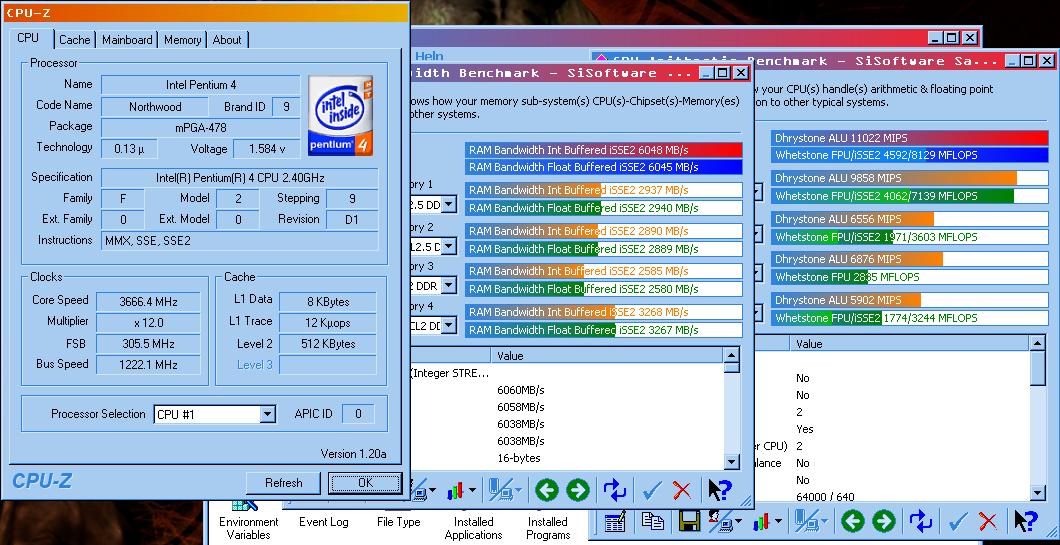
My 2.4C might have been my fav. processor of all time. It hit 3.6+ Ghz for a 50% overclock at 300FSB!

screen3666.jpg

Notice the name 2.4Ghz, notice it has HT, and notice the 12x mulitplier, etc....

By the way they had 2.4C, 2.6C, 2.8C, 3.0C, 3.2C, & a rare 3.4C
There were so many different 2.4Ghz processors its hard to keep track of them all.

First was the 2.4a (400FSB - Northwood based) 1.6a, 1.8a, 2.0a, 2.2a, 2.4a, 2.5a, 2.6a
then 2.4b (533FSB Northwood based) 2.4b, 2.66b, 2.8b, 3.06-with HT
then 2.4C (800FSB with HT Northwood) 2.4-3.4
then 2.4A (533 FSB Prescott - no HT) 2.4A, 2.8A
 
coldpower27 said:
Pentium 4 2.4GHZ = Northwood A 400FSB
Pentium 4A 2.4GHZ = Prescott 533FSB
Pentium 4B 2.4GHZ = Northwood B 533FSB
Pentium 4C 2.4GHZ = Northwood C 800FSB

Erhmm My P4A 2.4Ghz is a Northwood 400FSB.....

The chart should look like this:
Pentium 4 2.0GHZ = Wilamette 400FSB (Willamette's only went up to 2.0Ghz)
Pentium 4A 2.4GHZ = Northwood A 400FSB
Pentium 4B 2.4GHZ = Northwood B 533FSB
Pentium 4C 2.4GHZ = Northwood C 800FSB

Terra - How you could get the "Prescott" BEFORE "Northwood" is a mystery to me?
 
Donnie27 said:
No, I just go by whats real and not by whats made up or make believe. I still have both DDR1 and RAMBUS as i said. IMHO, the whole market is sleazy and they're about the same. RAMBUS did nothing more than the rest of the market, maybe less according to some folks. It's simple, When Northwood C launched and RAMBUS couldn't supply the goods, I moved to PC-3200=P No hard feelings or anything. Same for Processors or anything else, something better ships, I buy it if I have the money.

RAMBUS' fees are Industry standard just like anyone else's. nVidia once made the same BOGUS claim against Intel, that was later proven Wrong. Think they'll sue anyone else of trying to patch SLI to work on Intel, ATI and SIS chipsets? This after agreeing to a Tech swapp with these same folks? What Intel should do is Hire one of these Guys since nVidia has agreed to not sue LOL!

I am referring to Rambus' lawsuits against virtually the entirety of the JEDEC membership, claiming patent infringement (specifically, over DDR SDRAM). In addition to the memory manufacturers, both VIA and Intel were named as defendants. When that suit was tossed out, they tried to sue Micron, Infineon, and Intel (again); this time, claiming predatory pricing. (VIA was involved in a lawsuit of its own by Intel, over the Apollo Pro 133 and 133A chipsets, among others.)

My beef with Rambus wasn't over their being lawsuit-happy; it was (as you pointed out) that the memory was Too Darn Expensive. That nasty problem led *directly* to my purchase of the Trinity 400 (and the VP6 that replaced it).
 
chrisf6969 said:
LOL, are you smoking crack.

My 2.4C might have been my fav. processor of all time. It hit 3.6+ Ghz for a 50% overclock at 300FSB!

screen3666.jpg

Notice the name 2.4Ghz, notice it has HT, and notice the 12x mulitplier, etc....

By the way they had 2.4C, 2.6C, 2.8C, 3.0C, 3.2C, & a rare 3.4C
There were so many different 2.4Ghz processors its hard to keep track of them all.

First was the 2.4a (400FSB - Northwood based) 1.6a, 1.8a, 2.0a, 2.2a, 2.4a, 2.5a, 2.6a
then 2.4b (533FSB Northwood based) 2.4b, 2.66b, 2.8b, 3.06-with HT
then 2.4C (800FSB with HT Northwood) 2.4-3.4
then 2.4A (533 FSB Prescott - no HT) 2.4A, 2.8A
A little nit pick is that I tihnk the first Northwood 2.4GHZ was just Pentium 4 2.4 because it was the first model to reach that speedgrade.

So it goes sometihng like this:

Northwood A's = 1.6A, 1.8A, 2.0A, 2.2, 2.4, 2.5, 2.6

The letter designation is needed if there was a prior processor with the same GHZ rating.

There are also some OEM only 2.8 and 3.0GHZ 400FSB Northwoods. Never available in retail however. So no confusion for the naming scheme.

Then Northwood B = 2.26, 2.4B, 2.53, 2.66, 2.8, 3.06.

Northwood C = 2.4C, 2.6C, 2.8C, 3.0, 3.2, 3.4.

Prescott E = 2.8E, 3.0E, 3.2E, 3.4E

Prescott A = 2.4A, 2.66A, 2.8A

Not really a big deal if we disagree on this, though I think that is why they named the Prescott 2.4A, as there never was an A....
 
Terra said:
Erhmm My P4A 2.4Ghz is a Northwood 400FSB.....

The chart should look like this:
Pentium 4 2.0GHZ = Wilamette 400FSB (Willamette's only went up to 2.0Ghz)
Pentium 4A 2.4GHZ = Northwood A 400FSB
Pentium 4B 2.4GHZ = Northwood B 533FSB
Pentium 4C 2.4GHZ = Northwood C 800FSB

Terra - How you could get the "Prescott" BEFORE "Northwood" is a mystery to me?
Like I said, the Pentium 2.4GHZ = Northwood A, there was no letter needed as it is the first procesor to reach 2.4GHZ hence it was jsut refered to as Pentium 4 2.4GHZ..

Same thing with the 2.2GHZ as there was never a willamette that made it to 2.2GHZ so the 2.2GHZ is Northwood only, and hence does not need the additonal letter.
 
man the 2.4 had to be one of the best.
of course do you remember the 300 cele....mine did 550 on air
575 with a tech LOL
600 tech and water but not stable at ALL

wonder how the 2.4 conroe will do....and should you wait 3 revisions before trying.


sparks
 
Status
Not open for further replies.
Back
Top