• Some users have recently had their accounts hijacked. It seems that the now defunct EVGA forums might have compromised your password there and seems many are using the same PW here. We would suggest you UPDATE YOUR PASSWORD and TURN ON 2FA for your account here to further secure it. None of the compromised accounts had 2FA turned on.
    Once you have enabled 2FA, your account will be updated soon to show a badge, letting other members know that you use 2FA to protect your account. This should be beneficial for everyone that uses FSFT.

Best Processor in your cpu career?

Probably not along the same lines of what you guys were talking about but here goes:

I had a Pentium 100MHz processor that came in a Compaq computer back in '95 or so
Then a Pentium 2 that ran at 400MHz again in a Compaq, it had Windows 98 but I got it second hand. (This computer lasted a long time but was agonizingly slow)
Then I got an HP desktop with a 2.4GHz Pentium 4.
From there I moved on to laptops, where I had a 2GHz Pentium 4, terrible choice. Very hot, terrible battery life.
AMD Athlon, not sure about the clock speed, again single core, laptop. Better than the Pentium, not by much though.
This one here is probably my personal favorite: Core 2 Duo T7300 laptop clocked at 2GHz and it started off very fast, even today with Vista on it it runs quite well. Very reliable and I'm happy with the performance of it.
I also built a desktop with a Q9300. Very impressive as well, I ended up selling it though
My next build will have an i7 920 which is on order and should be arriving next week. Hopefully I get a new favorite!
 
ovrclk3.jpg


Opteron 144 gets honorable mention.


E8400 (Current, not maxed out yet)
 
Based on my own personal list I think the clear winner is the PIII 800 MHz cpu, that thing lasted so damn long and still performed great in pretty much everything for freaking ever!


Also amazing when you consider the PIII micro-architecure made its big comeback as the Core 2 Duo!!!


The Pentium III continued to evolve in laptop land as the Pentium M, the Core Solo and Core Duo while the Pentium 4 "Netburst" micro-architecture languished on the desktop-- probably what I'd consider the worst modern CPU of our time.


The i7 will continue the P6 legacy for at least a few more years.
 
E5200 followed by my sex machine Q9550. The e5200 was my first intel chip since i got into pc modding/building in 05. Was so amazed by its overclock abilities and speed, and like i said my Q9550, first quad ever and hopefully not my last.
 
http://img120.exs.cx/img120/2686/ovrclk3.jpg
Holy shit.
Also amazing when you consider the PIII micro-architecure made its big comeback as the Core 2 Duo!!!
The Core architecture is not based on the PIII architecture. It is brand new. The original Core Solo and Core Duo laptop CPUs were based on the Pentium M architecture which was an improved version of the Pentium III architecture, but Core 2 is not the same.
The Pentium III continued to evolve in laptop land as the Pentium M, the Core Solo and Core Duo while the Pentium 4 "Netburst" micro-architecture languished on the desktop-- probably what I'd consider the worst modern CPU of our time.
Netburst's only failing was that Intel tried to drag it out for too long. The Northwood P4s were killer CPUs, and were a lot better than the competition. At the time, there was nothing better, and the architecture worked very well. The problem was that A64 was faster, and Intel kept Netburst past its prime even though it couldn't compete very well. AMD did the same thing with the A64 architecture after Intel introduced Core 2, and nobody is calling the AMD64 architecture "the worst modern CPU of our time".
 
Similarly, I'd go with the E2140/E2160/etc.
Only because they came first and had similar OCing abilities.

To be fair, it looks like they're just binned C2D's with a smaller cache.
More than anything, their prices make them such an amazing processor...
 
The Core architecture is not based on the PIII architecture. It is brand new. The original Core Solo and Core Duo laptop CPUs were based on the Pentium M architecture which was an improved version of the Pentium III architecture, but Core 2 is not the same.


If by "brand new" you mean they added new features to the existing P6 architecture, you would be correct. I've been programming assembly language for a long long time and I can assure you-- the Core 2 architecture evolved from the Pentium III.


Take a Pentium III, add all the latest SSE instructions, AMD64 extension, micro-op fusion another instruction decoder and viola you have a Core 2. Add to that an on-board memory controller and hyper-threading and viola you have a Nehalem.
 
Netburst's only failing was that Intel tried to drag it out for too long. The Northwood P4s were killer CPUs, and were a lot better than the competition.


Sorry tiger, you don't know what your talking about here. Netburst was dead on arrival. Too many short comings to list and the only thing Intel could do to stay competative was to crank up the clock speed. And that trick ran out with Prescott.
 
If by "brand new" you mean they added new features to the existing P6 architecture, you would be correct. I've been programming assembly language for a long long time and I can assure you-- the Core 2 architecture evolved from the Pentium III.

I've been programming assembly language for a long time myself, and I can assure you that you can't tell anything about the architecture from just assembly language, since in essence they're all x86-compatible, and are all capable of executing the same instructions, give or take a few extensions. There's really only three major changes to the instructionset. First there's the original 8086, then the 80386, and finally the Athlon 64. The rest is all backward compatible, and as such, executes the exact same instructions down to the binary level.
Architecture is about HOW these instructions are executed. Something an assembly programmer has no control over (the instructions are translated from x86 to a native format of macro operations and micro operations, and then executed by the architecture-specific backend).

Having said that, no x86 architecture is ever truly 'brand new', they're all backwards compatible, and as such generally re-use the good features of architectures that went before them. So the argument is a bit silly.

Take a Pentium III, add all the latest SSE instructions, AMD64 extension, micro-op fusion another instruction decoder and viola you have a Core 2. Add to that an on-board memory controller and hyper-threading and viola you have a Nehalem.

Not entirely. Nehalem has a lot more new features than just an onboard controller and hyperthreading.
But you didn't come here for a realistic, factual discussion, did you?
 
I was like seconds from pulling the trigger on a new i7 setup, and then I got this sinking feeling, am I attached to my Q6600, or how my computer is now or something? Scary thought...
 
Having said that, no x86 architecture is ever truly 'brand new', they're all backwards compatible, and as such generally re-use the good features of architectures that went before them. So the argument is a bit silly.


The instruction set doesn't define the micro-architecture. Netburst was an entirely new micro-architecture that shared nothing with previous designs-- it was a clean sheet "do over" of the x86 chip circuitry. Intel went back to the P6 architecture for Core-- thats my point. The assertion that Nehalem is an entirely brand new micro-architecture isn't silly its absurd.


Christ even the CPUID instruction returns family 6-- common to all processors based on the P6 microarchitecture. The 486, Pentium, Itanium, Pentium 4 and Atom all have different family CPUID's because they are completely different.


So like I said, the Core architecture is a continuation of P6 architecture that started with Pentium Pro in the same way Phenom is a continuation of the aging Athlon architecture; the engineers didn't start over with a brand new design-- the design simply evolved. All coding optimizations you grew to love disappeared with Netburst but came back with Core. Why do you think that is? If you've been programming in assembly language you should know this.


Also doesn't anyone remember road maps for Nehalem used to be based on Netburst? Intel ran into an unexpected brick wall with Netburst and was forced to scrap it; only thing they could do was revert to the aging P6 micro-architecture, which as it turned out was still a gem! Why do you think they dug up laptop chips and put them on the desktop?


That doesn't seem like a brand new micro-architecture to me.


The P6 micro-architecture is easily the most successful ever and an egineering marvel. Netburst was a text-book failure and will only be studied in classes on how not to make a CPU.
 
Not entirely. Nehalem has a lot more new features than just an onboard controller and hyperthreading.
But you didn't come here for a realistic, factual discussion, did you?


Oh jesus are you freaking serious? You're saying that because I choose to leave out some of the lesser details for the sake of simplifying my post it makes my point entirely invalid? Do you want a complete fact sheet or a processor blue print in pdf format? A thesis maybe? What kind of retarded reasoning is this? I didn't bother to list all new features because it is entirely beside the point.


Get real.
 
Intel 80386 DX 25MHz
Intel 80486 DX2 50MHz 1996-1997 I bought this myself after saving up for it for months, ran Doom perfect
Cyrix/IBM 6x86 PR200+ POS CPU, always over heated
Intel Pentium MMX 233 Got this after I chucked the Cyrix CPU into the woods
AMD K6 II 350MHz Epox VIA Apollo AT board
Intel Pentium II 400MHz DFI 440BX mobo
Intel Pentium II 450MHz DFI 440BX mobo
Intel Pentium III 500MHz DFI 440BX mobo
Intel Pentium III 650MHz DFI 440BX mobo
Intel Pentium III 1000MHz Tyan Trinity 400
Intel Pentium III 1000MHz x2 (dual CPU system) Tyan mobo
AMD Athlon (Thunderbird) 1.4GHz
AMD Athlon (T-bred) 1700+ 1.4GHz Abit KX7333 mobo
AMD Athlon (T-bred) 2000+ 1.67GHz Abit KX7333
AMD Athlon (T-bred) 2100+ Asus A7N8X mobo, I had this one running at 2.1GHz
Intel Pentium 4a 1.8GHz Asus P4S533 mobo,
Intel Pentium 4 2.5a Had it running on an IS7-G for almost 5 years without any problems
Intel Pentium D 925 Had this for less than a year, ran too hot for my liking.
Intel Core 2 Duo E7200 Current and about to be replaced with an E8400…

That is just for my main system over time. Unfortunately my Antec 1040 clone case that I used since my PIII 500 is long gone. The best CPU I probably had was the Cyrix CPU because it sure did get fast when I was launched into the woods. It is still there to this day. It will be found by someone and they will be like wtf.

I have had numerous machines with different CPUs in them, I cannot remember them all...
 
The instruction set doesn't define the micro-architecture.

My point exactly, so your assembly-remark is a non-sequitur.

Netburst was an entirely new micro-architecture that shared nothing with previous designs-- it was a clean sheet "do over" of the x86 chip circuitry.

That's just arbitrary though. People like to say that because the performance between Pentium 3 and 4 is so different.
But if you look at it more closely, you'll see that the Pentium 4 still borrows heavily from its predecessors. It uses the same micro-op system that the Pentium Pro introduced, and the backend configuration is still very similar (it has a pretty much identical configuration of execution ports).
The biggest changes are the rather extreme lengthening of the pipeline and the use of trace cache.
Since the Core2 uses a significantly longer pipeline than the PPro/2/3 series, where do you draw the line? Just at the trace cache?

Christ even the CPUID instruction returns family 6-- common to all processors based on the P6 microarchitecture. The 486, Pentium, Itanium, Pentium 4 and Atom all have different family CPUID's because they are completely different.

Uhhhh? As if that matters? It's just a number hardcoded in the CPU. Intel can make it say any number they want. Heck, even AMD outputs family numbers that are equivalent to Intel's.
It's not like that number defines the whole architecture or anything. If they were to change it into 7 it wouldn't magically turn the rest of the CPU into a Netburst-variation.

All coding optimizations you grew to love disappeared with Netburst but came back with Core. Why do you think that is? If you've been programming in assembly language you should know this.

Not quite a strong argument. AMD also designs their CPUs so they run PPro/2/3-optimized code well. That merely means that the architecture is similar.

only thing they could do was revert to the aging P6 micro-architecture, which as it turned out was still a gem! Why do you think they dug up laptop chips and put them on the desktop?

Not quite though. The Core was a pretty direct descendant of the Pentium M, which in turn was a Pentium 3 modified for mobile uses. It had a big problem: it couldn't scale to high clockspeeds, and as such couldn't be made competitive with the Pentium 4s and Athlons on the desktop. So it wasn't quite the gem you make it out to be.

Core2 is a pretty rigourous redesign of that Core architecture, extending the pipeline significantly, and borrowing the high-performance SSE2 technology from the Pentium 4, resulting in a CPU that was a killer desktop chip.
 
Oh jesus are you freaking serious? You're saying that because I choose to leave out some of the lesser details for the sake of simplifying my post it makes my point entirely invalid? Do you want a complete fact sheet or a processor blue print in pdf format? A thesis maybe? What kind of retarded reasoning is this? I didn't bother to list all new features because it is entirely beside the point.

I would think that the modifications they did to the handling of loops is pretty significant.
They use a pre-decode buffer now, much like trace cache on the Pentium 4. Except they chose a hybrid now, so only loops get stored in decoded form, and first-time is run directly from decoder to backend.
So basically the Nehalem incorporates the two most innovative features of the Pentium 4: HyperThreading and trace cache.

Aside from that, the way the cache system was completely redesigned, and now made into a three-level system is also quite a big change to the architecture. It also makes me think back about how they moved to a really small and low-latency L1 cache in the Pentium 4, with a big L2 cache. Except this time it's the L2 whose size and latency they reduced, and they added a shared L3 cache instead.
Now, one might say they stole that idea from AMD's Phenom... thing is just that AMD's version pretty much bottlenecks the rest of the CPU, and Intel's doesn't.

I wouldn't call any of those 'lesser details'.
 
People like to say that because the performance between Pentium 3 and 4 is so different. But if you look at it more closely, you'll see that the Pentium 4 still borrows heavily from its predecessors. It uses the same micro-op system that the Pentium Pro introduced, and the backend configuration is still very similar (it has a pretty much identical configuration of execution ports).

Identical configuration of execution ports?!? No no no!! The Pentium 4 was a radical departure from P6!!! You don't even know what you're talking about so I'm done trying to explain this. Its hopeless. I'll just leave you with this Wikipedia and you disagree with it if you like:


"The Intel Core microarchitecture (previously known as the Intel Next-Generation Micro-Architecture, or NGMA) is a multi-core processor microarchitecture unveiled by Intel in Q1 2006. It is based around an updated version of the Yonah core and could be considered the latest iteration of the Intel P6 microarchitecture, which traces its history back to the 1995 Pentium Pro. The extreme power consumption of NetBurst-based processors and the resulting inability to effectively increase clock speed was the primary reason Intel abandoned the NetBurst architecture. The Intel Core Microarchitecture was designed by the Intel Israel (IDC) team that previously designed the Pentium M mobile processor."
 
Identical configuration of execution ports?!? No no no!! The Pentium 4 was a radical departure from P6!!! You don't even know what you're talking about so I'm done trying to explain this. Its hopeless.

Ah, so I give some arguments, and you don't respond. Indeed, hopeless.

"The Intel Core microarchitecture (previously known as the Intel Next-Generation Micro-Architecture, or NGMA) is a multi-core processor microarchitecture unveiled by Intel in Q1 2006. It is based around an updated version of the Yonah core and could be considered the latest iteration of the Intel P6 microarchitecture, which traces its history back to the 1995 Pentium Pro. The extreme power consumption of NetBurst-based processors and the resulting inability to effectively increase clock speed was the primary reason Intel abandoned the NetBurst architecture. The Intel Core Microarchitecture was designed by the Intel Israel (IDC) team that previously designed the Pentium M mobile processor."

Core != Core2.
 
They use a pre-decode buffer now, much like trace cache on the Pentium 4.

The pre-decode unit determines the length of instructions, tags branch instructions and decodes all prefixes like the REX prefix; has nothing to do with u-ops or the trace cache. The Nehalem architecture puts the so-called hybrid trace cache after the decode units-- probably in the reservation station. This is what allows Nehalem to shut off the front end on small loops.
 
The pre-decode unit determines the length of instructions, tags branch instructions and decodes all prefixes like the REX prefix; has nothing to do with u-ops or the trace cache. The Nehalem architecture puts the so-called hybrid trace cache after the decode units-- probably in the reservation station. This is what allows Nehalem to shut off the front end on small loops.

I meant they buffer instructions that have been decoded previously. I wasn't referring to a pre-decode unit. You knew what I meant, if you are as smart as you claim to be.
Which I doubt, since you didn't bother to go into my argument on a technical level.
 
Core != Core2.


Sorry I just don't understand what you mean? According to my Intel processor manuals (the optimization guide, specifically) it says the Intel Core 2 Extreme, Intel Core 2 Duo processors and Intel Xeon 5100 series implement two processor cores based on the Intel Core Microarchitecture.


What exactly are you saying? I think we're not on the same page about the specific relationship between branding and microarchitecture.


If I understand it correctly, Yonah is part of the Pentium M micro-architecture but was branded as Core Duo and Core solo. The argument I'm making is the Core architecture is derived from (or is a continuation of) the Pentium M micro-architecture which itself is a continuation of P6.


Are we clear?
 
Sorry I just don't understand what you mean? According to my Intel processor manuals (the optimization guide, specifically) it says the Intel Core 2 Extreme, Intel Core 2 Duo processors and Intel Xeon 5100 series implement two processor cores based on the Intel Core Microarchitecture.

"Based on" being a very vague statement.
Intel calls the Core2 stuff the "Core microarchitecture" in their own publications, which more or less ignores the Yonah-based Core Solo/Duo processors, which were more direct descendants of the P6 micro-architecture than the Core2 is.
That's the confusing part. Intel pretty much ignores the "Core Solo/Duo" mobile processors when referring to the "Core microarchitecture".
At the same time, they don't bother to come up with a new name.
This page refers to the "original Core microarchitecture":
http://www.intel.com/technology/architecture-silicon/core/index.htm?iid=tech_tt+info_core
This is about Core2 obviously.

Then this page is for the "new Core microarchitecture":
http://www.intel.com/technology/architecture-silicon/next-gen/index.htm?iid=tech_tt+info_next-gen
Which is Nehalem.

What exactly are you saying? I think we've confused about the specific meaning of the branding microarchitecture.

Well, Intel used the "Pentium" brand for Pentium Classic, Pro/2/3 and Pentium 4, which are basically three independent microarchitectures. And recently they even started selling low-end versions of Core2 processors under the Pentium name.
"Core" is just a marketing name, like "Pentium". It doesn't mean much in a technical sense. We already have three generations of "Core", where the first "Core" was more "Pentium M" really.

If I understand it correctly, Yonah is part of the Pentium M micro-architecture but was branded as Core Duo and Core solo. The argument I'm making is the Core architecture is derived from (or is a continuation of) the Pentium M micro-architecture which itself is derived from P6.

That's what I said earlier: "The Core was a pretty direct descendant of the Pentium M, which in turn was a Pentium 3 modified for mobile uses."
Thing is that Core was mostly a basis to develop the dual-core with shared cache. So Intel didn't really concentrate on modifying the Pentium M micro-architecture further.

Core2 however is focused solely on improving the micro-architecture, while maintaining the dual-core shared cache developed on the fist-generation Core.
Therefore its micro-architecture is quite significantly different. It's just not different in the sense that Pentium 4 was to Pentium 3, or the Pentium Pro to the Pentium.
And neither is Nehalem.
That doesn't mean that Intel put any less effort into the development of these architectures.
In fact, Intel's Tick-Tock system is exactly about introducing a new microarchitecture every 2 years:
http://www.intel.com/technology/tick-tock/
Intel said:
Year 2: Then the "Tock"
Intel delivers entirely new processor microarchitecture to optimize the value of the increased number of transistors and technology updates now available.

So yes, every 'Tock' is considered to be a new microarchitecture, at least by Intel. This includes Conroe and Nehalem so far.
Now, they may say that Nehalem is "based on" the microarchitecture of Conroe... but that is rather vague, given the fact that they spent 2 years on redesigning virtually every aspect of that chip. And "based on" doesn't rule out the possibility of a new microarchitecture either. "Based on" and "new" are both just very vague terms, very arbitrary. But if Intel says it's a new microarchitecture, well, I'll go with that. It makes sense to me anyway, when they include such drastic changes, which directly affect instruction latencies, and therefore the way you are able to optimize code for the specific microarchitecture.
Here's Intel's own list of current microarchitectures:
http://www.intel.com/technology/architecture-silicon/microarchitecture.htm
 
Scali2 and old skool: You guys will debate the facts and lay off the personal insults or you'll find yourself on vacation from the forums. You can debate and even argue the facts all you want but the personal insults stop....now.

Completely up to you at this point.
 
I picked up my Q9450 for $175 shipped, and runs incredibly cool @ 3.33
For the price and easy oc's on air this has my vote
 
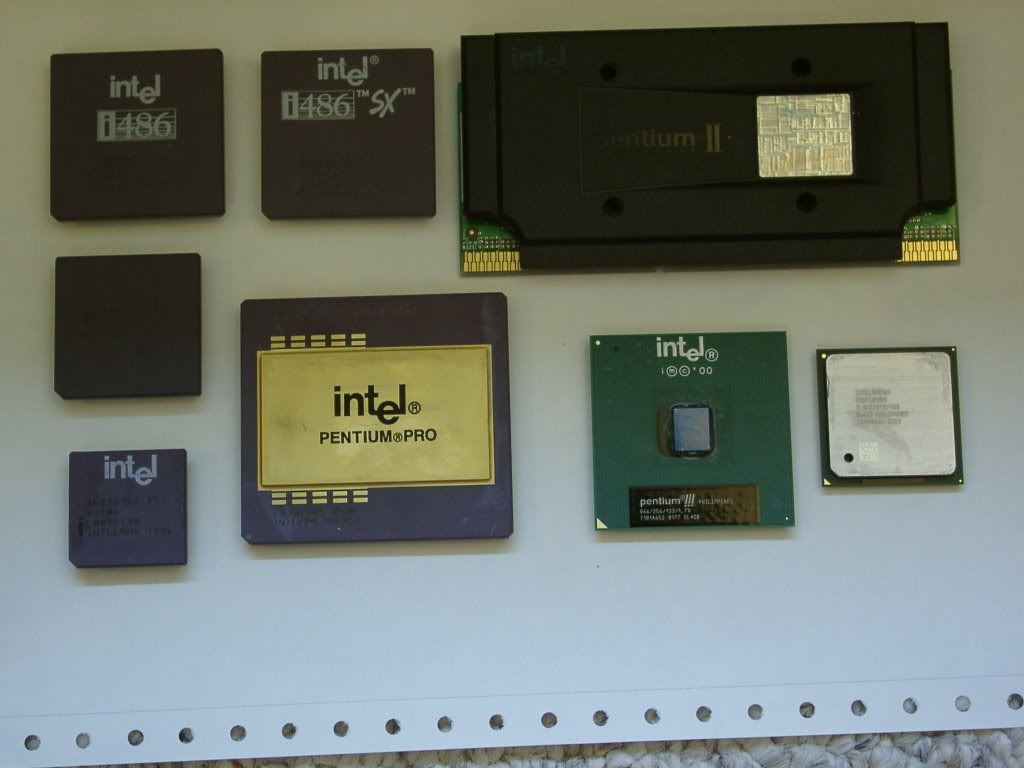
I've actually saved most of my old processors. My first was the Intel 386-16 MHz with the 387 Math Co-processor in 1988. Cyrix made a chip that plugged in the 386 socket making it comparable to a 486-32 MHz I was flying high playing Doom then. I had a 486-33 that was extremely powerful for its day and a 486-50 DX2 that was capable of playing video on the PC in the early 90's that was really neat.

I got a hold of a Pentium Pro 200 that was very decent and then on to a PII 333 which was one of my favorites coupled with 2 Canopus Voodoo II vodeo cards in SLI. I did get a lot of service out of several PIII 866s in some desktops and a 700 in my ThinkPad.
I put a P4 Northwood at 2.4GHz in a Dell 8200 that performed rather well.

My P4 3.4 GHz in my current AW desktop overclocks like crazy to over 4GHz, but the 2.16 GHz Duo Core in my Laptop easily matches it. I don't know which is my favorite I loved them all........:D

Intel_Procesoors_386_to_P4.jpg
 
Sorry I just don't understand what you mean? According to my Intel processor manuals (the optimization guide, specifically) it says the Intel Core 2 Extreme, Intel Core 2 Duo processors and Intel Xeon 5100 series implement two processor cores based on the Intel Core Microarchitecture.


What exactly are you saying? I think we're not on the same page about the specific relationship between branding and microarchitecture.


If I understand it correctly, Yonah is part of the Pentium M micro-architecture but was branded as Core Duo and Core solo. The argument I'm making is the Core architecture is derived from (or is a continuation of) the Pentium M micro-architecture which itself is a continuation of P6.


Are we clear?

I think Scali2's point is that you are a little off base here. Yonah is derrived from the Pentium M which is derrived from the P6 Microarchitecture, but Yonah isn't a Core Microarchitecture based CPU despite what the "Core Duo" branding implies. Core Duo processors have some things in common with Core 2 CPUs but they are more dissimilar than they are similar.

This excerpt from Wikipedia says it fairly well; "The Intel Core Microarchitecture is designed from the ground up, but similar to the Pentium M microarchitecture in design philosophy. The pipeline is 14 stages long — less than half of Prescott's, a signature feature of wide order execution cores. Core's execution unit is 4 issues wide, compared to the 3-issue cores of P6, P-M (Banias, Dothan, and Yonah), and NetBurst microarchitectures."

I've highlighted a few key points. While the philosophy of the two designs were similar in nature, the CPUs are very different when you get into their respective designs. I think this is what Scali2 was trying to say. (Correct me if I am wrong Scali2.)
 
Back in late 1994 when my Amiga 3000 was my main rig, I ordered a CPU card called the "WARP Engine". It had 4 Memory slots and could hold 128megs of Ram and had a Motorola 68040 @ 40mhz. The card set me back $1400, but I had to return it since it was designed for the Amiga 4000 (both share the same CPU card slot design) and was 1/4" too long, the A3000 version wasn't announced at the time I bought this card. That was the first time and last time that I would buy the newest processor, well, until I bought a Pentium 200MMX for $525, but that was the last time.
http://www.amiga-hardware.com/showhardware.cgi?HARDID=257
 
2.0ghz p4 that ran at 2.67ghz since the day I got it on stock cooling. I still have that chip somewhere. I think I paid $115 for it.

I paid $215 for my 3400+ A64 newcastle when they first came out. everyone was amazed that I had a 64-bit chip. I think that was back around 2004ish?
 
My e8400 by far (althought the Celeron 300A is close). Overclocking the e8400 was even easier than jumper-setting... bump the FSB in BIOS and I'm at 4.05GHz. And to be able to run it at a 35% OC while still undervolting it? All that for $165? Wow...
 
I think Scali2's point is that you are a little off base here. Yonah is derrived from the Pentium M which is derrived from the P6 Microarchitecture, but Yonah isn't a Core Microarchitecture based CPU despite what the "Core Duo" branding implies. Core Duo processors have some things in common with Core 2 CPUs but they are more dissimilar than they are similar.

This excerpt from Wikipedia says it fairly well; "The Intel Core Microarchitecture is designed from the ground up, but similar to the Pentium M microarchitecture in design philosophy. The pipeline is 14 stages long — less than half of Prescott's, a signature feature of wide order execution cores. Core's execution unit is 4 issues wide, compared to the 3-issue cores of P6, P-M (Banias, Dothan, and Yonah), and NetBurst microarchitectures."

I've highlighted a few key points. While the philosophy of the two designs were similar in nature, the CPUs are very different when you get into their respective designs. I think this is what Scali2 was trying to say. (Correct me if I am wrong Scali2.)

Yea, pretty much.
Here's another list of Intel microarchitectures:
http://en.wikipedia.org/wiki/List_of_Intel_CPU_microarchitectures

As you can see, the Core Solo/Duo are not "Core microarchitecture", they are a Pentium M microarchitecture.
Pentium M march is a direct descendant of P6, Core march is not. If anything, Core is a descendant of Pentium M.
But how far are you willing to go with that? Core i7 then is a descendant of P6, twice removed?
It loses all meaning since it's undergone so many changes at each new generation.

Yes, if you look hard enough, you will find things that resemble the P6 march in Core i7... But let's face it, Core i7 also has some things that obviously resemble Pentium 4, and even some that resemble AMD's K8/K10. So that's why I said it's all pretty silly.
The performance alone should say enough, in the case of Core i7. Its performance-per-clock and performance-per-watt are way beyond any of the marchs that it might resemble in some ways. So clearly it's not the same, it's taken the best of past marchs and improved on them from there. Which is what all CPU manufacturers have always done anyway, so it doesn't really mean anything. So why bother bringing it up in the first place?
 
My e8400 by far (althought the Celeron 300A is close). Overclocking the e8400 was even easier than jumper-setting... bump the FSB in BIOS and I'm at 4.05GHz. And to be able to run it at a 35% OC while still undervolting it? All that for $165? Wow...

Agreed. I've got one in one of my PCs and I'm happy with it.

Yea, pretty much.
Here's another list of Intel microarchitectures:
http://en.wikipedia.org/wiki/List_of_Intel_CPU_microarchitectures

As you can see, the Core Solo/Duo are not "Core microarchitecture", they are a Pentium M microarchitecture.
Pentium M march is a direct descendant of P6, Core march is not. If anything, Core is a descendant of Pentium M.
But how far are you willing to go with that? Core i7 then is a descendant of P6, twice removed?
It loses all meaning since it's undergone so many changes at each new generation.

Yes, if you look hard enough, you will find things that resemble the P6 march in Core i7... But let's face it, Core i7 also has some things that obviously resemble Pentium 4, and even some that resemble AMD's K8/K10. So that's why I said it's all pretty silly.
The performance alone should say enough, in the case of Core i7. Its performance-per-clock and performance-per-watt are way beyond any of the marchs that it might resemble in some ways. So clearly it's not the same, it's taken the best of past marchs and improved on them from there. Which is what all CPU manufacturers have always done anyway, so it doesn't really mean anything. So why bother bringing it up in the first place?

Agreed.
 
Intel Celeron 300A!
Actual quad cores are nice but only a few applications do use multiple cores.
 
Pentium @ 66mhz- included with a OEM
P2 @ 350 ~$380 (from 1999 until 2003)
P4 @ 2.4 $350 for the Mobo, and CPU (2003-2006)
C2D E6400 2.3 @ 3.0 $219 (2006 - ???)
ViaC-7 (2007 - ???)
E2180 $70 (2008 - ???)

i would have to say that the best build would have to be my current one. But the joys my P2 350 brought me are the best.
 
q6600 for sure, Ran air cooled at 3.6 for year a half or so with no problems.

Before that my favorite was my pentium D 805 that I ran at 3.8 for quite some time.

I also loved my Athlon XP barton... 3400 I think it was.

Next would've been probably the Itanium Pentium 3's. Great chips, decent OC's.

Before that my favorite was my 533 celeron that I ran at 850 for a year or two.

I've had probably 20-30 different chips in my Life so far and I would say I've been happy with 90% of them. It's hard to really say the "best" cpu because as time has gone on the CPU's keep getting better and faster so it's hard not to call the most recent the best, as it obviously is the fastest and best performing chip I have had.

I can easily say the worst chips I have used would be the 1st gen Pentium 4's with "Hyper threading" tied with the Pentium D chips (the non dual core pentium d's).
 
I've actually saved most of my old processors. My first was the Intel 386-16 MHz with the 387 Math Co-processor in 1988. Cyrix made a chip that plugged in the 386 socket making it comparable to a 486-32 MHz I was flying high playing Doom then. I had a 486-33 that was extremely powerful for its day and a 486-50 DX2 that was capable of playing video on the PC in the early 90's that was really neat.

I got a hold of a Pentium Pro 200 that was very decent and then on to a PII 333 which was one of my favorites coupled with 2 Canopus Voodoo II vodeo cards in SLI. I did get a lot of service out of several PIII 866s in some desktops and a 700 in my ThinkPad.
I put a P4 Northwood at 2.4GHz in a Dell 8200 that performed rather well.

My P4 3.4 GHz in my current AW desktop overclocks like crazy to over 4GHz, but the 2.16 GHz Duo Core in my Laptop easily matches it. I don't know which is my favorite I loved them all........:D

Intel_Procesoors_386_to_P4.jpg

All I could think of when I saw this picture was the Slot 1 pentium 2 you have there. I used to have an adapter that let me run my Socket 370 in a slot 1 mobo. Good times!
 
I looked for my processor collection the other day. I'm not sure what all is in there for sure, but some highlights are:

Intel 80486 DX2-66MHz
IBM Blue Lightning 486 (Unknown clock speed.)
Intel Pentium 66MHz
Intel Pentium 75MHz
Intel Pentium 133MHz
Intel Pentium 200MHz
Intel Pentium MMX 233MHz
Intel Pentium Pro 180MHz
Intel Pentium III 533
Intel Pentium III 933MHz (I could be wrong on the clock speed.)
Intel Pentium 4 1.6GHz (Socket 423 I believe.)
Intel Pentium D 965 Extreme Edition (3.73GHz)

That's all I can remember having in the box. I know I've got a Slot 1 to Socket 370 adapter in there as well.
 
intel Pentium 133MHz
intel Celeron 300MHz
intel Pentium 4 1.8GHz
AMD Athlon XP 2700+ 2.1GHz (Damaged in PSU explosion, would only run 1.7GHz after)
AMD Athlon XP 3200+ 2.3GHz
AMD Athlon 64 3000+ 1.8GHz
AMD Athlon 64 4000+ 2.4GHz
intel Pentium D 820 ES 2.8GHz
intel Core 2 Quad Q6600 2.4 - 3GHz

You can more or less see a pattern in my CPU, one I didn't even notice til now. I seem to stay in the 2.4GHz area for some reason, likely budget.

Something everyone will notice is the switch from a 2.4GHz AMD to a 2.8GHz Pentium D. "What were you thinking!?" you'll say. Well, times were tough, I was broke and at the same time wants to go intel. So I sold my Socket 939 stuff for a decent price, got a good mATX LGA775 for cheeaapp, and my friend had the Pentium D just sitting around. So, I took it, used it. Original plan was to just use it for a month or two til I got a Core 2.

...That month turned into little over a year.

Anyway, I'd have to say my favorite CPU out of all these would have to be the 4000+. I didn't notice the performance jump at first so much, but the more I did things the faster it seemed to me. Loved the hell out of that CPU.

Biggest jump should be obvious, 300MHz Celey to 1.8GHz P4, followed by the jump from that to the 2700+. The first jump was obviously the biggest in size but I was most impressed by the second one.

My most hated? The 300MHz Celey. I don't know what the bloody hell you guys are talking about, that slow piece of shit haunted me for years.
 
Back
Top