Automotive Paint: Heal Thyself

CommanderFrank

Cat Can't Scratch It
Joined
May 9, 2000
Messages
75,399
International teams from two universities and the US Army have moved one step closer to developing a true self-healing coating for automobile finishes.

The polymer's special character shows up when you expose it to UV light. The polymer enters a "molten" state, filling gaps and scratches. It then resolidifies.
 
So if you drive your car in daylight the paint will melt off?

And them talking about regular UV treatments to heal microscratches... what about all the plastic and the interiour of the car.. and the tires. everything would have to be masked off every single time to keep it from degrading.

sounds like a neat idea and a horrible idea at the same time.
 
http://www.youtube.com/watch?v=n5gaA47cmLA

Here's a video. Its in chinese but you can see some scratches made with a steel-wool type brush 'auto repairing themselves' just from hot water causing the coating to re-grow/re-distribute itself. This is an early generation from Infinity from back in 2009. They dont use it anymore on their new cars though :(.

If this technology works a well though, all the power to these scientists.
 
So if you drive your car in daylight the paint will melt off?

And them talking about regular UV treatments to heal microscratches... what about all the plastic and the interiour of the car.. and the tires. everything would have to be masked off every single time to keep it from degrading.

sounds like a neat idea and a horrible idea at the same time.

It won't melt the paint off your car. I don't know if you studied/took chemistry in your high school, but, in most modern chem 11/12 courses or intro chem for univeristy. They talk a bit about reaction rates.

If a reaction is 'endothermic' meaning it 'requires significant energy to start', the more energy you put in, the faster the reaction goes. So if the minimum amount of heat required to make a reaction occur is 100F and at that rate, 1KG of reactant A + 1KG of Reactant B ill take about 1 hour of time to turn into Product A, and you put the same reactants together in an oven that's heated to 150F, the same reaction might occur in just 5 minutes.

The reason is because the average kinetic energy for the molecules of reactant a and b has been increased. If the average kinetic energy is much greater than the activation energy(we'll say 105 F), then the majority of the molecules, are able to recombine into the product right away provided they have favourable geometry(Ie two molecules collide/touch). Where as at 100F, only a small portion of the molecules will be > 105F to actually combine should favorable geometry(a collision/touching) occur. Thus it takes a long time for the product to fully form.

To activate the paint-healing process as fast as you've described(all your paint in is a pool on the ground), you need a very-very-strong UV light source. Natural light, the process your describing might take years. What people do to speed up this process is provide more heat/energy to make the scratches disappear thousands of times faster(than the weeks upon weeks, it might take in the winter). The easiest way to do that? boiling boiling hot water poured on the scatch area. See the video I provided for a demonstration.

Generally, outdoor weather conditions, bearing end of the world circumstances, should never result in boiling boiling hot water streaming down from the sky onto your car ;) So your paint should remain attached to your car for years.
 
Just a follow-up; a good example of a slow reaction rate that takes ages to occur would be 'rust on your car'. Usually, you don't see much rust on a vehicle within the first 4-5 years of the car's lifespan. Rust really only starts to accumulate with water exposure + heat + exposed metal. Water is a 'catalsyt' that combined with heat makes the ordinarely very slow reaction occur a bit faster.
 
simple answer, for paint not being melting in day light

the original repair coating is underneath main paint, it unreactive because the main coating on top protects it from UV light. and of course once it reacts with UV light it won't be reactive.

the main paint itself is final product and doesn't react with the UV light.

what does this means, if you scratch is lighter and hasn't break through the top coating entirely the scratch will still be there, but once it's gone deep enough than the repair coating will start reacting and patch it up.
 
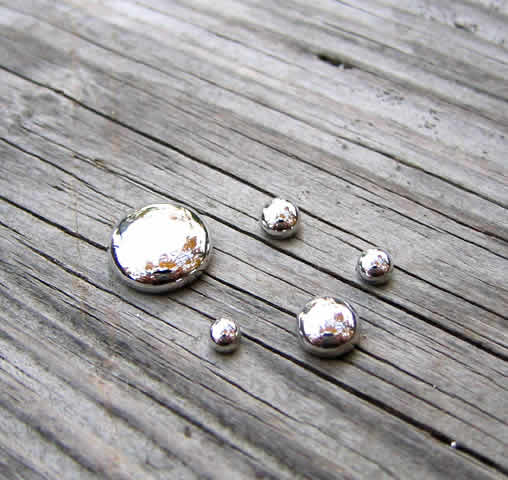
Oh sure, they thought it was cool when it reformed like this too:

mercury_drops_large.jpg


with some time equals

t1000.jpg


Apparently it will be back, as a car paint coating :eek:
 
Back
Top