http://news.cnet.com/8301-13924_3-9978746-64.html
I hope each and every one of you will purchase a Radeon as your next video card
I hope each and every one of you will purchase a Radeon as your next video card
![[H]ard|Forum](/styles/hardforum/xenforo/logo_dark.png)
Follow along with the video below to see how to install our site as a web app on your home screen.
Note: This feature may not be available in some browsers.

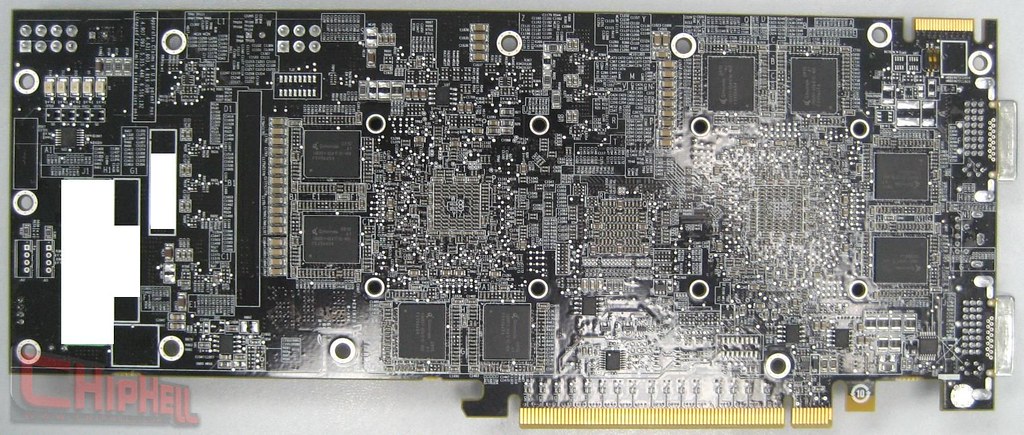
For ATI, the execution of this chip-ganging strategy is the key. And this is where ATI appears to have been successful. "The inter-processor communications. Getting that to work has been the trick. This is what ATI has done. They've come up with this stellar way of doing inter-processor communications so they can in fact get the scaling," according to Peddie.
AMD-ATI's upcoming R700 (rumored to be called the 4870 X2) two-chip graphics board will be the ultimate test of this strategy.
"It's a new proprietary inter-processor communication technology. If they put these two chips on one board and it does scale properly, then they have pulled off a coup," he said.
"When you gang up graphics chips (using the traditional Scalable Link Interface or CrossFire technologies) they roll off pretty fast. ("Roll off" implies that performance doesn't scale up well.) "So when you put two boards in, you don't get twice the performance but you (only) get one and a half. You put four boards in and you (only) get about 1.7, 1.8. What ATI is saying is that with two chips using (their) proprietary inter-bus, they will get 1.8 (the performance) with two chips. If that's true, you can expect to see four of them giving you something around 2.5."
Getting 2.5 times the performance from four boards would be a masterstroke for ATI.
The previous ATI dual-chip solution was very different, Peddie said. "The HD 3870 X2 was not a proprietary bus but a CrossFire connection. The CrossFire connection and the SLI connection are at the very, very end of the pipeline. Not the most efficient place to do an inter-processor communication. That's one of the reasons ATI has abandoned it."
Digital PWM, killed it right there for me. They put it on the x1950pro first I believe (a card that I own), well on the x1950pro, the GPU didn't want to overclock for shit (instead of hitting an unstable frequency and seeing artifacts, it just turns your screen blank, and makes your computer inoperable). The x1950pro was the only video card I have seen with a digital PWM (they weren't on the x1950xt or xtx). The cheaper non reference x1950pros that came out later with analog PWM overclocked better (consistent) then their digital PWM counterparts.
I would like to see some reviews, but I remain wary. Also, you got the PLX pciE bridge chip on the board, what makes this "not crossfire"? I mean are there H/T links between the two chips? Its still crossfire on a card until proven otherwise.
 .
.I wonder how the X2's will overclock, whether both cores will be affected or you can just OC one, not that I know why you would only want to OC one.
Waffles. I should put a VITEC sticker on my car.I don't know but at least they're still using the VTEC chip!111 lols
The trick to the 4870X2 is GDDR5, which allows two devices to access the same RAM. This means the 4870X2 will have one shared 1GB buffer.

Performance king confirmed.
I'm sure Nvidia will have their own dual chip card.
Digital PWM, killed it right there for me. They put it on the x1950pro first I believe (a card that I own), well on the x1950pro, the GPU didn't want to overclock for shit (instead of hitting an unstable frequency and seeing artifacts, it just turns your screen blank, and makes your computer inoperable). The x1950pro was the only video card I have seen with a digital PWM (they weren't on the x1950xt or xtx). The cheaper non reference x1950pros that came out later with analog PWM overclocked better (consistent) then their digital PWM counterparts.
I would like to see some reviews, but I remain wary. Also, you got the PLX pciE bridge chip on the board, what makes this "not crossfire"? I mean are there H/T links between the two chips? Its still crossfire on a card until proven otherwise.
ATI has more processing units than Nvidia inside its chip too. "The other thing is that ATI has 800 processors in their chip and Nvidia has 240. That has a processor count advantage," Peddie said.
The guy they're quoting is full of crap:
Sounds like he read the marketing materials and suddenly became an "expert". I highly doubt these guys have any valid insider information.
If you go to his website you can see all his "analysts" are in the marketing business, not the tech business.


The guy they're quoting is full of crap
Dr. Jon Peddie is a pioneer of the graphics industry, starting his career in computer graphics in 1962. After the successful launch of several graphics manufacturing companies, Peddie began Jon Peddie Associates in 1984 to provide comprehensive data, information and management expertise to the computer graphics industry. With those same goals in mind, he left JPA to form Jon Peddie Research in 2001 to provide a more customer intimate environment for clients, and to further explore the business of multimedia. Peddie lectures at numerous conferences on topics pertaining to graphics technology and the emerging trends in digital media technology. Recently named one of the most influential industry analysts, he is frequently quoted in trade and business publications, and contributes articles to numerous publications including as well as appearing on CNN and TechTV. Peddie is also the author of several books including Graphics User Interfaces and Graphics Standards, High Resolution Graphics Display Systems, and Multimedia and Graphics Controllers. Jon Peddie is recognized as one of the leading analysts in the country by AdWeek Magazine.