![[H]ard|Forum](/styles/hardforum/xenforo/logo_dark.png)
We have a lot of people here who enjoy synthetic benchmarks and the speculation that they bring (myself included). 3DMark has been released for Android.
https://play.google.com/store/apps/details?id=com.futuremark.dmandroid.application
The benchmark suite consists of two settings, the first is 720p and the extreme is 1080p. This is then subdivided into three specific benchmarks.
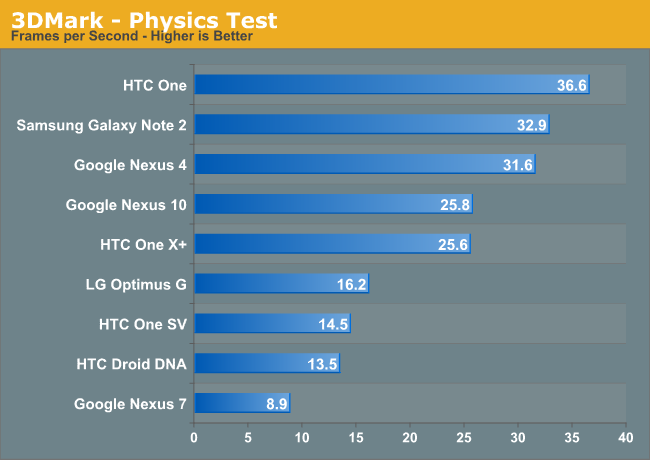
Graphics test one is meant to test geometry, or how many triangles can be displayed in a given period of time. Graphics test 2 focuses on pure fill-rate and reduces the geometric load. Lastly, there is the physics test, which is mainly a CPU test. All three tests stress all areas to different degrees, but those are the key areas stressed.
I'm running ye olde Galaxy S II with a dual-core Cortex A9 CPU (1.2ghz) and a Mali-400MP GPU. My results were (on 1080p);
GT1 - 3.6fps
GT1 - 5.9fps
PT1 - 13.4fps
In my second post, I'll go over some Anandtech results.
https://play.google.com/store/apps/details?id=com.futuremark.dmandroid.application
The benchmark suite consists of two settings, the first is 720p and the extreme is 1080p. This is then subdivided into three specific benchmarks.
Graphics test one is meant to test geometry, or how many triangles can be displayed in a given period of time. Graphics test 2 focuses on pure fill-rate and reduces the geometric load. Lastly, there is the physics test, which is mainly a CPU test. All three tests stress all areas to different degrees, but those are the key areas stressed.
I'm running ye olde Galaxy S II with a dual-core Cortex A9 CPU (1.2ghz) and a Mali-400MP GPU. My results were (on 1080p);
GT1 - 3.6fps
GT1 - 5.9fps
PT1 - 13.4fps
In my second post, I'll go over some Anandtech results.