• Some users have recently had their accounts hijacked. It seems that the now defunct EVGA forums might have compromised your password there and seems many are using the same PW here. We would suggest you UPDATE YOUR PASSWORD and TURN ON 2FA for your account here to further secure it. None of the compromised accounts had 2FA turned on.
    Once you have enabled 2FA, your account will be updated soon to show a badge, letting other members know that you use 2FA to protect your account. This should be beneficial for everyone that uses FSFT.

3DMark for Android released

Medion

[H]ard|Gawd
Joined
Mar 26, 2012
Messages
1,584
We have a lot of people here who enjoy synthetic benchmarks and the speculation that they bring (myself included). 3DMark has been released for Android.

https://play.google.com/store/apps/details?id=com.futuremark.dmandroid.application

The benchmark suite consists of two settings, the first is 720p and the extreme is 1080p. This is then subdivided into three specific benchmarks.

Graphics test one is meant to test geometry, or how many triangles can be displayed in a given period of time. Graphics test 2 focuses on pure fill-rate and reduces the geometric load. Lastly, there is the physics test, which is mainly a CPU test. All three tests stress all areas to different degrees, but those are the key areas stressed.

I'm running ye olde Galaxy S II with a dual-core Cortex A9 CPU (1.2ghz) and a Mali-400MP GPU. My results were (on 1080p);

GT1 - 3.6fps
GT1 - 5.9fps
PT1 - 13.4fps

In my second post, I'll go over some Anandtech results.
 
Anandtech tested a few devices with this benchmark. Here's their results and my commentary. NOTE: They could not get it to run in a stable fashion on the Motorola RAZR i (Intel) nor the HTC One X (Snapdragon model). These are anomalies and are expected on new software.

53947.png


In this test we're looking at geometric throughput. There are some anomalies here. Why the gap between the Nexus 4/HTC One and the Droid DNA/Optimus G given similar hardware? All of them use the Adreno 320 paired with LPDDR533 RAM. The key differences are CPU clock speeds, with the HTC One at 1.7ghz and the rest at 1.5ghz. We have two Adreno models at around 50fps, and two at around 36-37fps. Weird. The Mali T-604 is next with roughly 37fps, but the Nexus 10 is the only device using it. Would have liked to see multiple runs to see what's going on here (although Mali is typically behind Adreno/Tegra in geometric performance). After that we have the Adreno 225, the Adreno 305, the Tegra 3 (twice), and finally the Mali400MP slotted where I would expect them in these tests.


Graphics Test 2 tests pixel shader/fill-rate more than anything else. We're once again seeing the Nexus 4/HTC One and the Droid DNA/Optimus G separated. This is curious. The Nexus 10 falls slightly behind the second grouping despite fill-rate typically being Mali's strength (and the area where it kills Adreno in GLBenchmark). The remaining benchmarks also slot about the same as the previous test, with the exception of the Note II (Mali-400MP) moving up a few rungs.

With the graphics tests out of the way, it's safe to say that 3DMark gets different results than what we're accustomed to. Typically we use GLBenchmark which does a very good job of stress testing pixel and geometry performance in different tests. Those tests usually show Mali far ahead in pixel performance and far behind in geometric performance, PowerVR as the most balanced, and Adreno/Tegra fighting it out behind them. 3DMark tries to replicate an actual game engine that stresses the areas a game would use, while also highlighting certain areas. This does a good job of showing Adreno 320's prowess for modern mobile gaming whereas GLBench always had a more synthetic feel to it.

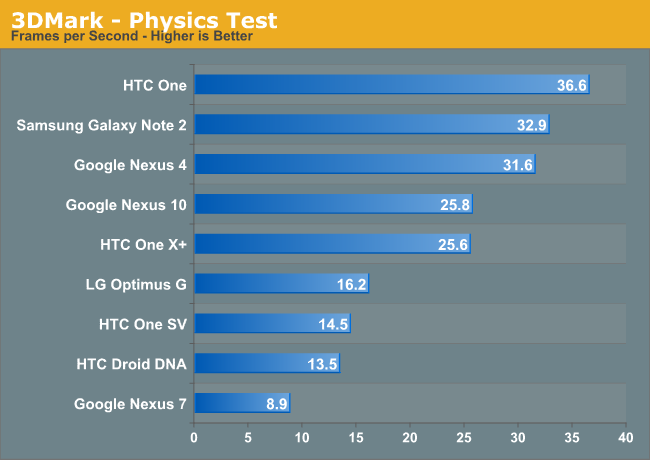
53951.png


The physics test is meant to test CPU performance, specifically with multi-threading. Once again we're seeing some strange issues with Snapdragon S4/600 chipsets. The gap between the HTC One (1.7ghz) and the Nexus 4 (1.5ghz) makes sense given same CPU, same memory, different CPU clock speed. But then, why does the Optimus G and Droid DNA do so poorly? The Note 2's quad-core A9 competes with the S4/600, while the Nexus 7's quad-core A9 competes with PowerPoint. The dual-core Krait used in the One SV is on par with the quad-core Kraits used in the Optimus G and Droid DNA.

Conclusion:

As is the case with Android benchmarks, we're looking at a system benchmark because you cannot separate components as you would in in a desktop PC. And as you would expect with a fragmented OS, there are driver/consistency issues. But with refinements, this may become the best available benchmark as it has a more realistic approach when compared to GLBench.
 
It'll run on my Razr HD, but it doesn't report the score at the end. No 1080 for this device. In 720, it plays fairly smooth.

My Asus Transformer TF101 runs it. Score of 773
Graphic test 1- 3.1 fps
Graphic test 2- 2.5 fps
Physics test - 9.1 fps

Time to oc it.
 
Doesn't make much sense for the Galaxy S3 to ahead of any of those phones/tabs listed below it in that first test. The Adreno 225 should be well behind the Tegra 3 or Mali in the Note 2 and they're all about the same resolution except for the One SV.
 
It wouldn't be the first time. Different benchmarks weight different aspects of GPU processing.

Tegra3 does a bit better than Adreno225 in Epic Citadel

Adreno225 does better in 3Dmark and Basemark.

They're tied in GLbenchmark.


There's a lot of talk about how bad Adreno 225 is but benchmarks haven't really shown outside of the theoretical tests. You can say that it's because the SoC on the whole hampers the other GPU's and you'd be right but that only means Qualcomm balanced their SoC perfectly.
 
Last edited:
The Geforce in the Tegra3 doesn't have unified shaders IIRC. Perhaps its balance happens to be a bad match for 3DMark.

With that said, Tegra3 is only on par (and that's being generous) with the Adreno 225 when you look at other benchmarks. If you compare the HTC One X Tegra3 and Snapdragon S4 versions, you'll see that very easily.


With that said, the results for the Physics test looks like not all the cores were engaged properly. I'm starting to think this is a 3DMark bug because Anand's GS3 clearly only engaged one of its two cores as well.
 
I don't understand how the nexus 7 rates so bad compared to the competition.

Tegra 3 is slow, it is only used because it is cheap. And the N7 in particular uses the cheapest, slowest of the Tegra 3 lineup - the T30L. The other Tegra 3 models, the T30 and T33, have a 25% faster GPU clock than the T30L.

With that said, the results for the Physics test looks like not all the cores were engaged properly. I'm starting to think this is a 3DMark bug because Anand's GS3 clearly only engaged one of its two cores as well.

Why do you think that's a bug? Sounds like they are using N-1 cores for physics, which is what you'd expect. One core for the rendering and UI work, the rest for physics.
 
Because almost every other phone with the same hardware gets exactly double the score. The One X (ATT), the Razr HD, etc.

The GS3 (ATT) is simply scoring too low for whatever reason.
 
hmm 283mb app, i guess it has to be with all of the video it uses for the stress test but kinda threw me off at first.
 
10010 for my XZ. Probably be able to top the GS4 once Sony releases 4.2 JB update.
 
Back
Top