![[H]ard|Forum](/styles/hardforum/xenforo/logo_dark.png)
As you can see in the video below, Linux gaming in 2019 could be technically superior to gaming on Windows in specific situations.
https://www.youtube.com/@nahum7995/videos
You see that I make the recording on a system with very weak hardware. If I do not record then I see +- 2 fps higher on average.
That's just the point that Assassin's Creed Odyssey is fairly decent playable, with average 27 fps or slightly above the framerate of almost all cinema films (24 fps).
When Assassin's Creed Odyssey came out on windows, it had a lot of bugs on windows and it wasn't very playable in the first months after the release.
In 2019, Linux was doing better in terms of general stability in this game although DXVK still had little refinement due to the fact that it had only been developed for a few months.
I also don't think this game was playable on windows on a PC with 4GB of system RAM, 2GB VRAM and old dual core Intel CPU, which means that Linux was technically superior in some situations.
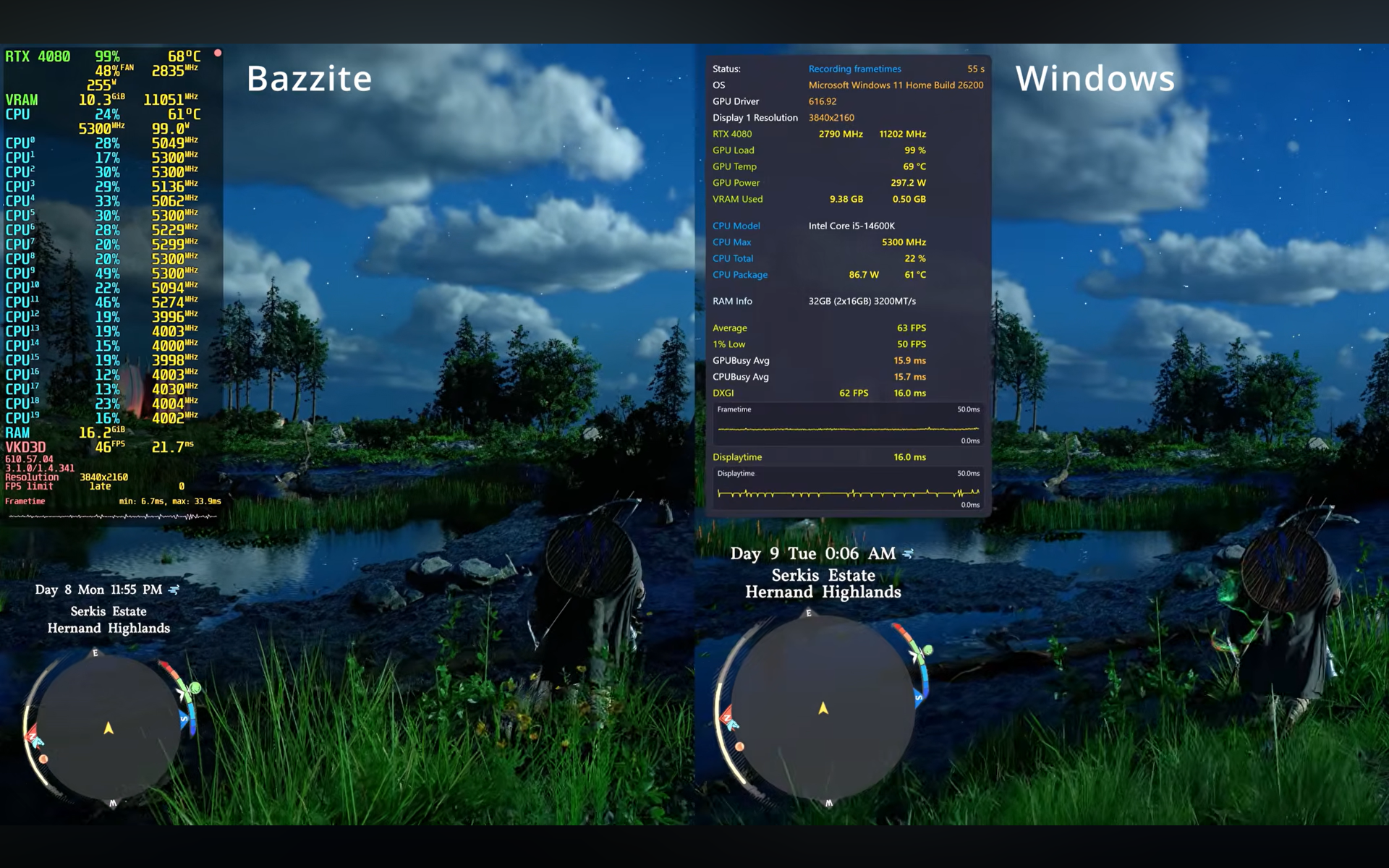
The Windows Vulkan path remains unoptimized compared to its Linux counterpart. While Vulkan is designed to be cross-platform, benchmarks regularly show that identical hardware yields higher Vulkan throughput and lower frame-time stutters on Linux systems compared to Windows.
There are several factors that have an impact on this situation.
Under Windows, all graphics applications must interact with the DirectX Graphics Kernel (dxgkern.sys) to negotiate hardware access time and memory allocation. Because Windows treats Microsoft's own DirectX 12 as its premier, first-class graphics API, WDDM is heavily tailored around Direct3D's behavior.
The Linux Advantage: Linux operating systems bypass this layer entirely. Vulkan drivers interact much more directly with the kernel and the display server (like Wayland), eliminating the "middleman" CPU overhead and scheduling interference caused by Windows' core display architecture.
GPU manufacturers (NVIDIA, AMD, and Intel) must prioritize their engineering resources based on market realities. On Windows: DirectX 11 and DirectX 12 are the dominant targets. Consequently, Windows graphics drivers have decades of hyper-optimized, game-specific hacks baked into them for DirectX. Vulkan on Windows is often treated as a secondary API.
On Linux: Vulkan is the foundational, first-class modern API. Because Linux gaming relies natively on Vulkan (and translates DirectX games into Vulkan via layers like Proton/DXVK), driver teams focus their optimization efforts squarely on Vulkan
The Linux ecosystem benefits from open-source drivers like Mesa RADV (for AMD), which are maintained actively by community developers, Valve, and Red Hat. Because these drivers are open, game developers and engine optimizations can be committed directly to the driver codebase to strip away inefficiencies. On Windows, drivers are proprietary, closed source, and rely entirely on vendor updates.
Many game engines are built primarily for Windows using DirectX. When developers add a Vulkan path to a Windows game, they frequently write it as a basic translation layer over their existing DirectX architecture rather than building a true, low-level Vulkan pipeline. This results in a poorly optimized Windows-Vulkan path.
Conversely, when those same games are run on Linux via translation tools like DXVK, the translation is highly multi-threaded and purpose-built to map DirectX commands efficiently to Linux's highly optimized native Vulkan stack, often making the translated Linux version smoother than the native Windows version.
On Linux: Gaijin had to heavily optimize Vulkan for their game. The original Linux OpenGL client performed notoriously poorly. Vulkan became the primary focus for the native Linux client to achieve performance parity with Windows.
On Windows: Microsoft’s DirectX 11 and 12 handle 90% of the Windows player base. Because Gaijin builds the Dagor Engine primarily around the DirectX API ecosystem, the Windows Vulkan path is largely a development byproduct rather than a prioritized optimization goal.
Linux is very suitable for doing the exact same business for which many people buy a console.
I think that no standard home gaming console matches the raw performance of the AMD Radeon RX 9060 XT 16GB or the Radeon RX 9070 GRE.
If you calculate the games that you can play on Linux (e.g. Android), taking into account all the possible ways, you will soon come to more than 105 000 games.
I often use Linux in combination with a 8BitDo ultimate wired controller.
And since the JONSBO Z20 desktop looks rather small compared to the panel I use it really almost feels like I'm using a console instead of a desktop system.

Wired controllers perform slightly faster than the absolute fastest wireless options and they are also more reliable.
In terms of design and comfort, it looks like a new more sophisticated version of the Xbox wireless controller.
Games running via wine-staging or Steam work straight out of the box with this controller.
GOG Linux games do not always work 100% how I want it with this controller.
But I map the +- four keyboard actions that are missing in a few seconds via AntiMicroX.
You can easily convert Linux into a system that feels very similar to a PS5 or an Xbox Series X in use.
You can do the same with windows11 but Linux has some advantages.
1. Higher performance in more than 25% of the games (the exact percentage is hard to say but it can be more than 50% of the games) It can give the same result in many games as using a GPU that is 150 dollars more expensive.
2. Can be configured for extremely low RAM usage and lower CPU usage than windows, which allows it to support old hardware that windows11 doesn't support
3. Directly from the official store, Microsoft charges $139.00 for a standard, full retail Windows 11 Home license. If you buy games during promotional periods, you can buy more than ten decent games for $139.00
4. There is a lot of gaming hardware that works better on Linux than on windows11. Linux supports significantly more hardware than windows in absolute numbers.
5. Both Gentoo and Arch Linux have an exemplary, near-flawless track record regarding telemetry and privacy of the core system. By design, neither distribution includes any built-in telemetry, spyware, or background phone-home diagnostics in their default base configurations. Microsoft is frequently scrutinized and occasionally sued or penalized for privacy practices and telemetry data collection.
6. Linux is easier to use as an immutable system where you, for example, install fifteen games and can choose to update the system only when you have finished all these games.
Windows11 also has a very large target group of people aged >59 and windows tries to help them by automating many things that would be better for power users not to be automated, such as update management.
7. Arch Linux, FreeBSD, Gentoo Linux, OpenBSD and Fedora are renowned for meticulous, comprehensive, and gold-standard documentation. They have much better official documentation and reference materials than Windows 11.
8. Windows11 has a fast boot option and essentially this only hibernates the system, making drivers less reliable after restarting the system. If you want optimal reliability you need to do a full startup and this is slow in windows11

Calculate Linux does a full startup in 7 seconds on the latest hardware. So windows11 takes 65% extra time for a full startup.
By the way, Clear Linux was significantly faster than the 7 seconds that Calculate Linux needs.
9. The average user of systems such as Arch Linux, Fedora, and Gentoo Linux often possesses more technical knowledge and problem-solving skills than Microsoft Tier 1 and Tier 2 support agents, meaning that questions on their forums and Reddit are frequently resolved faster than similar questions via Microsoft's helpdesk.
10. Linux (EXT4, XFS or F2FS) typically edges out Windows by a small margin in I/O performance and game load times, primarily because the Linux kernel has highly streamlined and efficient I/O paths with less background bloat than Windows.
11. Linux's modularity, lightweight window managers, and customizable desktop environments can provide distinct advantages for gamers, mostly through resource efficiency and workflow control. The high customizability of Linux is a distinct advantage for gamers in many situations, allowing users to optimize system performance, remove background bloatware, and fine-tune hardware settings in ways that Windows and macOS do not permit. Games with native builds or open-source engines are generally easiest to mod on Linux.
12. AMD graphics drivers are built directly into the Linux kernel, often providing smoother performance and open-source improvements.
13. Steam on Linux pre-compiles shaders to significantly reduce in-game stuttering common on Windows.
14. Better Resolution Scaling: Tools like Gamescope allow custom resolutions, downsampling, and FSR upscaling globally for almost any game.
15. Linux window managers and compositors handle switching out of fullscreen games much more reliably without crashing.
16. Linux often delivers slightly faster single-core performance or execution times than Windows on identical hardware
Single-core performance is often the bottleneck for game load times if you use a fast NVMe SSD.
17. You can set up and run a Linux system locally without logging into an external corporate online Microsoft account.
18. Complete system ownership. You have root access to modify, strip, or replace any part of the operating system down to the kernel.
19. Windows offer a slower 'hybrid' kernel instead of a faster 'monolithic' kernel
Windows also doesn't offer custom kernels. Advanced users can't compile custom kernels optimized specifically for low latency and high gaming performance.
20. Older Windows games often run more reliably through Wine and Proton on modern Linux than they do on Windows 11 compatibility modes.
21. ChimeraOS and Bazzite offer a dedicated "gaming mode" that boots directly into Steam's gamescope interface for a true console feel.
Microsoft does not offer a separate, standalone "lite" or custom ISO build of Windows designed specifically to compete with immutable, console-like Linux distributions.
22. Multiple studies have found that popular open-source software (OSS) often has a lower defect density (fewer bugs per 1,000 lines of code) than comparable proprietary software. I've always used Linux and AMD GPU's as a daily driver, and I was playing Left 4 Dead 2 co-op with someone who used windows and Nvidia on a windows notebook.
During the game, there was a moment when the game of this Nvidia windows user completely stuck and was no longer responsive, a situation that she could only solve by interrupting the power and restarting it. In the meantime, I just continued playing the game without ever seeing a similar problem on the AMD GPU in Linux.
Taking these points into account, do you think the trend of using Linux as a console-like system will continue growing?
I’d love to hear your prediction related to this topic.
https://www.youtube.com/@nahum7995/videos
You see that I make the recording on a system with very weak hardware. If I do not record then I see +- 2 fps higher on average.
That's just the point that Assassin's Creed Odyssey is fairly decent playable, with average 27 fps or slightly above the framerate of almost all cinema films (24 fps).
When Assassin's Creed Odyssey came out on windows, it had a lot of bugs on windows and it wasn't very playable in the first months after the release.
In 2019, Linux was doing better in terms of general stability in this game although DXVK still had little refinement due to the fact that it had only been developed for a few months.
I also don't think this game was playable on windows on a PC with 4GB of system RAM, 2GB VRAM and old dual core Intel CPU, which means that Linux was technically superior in some situations.
The Windows Vulkan path remains unoptimized compared to its Linux counterpart. While Vulkan is designed to be cross-platform, benchmarks regularly show that identical hardware yields higher Vulkan throughput and lower frame-time stutters on Linux systems compared to Windows.
There are several factors that have an impact on this situation.
Under Windows, all graphics applications must interact with the DirectX Graphics Kernel (dxgkern.sys) to negotiate hardware access time and memory allocation. Because Windows treats Microsoft's own DirectX 12 as its premier, first-class graphics API, WDDM is heavily tailored around Direct3D's behavior.
The Linux Advantage: Linux operating systems bypass this layer entirely. Vulkan drivers interact much more directly with the kernel and the display server (like Wayland), eliminating the "middleman" CPU overhead and scheduling interference caused by Windows' core display architecture.
GPU manufacturers (NVIDIA, AMD, and Intel) must prioritize their engineering resources based on market realities. On Windows: DirectX 11 and DirectX 12 are the dominant targets. Consequently, Windows graphics drivers have decades of hyper-optimized, game-specific hacks baked into them for DirectX. Vulkan on Windows is often treated as a secondary API.
On Linux: Vulkan is the foundational, first-class modern API. Because Linux gaming relies natively on Vulkan (and translates DirectX games into Vulkan via layers like Proton/DXVK), driver teams focus their optimization efforts squarely on Vulkan
The Linux ecosystem benefits from open-source drivers like Mesa RADV (for AMD), which are maintained actively by community developers, Valve, and Red Hat. Because these drivers are open, game developers and engine optimizations can be committed directly to the driver codebase to strip away inefficiencies. On Windows, drivers are proprietary, closed source, and rely entirely on vendor updates.
Many game engines are built primarily for Windows using DirectX. When developers add a Vulkan path to a Windows game, they frequently write it as a basic translation layer over their existing DirectX architecture rather than building a true, low-level Vulkan pipeline. This results in a poorly optimized Windows-Vulkan path.
Conversely, when those same games are run on Linux via translation tools like DXVK, the translation is highly multi-threaded and purpose-built to map DirectX commands efficiently to Linux's highly optimized native Vulkan stack, often making the translated Linux version smoother than the native Windows version.
On Linux: Gaijin had to heavily optimize Vulkan for their game. The original Linux OpenGL client performed notoriously poorly. Vulkan became the primary focus for the native Linux client to achieve performance parity with Windows.
On Windows: Microsoft’s DirectX 11 and 12 handle 90% of the Windows player base. Because Gaijin builds the Dagor Engine primarily around the DirectX API ecosystem, the Windows Vulkan path is largely a development byproduct rather than a prioritized optimization goal.
Linux is very suitable for doing the exact same business for which many people buy a console.
I think that no standard home gaming console matches the raw performance of the AMD Radeon RX 9060 XT 16GB or the Radeon RX 9070 GRE.
If you calculate the games that you can play on Linux (e.g. Android), taking into account all the possible ways, you will soon come to more than 105 000 games.
I often use Linux in combination with a 8BitDo ultimate wired controller.
And since the JONSBO Z20 desktop looks rather small compared to the panel I use it really almost feels like I'm using a console instead of a desktop system.
Wired controllers perform slightly faster than the absolute fastest wireless options and they are also more reliable.
In terms of design and comfort, it looks like a new more sophisticated version of the Xbox wireless controller.
Games running via wine-staging or Steam work straight out of the box with this controller.
GOG Linux games do not always work 100% how I want it with this controller.
But I map the +- four keyboard actions that are missing in a few seconds via AntiMicroX.
You can easily convert Linux into a system that feels very similar to a PS5 or an Xbox Series X in use.
You can do the same with windows11 but Linux has some advantages.
1. Higher performance in more than 25% of the games (the exact percentage is hard to say but it can be more than 50% of the games) It can give the same result in many games as using a GPU that is 150 dollars more expensive.
2. Can be configured for extremely low RAM usage and lower CPU usage than windows, which allows it to support old hardware that windows11 doesn't support
3. Directly from the official store, Microsoft charges $139.00 for a standard, full retail Windows 11 Home license. If you buy games during promotional periods, you can buy more than ten decent games for $139.00
4. There is a lot of gaming hardware that works better on Linux than on windows11. Linux supports significantly more hardware than windows in absolute numbers.
5. Both Gentoo and Arch Linux have an exemplary, near-flawless track record regarding telemetry and privacy of the core system. By design, neither distribution includes any built-in telemetry, spyware, or background phone-home diagnostics in their default base configurations. Microsoft is frequently scrutinized and occasionally sued or penalized for privacy practices and telemetry data collection.
6. Linux is easier to use as an immutable system where you, for example, install fifteen games and can choose to update the system only when you have finished all these games.
Windows11 also has a very large target group of people aged >59 and windows tries to help them by automating many things that would be better for power users not to be automated, such as update management.
7. Arch Linux, FreeBSD, Gentoo Linux, OpenBSD and Fedora are renowned for meticulous, comprehensive, and gold-standard documentation. They have much better official documentation and reference materials than Windows 11.
8. Windows11 has a fast boot option and essentially this only hibernates the system, making drivers less reliable after restarting the system. If you want optimal reliability you need to do a full startup and this is slow in windows11
Calculate Linux does a full startup in 7 seconds on the latest hardware. So windows11 takes 65% extra time for a full startup.
By the way, Clear Linux was significantly faster than the 7 seconds that Calculate Linux needs.
9. The average user of systems such as Arch Linux, Fedora, and Gentoo Linux often possesses more technical knowledge and problem-solving skills than Microsoft Tier 1 and Tier 2 support agents, meaning that questions on their forums and Reddit are frequently resolved faster than similar questions via Microsoft's helpdesk.
10. Linux (EXT4, XFS or F2FS) typically edges out Windows by a small margin in I/O performance and game load times, primarily because the Linux kernel has highly streamlined and efficient I/O paths with less background bloat than Windows.
11. Linux's modularity, lightweight window managers, and customizable desktop environments can provide distinct advantages for gamers, mostly through resource efficiency and workflow control. The high customizability of Linux is a distinct advantage for gamers in many situations, allowing users to optimize system performance, remove background bloatware, and fine-tune hardware settings in ways that Windows and macOS do not permit. Games with native builds or open-source engines are generally easiest to mod on Linux.
12. AMD graphics drivers are built directly into the Linux kernel, often providing smoother performance and open-source improvements.
13. Steam on Linux pre-compiles shaders to significantly reduce in-game stuttering common on Windows.
14. Better Resolution Scaling: Tools like Gamescope allow custom resolutions, downsampling, and FSR upscaling globally for almost any game.
15. Linux window managers and compositors handle switching out of fullscreen games much more reliably without crashing.
16. Linux often delivers slightly faster single-core performance or execution times than Windows on identical hardware
Single-core performance is often the bottleneck for game load times if you use a fast NVMe SSD.
17. You can set up and run a Linux system locally without logging into an external corporate online Microsoft account.
18. Complete system ownership. You have root access to modify, strip, or replace any part of the operating system down to the kernel.
19. Windows offer a slower 'hybrid' kernel instead of a faster 'monolithic' kernel
Windows also doesn't offer custom kernels. Advanced users can't compile custom kernels optimized specifically for low latency and high gaming performance.
20. Older Windows games often run more reliably through Wine and Proton on modern Linux than they do on Windows 11 compatibility modes.
21. ChimeraOS and Bazzite offer a dedicated "gaming mode" that boots directly into Steam's gamescope interface for a true console feel.
Microsoft does not offer a separate, standalone "lite" or custom ISO build of Windows designed specifically to compete with immutable, console-like Linux distributions.
22. Multiple studies have found that popular open-source software (OSS) often has a lower defect density (fewer bugs per 1,000 lines of code) than comparable proprietary software. I've always used Linux and AMD GPU's as a daily driver, and I was playing Left 4 Dead 2 co-op with someone who used windows and Nvidia on a windows notebook.
During the game, there was a moment when the game of this Nvidia windows user completely stuck and was no longer responsive, a situation that she could only solve by interrupting the power and restarting it. In the meantime, I just continued playing the game without ever seeing a similar problem on the AMD GPU in Linux.
Taking these points into account, do you think the trend of using Linux as a console-like system will continue growing?
I’d love to hear your prediction related to this topic.