![[H]ard|Forum](/styles/hardforum/xenforo/logo_dark.png)
Navigation
Install the app
How to install the app on iOS
Follow along with the video below to see how to install our site as a web app on your home screen.
Note: This feature may not be available in some browsers.
More options
-
Some users have recently had their accounts hijacked. It seems that the now defunct EVGA forums might have compromised your password there and seems many are using the same PW here. We would suggest you UPDATE YOUR PASSWORD and TURN ON 2FA for your account here to further secure it. None of the compromised accounts had 2FA turned on.
Once you have enabled 2FA, your account will be updated soon to show a badge, letting other members know that you use 2FA to protect your account. This should be beneficial for everyone that uses FSFT.
You are using an out of date browser. It may not display this or other websites correctly.
You should upgrade or use an alternative browser.
You should upgrade or use an alternative browser.
PWM water pump control
- Thread starter Auraka
- Start date


- Joined
- Oct 7, 2000
- Messages
- 79,091
constant speed, ~75-80%
hititnquitit
2[H]4U
- Joined
- Apr 16, 2018
- Messages
- 3,129
Sorry I've no idea 
I have a Koolance manual pump controller that I make adjustments with. I stopped worrying about pump speeds a long time ago. As long as I can effectively purge my loop and keep the micro bubbles from re-entering my loop over and over(maddening) I'm gtg.
Dual d5s.
I have a Koolance manual pump controller that I make adjustments with. I stopped worrying about pump speeds a long time ago. As long as I can effectively purge my loop and keep the micro bubbles from re-entering my loop over and over(maddening) I'm gtg.
Dual d5s.
Noise is my priority for my loop. My current pump is only on/off, but I would set it to the highest inaudible setting and let it sit there if I could. Maybe set a curve to peak in extreme conditions to prevent throttling, but that's about it.

- Joined
- Oct 7, 2000
- Messages
- 79,091
whys the pumps speed all over the place?
This particular run it's bios controlled with a custom curve, that's the way I ran the last pump. ASUS PWM profiles for pumps tends to be pretty high 80% or above. The CPU load gaming is relatively low.whys the pumps speed all over the place?

- Joined
- Jun 7, 2007
- Messages
- 14,482
It's not as bad as it looks -- the graph is zoomed in at 2200 rpm to 3200 rpm, most of the movement happens in the upper 600 rpm of the graph.whys the pumps speed all over the place?
- Joined
- Oct 7, 2000
- Messages
- 79,091
i can see that...It's not as bad as it looks -- the graph is zoomed in at 2200 rpm to 3200 rpm, most of the movement happens in the upper 600 rpm of the graph.
it should be a constant speed, thats litterally what he was asking about.
- Joined
- Oct 7, 2000
- Messages
- 79,091
View: https://www.youtube.com/watch?v=F7U9QZhulXk
yes its an aio shown, same principals apply. your speeds technically are in that zone though, just ramping up and down for no reason.
mines set to 80% in the bios and control software.


- Joined
- Nov 11, 2012
- Messages
- 1,940
I've ran it for years at 100%, no issues or noise (depends on your reservoir and how it mounts to your case as well). Then I ran it at ~80%. No issues or noise, still, and no perceptible performance drop. Probably has more to do with your setup and what you can get away with. I still have D5 pumps going strong after almost 17 years? Thinking how long I've had them makes me want to replace them...
- Joined
- Jun 7, 2007
- Messages
- 14,482
Ehh, they're brushless motors. Theoretically, as long as they are cooled properly (not ran dry), they should last forever. I guess technically a driver board component could fail, but that could happen with a new one too.I've ran it for years at 100%, no issues or noise (depends on your reservoir and how it mounts to your case as well). Then I ran it at ~80%. No issues or noise, still, and no perceptible performance drop. Probably has more to do with your setup and what you can get away with. I still have D5 pumps going strong after almost 17 years? Thinking how long I've had them makes me want to replace them...
- Joined
- Nov 11, 2012
- Messages
- 1,940
Yeah, proper maintenance has helped. Cleaning after ever re-build. Using only silver and distilled water so there's no gunk build-up with certain OTC coolants, no corrosive mixes of metals, etc.Ehh, they're brushless motors. Theoretically, as long as they are cooled properly (not ran dry), they should last forever. I guess technically a driver board component could fail, but that could happen with a new one too.


- Joined
- Oct 7, 2000
- Messages
- 79,091

Last edited:
- Joined
- Jun 7, 2007
- Messages
- 14,482
Except the last one, they are all within 50 rpm deviation, max. I'd say that's pretty nearly fixed RPM. The variation could be caused by inconsistent voltage being sent to the pwm circuit, or measurement errors. You could rule out PWM control issues by removing the PWM wire from the connector body and testing. That should cause the pump to run at either min or max speed, depending on how it's designed.this indicates it is not fixed, it should be a flat line. but if your happy, roll with whatever you want.
View attachment 817074
It could also be an issue with the pump itself, but if it is cooling fine I wouldn't worry about that.
- Joined
- Oct 7, 2000
- Messages
- 79,091
nope, youre right, i didnt look close enough at the scale. mine does it too but my monitor only shows a flat line.Except the last one, they are all within 50 rpm deviation, max. I'd say that's pretty nearly fixed RPM. The variation could be caused by inconsistent voltage being sent to the pwm circuit, or measurement errors. You could rule out PWM control issues by removing the PWM wire from the connector body and testing. That should cause the pump to run at either min or max speed, depending on how it's designed.
It could also be an issue with the pump itself, but if it is cooling fine I wouldn't worry about that.
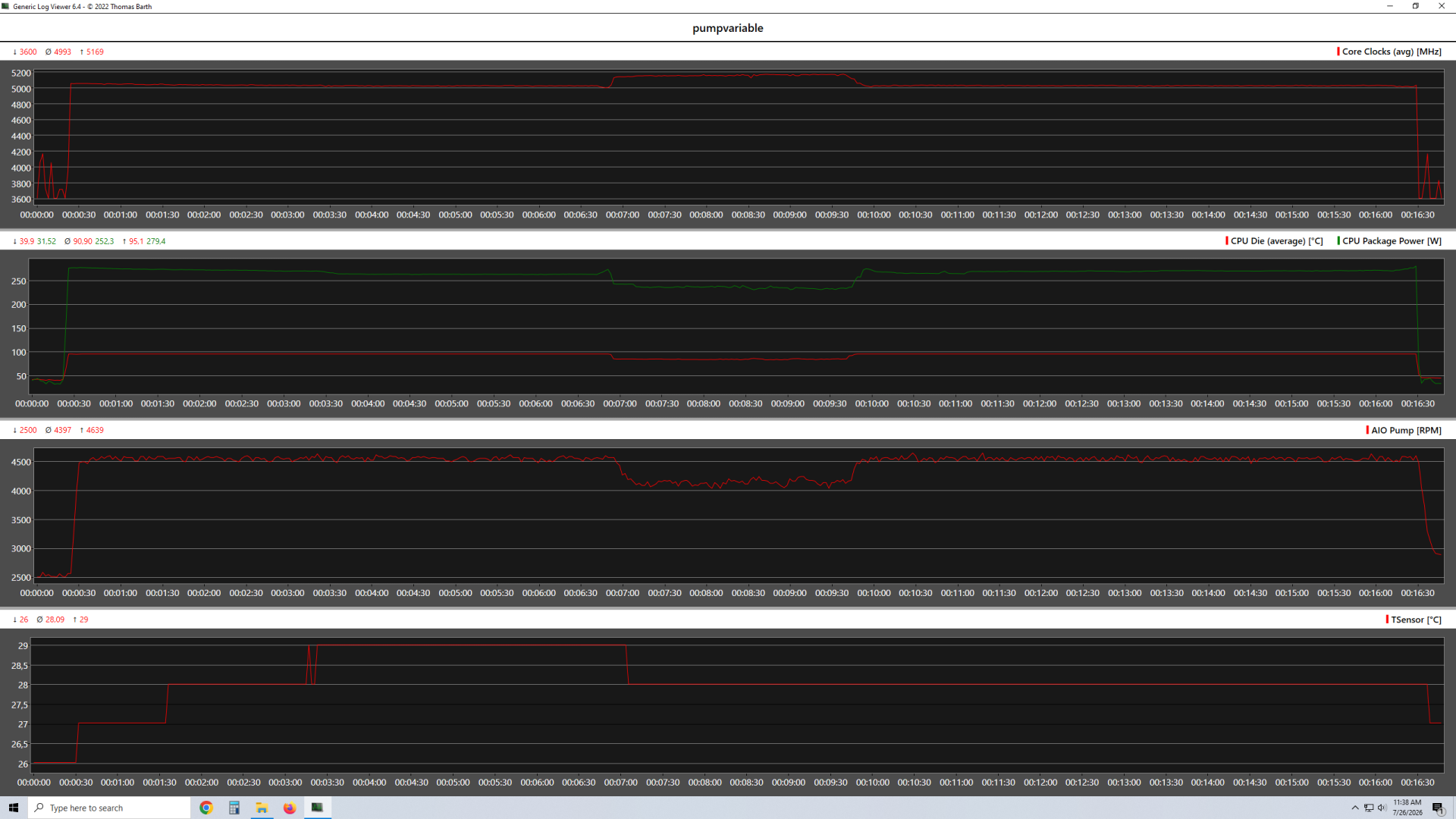
Those spikes in pump RPM under a gaming load are levels loading I'm pretty sure, otherwise it's pretty constant. My last pump/reservoir combo resonated around 3300 RPM so my curve was set to be under or over that for normal loads but never fixed there. This pump while slightly audible is without the resonance at 3300 like the prior pump so I'm less constrained.It's not as bad as it looks -- the graph is zoomed in at 2200 rpm to 3200 rpm, most of the movement happens in the upper 600 rpm of the graph.
That's just normal PWM variation zoomed in, those speed were fixed in the bios.this indicates it is not fixed, it should be a flat line. but if your happy, roll with whatever you want.
View attachment 817074
This was my first watercooling project befor things got easy.
https://www.overclockers.com/eheim-reservoir-mod/
https://www.overclockers.com/eheim-reservoir-mod/
In my experience, pump speed doesn't make all that much of a difference as long as you reach roughly 0.5gpm. Some water blocks love flow so in the extreme cases it can make maybe 1.5 degrees difference between 50% and 100%, but most blocks it will be in the 0.5-1.0 degrees range in a regular loop. My water block barely cares about flow so the difference between 0.45gpm (50%) and a little over 1gpm (100%) is around 0.2 or 0.3 degrees in steady state. I would just set it at the highest speed above 40%, where you don't notice the noise, and leave it at that.
Higher flow causes more turbulence in the water block, which gives better cooling, but the water also spends less time in the radiator(s) so coolant temp rises a bit as well. I did test it quite a few years ago, but I don't have my notes anymore so just going off memory. My loop is a Techn AM 4 block with 2 HW-labs LX 480 with Noctua NF-A120x25 PWM in pull configuration at intake for my CPU with 1L of water in the loop so steady state isn't reached until 30m has passed with fans in fixed speed. I do run a flow meter and have temp sensors on exit of CPU, entry to first radiator and exit of second radiator.
When I tested it at full flow I got around 1 degree higher water temp out of the CPU in steady state, but also 1 degree higher going into the reservoir at steady state, when compared to ambient. This was comapared to running at 50% on the pump. My radiators cool between 1.5 and 2.5 degrees, depending on fan speeds. The cooling in the radiators went down a little bit due to the liquid spending less time in the radiators. I think it was around 0.1 to 0.2 degrees less cooling per pass until steady state was reached and general loop temp was generally higher. CPU temp was in the 0.2 to 0.3 degrees cooler range, with the higher flow rate, but it would have been more if the water temp was the same as with lower flow rate. Fans were fixed, but don't remember the exact speed. My guess is it was somewhere between 950 and 1200 RPM.
Higher flow causes more turbulence in the water block, which gives better cooling, but the water also spends less time in the radiator(s) so coolant temp rises a bit as well. I did test it quite a few years ago, but I don't have my notes anymore so just going off memory. My loop is a Techn AM 4 block with 2 HW-labs LX 480 with Noctua NF-A120x25 PWM in pull configuration at intake for my CPU with 1L of water in the loop so steady state isn't reached until 30m has passed with fans in fixed speed. I do run a flow meter and have temp sensors on exit of CPU, entry to first radiator and exit of second radiator.
When I tested it at full flow I got around 1 degree higher water temp out of the CPU in steady state, but also 1 degree higher going into the reservoir at steady state, when compared to ambient. This was comapared to running at 50% on the pump. My radiators cool between 1.5 and 2.5 degrees, depending on fan speeds. The cooling in the radiators went down a little bit due to the liquid spending less time in the radiators. I think it was around 0.1 to 0.2 degrees less cooling per pass until steady state was reached and general loop temp was generally higher. CPU temp was in the 0.2 to 0.3 degrees cooler range, with the higher flow rate, but it would have been more if the water temp was the same as with lower flow rate. Fans were fixed, but don't remember the exact speed. My guess is it was somewhere between 950 and 1200 RPM.
My coolant delta temp is less than 10°C under prime95 (ambient room temp 21.1°C vs coolant temp max 29°C) at ~280W, I think my system has so much capacity it doesn't much matter what I do. My radiator is a double 180 and 45mm thick so 360x180x45mm=2,916,000 physical size vs a standard triple 120mm 360x120x25mm=1,080,000, so nearly triple the size of an AIO or single triple radiator, my limiting factor is how fast can I pull heat out of the IHS.In my experience, pump speed doesn't make all that much of a difference as long as you reach roughly 0.5gpm. Some water blocks love flow so in the extreme cases it can make maybe 1.5 degrees difference between 50% and 100%, but most blocks it will be in the 0.5-1.0 degrees range in a regular loop. My water block barely cares about flow so the difference between 0.45gpm (50%) and a little over 1gpm (100%) is around 0.2 or 0.3 degrees in steady state. I would just set it at the highest speed above 40%, where you don't notice the noise, and leave it at that.
Higher flow causes more turbulence in the water block, which gives better cooling, but the water also spends less time in the radiator(s) so coolant temp rises a bit as well. I did test it quite a few years ago, but I don't have my notes anymore so just going off memory. My loop is a Techn AM 4 block with 2 HW-labs LX 480 with Noctua NF-A120x25 PWM in pull configuration at intake for my CPU with 1L of water in the loop so steady state isn't reached until 30m has passed with fans in fixed speed. I do run a flow meter and have temp sensors on exit of CPU, entry to first radiator and exit of second radiator.
When I tested it at full flow I got around 1 degree higher water temp out of the CPU in steady state, but also 1 degree higher going into the reservoir at steady state, when compared to ambient. This was compared to running at 50% on the pump. My radiators cool between 1.5 and 2.5 degrees, depending on fan speeds. The cooling in the radiators went down a little bit due to the liquid spending less time in the radiators. I think it was around 0.1 to 0.2 degrees less cooling per pass until steady state was reached and general loop temp was generally higher. CPU temp was in the 0.2 to 0.3 degrees cooler range, with the higher flow rate, but it would have been more if the water temp was the same as with lower flow rate. Fans were fixed, but don't remember the exact speed. My guess is it was somewhere between 950 and 1200 RPM.
Your capacity is probably similar to my 2 fat 480 rads (55m thick). It still makes a lot more difference for me to slightly up my fan speed than to increase flow rate. E.g. with my old CPU pulling 220w I could keep my coolant around 4 degrees above ambient at full speed on some of the best radiator fans, but lowering that speed to low noise would cause the coolant to increase 3-5 degrees in temp.My coolant delta temp is less than 10°C under prime95 (ambient room temp 21.1°C vs coolant temp max 29°C) at ~280W, I think my system has so much capacity it doesn't much matter what I do. My radiator is a double 180 and 45mm thick so 360x180x45mm=2,916,000 physical size vs a standard triple 120mm 360x120x25mm=1,080,000, so nearly triple the size of an AIO or single triple radiator, my limiting factor is how fast can I pull heat out of the IHS.