Zen gets even with Broadwell-E in Blender

Intel drivers for iGPU overall suck royal raunchy donkey nuts. Bandwidth be damned. There is a reason they don't show frametime graphs anymore for Intel iGPU tests.

I don' t see anyone showing frametime graphs even testing Intel iGPUs.
 
Just because you say it is doesn't make it so.

bioshock-infinite.png


Just a reminder these are scores on the awful BD core on Kaveri (2 generations old at this point) .If Intel was that competitive don't you think that Microsoft and Sony would have picked them? There's a reason they didn't.

A few points:

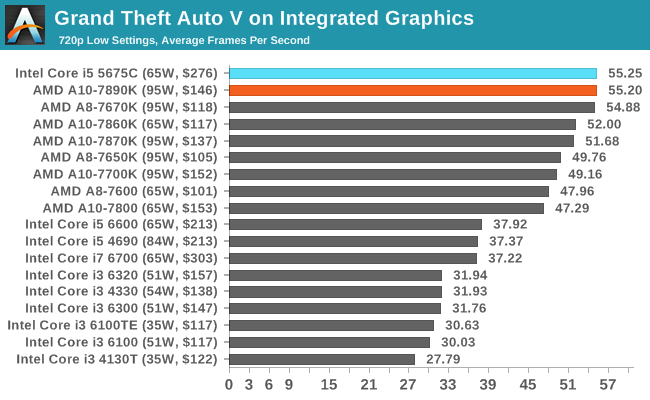
1: The CPU is not the bottleneck here; otherwise you'd see the normal ordering where the i3 comes out ahead. Other GPU benchmarks prove the CPU isn't a limiting factor here. You are seeing iGPU performance, and you see Intels latest offerings beat AMDs latest offerings, even before we take Iris Pro into account.

2: APUs are clearly starved by memory bandwidth; numerous tests show performance scaling linearly with RAM speed. DDR4 helps, but you still have very long memory read times which limit overall performance. At the end of the day, regardless of how much processing power you have, if you can't provide the data, performance tails off. And we've reached the point where the memory bus, rather then the iGPU itself, is becoming the primary limiting bottleneck for integrated graphics.

3: The reason AMD was chosen for consoles this generation come down to several factors:

a: Both Sony and Microsoft wanted to move away from the POWER architecture. As ARM doesn't have the necessary performance, this necessitated x86 based hardware.

b: Both companies wanted significantly cheaper consoles this go around; everyone remembers the debacle that was the $600 PS3.

c: Power requirements for consoles are tight, requiring very low power draw at load. This necessitated integrated graphics rather then a discrete card [which has the side effect of also reducing unit cost].

These three requirements basically necessitated AMD, due to its [at the time] superior performance on its APUs at lower power draw. From there, you naturally drove the other system specs [pooled GDDR5, etc] to maximize performance on that specific architecture.

It's worth noting that CPU performance is actually LOWER this generation; especially in Sonys case, the PS4 is about 60 GFLOPs slower on average [the Cell was, and still is, a BEAST of a CPU, architectural headaches aside]. The performance gain is due to the vast increase in RAM [up from 256MB] and improved GPUs [no longer being 7800 GTX/2950XT based]. Perhaps the relatively weak CPU performance explains the early rush for more powerful console hardware this generation?
 
I don' t see anyone showing frametime graphs even testing Intel iGPUs.

You really can't test Intel's GPU hardware on Linux because the driver is in such a sorry state. You can't compare hardware when the hardware isn't used properly.

Intel iGPUs generally get tested once per generation, and they've been showing significant performance gains (40% on average). Intel has been very heavily focused on increasing their performance on their iGPU, mainly because they DESPERATELY want to move into mobile. That's partially why CPU performance gains are limited strictly to architectural improvements, as the majority of die space added due to die shrinks is going directly to the iGPU.
You miss the point: i talk about frametimes on Intel iGPUs in Windows environement. It just so happens that publications that test frametimes, don't test intel gpus.

In linux case, literally nobody tracks frametimes on any dGPU, to top it off.
 
You really can't test Intel's GPU hardware on Linux because the driver is in such a sorry state. You can't compare hardware when the hardware isn't used properly.

Intel iGPUs generally get tested once per generation, and they've been showing significant performance gains (40% on average). Intel has been very heavily focused on increasing their performance on their iGPU, mainly because they DESPERATELY want to move into mobile. That's partially why CPU performance gains are limited strictly to architectural improvements, as the majority of die space added due to die shrinks is going directly to the iGPU.

Do you use linux? Because, I use linux and the intel drivers are pretty damn good.
 
came looking for new zen info, found bullshit...
go start another thread to argue about igpus, Linux, consoles, intel frame times(WTF?!) and all the other NON ZEN shit, FFS!
 
Since AMD has been so quiet, I expect we will continue the BS discussion for 4 to 6 more months. Although I do expect more leaks..
 
So far the Zen bencmarks have ranged from as slow as Sandy Bridge to slightly faster than Broadwell in terms of IPC. I'm getting sick of this speculation and am about to jump on Haswell/Skylake.
 
Since AMD has been so quiet, I expect we will continue the BS discussion for 4 to 6 more months. Although I do expect more leaks..

Leaks based on the engineering sample , no thank you :).

Best we can hope for is some screw up from motherboard vendor showing clocks and configurations ;) .
 
A few points:

1: The CPU is not the bottleneck here; otherwise you'd see the normal ordering where the i3 comes out ahead. Other GPU benchmarks prove the CPU isn't a limiting factor here. You are seeing iGPU performance, and you see Intels latest offerings beat AMDs latest offerings, even before we take Iris Pro into account.

Anand released Bristol Ridge iGPU benches. Please stop this nonsense that Intel is beating AMD's GPUs. It's just not the case. Yes. That's Iris Pro AMD is nipping at with no on die cache.

83864.png
 
Anand released Bristol Ridge iGPU benches. Please stop this nonsense that Intel is beating AMD's GPUs. It's just not the case. Yes. That's Iris Pro AMD is nipping at with no on die cache.

83864.png
^ This

The thing to take away from this graph isn't the A10 7890K, It's that A8 7600... You can buy those things for $80 all day long, Show me an Intel CPU that can handle light gaming and consumer-level tasking as well for $80... None... If you buy Intel, you either aren't expecting anything from the iGPU or you're at LEAST buying a $60 dedicated card... Iris Pro is cheating, and still can only keep up with APUs half its price. Sure, the i5 is more impressive when running just CPU benchmarks, but we aren't talking about running render farms with an APU either. We're talking about a general use, low-cost CPU that has the most bang for the buck. Not having to drop another $60 or so just to play a few games... Talking about building a general-use PC for everyday tasks and entertainment, etc... That's where AMD should be shining, especially with OEMs. OEMs screwed AMD over with laptops by underclocking their APUs in order to get a lower TDP, and then kicking them again by making the memory controller deal with a single channel motherboard... Then for the Icing on the cake, they overcharge for AMD in order to keep Intel on top...

AMD should have started building their own laptops, since none of the OEMs are doing it right...


AMD should put in place some rules that the OEMs need to follow to get the best optimization.
 
Would I be wrong in saying AMD needs the OEMs more than they need AMD?
AMD needs to make a product remotely worth buying in the CPU market. They probably will, with Zen.
Bulldozer has been the biggest fail the CPU market has ever seen or hopefully will see
 
AMD needs to make a product remotely worth buying in the CPU market. They probably will, with Zen.
Bulldozer has been the biggest fail the CPU market has ever seen or hopefully will see

No....

The biggest failure in the CPU market was Pentium 4. (Williamette, Northwood, Gallatin, and Prescott) And it's supposed successor "Tejas", which was taped out but never released because of a 150 watt TDP for a single core processor. In fact Intel publicly claimed that the architecture would top out at 10Ghz! (talk about screwed up marketing!)

And by extension- it could be said that the Thunderbird and Athlon XP lines that competed against it were perhaps over valued because those Pentium 4 cores sucked so bad.

True- AMD did produce a dog with Bulldozer. But nothing will equal the stinking turd that was the Pentium 4.
 
The biggest failure in the CPU market was Pentium 4. (Williamette, Northwood, Gallatin, and Prescott) And it's supposed successor "Tejas", which was taped out but never released because of a 150 watt TDP for a single core processor. In fact Intel publicly claimed that the architecture would top out at 10Ghz! (talk about screwed up marketing!)

I would put bulldozer as a close second to that. Intentionally designing cores with significantly lower IPC than Intel and trying to make up for that using a much higher frequency (around double the frequency was needed) was not going to work well without greatly superior silicon to what Intel had.
 
Last edited:
I would put bulldozer as a close second to that. Intentionally designing cores with significantly lower IPC than Intel and trying to make up for that using a much higher frequency (around double the frequency was needed) was not going to work well without greatly superior silicon to what Intel had.

I would have to agree since I believe Intel tried that with Netburst and failed....so AMD knew it was a failed idea but did it anyway.
 
The thing is that P4 didn't damage Intel nearly as bad as bulldozer crippled AMD.
One might be a bigger architectural failure than the other but Bulldozer was clearly the bigger failure to the company in terms of business.

They destroyed their bread and butter product.
 
Dozer had a rough launch, It really really needed the die shrink to 22nm, being stuck on 32nm cause them to have to throw out all the plans they had for the thing.

The crippled caching system is probably what killed it more then anything else, the l1 cache on the bulldozer/piledriver chips has hideous latencies, and is far to narrow for its duel core module setup their is only 1 l1 instruction cache per module with 26byte read width for both cores, They need a dual ported 28byte or better width to the l1, or 2 separate l1 instruction caches, I get the impression this was cut due to 32nm. Dozer was also planned to have a micro op cache, but they had to be cut to fit on 32nm process, Originally the refresh was supposed to support reverse SMT, where the scheduler could barrow unused execution unit slots from the adjacent core, again cut due to 32nm, this feature requires the unified decoder to work, so when they went dual decoders the idea was abandoned, also needs the micro op cache to really see a benefit. They used microcode to disable some cache prefetch features due to a bug.

Dozer was a litteny of failures, They really should have delayed it another generation, and shrunk the k10 cores for another generation(my phenom II was a great chip). They should have atleast fixed the cache issue, not just the bugs as piledriver did do, but fix the width issue. I really don't know wtf AMD's management was thinking, to much panic mode decision making possibly.

The design isn't bad however, its just their implementation was horrid.
Dozer was intiially planned for 45nm, so no, it was not cut for 32nm. Not to mention that even "cut" it's inadequately large.
 
The thing is that P4 didn't damage Intel nearly as bad as bulldozer crippled AMD.
One might be a bigger architectural failure than the other but Bulldozer was clearly the bigger failure to the company in terms of business.

They destroyed their bread and butter product.

Netburst was only a failure in the form of the Willamette and Prescott. Northwood were competitive with AMD and Northwood-C in particular significantly outperformed Athlon XP. As a whole, nowhere even close to Faildozer.

Besides, Intel was beating the crap out of AMD on laptops since Pentium M.
 
Anand released Bristol Ridge iGPU benches. Please stop this nonsense that Intel is beating AMD's GPUs. It's just not the case. Yes. That's Iris Pro AMD is nipping at with no on die cache.

83864.png

This ...... and this is with a lot slower cpu. Put AMD's IGPU with Intels cpu and I think It would be better. Zen should do this.
 
Dozer was intiially planned for 45nm, so no, it was not cut for 32nm. Not to mention that even "cut" it's inadequately large.

45nm would never have provided the transistor budget they needed to make it. 32nm only barely did, And 28nm required the use of a hybrid mobile/gpu/cpu process, and the use of clock unfriendly high density libraries to pack enough transistors in to hit the ipc goals they should have been hitting in 2012, And that was after they abandoned almost all of the game changing features that would have eventually really made a huge difference. I will consed that AMD management should have allowed a larger die size target, I think they ended up discarding enough fab capacity that the difference would not have really hurt them much anyway.

I still find it odd they never released a 8450 running steamroller cores, and a 8550 running XV cores, Even stuck at 4ghz with 32/28nm process with a higher wattage then intel, it would have kept the difference in performance from growing so wide, and the better power management in steamroller and XV would also have helped. I am curious what XV core would perform like with a well designed l3 to help keep the thing fed.
 
This ...... and this is with a lot slower cpu. Put AMD's IGPU with Intels cpu and I think It would be better. Zen should do this.
There is no CPU bottleneck in action in those benches. Not even on weakest of CPUs there.

45nm would never have provided the transistor budget they needed to make it. 32nm only barely did, And 28nm required the use of a hybrid mobile/gpu/cpu process, and the use of clock unfriendly high density libraries to pack enough transistors in to hit the ipc goals they should have been hitting in 2012, And that was after they abandoned almost all of the game changing features that would have eventually really made a huge difference. I will consed that AMD management should have allowed a larger die size target, I think they ended up discarding enough fab capacity that the difference would not have really hurt them much anyway.

I still find it odd they never released a 8450 running steamroller cores, and a 8550 running XV cores, Even stuck at 4ghz with 32/28nm process with a higher wattage then intel, it would have kept the difference in performance from growing so wide, and the better power management in steamroller and XV would also have helped. I am curious what XV core would perform like with a well designed l3 to help keep the thing fed.
Sorry, but you are just giving explanation why Bulldozer sucked so hard: it required larger transistor budget than Phenom II (per core) for less/comparable performance. In fact, you are now giving a justification by claiming there were not enough transistors! If anything, that just spells out exact reason Bulldozer as design was bad.

As for lack of 8450/8550 it's easy as peanuts: selling 300+mm^2 dies for under $200 is not exactly worth the budget required to develop them.

EDIT: Credit where it's due: SemiAccurate Forums - View Single Post - Official AMD Zen uarchitecture thread
Benches in the post: AMD Corporation Diesel vs AMD Corporation Diesel - Geekbench Browser

I would not take those too seriously ( i mean, 32-bit Linux in 2016, wut). But hey, it's funny as hell still
 
Last edited:
8 core piledriver is 1.2 billion transistors with 315mm^2 area on 32nm process, 4core+igpu Bristol ridge is 3.1 billion transistors with 250.4 mm^2 area on 28nm process, They already passed the 300mm^2 space for the thing in the first place, And the uarch clearly could do 4ghz on their 28nm hybrid process, which was available for steamroller(kavari used it). Hell with the surprising density of the 28nm process they could have really increased their transistor budget by alot and still hit the sub 300mm^2 target for die size.
 
Netburst was only a failure in the form of the Willamette and Prescott. Northwood were competitive with AMD and Northwood-C in particular significantly outperformed Athlon XP. As a whole, nowhere even close to Faildozer.

Besides, Intel was beating the crap out of AMD on laptops since Pentium M.
True.. Northwood-C was the best chip on the market until A64 came out. AXP was at least competitive, but after their flirtation with superiority during the Athlon days, AMD was definitely caught and surpassed by Northwood-C. Intel just failed to recognize that increasing clock speeds wasn't a viable long term strategy for growth. The thing is, even at its absolute worst, I don't think Intel's products were ever as far behind the top AMD products as AMD's stuff is right now.... and I say this as a former AMD CPU fanboy. Prescott had more feathers in its cap than Bulldozer. Bulldozer was a turd unlike anything Intel has ever really laid at the feet of enthusiasts.
 
Back
Top