If like me you have a long list of vintage of hardware you want to hold on to without having to explain why (those who know, know) but space is an issue, if you have a built and working X79 and X99 platform, are attached to both but accept that you only have space for one, which do you keep?
![[H]ard|Forum](/styles/hardforum/xenforo/logo_dark.png)
Navigation
Install the app
How to install the app on iOS
Follow along with the video below to see how to install our site as a web app on your home screen.
Note: This feature may not be available in some browsers.
More options
You are using an out of date browser. It may not display this or other websites correctly.
You should upgrade or use an alternative browser.
You should upgrade or use an alternative browser.
X79 or X99 - which to keep?
- Thread starter sphinx99
- Start date

- Joined
- Jan 7, 2020
- Messages
- 1,784
Just do what I do, keep them both and buy more.
That’s what I have been doing but I want to change my ways. Which would you pick and why?Just do what I do, keep them both and buy more.

acquacow
Gawd
- Joined
- Mar 7, 2016
- Messages
- 515
I still have about 5 or 6 x99 machines. There are great processor options, you can drop in xeon chips and get ECC support. Add in a NanoKVM and you have headless, remotely-powered servers.

- Joined
- Jul 11, 2001
- Messages
- 12,831
X99 would seem to be the easy choice here-
-X99 + Haswell-E/Broadwell-E uses DDR4 which is a lot more current/relevant, and faster than DDR3.
-There were architectural improvements in Haswell which *may* eventually give those CPUs more longevity than older CPUs as newer OS versions eventually cut-off support for older CPUs in the future.
-A Xeon E5-1660 V3, which is the equivalent of an i7-5960X Extreme Edition (including being unlocked and overclockable) can be found stupid cheap on places like eBay right now. I've put these in every X99 system that I still have. Even though these are Haswell-E CPUs, I'd still consider them the best CPU for the platform at this point (Gaming / General Purpose) since they are more overclockable than Broadwell-E CPUs to the point of easily making up for the the tiny performance increase that Broadwell had over Haswell.
-X99 has better NVMe support overall compared to X79, even if it involves using a PCIe to NVMe adapter card.
I'm still using an X99 + Xeon E5-1660 V3 in both my backup gaming system and my Fileserver / Plex server, and I don't see that changing any time soon as I continue to be impressed with the performance and longevity of both systems.
-X99 + Haswell-E/Broadwell-E uses DDR4 which is a lot more current/relevant, and faster than DDR3.
-There were architectural improvements in Haswell which *may* eventually give those CPUs more longevity than older CPUs as newer OS versions eventually cut-off support for older CPUs in the future.
-A Xeon E5-1660 V3, which is the equivalent of an i7-5960X Extreme Edition (including being unlocked and overclockable) can be found stupid cheap on places like eBay right now. I've put these in every X99 system that I still have. Even though these are Haswell-E CPUs, I'd still consider them the best CPU for the platform at this point (Gaming / General Purpose) since they are more overclockable than Broadwell-E CPUs to the point of easily making up for the the tiny performance increase that Broadwell had over Haswell.
-X99 has better NVMe support overall compared to X79, even if it involves using a PCIe to NVMe adapter card.
I'm still using an X99 + Xeon E5-1660 V3 in both my backup gaming system and my Fileserver / Plex server, and I don't see that changing any time soon as I continue to be impressed with the performance and longevity of both systems.

- Joined
- Oct 20, 2010
- Messages
- 1,709
Pretty sure it's the 1680 V2 that is the 5960X equivalent.X99 would seem to be the easy choice here-
-X99 + Haswell-E/Broadwell-E uses DDR4 which is a lot more current/relevant, and faster than DDR3.
-There were architectural improvements in Haswell which *may* eventually give those CPUs more longevity than older CPUs as newer OS versions eventually cut-off support for older CPUs in the future.
-A Xeon E5-1660 V3, which is the equivalent of an i7-5960X Extreme Edition (including being unlocked and overclockable) can be found stupid cheap on places like eBay right now. I've put these in every X99 system that I still have. Even though these are Haswell-E CPUs, I'd still consider them the best CPU for the platform at this point (Gaming / General Purpose) since they are more overclockable than Broadwell-E CPUs to the point of easily making up for the the tiny performance increase that Broadwell had over Haswell.
-X99 has better NVMe support overall compared to X79, even if it involves using a PCIe to NVMe adapter card.
I'm still using an X99 + Xeon E5-1660 V3 in both my backup gaming system and my Fileserver / Plex server, and I don't see that changing any time soon as I continue to be impressed with the performance and longevity of both systems.
Used to run an Asus Rampage IV and 3970X. Great system. Upgraded to Ryzen when it came out and never looked back.
- Joined
- Jul 11, 2001
- Messages
- 12,831
Pretty sure it's the 1680 V2 that is the 5960X equivalent.
Incorrect.
V2 would indicate Ivy Bridge-E. V3 is the correct designation for Haswell-E (compatible with X99).
The E5-1660 V3 has the same specifications as the i7-5960X
i7-5960X:
https://www.intel.com/content/www/u...-20m-cache-up-to-3-50-ghz/specifications.html
E5-1660 V3:
https://www.intel.com/content/www/u...660-v3-20m-cache-3-00-ghz/specifications.html
Notice the identical specifications, including base clock, boost clock, core count, cache, etc.
The E5-1680 V3 is actually slightly faster than both:
https://www.intel.com/content/www/u...680-v3-20m-cache-3-20-ghz/specifications.html
However, the catch is that the E5-1680 V3 tends to carry a price premium over the E5-1660 V3 on the used market, but because both CPUs are multiplier unlocked, you can simply overclock the 1660 V3 to match the 1680 V3. In fact, the CPU can be overclocked much further quite easily, making the tiny difference in stock settings between the 1660 and 1680 CPUs quite meaningless.
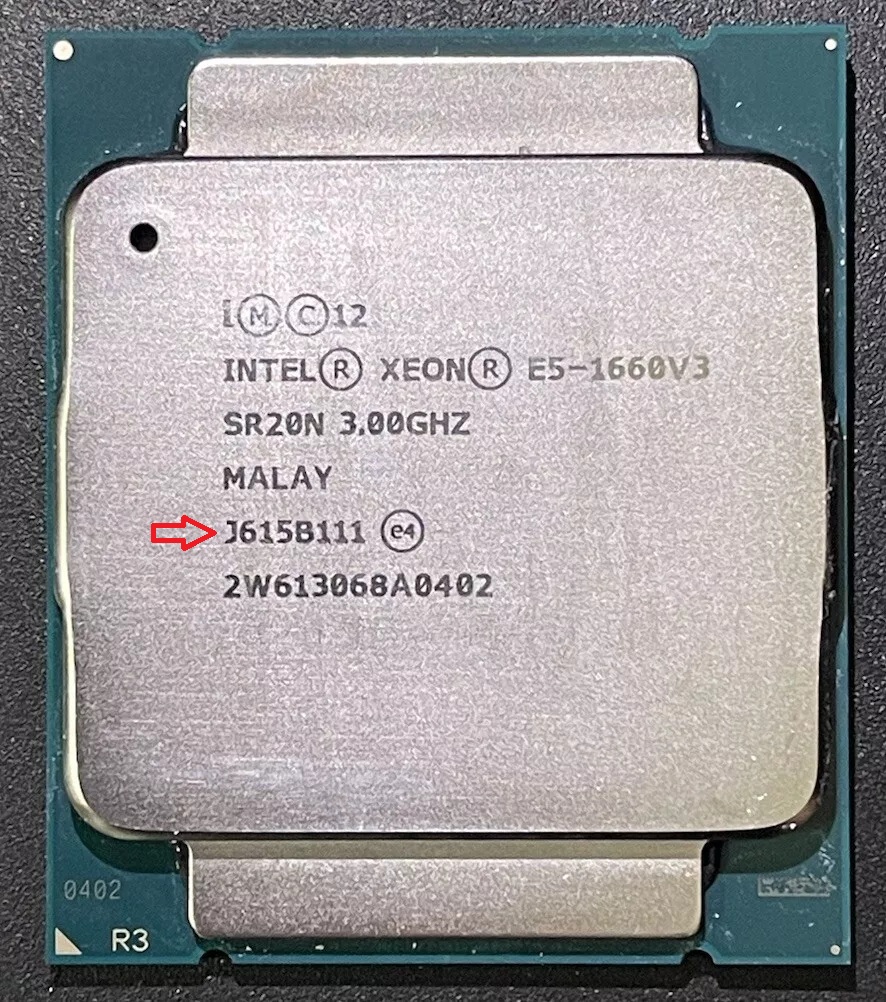
If you're concerned with achieving max clocks, then what you want to look for is a "J Batch" CPU, as these will often overclock 200-300Mhz faster than the others. That's what I'm running in my backup gaming system at 4.7Ghz.
"J Batch" CPU:

funkydmunky
2[H]4U
- Joined
- Aug 28, 2008
- Messages
- 4,018
X-79. It will have retro value sooner.
X99 has AVX2 support so still runs all modern stuff. My daily is on X99 and still does everything I have any desire to do on a Windows PC at this point, and I feel zero need to upgrade from it anytime soon (see signature)! Best part was I paid a whole $20 for my current 2667V4 8-core/16-thread CPU! Keep the X99 system!
- Joined
- Oct 20, 2010
- Messages
- 1,709
Incorrect.
V2 would indicate Ivy Bridge-E. V3 is the correct designation for Haswell-E (compatible with X99).
The E5-1660 V3 has the same specifications as the i7-5960X
i7-5960X:
https://www.intel.com/content/www/u...-20m-cache-up-to-3-50-ghz/specifications.html
E5-1660 V3:
https://www.intel.com/content/www/u...660-v3-20m-cache-3-00-ghz/specifications.html
Notice the identical specifications, including base clock, boost clock, core count, cache, etc.
The E5-1680 V3 is actually slightly faster than both:
https://www.intel.com/content/www/u...680-v3-20m-cache-3-20-ghz/specifications.html
However, the catch is that the E5-1680 V3 tends to carry a price premium over the E5-1660 V3 on the used market, but because both CPUs are multiplier unlocked, you can simply overclock the 1660 V3 to match the 1680 V3. In fact, the CPU can be overclocked much further quite easily, making the tiny difference in stock settings between the 1660 and 1680 CPUs quite meaningless.
If you're concerned with achieving max clocks, then what you want to look for is a "J Batch" CPU, as these will often overclock 200-300Mhz faster than the others. That's what I'm running in my backup gaming system at 4.7Ghz.
"J Batch" CPU:
View attachment 724085
You're right. I was thinking the 1680 V2 but that's only because back when I had my X79 system that was essentially the best upgrade. Its performance was close to the 5960X when overclocked. The 1680 V3 in and 5960X weren't an upgrade option for me at the time.