• Some users have recently had their accounts hijacked. It seems that the now defunct EVGA forums might have compromised your password there and seems many are using the same PW here. We would suggest you UPDATE YOUR PASSWORD and TURN ON 2FA for your account here to further secure it. None of the compromised accounts had 2FA turned on.
    Once you have enabled 2FA, your account will be updated soon to show a badge, letting other members know that you use 2FA to protect your account. This should be beneficial for everyone that uses FSFT.

Where is AMD's Tegra?

JoeUser

2[H]4U
Joined
Mar 30, 2010
Messages
3,919
I mean, really. Why hasn't/isn't AMD working on a Tegra like SOC?

Nvidia has been crushing competition with the Tegra 2 and 3 which seem to be in every other tablet...so what is AMD doing? Sitting there with a thumb up their ass?

And it's not even that damn hard to do...not like Nvidia designed the Tegra silicon from the ground up...they're using ARM CPU's and tacking on a low powered GPU onto it.

Why isn't AMD trying to do the same?

Just seems like they're WANTING to die and fade away, Sheesh...
 
I believe that's what they're shooting for with Bobcat - though unlike Tegra, Bobcat will run Windows 8 instead of Windows RT, so that would put it at an advantage, in terms of software.

EDIT: Though they did just announce that they're working on some ARM CPUs, but those will be for servers.
 
I believe that's what they're shooting for with Bobcat - though unlike Tegra, Bobcat will run Windows 8 instead of Windows RT, so that would put it at an advantage, in terms of software.

EDIT: Though they did just announce that they're working on some ARM CPUs, but those will be for servers.

amd will have the x86 mobile market on lock next year as intel has nothing to compete with a 2/4 core 28nm apu on cpu performance and graphics performance. it will essentially be a killer chip for windows 8 pro tablets. as for the arm cpu's its just an arm ip block to combine with its own ip remember the presentation where this was outlined earlier this year the arm deal is just amd actually executing for once :eek:
 
Adreno (Anagram) = Radeon

Qualcomm's line-up is like the AMD against Nvidia's Tegra
 
Adreno (Anagram) = Radeon

Qualcomm's line-up is like the AMD against Nvidia's Tegra

yep that was a fail of a sell. i do believe dirk selling off assets is what ultimately got him shit canned once the board saw the future was in mobile then an oh shit moment when thats what dirk sold off last year

"3) Completely missing the perspective on handheld space - selling Imageon to Qualcomm, Xilleon to BroadCom"

http://www.brightsideofnews.com/news/2011/1/10/coup-at-amd-dirk-meyer-pushed-out.aspx

That lost them customers and pissed off those former customers off in the process. doing so did not does not bring in a flood of new customers at all it was a signal to the industry stay away cause we may screw you with out the customary reach around
 
Last edited:
lol i do remember xilleon, got one in my shitty ass westinghouse hdtv
 
amd will have the x86 mobile market on lock next year as intel has nothing to compete with a 2/4 core 28nm apu on cpu performance and graphics performance. it will essentially be a killer chip for windows 8 pro tablets. as for the arm cpu's its just an arm ip block to combine with its own ip remember the presentation where this was outlined earlier this year the arm deal is just amd actually executing for once :eek:

Haswell's graphics performance will be greatly improved as well as its power consumption.

I'll be surprised if AMD competes well with Win 8 pro tablets considering intel's progress at 22nm, but who knows maybe they'll pull a rabbit out of their hat.
 
Haswell's graphics performance will be greatly improved as well as its power consumption.

I'll be surprised if AMD competes well with Win 8 pro tablets considering intel's progress at 22nm, but who knows maybe they'll pull a rabbit out of their hat.

let me be really frank here 22nm haswell will not find its way into tablets and smartphones thats not what intel designed it for. haswell will not make it into tablets as it is not a tablet processor it is a desktop processor. Now intels atom is still manufactured on 45/32nm its not scheduled to be @22nm till late2013/ early 2014 with ivy bridge graphics. Amd's 28nm kabani is a mobile/tablet 2/4 core soc with radeon graphics. intel has to fight amd's 28nm apu with its 32nm atom and that is a battle that intel will loose every time. heck even the 22nm atom will still be hindered by ivy bridge graphics. Amd's shift to mobile next year makes sense as it will keep the lights on till other 2 next gen consoles launch since amd locked up all 3 (note the wii u is out already) and thats a steady stream of cash coming in.
 
Last edited:
I mean, really. Why hasn't/isn't AMD working on a Tegra like SOC?

Because years ago when Tegra was announced, everyone figured Nvidia was just trying to stay afloat after the Intel chipset lockout. Nobody at AMD at the time imagined that ARM would be competitive (or they would have never invested so heavily in Bulldozer).

And just because you don't have to develop the CPU doesn't mean it's just easy to throw everything else together and target a brand-new power-point. If it were that easy, AMD would have released Llano a whole lot earlier than they did.

And Nvidia has done much more for Tegra than just put a bunch of bits together on a die - they've been trying to sell this poor chip to the world over the last 3 years, and have taken advantage of every inroad possible.

Remember the original Tegra? Outdated ARM11 core running slower than Raspberry Pi, 32-bit DDR memory controller castrating performance, and TDP that was way too high for devices (so all those "design wins" turned into smoke)? Whatever devices featured this chipset were likely heavily discounted, and it was a huge loss of face and money for Nvidia.

Tegra 2 fixed the CPU and bandwidth problems, but still had too high a TDP to attract most phone makers (phones appeared a year after release, after yields improved), so Nvidia put all their efforts behind making Tegra 2 the prime launch platform for Honeycomb. This was a serious investment to make sure their driver sets were ready early (despite Android for tablets being rushed), and they made engineers available to OEMs to make sure the software ecosystem played nicely with the hardware. But it paid in spades as Nvidia became a top supplier for the new Android tablet market.

For AMD to just come along with their own Tegra-equivalent, expecting that level of industry adoption today would be asking way too much, because the Android ecosystem is now mature. And since they're fighting the same physics everyone else is, they would be unlikely to offer enough of a performance advantage to win-over customers purely on specs.

AMD already missed the boat on a massive growth market like Android, because they lacked the vision to believe mobile graphics could be a part of something big. I would not expect them to make smarter business decisions in the future, so I expect they're headed downward.
 
Last edited:
let me be really frank here 22nm haswell will not find its way into tablets and smartphones thats not what intel designed it for. haswell will not make it into tablets as it is not a tablet processor it is a desktop processor. Now intels atom is still manufactured on 45/32nm its not scheduled to be @22nm till late2013/ early 2014 with ivy bridge graphics. Amd's 28nm kabani is a mobile/tablet 2/4 core soc with radeon graphics. intel has to fight amd's 28nm apu with its 32nm atom and that is a battle that intel will loose every time. heck even the 22nm atom will still be hindered by ivy bridge graphics. Amd's shift to mobile next year makes sense as it will keep the lights on till other 2 next gen consoles launch since amd locked up all 3 (note the wii u is out already) and thats a steady stream of cash coming in.

http://forwardthinking.pcmag.com/no...-changes-plans-10-watt-version-new-brand-name

Your info is totally out of date. New Haswell will be even lower power than current Atoms. 10 watt haswell is designed specifically for the convertible and Win 8 pro markets. The new GPU changes and the lower idle state of Haswell make it ideal.

AMD doesn't really have anything to compete with that.
 
http://forwardthinking.pcmag.com/no...-changes-plans-10-watt-version-new-brand-name

Your info is totally out of date. New Haswell will be even lower power than current Atoms. 10 watt haswell is designed specifically for the convertible and Win 8 pro markets. The new GPU changes and the lower idle state of Haswell make it ideal.

AMD doesn't really have anything to compete with that.

Haswell dips down below 5W? You either have some precious info to share with the rest of us or you're mistaken... :p

*Some* Atoms? Yes, although that's the 45nm netbook Atoms of yesteryear. Current Atoms, aka Clover Trail and Medfield? No, Haswell is still higher in TDP and still meant for Ultrabooks and convertibles.

Low power sleep states have nothing to do with TDP.
 
I really think an evolution of Bobcat is where it's at for AMD. I gave my sister a Compaq CQ-57, I think it was, with a C-50 and 2GB DDR3 for her birthday last year. I had fixed up and took with me an Atom based ACER Netbook. As I was configuring it for her, I was finding I could not even play HD video at Netbook resolution with the Atom (1.6GHz single core). I ran out to Walmart and saw the Compaq, and I liked the look and the price (about $240 on clearance).. but was super scared of an AMD 1GHz dual-core. I got assurances from the Manager that I could return it if it did not perform for what I wanted. When I fired it up and removed all the pre-installed crapware, I was REALLY impressed. It chewed up everything I thought she should possibly ask of it, from HD AVIs played through VLC to Facebook games, and even EverQuest... If they build on Bobcat for a W8 Pro tablet, I think they will have a real winner, that could save AMD.. well, all except for the W8 part.
 
I really think an evolution of Bobcat is where it's at for AMD. I gave my sister a Compaq CQ-57, I think it was, with a C-50 and 2GB DDR3 for her birthday last year. I had fixed up and took with me an Atom based ACER Netbook. As I was configuring it for her, I was finding I could not even play HD video at Netbook resolution with the Atom (1.6GHz single core). I ran out to Walmart and saw the Compaq, and I liked the look and the price (about $240 on clearance).. but was super scared of an AMD 1GHz dual-core. I got assurances from the Manager that I could return it if it did not perform for what I wanted. When I fired it up and removed all the pre-installed crapware, I was REALLY impressed. It chewed up everything I thought she should possibly ask of it, from HD AVIs played through VLC to Facebook games, and even EverQuest... If they build on Bobcat for a W8 Pro tablet, I think they will have a real winner, that could save AMD.. well, all except for the W8 part.

bobcat 2.0 is in tablets the 28nm replacement for bobcat is your tablet/mobile apu of choice
 
bobcat 2.0 is in tablets the 28nm replacement for bobcat is your tablet/mobile apu of choice

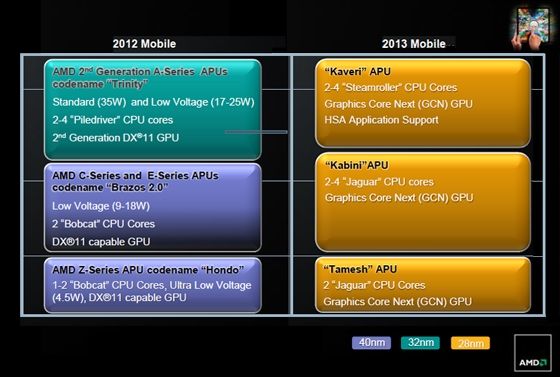
AMD-Intros-Jaguar-Based-Kabini-and-Temash-APUs-Next-Month-Not-Next-Year-3.jpg


Kaveri has been delayed or cancelled but Kabini and Tamesh are on schedule... although technically they're also a year late :p
 
If Kaveri is dead in the water, then AMD's promise of next-gen FM2 support is kinda empty. Balls. :(
 
Kaveri has been delayed or cancelled but Kabini and Tamesh are on schedule... although technically they're also a year late :p

Kabini and Tamesh are on schedule cause amd's focus is on the mobile sector and embedded for next year. (think wii u ps4 xbox next) Everything that is not Kabini or Tamesh or embedded consider scrapped. As the new chip architect most likely is revamping the desktop/server roadmap could it be for 28nm/22nm/20nm/14nm processes who knows. However i do know gf will have a 14nm fdsoi process ready in 2014. if amd's new chip man got neck deep into amd's designs its possible for the 28nm Kabini and Tamesh be on time and everything else but embedded be scrapped for simple refreshes to focus efforts on a 14nm server/desktop part
 
Last edited:
Kabini and Tamesh are on schedule cause amd's focus is on the mobile sector and embedded for next year. (think wii u ps4 xbox next) Everything that is not Kabini or Tamesh or embedded consider scrapped. As the new chip architect most likely is revamping the desktop/server roadmap could it be for 28nm/22nm/20nm/14nm processes who knows. However i do know gf will have a 14nm fdsoi process ready in 2014. if amd's new chip man got neck deep into amd's designs its possible for the 28nm Kabini and Tamesh be on time and everything else but embedded be scrapped for simple refreshes to focus efforts on a 14nm server/desktop part

I was thinking the same thing regarding a 14nm part sometime in 2014 but GloFo's 14nm-XM is catered around low power SoCs rather than high TDP parts, thus it might take longer for 14nm desktop, laptop, and server parts to appear. While a 14nm Tamesh type of SoC would probably be just fine for their 14nm-XM process, a 100W+ server chip might be stretching it.

It also doesn't make sense for AMD to outright cancel/delay Steamroller in desktop/server/APU form if they were on schedule. Chances are that the rumors regarding the chips not being taped out were true and AMD decided to just scrap them or delay them and work on their architecture in order to make future iterations more competitive with Haswell and Broadwell.

Keep in mind that if AMD only offers Richland (Trinity v2.0) through 2013 and 2014 that would mean AMD will be competing against a 14nm Broadwell on a 28nm bulk process that's already very close -- in that it offers barely any benefits -- over their current 32nm SOI HKMG.

If that 14nm node doesn't fit well with AMD's chip designs going forward (or 16nm at TSMC) then there's no point in designing a chip at all. 28nm bulk against Intel's partially depleted 14nm FinFETs is a death wish.
 
I was thinking the same thing regarding a 14nm part sometime in 2014 but GloFo's 14nm-XM is catered around low power SoCs rather than high TDP parts, thus it might take longer for 14nm desktop, laptop, and server parts to appear. While a 14nm Tamesh type of SoC would probably be just fine for their 14nm-XM process, a 100W+ server chip might be stretching it.

It also doesn't make sense for AMD to outright cancel/delay Steamroller in desktop/server/APU form if they were on schedule. Chances are that the rumors regarding the chips not being taped out were true and AMD decided to just scrap them or delay them and work on their architecture in order to make future iterations more competitive with Haswell and Broadwell.

Keep in mind that if AMD only offers Richland (Trinity v2.0) through 2013 and 2014 that would mean AMD will be competing against a 14nm Broadwell on a 28nm bulk process that's already very close -- in that it offers barely any benefits -- over their current 32nm SOI HKMG.

If that 14nm node doesn't fit well with AMD's chip designs going forward (or 16nm at TSMC) then there's no point in designing a chip at all. 28nm bulk against Intel's partially depleted 14nm FinFETs is a death wish.

muuahaha i already detailed this in another thread we are talking near term 2013 only we will prob see 28nm fdsoi or even 20nm fdsoi amd chips but doubtful, 2014 will be new 14nm product as GF is following intel with just having 1 foundry process to rule them all (to fit all applications). GF has said this about 14nm-XM

"The company is calling this new process "14XM," for "extreme mobility." This is designed in particular to allow chips that use lower power and is focused around Mobile SoCs (system on chip). But Kengeri said that because the new transistors can scale so much, allowing different amounts of voltage to scale the frequency and thus the performance of the transistors, this single 14nm process should also be appropriate for CPUs and multi-core GPUs.

http://forwardthinking.pcmag.com/none/302957-GLOBALFOUNDRIES-sees-14nm-production-in-2014


so 2014 if GF and amd pull it off and amd has a 14nm chip to go up against haswell and beats it amd will have essentially risen from the ashes.
 
Last edited:
muuahaha i already detailed this in another thread GF is following intel with just having 1 foundry process to rule them all (to fit all applications). GF has said this about 14nm-XM

"The company is calling this new process "14XM," for "extreme mobility." This is designed in particular to allow chips that use lower power and is focused around Mobile SoCs (system on chip). But Kengeri said that because the new transistors can scale so much, allowing different amounts of voltage to scale the frequency and thus the performance of the transistors, this single 14nm process should also be appropriate for CPUs and multi-core GPUs.

http://forwardthinking.pcmag.com/none/302957-GLOBALFOUNDRIES-sees-14nm-production-in-2014

Now you see what i am speculating makes some sense. i mean the pieces do fit

That doesn't state anything regarding the timing, though. For example, Intel's Atoms won't catch up to their laptop/server chips in node/process until late 2013 and probably 2014. Which is to say, a 14nm node may work, but it could take months of additional work for a 100W+ TDP chip to use the same process as the 5W SoCs that are being fabricated on its processes. And then, would you call it 14nm-XM? Probably not.

It still doesn't answer why AMD would flat out cancel/delay Steamroller on 28nm either. That makes absolutely no sense unless they haven't taped it out yet or they don't feel that it stands up well against the likes of Haswell. The cancel/delay of Steamroller derived chips has nothing to do with any 14nm node looming in the future. You don't delay two products made around 28nm unless there are unforeseen problems. AMD's Excavator cores should have been close to done, and there's going to be additional year (and likely year and a half) of work dedicated to moving Steamroller to a separate node and process or readjusting Excavator. That's what you're implying... that doesn't make any sense at all. Delay/cancel a product and then wait another 2 years to come up with another? If GloFo's 14nm process is viable for AMD in a short amount of time after SoCs are coming off the line (or TSMC's 16nm), then Steamroller is likely cancelled and not delayed. Excavator would be the design that's being pushed and designed around 14nm, or whatever node AMD has available to them.
 
That doesn't state anything regarding the timing, though. For example, Intel's Atoms won't catch up to their laptop/server chips in node/process until late 2013 and probably 2014. Which is to say, a 14nm node may work, but it could take months of additional work for a 100W+ TDP chip to use the same process as the 5W SoCs that are being fabricated on its processes. And then, would you call it 14nm-XM? Probably not.

It still doesn't answer why AMD would flat out cancel/delay Steamroller on 28nm either. That makes absolutely no sense unless they haven't taped it out yet or they don't feel that it stands up well against the likes of Haswell. The cancel/delay of Steamroller derived chips has nothing to do with any 14nm node looming in the future. You don't delay two products made around 28nm unless there are unforeseen problems. AMD's Excavator cores should have been closed to done, and there's going to be additional year (and likely year and a half) of work dedicated to moving Steamroller to a separate node and process or readjusting Excavator.

So, no, what you're saying doesn't make any sense at all.

first off do you see any intel 22nm 100w parts no if you do let me know last i checked they where capped at 77 watts.

second off what i am speculating does make sense why waste resources on a chip that will end up a looser that will only give you a 5- 15% performance increase that would still be behind intel in performance. the new chip architect most likely scraped the desktop/server roadmap and realign it for a 14nm part in 2014. since the14nm chip Processor Development Kits are already out since september of this year and most likely in the hands of amd. it takes about 2 years from prototype to tape-out to production this would amd on track for a 14nm chip 2h 2014 early 2015.

amd is focused on mobile and the embedded space for 2013. why amd locked up all 3 next gen consoles and those delivery dates can not slip. its as simple as focus your resources on the company's money streams and come out with swinging with a 14nm server/desktop part around the same time intel has one and see who comes out on top when intel does not have a process advantage. its really simple not saying they are doing this but i was them it would what i would focus on. simple common sense
 
Last edited:
They're not "capped at 77 watts." Ivy Bridge E will tip over that and so will the server variants.

Wasting resources would be cancelling and delaying a chip that was scheduled for release in 9 months, scrapping it and then stumbling about trying to get it to fit a 14nm node that may or may not work for you in 2014.

How does cancelling/delaying a product, any product, make sense? How does adding 2 years to another release, millions of dollars and reallocating resources (and engineers) within the company make sense?

But we don't know any of that. We know that we'll only be seeing a Richland, Trinity refresh on 28nm in 2013 with Kabini and Temash bringing up the low TDP range (from 4.5W to ~20W). The high end? Absolutely nothing. So we know Steamroller, as far as AMD roadmaps are concerned, doesn't exist. AMD hasn't even said anything regarding what node, or who, they'll be using for any future products. In fact, they haven't even said a word about any other products at all other than potential 64-bit A50-based ARM server chips with SeaMicro fabric.
 
first off do you see any intel 22nm 100w parts no if you do let me know last i checked they where capped at 77 watts.

second off what i am speculating does make sense why waste resources on a chip that will end up a looser that will only give you a 5- 15% performance increase that would still be behind intel in performance. the new chip architect most likely scraped the desktop/server roadmap and realign it for a 14nm part in 2014. since the14nm chip Processor Development Kits are already out since september of this year and most likely in the hands of amd. it takes about 2 years from prototype to tape-out to production this would amd on track for a 14nm chip 2h 2014 early 2015.

amd is focused on mobile and the embedded space for 2013. why amd locked up all 3 next gen consoles and those delivery dates can not slip. its as simple as focus your resources on the company's money streams and come out with swinging with a 14nm server/desktop part around the same time intel has one and see who comes out on top when intel does not have a process advantage. its really simple not saying they are doing this but i was them it would what i would focus on. simple common sense

Xeon Phi, 300W for the whole card, that's at least 200W for the 22nm chip.
 
In comes the trolls to the first off the ivy bridge e will not see the light of day till late 2013/eairly 2014 when haswell is about to be released.

Now take what is happening at amd like this you know your cpu is going to be a looser and will will be behind in performance to a cash rich intel. do you continue down the path to bleed money or do you stop it. obviously you have to stop the bleeding and fast.

two things have happened at amd that may have stopped that bleeding. they hired a new very seasoned and experienced chip architect and a couple of months later steamroller vanishes from road-maps and we get word of piledriver 2.0 trinity 2.0 and two new 28nm mobile cpu's. the 28nm low power apu's will own the mobile x86 market think windows 8 pro tablets and x86 smartphones as intels atom will still be manufactured on a 32nm node with abysmal graphics. Hell the situation doesn't improve in 2014 when a 22nm atom comes out with ivy bridge class graphics.
The bottom line is Amd caught intel napping with the bobcat apu's. that trend is looking to continue till at least late 2014.

Now it looks like steamroller was scrapped and vital resources where redirected to the embedded xbox 720/ps 4 projects both have real world dead lines that can not slip no matter what since contracts have been signed and a delivery date is in the contract. Amd is already getting cash from nintendo and they have to deliver to get cash from sony and microsoft having all 3 consoles puts amd in a very good position in the gaming world not to mention the 6 - 10 years of cash the consoles will generate for amd

lastly off the Xeon Phi is 300 or so tweaked p5c's at 22nm trying to act like a gpu and failing miserably not a consumer grade desktop/server cpu so your comparison is baseless and meaningless
 
Last edited:
In comes the trolls to the first off the ivy bridge e will not see the light of day till late 2013/eairly 2014 when haswell is about to be released.

Now take what is happening at amd like this you know your cpu is going to be a looser and will will be behind in performance to a cash rich intel. do you continue down the path to bleed money or do you stop it. obviously you have to stop the bleeding and fast.

two things have happened at amd that may have stopped that bleeding. they hired a new very seasoned and experienced chip architect and a couple of months later steamroller vanishes from road-maps and we get word of piledriver 2.0 trinity 2.0 and two new 28nm mobile cpu's. the 28nm low power apu's will own the mobile x86 market think windows 8 pro tablets and x86 smartphones as intels atom will still be manufactured on a 32nm node with abysmal graphics. Hell the situation doesn't improve in 2014 when a 22nm atom comes out with ivy bridge class graphics.
The bottom line is Amd caught intel napping with the bobcat apu's. that trend is looking to continue till at least late 2014.

Now it looks like steamroller was scrapped and vital resources where redirected to the embedded xbox 720/ps 4 projects both have real world dead lines that can not slip no matter what since contracts have been signed and a delivery date is in the contract. Amd is already getting cash from nintendo and they have to deliver to get cash from sony and microsoft having all 3 consoles puts amd in a very good position in the gaming world not to mention the 6 - 10 years of cash the consoles will generate for amd

lastly off the Xeon Phi is 300 or so tweaked p5c's at 22nm trying to act like a gpu and failing miserably not a consumer grade desktop/server cpu so your comparison is baseless and meaningless


The Xeon Phi is not a gpu what so ever...It is an add card with 60 cores/240 threads designed to run massively parallel applications which AMD/Nvidia GPUs just happen to be able to do aside from render games..
 
The Xeon Phi is not a gpu what so ever...It is an add card with 60 cores/240 threads designed to run massively parallel applications which AMD/Nvidia GPUs just happen to be able to do aside from render games..

yes a card a card fits in a slot not a socket like a consumer cpu and it was primarily developed as a gpu architecture. the xeon phi accelerator card is a piss poor gpu concept that has been shoehorned into a competitive accelerator card ?!?!

http://semiaccurate.com/2009/12/04/intel-kills-consumer-larrabee-focuses-future-variants/

back on topic in 2014 amd will have an arm cpu in the server space and if its necessary one in the consumer space i mean honestly its just a arm cpu ip block combined with amd's x86 cpu / gpu ip blocks it wont be that hard to pull off
 
yes a card a card fits in a slot not a socket like a consumer cpu and it was primarily developed as a gpu architecture. the xeon phi accelerator card is a piss poor gpu concept that has been shoehorned into a competitive accelerator card ?!?!

http://semiaccurate.com/2009/12/04/intel-kills-consumer-larrabee-focuses-future-variants/

back on topic in 2014 amd will have an arm cpu in the server space and if its necessary one in the consumer space i mean honestly its just a arm cpu ip block combined with amd's x86 cpu / gpu ip blocks it wont be that hard to pull off

Again, you're jumping to conclusions and ignoring facts and statements by AMD themselves, basing your assumptions on nothing other than "Well, I think..."

CHIP DESIGNER AMD said it needs to get ARM CPU cores accessing the same memory as its GPU cores before it can bring out ARM accelerated processing units (APU).
AMD's decision to design ARM chips for servers means that the firm can combine the ARMv8 architecture with its own GPU, something the firm already revealed to The INQUIRER. Now AMD has said that it needs to ensure both the CPU and GPU can access the same shared memory before it will launch an ARM based APU.
Suresh Gopalakrishnan, corporate VP and GM of AMD's Server Business Unit told The INQUIRER the firm could already design an ARM chip with a CPU and GPU that would each have their own memory, however that won't bring the advantages in both programmability and performance of having a shared memory structure between the two cores. He also talked up OpenMP support in future ARM APUs, an application programming interface that both Nvidia and Intel are working to support in their Tesla and Xeon Phi accellerators, respectively, for sharing memory among different cores.
Gopalakrishnan said, "You'll see the ARM APU first [before an Opteron APU]. You'll see the first ARM APU at a similar time as the first ARM chip. The value proposition [of an APU] is that we can go to the memory controller to access a common memory pool, that is what we have already done between our X86 and GPU cores. ARM has joined the HSA foundation and we have some work to do to make the ARM [core] and the GPU access the same memory. [...] Once that is done we can bring an ARM APU to the market."

The Inquirer (http://s.tt/1t4xu)

Bolting it on-die would be like the first iteration of APUs in Llano and Brazos. Getting them to work together (that's the point in a server variant, no?) isn't that easy.

The Xeon Phi is not a gpu what so ever...It is an add card with 60 cores/240 threads designed to run massively parallel applications which AMD/Nvidia GPUs just happen to be able to do aside from render games..

It's a GPU. It's the Larrabee project that was intended originally to be a GPU but was slightly tweaked to make an HPC GPGPU product that they call Xeon Phi/MIC/Knight's Corner. The best way to look at it would be a "co-processor", but, yes, it was originally meant as a GPU.
 
lastly off the Xeon Phi is 300 or so tweaked p5c's at 22nm trying to act like a gpu and failing miserably not a consumer grade desktop/server cpu so your comparison is baseless and meaningless

It doesnt matter WHAT the Xeon Phi IS. However it IS a >100W TDP part that is made on Intel's 22nm current gen lithography process.

first off do you see any intel 22nm 100w parts no if you do let me know last i checked they where capped at 77 watts.

So yes. You are wrong there are 22nm parts for big power.

And FWIW the Xeon Phi is actually quite competitive. It is not a piss-poor design in any way. You are just acting like a child now dude, come on act like an adult and don't revert to slang.
 
It doesnt matter WHAT the Xeon Phi IS. However it IS a >100W TDP part that is made on Intel's 22nm current gen lithography process.


So yes. You are wrong there are 22nm parts for big power.

And FWIW the Xeon Phi is actually quite competitive. It is not a piss-poor design in any way. You are just acting like a child now dude, come on act like an adult and don't revert to slang.

last i read the xeon phi came out the failed larrabee project to create a x86 gpu using P54c's that where debugged by the government and the design was shrunk to 22nm they took that concept and made x86 accelerator cards thats about as far as i have read into larrabee/xeon phi. so if i was wrong meh its still 61 p54c cpu cores on a single chip not in a socket
 
Back
Top