Ubisoft Hacked, Account Info Accessed

HardOCP News

[H] News
Joined
Dec 31, 1969
Messages
0
If you have a Ubisoft account, you might want to read this. Thanks to everyone that sent this one in.

We recently found that one of our Web sites was exploited to gain unauthorized access to some of our online systems. We instantly took steps to close off this access, to begin a thorough investigation with relevant authorities, internal and external security experts, and to start restoring the integrity of any compromised systems.

During this process, we learned that data were illegally accessed from our account database, including user names, email addresses and encrypted passwords. No personal payment information is stored with Ubisoft, meaning debit/credit card information was safe from this intrusion. Out of an abundance of caution, we are recommending all our users change their passwords. We sincerely apologize to them for any inconvenience. Additional information is available here.
 
I can't even remember my uplay login info. Hopefully they will change these shitty systems to protect their customers, but I could also hope for world peace at the same time.
 
I can't even remember my uplay login info. Hopefully they will change these shitty systems to protect their customers, but I could also hope for world peace at the same time.

World Peace is published by EA I think and it requires that always on internet connection ... also, they keep releasing new DLC all the time everytime some bozo starts a new country or invades his neighbor ... it's pretty buggy too since you keep getting minor regional conflicts and Wars on Terror and the like :D
 
Yet another reason to hate UPlay....

This hacking isn't unique to their platform (Steam has been hacked before and I would assume Origin probably has also) ... ultimately I think we will need some sort of biometric login eventually since I would assume that a thumb print or retina scan is much more difficult to steal or fake
 
I just got that email too, guess its time to change the password.
 
Well at least they told their customer about it ASAP. Either way this shit is getting real annoying.
 
Well at least they told their customer about it ASAP. Either way this shit is getting real annoying.

LastPass (or other password managers that generate random passwords) makes this inconvenient, but not scary. Sure you got my name, one of my many email addresses and a hashed password that I could only tell you what it was if I opened up LastPass and looked it up.
 
This hacking isn't unique to their platform (Steam has been hacked before and I would assume Origin probably has also) ... ultimately I think we will need some sort of biometric login eventually since I would assume that a thumb print or retina scan is much more difficult to steal or fake

Yeah, but once it's stolen or faked, it can't ever be reset.
 
Don't know much about this particular hack (I got the Ubisoft email as well), but sounds like a classic database blunder. Among obvious things like input validation and parameterization up front, the back-end database should be on a separate server with limited trust to the web front end server.
 
Went to change my PW and I get: UBI.COM IS CURRENTLY UNDER MAINTENANCE.
 
that's why I never save payment information on any website...always prefer to manually enter it each time

last Uplay game I played was Assassin's Creed 3...guess it's time to log back in and change my password
 
Always worth using a password generator too that will make up crazy shit like, 0bL!LTg^Ck#z. :)
 
This hacking isn't unique to their platform (Steam has been hacked before and I would assume Origin probably has also) ... ultimately I think we will need some sort of biometric login eventually since I would assume that a thumb print or retina scan is much more difficult to steal or fake

It's not the user input method that's the problem. It's everything else. I'm not calling you out,but as a security major, it's frustrating dealing with people that try to use technology to combat security while ignoring the flaws at the basic foundation. Nothing will ever be secure. It's just impossible to think that way.
 
what is the point of password protection programs and sites. wouldnt those be more of a target for hackers to get ahold of bunch of valid password of yours
 
what is the point of password protection programs and sites. wouldnt those be more of a target for hackers to get ahold of bunch of valid password of yours

If It's stored properly, All that data would be useless.
 
It's not the user input method that's the problem. It's everything else. I'm not calling you out,but as a security major, it's frustrating dealing with people that try to use technology to combat security while ignoring the flaws at the basic foundation. Nothing will ever be secure. It's just impossible to think that way.

The other solution is to use random credit card numbers that expire and that you assign value to (a couple of my credit cards have this function) ... that way even if a credit card number is stolen it would be useless ... having online functionality for purchasing and playing is useful but hackers want to take this away ... we really need some way for business and countries to retaliate against hackers :(
 
The other solution is to use random credit card numbers that expire and that you assign value to (a couple of my credit cards have this function) ... that way even if a credit card number is stolen it would be useless ... having online functionality for purchasing and playing is useful but hackers want to take this away ... we really need some way for business and countries to retaliate against hackers :(

While these are still small steps, It doesn't help that stuff liek this happens. http://www.beneaththewaves.net/Projects/Motorola_Is_Listening.html
 
I think I'm going to start using a generator my for passwords...makes it a pain in the ass whenever I have to enter the password as I have to write it down and look it up each time but in the end the extra security is worth a little extra inconvenience
Or do what I do. Set up an algorithm that's easy for you to remember, and just remember that.

Making one up off the top of my head: "A1!" followed by site name using a letter+1 substitution.

So your [H]ard|Forum password would be "A1!ibsegpsvn". A hotmail account password would be "A1!ipunbjm". Meets most modern complexity requirements. Allows for a different password for every site. Passwords are hard to remember for any human who doesn't know your cypher.
 
Or do what I do. Set up an algorithm that's easy for you to remember, and just remember that.

Making one up off the top of my head: "A1!" followed by site name using a letter+1 substitution.

So your [H]ard|Forum password would be "A1!ibsegpsvn". A hotmail account password would be "A1!ipunbjm". Meets most modern complexity requirements. Allows for a different password for every site. Passwords are hard to remember for any human who doesn't know your cypher.


I really like this idea. could you explain it a little better? I am looking at your examples and can't figure out exactly how you got "A1!ipunbjm" from hotmail. I guess could you explain what you mean by the letter+1 substitution?
 
I really like this idea. could you explain it a little better? I am looking at your examples and can't figure out exactly how you got "A1!ipunbjm" from hotmail. I guess could you explain what you mean by the letter+1 substitution?
By looking at the last letter in the example, what letter comes after L? M would be it, same with all the other letters. The letter of the site then use the next following letter as a replacement.
 
I really like this idea. could you explain it a little better? I am looking at your examples and can't figure out exactly how you got "A1!ipunbjm" from hotmail. I guess could you explain what you mean by the letter+1 substitution?

Hotmail +1 letter = ipunbjm.
 
Or do what I do. Set up an algorithm that's easy for you to remember, and just remember that.

Making one up off the top of my head: "A1!" followed by site name using a letter+1 substitution.

So your [H]ard|Forum password would be "A1!ibsegpsvn". A hotmail account password would be "A1!ipunbjm". Meets most modern complexity requirements. Allows for a different password for every site. Passwords are hard to remember for any human who doesn't know your cypher.

I think that method would be more of a pain to remember then simply writing down a password generated through a program and copying it someplace...with the +1 method you still would have to look through all the letters and think of the +1...plus I'm not sure how secure it is as I'd rather have a completely random series
 
The only benefit of these exotic password schemes is that if the password is stolen then only the one account is at risk ... it still doesn't address any other security issues you might have if the site was actually hacked (bank information, credit card numbers, identity info, SS #, etc) ... since you can never make something 100% hack proof without disconnecting it from the internet completely they need to find some way of storing the information that becomes progressively harder to hack (maybe store all the individual info on different servers so that you only lose one piece of info at a time ... use an encoded identity marker to link the info together ... not sure if that is even feasible)
 
I think that method would be more of a pain to remember then simply writing down a password generated through a program and copying it someplace...with the +1 method you still would have to look through all the letters and think of the +1...plus I'm not sure how secure it is as I'd rather have a completely random series
Obviously the letter+1 is just a simple example. You could use passwords like "MyName1@sitename", which would be much easier to remember. You could use a "letter+1, letter-1" setup which would be more complex. You could use a "convert site name to binary, divide by number of characters, convert to hex" setup, which would be quite a bit more complex. All of these have an advantage that the "generate random, write down" setup doesn't have - You don't have to worry about losing your password. If you store your passwords in a text file and your computer crashes, you're losing a lot of passwords. If you write them down on a sheet of paper, and you lose the paper, you're losing a lot of passwords. I suppose you could keep them in an encrypted document stored in "the cloud". Then you'd only need to remember a single password - If you trust "the cloud". You could truecrypt it, I guess... But then you'd need to download the truecrypt file each time, and that's just a pain.

There's a billion different methods of selecting a password. I'm partial to mine, but that's just me!
 
i used pass safe too, had a notebook which was neatly kept with my passwords, then my kid tried to flush it ... That was terrible.
 
By looking at the last letter in the example, what letter comes after L? M would be it, same with all the other letters. The letter of the site then use the next following letter as a replacement.
Bingo! Anyone remember HAL 9000 of Arthur C. Clarke fame? HAL+1 = IBM. It's where I got the idea from! :)
 
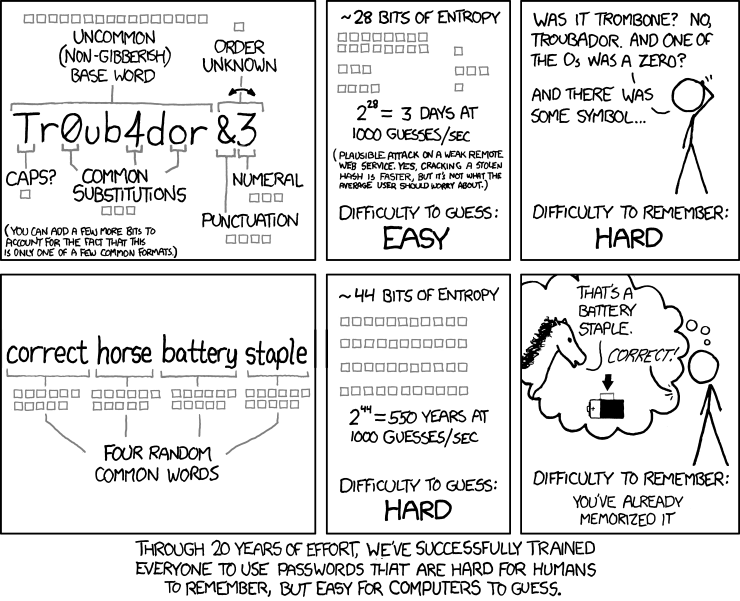
password_strength.png
 
I forgot my Ubisoft password a long time ago. Maybe I can email the hacker and have him give it to me!
 
You realize that the code password searches for those lightly mangled formats and that the patterns you volunteered probably just got added to the list of mangling patterns they apply to plain jane dictionary-alpha-numeric based passwords.
 
I used to do that and keep a really impossible to guess password, but then IT came through and made us change our password once a month (forced by the system). Now I just use "Happy1", when the system forces me to reset I use "Happy2", etc.

I guess it's more secure that way since it changes constantly, right? :rolleyes:

well, now IT gets to blame you if something happens.
 
I used to do that and keep a really impossible to guess password, but then IT came through and made us change our password once a month (forced by the system). Now I just use "Happy1", when the system forces me to reset I use "Happy2", etc.

I guess it's more secure that way since it changes constantly, right? :rolleyes:

Lol... Reminds me of a place I worked with once, IT got tired real fast of all the forgotten password calls they kept receiving... :D
 
Back
Top