• Some users have recently had their accounts hijacked. It seems that the now defunct EVGA forums might have compromised your password there and seems many are using the same PW here. We would suggest you UPDATE YOUR PASSWORD and TURN ON 2FA for your account here to further secure it. None of the compromised accounts had 2FA turned on.
    Once you have enabled 2FA, your account will be updated soon to show a badge, letting other members know that you use 2FA to protect your account. This should be beneficial for everyone that uses FSFT.

two radiator loop sequence options....

indokyne

2[H]4U
Joined
Jun 21, 2006
Messages
2,159
is there such thing as an "optimal loop sequence" for single pump / dual rad loops?

it would have:
1 pump (DDC + top)
2 radiators (preferably one for CPU, one for GPU)
1 cpu block
1 gpu block

am i right in assuming the obvious choice would be
PUMP -> (RAD 1 -> CPU) -> (RAD 2 -> GPU)
?

finally, what if I added a second pump?
would it be better to run the pumps in series thru the above mentioned loop or would it be more optimal to run two separate loops?
 
i have one dcc and 2 radiators... a BIP240 and a innovatek 120.1 rad with a tdx, maze4 and alphacool chipset and i have enought flow to get some good temps.. .when my room isnt 83*F

i think one pump would be the best. but if you want to get 2 dcc-plus' and run them in series.
 
thanks.

but my question is more -
rad - block - rad -block
vs.
rad - rad - block - block

i would assume R - B - R - B would be better since the water gets a chance to cool before hitting the next block ...

and - is the R-B-R-B much more restrictive ?

thoughts?
 
with the pump you have, it'll be fine. if you have low restrictive blocks then you need not worry.
 
Arcygenical said:
I'd go Rad, CPU, Rad GPU...
i was thinking the same...

aiya said:
with the pump you have, it'll be fine. if you have low restrictive blocks then you need not worry.

yea - i'm not too worried about flow - just sequence.

and besides. though scorned by many in the WC community, I use a swiftech Apogee that i'm completely satisfied with.
(I never understood the hate for such a great block)

and along with the MCW60, I'd say that those two would be considered high flow blocks...
 
I would think

rad-->T-Line-->pump-->CPU-->rad--->GPU

myself. But if the GPU always runs much hotter then the CPU, then anything coming out from the CPU would still probably cool the GPU ok as well. So then if you ran, Rad to rad, you'd have two rads cooling the water before it circulates back to the CPU. As it is, it will go from the CPU where it heats up slightly, then through the rad, where it cools down slightly, then to the GPU where it will heat up the most, then to the second rad where it cools down slightly and back around. Starting to wonder if it's better to just feed the GPU right off the CPU.

Planning on this for me:


and eventually the GPU section will be a lot more demanding for heat build up.
 
If you Y the radiators you'll cut the flow through each rad roughly in half along with the added benefit of lowering the overall flow restriction. Fluid works in a similar fashion to resistors in that putting 2 items in series doubles the resistance whereas putting the same 2 in parallel cuts it nearly in half. As for radiators the benefit of cutting the resistance is twofold, the flow rate through each rad is effecively halved as well so that equals twice as the time the water has to interact with the pass tubes therebly increasing the rads ability to disipate heat without hobbling the flow rate to the rest of the loop. It's a win-win situation. This is assuming that you're using two identical rads.
 
madmat said:
If you Y the radiators you'll cut the flow through each rad roughly in half along with the added benefit of lowering the overall flow restriction. Fluid works in a similar fashion to resistors in that putting 2 items in series doubles the resistance whereas putting the same 2 in parallel cuts it nearly in half. As for radiators the benefit of cutting the resistance is twofold, the flow rate through each rad is effecively halved as well so that equals twice as the time the water has to interact with the pass tubes therebly increasing the rads ability to disipate heat without hobbling the flow rate to the rest of the loop. It's a win-win situation. This is assuming that you're using two identical rads.
ooh... i like these kinds of posts.
so if you use a "Y" to split into two rads, at what point is it optimal to "Y" again to bring back to one hose to your pump?

is this it?:

............PUMP
...............Y
............|......|
...........V.....V
.........rad....rad
.........cpu...gpu
...............Y....
.........t-line / res
.............pump


OR - would you use the "Y" to combine as soon as the water exits both radiators

like this:
............PUMP
...............Y
............|......|
...........V.....V
.........rad....rad
..............Y....
.............cpu
.............gpu
.........t-line / res
.............pump


with the first one, I'm assuming that your CPU and GPU blocks would have to be similar in terms of flow restriction for it to work as designed (parallel) ?
 
I'd go with the second example myself. Unless you were using, say, an Appogee and an MCW60 which are basically both based on the same block and therefore nearly equal in terms of flow restriction it'd be too fiddly to get the flow balanced properly through both blocks.

Hope that helps to explain the method behind that bit of madness.
 
madmat said:
I'd go with the second example myself. Unless you were using, say, an Appogee and an MCW60 which are basically both based on the same block and therefore nearly equal in terms of flow restriction it'd be too fiddly to get the flow balanced properly through both blocks.

Hope that helps to explain the method behind that bit of madness.
yes it does - thank you. and yes, it's an Apogee and mcw60.

matter of fact - this project i'm about to embark on uses the "Low profile Apogee" which looks like it's essentially the MCW60 with CPU socket mounts...

hmm.... :cool:
 
the order you put the stuff wont matter, shortly after startup the system will stabilize and at most there will be a 1C difference between any two points in the loop.

Y the rads is a good idea.

Route it so it makes the least amout of mess in your case or easist to route/mount.

Also good to have pumps at bottom of case to make sure they are primed.
 
BillParrish said:
Route it so it makes the least amout of mess in your case or easist to route/mount.
i live by this...

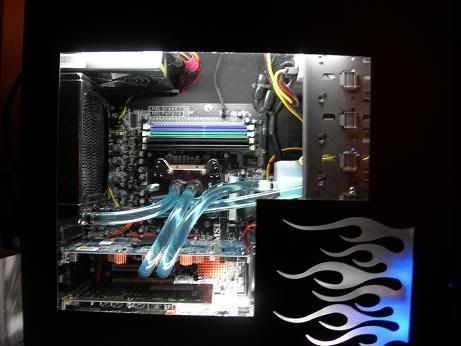
DSCN6217.jpg
 
The MCW60 uses the same exact base as the Appogee. The difference is in the top and the relief grinding at the contact spot. Using the low pro will give you basically the same block on both the CPU and GPU.

Actually the fact that the MCW60 is based on a CPU block is why I'm so fond of it, unlike most other GPU blocks out there that base their design on a modified chipset block that's *maybe* optimal for 50W the MCW60 has proven itself more than capable of heatloads well above 110W.
 
Back
Top