• Some users have recently had their accounts hijacked. It seems that the now defunct EVGA forums might have compromised your password there and seems many are using the same PW here. We would suggest you UPDATE YOUR PASSWORD and TURN ON 2FA for your account here to further secure it. None of the compromised accounts had 2FA turned on.
    Once you have enabled 2FA, your account will be updated soon to show a badge, letting other members know that you use 2FA to protect your account. This should be beneficial for everyone that uses FSFT.

Raphbox, mITX gamer chassi ~10,66L

Raphaei

n00b
Joined
Sep 10, 2014
Messages
28
Raphbox


krNTznW.png


This is a work in progress. Keep that in mind!​


If you’re looking for specifics about the chassis, it’s chapter 5.


1. News / Updates (this post)
2. Forewords
3. Introduction, my views on ITX
4. Introduction, my first attempt at an ITX chassi
5. More in-depth details about the chassis, images, dimensions, what it supports etc
6. Media (Pictures, renders, drawings, videos, etc)
7. FAQ


News / Updates


2015-03-25
Thread created.
Update: Fixed a typo.
 
Last edited:
Forewords

Before we get started, I’d like to point out a few things. You might have scrolled down for a while until giving up, and then went back here to start reading to figure out what the hell I’m smoking. Who makes a 5000+ word (~30 000 character) presentation of a hobby project? Well, let me put it this way. *waves hand* Hello. Nice to meet you. :)

First thing I’d like to point out is that I made this chassis for me. It’s done with me in mind; my wants, and my needs, based on my expectations and experiences. There’s no market research or asking others what they would like in order to buy one. Not before, and not now. That’s not what this thread is about. If there are people that would like one, that’d be nice, mostly because it says I did something right. But if no one wants one, for whatever reason, I want you to know that it’s what I had in mind from the start. But regardless of your views, I still would like your input. When I started on this project I did so with my views on what I think other people want, or need.

Those views doesn’t have to reflect reality in any way, the only reason I did it this way is because if I spent the thousands of hours since the summer doing the research, contacting manufacturers, reading reviews, doing the design, getting prototypes, haggling (something I really don’t like doing), testing them, etc etc ad infinitum, I’d feel it to be a waste if the target audience was a total of one person. Talk about spoiling that target audience!

So I opted to do something I think others would like as well, and even if this isn’t the case, and there will only be a single unit ever produced, I will feel good about it. And that’s what’s most important to me. I like to share, I like to help, and I like to make people feel included. If I did all of this with only me, my wants and my needs in mind, I would feel like I had betrayed those core values.

Second thing, related to the first, is the sheer amount of work I put into creating this topic. If I had encountered this thread as a reader and not as the author, the longer I read the more I’d suspect it’s nothing but advertisement. I mean, who in their right mind would do all of this with no financial agenda? The one thing I’ve seen through all of my years that would make someone do this amount of work for something is money. Maybe not as an immediate reward, in school for instance it’s about the grades deciding how much money you can make later on.

I’m a very methodical person. I do everything step by step, and I make sure each step is done properly. Note: Not perfectly, but properly. Now that I’m on the step of creating this thread, this is my idea of doing it properly. Everything in this thread isn’t intended for everyone, but rather something for everyone. The fifth chapter is where all the tech stuff is, and it’s more than a few rows. But for those few who are interested in having a peek behind the scenes, this is for you.

I consider life too short to do everything I want to do. I’ve tried, there simply aren’t enough hours on the day! Hardlined, it means one of two things. I can either be good at a few things, or semi-good at a lot of things. Given the choice, I’d rather be f-ing awesome at some things, than mediocre at everything (“Hello, my name is x, and I’m a mediocre real estate agent. Please buy this house.”).

In a nut shell, life’s too short to do things half-assed. This is me, not half-assing my way through life. So, let us begin. And by begin, I mean continue.
 
Last edited:
What is mini-ITX for me?


This chapter is long and windy, and a must-include for a wall-of-texter like me. Its only purpose is for you to get to know me better, how I view things, my values, how I operate, etc. You can safely skip this part if your only interest is in my project. No hard feelings, I promise. But for some people, me included, knowing what makes a person ticks is important. If a person has certain values, or certain ways of doing things, it usually means whatever work they do will reflect those qualities, directly or indirectly.

A sloppy person usually does sloppy work, a couch potato usually isn’t first in line to burn the midnight oil, a greedy person offering a service to you usually does so because it benefits him, and so on. But it also means that an intelligent person usually make intelligent choices, and that an enthusiast is enthusiastic about what he does. Rather self-explanatory when you think about it. Know the person and you know the quality of his work. Which is why there are job interviews.


So, back to the point, what is mini-ITX for me?

With a lack of proper standards, like the ATX having standards for both MB and PSU, as well as having standard dimensions affecting it indirectly, like the GPU (dual slot, especially), chassi fans (120x120x25), HDD's (3,5"), mini-ITX pretty much borrows all of these larger form factor specs. Outside upgradeable laptop parts, there’s no smaller form factor to borrow from. There are no oddities in mini-ITX chassis mixing 3,5” and 2,5” storage, supporting ATX and/or SFX-PSU’s, and/or supporting full length GPU’s instead of only ITX-sized GPU’s. One could consider 92x92x25mm or 120x120x15mm fans a smaller sibling to the “ATX-standard” 120x120x25 fan, but not really surprisingly, neither is a standard sized fan ITX-chassis support.

To me mini-ITX represents "ATX form factor, but smaller". And I’m hardly alone on this, as there’s no “like a laptop, but bigger”. That includes things like low profile fans, SFX(-L) PSU, 2,5" HDD/SSD/SSHD, slim OOD's, and all but the longest, thickest and hungriest GPU:s. If I wasn’t a gamer by heart, I’d most likely say ITX-sized GPU’s. Surely this is a sensible view on the formfactor? But where are the standards? To recap the dominant features of each form factor:

Code:
ATX	ITX
MB	ATX	mITX
PSU	ATX	SFX
GPU	Full	various
HDD	3,5”	various
OOD	5,25”	various
Fans	12/14cm	various
Front USB	Yes	Yes/No

Without standards, we won’t have standard items. That means that the small (but growing) mITX-market is made up of even smaller fragments. Could you imagine a ATX-chassis that doesn’t support ATX-PSU’s, or 3,5” HDD’s? In the mITX world, mixing and matching like that is business as usual. To me, that spells one of two things. A dying standard, or what I believe, a standard still in its infancy. And with the last 10 years having seen a boom in both cellphones and tablets, Intel and the likes have switched focus from performance to energy efficiency, a trend the m-ITX form factor most absolutely can and most likely will ride on for years to come.

If you want to overclock your CPU to its maximum, and keep it cool with radiators large enough to contain enough water to end world thirst forever, with an array of 3,5" HDD's, and juicing a 13" 8+8-pin GPU, I firmly believe ATX is the way to go. If, on the other hand, a smaller form factor is higher on your agenda, that means lowering your standards for all of the above; there’s only so much space in any one enclosure. Smaller fans can't cool as well, a 2,5" HDD won't fit as much, and so on. As I mentioned, to me mini-ITX is a hybrid between a laptop and an ATX-based enthusiast system, like a desktop version of a laptop (read: bulkier, but more oomph). Performance-wise leaning more towards the ATX-system, but in terms of energy/cooling/size of components, leaning more towards the laptop.

If you ask me, the beauty of the PC (#pcmasterrace) is its modularity. Not only in terms of performance, but in both sizes and aesthetics alike. Standards allows this modularity to not spiral out of control. Until the mini-ITX market grows big enough to get a full range of proper standards, we’re allowed to mix and match to our hearts content. Now is the time for innovation, or as a gamer would call it, “clever use of game mechanics”, as it will be much harder later on when we’ll be confined by a standardized framework (see table above for ATX, you get the picture).

So if you’ve got ideas for designs others haven’t done, either because no one has thought about it, or like in my case, everyone is aware of the design but has dismissed it long before actually testing its viability. In some situations the design has been tested, but kept elements that makes the design unviable. People then point at this case erroneously and conclude the design doesn’t work. It’d be like pointing at SimCity 2013 and saying that citybuild sim is an unviable genre. A smarter man would say there was something wrong with their approach.

On the flipside of the PC’s we have the consoles. They’re everything the PC isn’t. I’d even call them its polar opposite. Much like when comparing an iPhone to an Android phone, the consoles are designed to be closed systems. With a closed system you know exactly what’s in it, which makes things so much easier for everyone involved. If we forgo the software side of things - like how much easier it must be for the phone support to assist in troubleshooting a console, or how much easier it is to create software for such a device - and focus on the hardware, the first thing made substantially easier is layout. And with layout, I mean the chassi. If you know exactly how big the GPU is, there’s no need to make additional room for larger GPU’s. If you know the console will have a single 2,5” storage device, there’s no point in adding extra room for a few 3,5” HDD’s. Etc.

The closest a PC can get to a console in terms of size/performance, while still keeping its soul as a PC (modularity) is the mini-ITX form factor. And that’s a notion that tickles my interest; while the console remains exactly the same for some half decade, the PC continues to evolve its hardware. It’s always a matter of time before the PC can beat the console in size/performance despite its open modularity. I do not count small, prebuilt, custom, overly expensive, closed PC systems, as they can get freakishly small, but they don’t appeal to me for the same reason consoles and Apple products don’t appeal to me; upgrades is a road permanently closed. And as my friend has an Xbox One, I don’t care much for the noise level either.

Mini-ITX also offers a great range of fidelity. I’m writing things most people already know, but I want to share my views regardless. Anything from a AMD powered, GPU-less system in a M350 hanging on the back of the screen to a watercooled enthusiast system in the M1 or Prodigy, the form factor allows almost everyone to get a system tailored to their specific needs. Its only drawback is, as with everything human made, the natural tendency for a price premium for the reduced size, which means that those that don’t care if their computer is small or medium sized will still favor ATX-builds, since it’s (slightly) cheaper.

[pic of something]

Have you ever gone through the process of buying and building a computer with a preset design in mind? Knowing what hardware you want to put into the system, and at least a general idea how you want them arranged, and bought the parts following that general guideline? I’m sure I’m far from the only one. If I had to hazard a guess I’d say it’s fairly commonplace, at least for the experienced builders. That’s what I’ve done with every build I can remember that I’ve done for myself, my friends, and even their friends. I’m hardly a hardware guru, but I like to consider myself at least the one-eyed king in the land of the blind when it comes to computers among my friends and acquaintances.


To the point

Last summer (2014) I wanted to start on a programming project. I had this great idea for a online-based system that helps and assists companies in their everyday tasks. Having worked with IT, customer support, personnel management, logistics and having received a lot of leadership training over the years to name a few, I like to think I have a firm grasp on what a company needs, as opposed to what they think they need. But I didn’t want to start programming on my thirsty gaming machine, as I’d feel like a eco terrorist, and my laptop I normally had done programming on was starting to show its age, so I decided to make a new system tailored for my specific needs.

I had always been curious about the mini-ITX form factor, having spent many times doing thorough window shopping for different types of systems in the past, mostly super small office type computers. But now, in essence, I wanted to do a M350-type build to hang up behind the screen, but I wanted a 750Ti for the lighter games I played (like I mentioned, doing light stuff on my thirsty gaming machine makes me feel like a eco terrorist). This caused some problems as I didn’t want the GPU stuck into the motherboard in the traditional L-shape, as that’d be kinda bulky hanging behind the screen.

I thought finding a chassi that was in practice something like two M350:s stuck together side-by-side, one housing the system and the other one housing the GPU. I spent weeks day and night trying to find one, but to no avail. I was confident I wasn’t the first one in existence to have thought of the concept, and as I later found out I hardly was, but there was no chassi made for this purpose.

I have this thing when on the outside looking in, I go “how hard can it be?”, and then I go and do it. Unwilling to compromise on either size or features, I started on my design. The first thing I did was making a list of features and goals spanning half a dozen A4 sheet papers (are you really surprised?). And then I started designing, learning Sketchup along the way and later on more advanced CAD-software, while spending months just reading chassi reviews and looking at pictures trying to figure out how different manufacturers solved different things. Over time I realized I spent way too much time making a single chassis that I would use for my programming project, and started leaning more towards making something for others as well. But how many would want this type of chassis, really? Offices have no need for that GPU, and gamers have no need for such a weak system. But if it was large enough to incorporate a gaming system, surely that would pique the interest of a whole lot of people?
 
My first take on mini-ITX


(click for larger version)


If there’s one thing I know, it’s games, and as a natural extension gamers; as I am one myself. As a gamer, I’ve always been drawn to the concept of squeezing as much power as possible into as a small space as possible. Makes sense if you think about it, in games the difference between a win and a defeat is often who can do most with fewest resources. So, how do you make a solid gaming machine that fulfil as many standardized criteria as possible without feeling like it’s a product of too many compromises, or heavily leaning towards a niche?

Codenamed Raphbox, since I lack imagination and have yet to decide on the final name (I’m guessing Battlestation is already taken or too generic), my design sets out to be the mobile stationary (oxymoron) gaming chassis you can bring with you to your friends over the weekend, or an alternative when you can’t decide on a gaming laptop or a stationary computer, commonplace for students I expect. It takes what I later found out to be a well-known design approach, so there’s nothing revolutionary about it, at least from my part.

[pic of barebone skeletal GPU+MoBo layout]


When deciding what features I wanted in my SFF-gaming chassis a few plopped into mind. First, obviously, is dual-slot GPU support and, in a lack of a better word, “non-small” CPU coolers. I can’t think of anyone taking a performance oriented chassis seriously if it doesn’t, as many gamers want to find that middle ground “sweet spot” in CPU overclocking. Second thing that came to mind was mobility, gaming is as much a learning experience (practicing eye-hand coordination, honing skills, learning about medieval warfare, what services a functioning city needs, how to run a farm, etc) as it is a social one, something a SFF-chassis should be particularly adept at. But having mobility as a high priority, I opted to completely scratch watercooling, and go for solid, properly done air cooling.

These are notions many other chassis already incorporate. But there are many other notions they skim the edges of, compromising heavily, or completely forgo. They either go all the way in one direction, or in the other, or aim for some strange middle ground that for some reason takes the worst bits from both ends of the spectrum and keeping none of the good.

Airflow is a big one. Do the engineers designing computer cases not test to see if hot air gets trapped where there are warm components? Do they not test if a warm component in need of cooling is actually getting enough? What about vortex buildup, something that completely screws with a flow? And then there are general bad “engineering” choices. So often have I built a gaming system for a friend only to (once again) discover something stupid, like the HDD’s being mere millimeters away from the front intake fan or the PSU and CPU cooler fighting for air. Where is the strive for excellence? Where is the respect for themselves and their work, where they are content doing something that is borderline passable?

[pic of HDD area]
 
Raphbox* details


Outside details:
Dimensions*: 138x214x361 (mm, WxHxD), 10,66 liters.
Material: Aluminum. Right now only 2mm, but will convert some to 1-1,5mm (panels will be either 1,5mm or stay 2mm)
Front panel**: 2x USB 3.0. Hideable. No mic/audio jacks.
Fan controller**: This is undecided. Either one throttle for both chassi fans, or one for intake and one for exhaust. I’m leaning towards a single throttle, I just need to find a decent manufacturer.


Inside details:
Motherboard support: mini-ITX
PSU support: SFX/SFX-L
GPU thickness support: Dual-slot
GPU length support**: <= ~310-330mm. Supports blower-types, but prefer larger third party cooling.
GPU height support**: ~170mm**. While it fits, I don&#8217;t recommend a height of above ~150mm**.
CPU cooler support**: I don&#8217;t recommend anything higher than ~60mm. Noteworthy is that even if a larger CPU cooler (like the scythe shuriken) will block the PCI-Express slot, they&#8217;re still supported. Opens up for new motherboard+cpu cooler combos!
Height clearance above CPU**: ~73mm (~110-120mm without GPU)

Storage mediums supported***: 1x 3,5&#8221; + 2x 2,25&#8221;. No 5,25&#8221; support.
Sound isolation*: Undecided. I&#8217;m looking for manufacturers, I have a few specific in mind. If I get what I wish, the flaps will be covered by <=4mm mats for sound absorbtion, and one larger ~10-15mm stripe above the GPU for whatever the technical term is for sound normalization (not making the sound pressure weaker, but to make the frequency kinder to the ears).


* = Subject to change
** = Subject to change, but if so it will be minor
*** = Subject to change, but probably not.


Specific features


Sound traps


(click for larger version)

The chassi has sound traps for all intakes/exhausts; front main intake, GPU and PSU, as well as the entire top, where it both dampens the noise and redirects it away from the user. Where most premium &#8220;silent&#8221;-oriented chassis lets the user decide to either have a dampened lid or an open hole for a chassi fan, this isn&#8217;t a dilemma with this chassi. Note that a well ventilated chassis can&#8217;t perform miracles in the sound department, but I&#8217;ve always felt like there&#8217;s room for healthy ventilation without butchering sound levels.


The motherboard and GPU are parallel

[pic of GPU + motherboard]

My biggest gripe with a small chassi that supports a GPU is the fact that they have to be very wide. The Steambox has an elegant solution to this issue, but it raises another with a larger footprint (which isn&#8217;t a problem for a HTPC, but is for a desktop). The A4-SFX has its own solution to this, and while it might not even be a problem, I&#8217;m uncomfortable with the idea of having a vital cable run between the two hottest components in the system within such a tiny space, which is one of the reasons I opted to put the GPU in front of the motherboard.

One could argue that regardless of direction, adding a PCI-extender provides for another component that can fail. While this might not even be a concern in the real-world, I&#8217;m going to make thorough benchmarking, compares and longevity testing before deciding on the viability of this design. In other words, if I&#8217;m not happy with the results, I&#8217;m going to shelf this project.


Silence

KwOtm4i.png


One of the biggest gripes I have with SFF chassis intended for stronger systems is that they have perforations everywhere. I&#8217;m allergic to sound. I can&#8217;t even have my computer on when I go to sleep. If I wanted to make a SFF-chassis that could handle a enthusiast grade gaming computer (say&#8230; 350W?) I would have to do something about the noise levels, without killing ventilation (and temperatures!).

So I decided to simply redirect the noise away from the user, and as a continuation of that, I wanted to dampen the sound before it escaped. I also wanted to insure that the chassi doesn&#8217;t amplify any noise. The goal is to rubber/silicone any metal-to-metal contact. A well ventilated chassis can&#8217;t do a lot to dampen noise, so there&#8217;s no miracle here. But I do believe it will &#8220;shave the top off&#8221;, at the very least.

I&#8217;m also planning on adding (comparatively speaking) a huge piece of foam which will take care of high pitched noises. Any noise escaping must be pleasant to the ear.


SSD + 3,5&#8221; HDD

[pic of HDD+SSD bracket from outside, behind]

While not everyone want or need a 3,5&#8221;, and would rather have a smaller case in compensation, there are plenty of people who simply need the additional diskspace. A youtuber might want a dedicated FRAPS-HDD, the guy making videos in Vegas might want the space for large projects as well as save the originals from the youtubes rather harsh re-encoding process, the 3D artist using Blender or Maya (or whatever) who would like assets etc for animations, as well as enough space for uncompressed frames for longer animation renders, etc.

Or you simply want a backup HDD where you keep emptying your pictures from your smartphone into. Or you, like me, rip your Bluerays into a HDD for convenience. Either way, there are plenty of people who want or need a 3,5&#8221; HDD.

And if you don&#8217;t, it&#8217;ll still help the airflow in the chassis, something that is very important yet surprisingly often neglected.


Compact

[pic]

(I started typing on this, got distracted by IRL, and when I got back completely forgot my trail of thought. If I find it again, I&#8217;ll update this)


Lightweight, solid construction

[pic of GPU + top flaps from behind]

If this chassis was meant to be stationary I&#8217;d at the very least contemplate steel, but as I want it to be an obvious and sturdy travel companion, I&#8217;m going for aluminum. The sound isolation will add a lot of weight - comparatively speaking - to the chassis, but it will also make it very resistant to bent panels, skewed frame and the likes.

I already have a prototype I use for fitting and measurements, but once I get the first prototype that will house hardware for benchmarks for thermals and PCIe-extender viability, I&#8217;m going to manhandle it. I mean like punch it, drop it, slam the door at it type of manhandling. As an added bonus, it will also test the quality of the paintjob. I&#8217;m also open to recording it and putting it up on youtube, if there&#8217;s interest in watching this rather unique QA-session.


Easy cabling

[pic of real working prototype (this will be a while)]

This is one of the aspects I haven&#8217;t touched yet in the design, but I do have a few specific things in mind. The smaller the case, the less room there is for cabling properly. And often the cabling is hurting the air flow, which is logical due to the lack of space. When looking at reviews for many of the SFF-cases you can see most of the cables usually being stuffed in somewhere where they don&#8217;t belong, like in the way of the main intake or exhaust vents, butchering airflow.


Easy to maintain


(click for larger version)

If you think about it, when the GPU is parallel to the motherboard (read: in front, and in the way), when opening the side panel you&#8217;ll have the GPU in the way, totally blocking the rest of the system. Having to unscrew hardware to get behind them to reseat the cables to the SSD&#8217;s, checking for dust buildup, etc, is a major pain for a lot of people. Heck, for some it&#8217;s even too much hassle to unscrew a HDD to unseat it.

The GPU is physically separated from the rest of the system, meaning that when you open the side panel it won&#8217;t be in the way. This dynamic is only possible due to the PCIe-extender, which is why I didn&#8217;t opt for a elongated PCIe-riser.


Easy access to the system

[pic of chassi without top, front and side panels.]

Ties in with the above. Removable top, front and sides allow you to get in there from all sorts of angles when building your system. Many times, even in standard sized ATX cases have I had issues getting to a certain spot because stuff was in the way, and wished that I could get in there from another direction (like the top).


Hideable front USB-ports

[pic of front USB-panel, open]

There&#8217;s a lot of debate on whether or not there should be a front panel, and what it should support. Some want it, while others want a clean front. Some want 2xUSB3.0, others also want USB2.0-support. Most seem to want audio and mic-jacks, while some don&#8217;t. I figured why not take the best of all worlds, and make the front panel hideable.

As I&#8217;ve yet to find a manufacturer for this part yet, it&#8217;s still open for debate. My goal though is to have 2x USB3.0, with no USB2.0 or audio/mic-jacks. If I find a manufacturer who can support both USB 3.0 and 2.0 for the same price without being too big, I will likely opt for that, if I feel the additional cable won&#8217;t get in the way inside the case. I don&#8217;t want audio/mic-jacks at all, given how small the chassi is, you can either plug the headset behind, in your keyboard or your screen. If this is a problem, and if this chassi goes commercial, I&#8217;m willing to throw in an extension cord for the headset if there&#8217;s huge demand for it, but I don&#8217;t expect it to be the case.


Many color combinations

[pic of one, two and three color combinations]

I&#8217;ve been in contact with a local paint shop. They have plenty of colors to choose from, and can do single, dual or even triple color combinations. This means that if you want a silver case, a iron-man themed red/yellow, or a patriotic blue/white/red, it&#8217;s doable. Having this in mind during the design process, I&#8217;ve done my best to allow for a main and secondary color, with a third colored highlights. If all these are done in the same color, no one looking at the case would notice. If an artist would like to give input on the highlights/details for the third color, I would greatly appreciate the help. The only artistry I can perform is the art of math, and logic. I paint like a six year old (source: comparing recent drawings with ones I did when I was in kindergarten).


And yes, I&#8217;m as thorough designing my chassis in every aspect as I was creating this thread. It&#8217;s how I&#8217;m wired.
 
Last edited:
Media

(this section will be added to within the week, I spent way too much time on this presentation I&#8217;ve fallen behind on a lot of IRL stuff)

Renders:

Drawings:

Pictures:

Videos:
 
FAQ


1) Do you have a TL;DR?
Yes: TL;DR: Read it all.

2) Something something Ncase something?
No.
 
That's actually pretty genius. I would prefer a case like this with regular vent holes rather then the fins, but it's your baby. Good luck.
 
That's actually pretty genius. I would prefer a case like this with regular vent holes rather then the fins, but it's your baby. Good luck.

Thanks man, I appreciate it. Your response was way faster than I had anticipated the first response to be.

The SFF is heading into a brave new world the upcoming years, I don't expect it to be too long until someone makes what you wish for. :)
 
Aesthetics is something very personal. I don't dislike the fins but I hate the colors so much I don't have words to describe it (red and yellow are the colors of archrivals of my team, so... :) )

About functionality, my biggest concern is that the backside of the GPU (literally the hottest spot in that rig) is facing the CPU fan. Not only the CPU will get very hot, that fan might fail miserably quicker than you think.

In A4-SFX, there are two layers of material to isolate that heat from the riser cable. A4-SFX, in comparison, would have better CPU temps, which in turn reduce the requirement of faster running fans, which in turn would negate the sound dampening/directing ideas you have.

Sorry to do a direct comparison, but it's inevitable in this situation, since the case layouts are very similar with a minor difference in design. In terms of temperature performance, the two cases would be very similar, with insignificant differences (your GPU temps could be better at the expense of CPU temps and more noise). In terms of noise, your case could be worse off, due to more fans and the CPU fan having to run faster. In terms of size, there is a clear winner. So, I don't know, with the goal of cramming more into less, it seems like A4-SFX should be the choice...
 
I'm really interested in how good the sound dampening will work, I also really like the front panel, that's a great way to make it customisable!

I'll be interested in following a build log if you ever make one!
 
Have you thought about how to manufacture those flaps? Because to me, their design in the renders doesn't look very plausible. Especially if they're meant to articulate.

Sound isolation*: Undecided. I’m looking for manufacturers, I have a few specific in mind. If I get what I wish, the flaps will be covered by <=4mm mats for sound absorbtion, and one larger ~10-15mm stripe above the GPU for whatever the technical term is for sound normalization (not making the sound pressure weaker, but to make the frequency kinder to the ears).

[...]

The chassi has sound traps for all intakes/exhausts; front main intake, GPU and PSU, as well as the entire top, where it both dampens the noise and redirects it away from the user. Where most premium “silent”-oriented chassis lets the user decide to either have a dampened lid or an open hole for a chassi fan, this isn’t a dilemma with this chassi. Note that a well ventilated chassis can’t perform miracles in the sound department, but I’ve always felt like there’s room for healthy ventilation without butchering sound levels.

[...]

One of the biggest gripes I have with SFF chassis intended for stronger systems is that they have perforations everywhere. I’m allergic to sound. I can’t even have my computer on when I go to sleep. If I wanted to make a SFF-chassis that could handle a enthusiast grade gaming computer (say… 350W?) I would have to do something about the noise levels, without killing ventilation (and temperatures!).

So I decided to simply redirect the noise away from the user, and as a continuation of that, I wanted to dampen the sound before it escaped. I also wanted to insure that the chassi doesn’t amplify any noise. The goal is to rubber/silicone any metal-to-metal contact. A well ventilated chassis can’t do a lot to dampen noise, so there’s no miracle here. But I do believe it will “shave the top off”, at the very least.

I’m also planning on adding (comparatively speaking) a huge piece of foam which will take care of high pitched noises. Any noise escaping must be pleasant to the ear.

[...]
I think you may have some misconceptions about noise reduction:

  • "Sound trap" is something of a misnomer here, since the sound waves will still have a direct, unimpeded line of travel from their source inside the case to the outside. A true sound trap forces the sound waves to bounce (and be partially absorbed) as many times as possible. Think the arrays of wedge-shaped acoustic foam in studios. The flaps will redirect some sound away from the front of the case (and presumably the user), but the overall attenuation is unlikely to be significant.
  • Thin acoustic damping material, as used in PC cases, is primarily useful for adding mass to reduce vibrational noise and resonance effects transmitted through the chassis - not for absorbing airborne sound waves. Applying it to the flaps will do next to nothing because, again, sound waves will have an unimpeded line of travel outside the case.
  • Similarly, a single large piece of foam isn't going to accomplish anything. It's not like putting a box of baking soda in your refrigerator to absorb odors; sound waves don't just hang around in the air - they need to repeatedly bounce off an absorbent surface to have any measurable attenuation.


Now, this is just my understanding as a layman, so take it with a grain of salt. But this is what I've gathered over some years of casual reading on the subject. It's also meant as a critique rather than a criticism, so I hope you take it that way.
 
@theGryphon

Heh, yeah, the red/yellow sticks out. I keep switching colors for different renders, mostly so I can see how things look (it's hard to see where something ends and something else begins otherwise. I even have to intentionally mess up the lining of the panels otherwise it'll look like the entire thing is completely uniform (panels etc merging with no visible seam line). Right now I'm doing the red/yellow. Black/white looks surprisingly good (matter of taste I suppose), and blue/yellow is nice too.

Regarding the GPU and CPU interaction, it's been a great concern for me too. I've given it a lot of thought. I concluded the following:

1) Most games are either CPU or GPU bound. Roughly speaking, if you really push your system, one of the components will work at 100% while the other will work less, how much is dependent on title, settings, hardware, etc. When a game is GPU bound, the CPU won't work as hard (usually the case in eye candy-esque games), meaning the CPU will offload some of that heat, meaning lower temperatures and (hopefully) lower noise levels. When a game is CPU bound (usually the case when massive amounts of draw calls is done) the GPU won't work as hard, and will have less of an impact on the CPU.

2) With enough space between the two you can lower the amount of hot air the CPU fan sucks in. How much, I don't know. But since I don't, I intend to find out.

3) Related to the second, air flow. With enough space inbetween the two, and funneling air between the two, you can offset the heat impact. Once again, I don't know by how much, but as above it's on my todo-list to find out.

49 Related to the third, remove as much hot air as possible, as fast as possible. That's why I have a 120mm fan right above the CPU+GPU, and the front intake lined up to feed cool air inbetween the two.

5) As the GPU is the one closest to the outside, its noise levels are the ones that will have biggest impact on perceived noise. The question is if the GPU can block the increase in sound levels from the CPU fan, or if it'll spiral beyond control. Part of why I have a large foam strip above the GPU (in direct line of sight from the CPU fan) is to (partly?) take care of this (potential) problem, high pitched noise from a high RPM CPU fan is a no-no, and if it'll really increase perceived noise levels despite my best efforts, I'll shelf the project. Period. There will be no point in this chassi if that'll be the case.

With all of the points above, these conclusions are based on no hard data. I share your concerns. I expect the GPU+CPU interaction to be the #1 reason why people who thought of this before me decided not to run with it. While I hope the impact will be minimal, as you can probably tell from the wall of text above, I'm planning for the GPU to have a measurable impact on the CPU, one of several reasons I want to support a 120mm CPU fan.

And I'm okay with direct comparisons with the A4-SFX, despite the differences in priorities (A4: Size first, performance second, me: performance first, size second). And my chassi is a whole lot bigger, anyone who want the smallest chassi that supports full-length GPU's won't look twice at mine. I could shave off an inch in height and two in depth (space allocated for features I'm unsure will be implemented), which would drastically lower the volume, but right now I don't see any point. I don't expect my chassi to grow over time, though.
 
@Necere

Thank you for the reply, I really appreciate it. The flaps are very simple in design, from above they look like two V's, one above the other (sides connected with straight lines, shaping a wierd looking arrow). From the side (or front/back, rather) they are once again shaped as a V, only ever so slightly. If my description was cryptic, or not clear enough, I could do a simple render showing them from various angles.

About the sound absorption, it has to be taken with a grain of salt. You're right in that the material enjoys sound bouncing as many times as possible (meaning they're best used in a closed off chassi), and my flaps only get one bounce, at best. The material will hardly reach a peak performance. Regardless, as you pointed out (and it's one of the things I didn't bring up in my introduction that I probably should) is that since I want my chassi to be mobile friendly, the flaps gain rigidity during transport, or random manhandling during LAN-events (hey, stuff happens), as a bent flap will hurt overall aesthetics, and if it should brake or fall off, the entire point with the flaps is defeated. They have to be solid.

The flaps exist for only one reason (not counting aesthetics, if you're into that kind of thing), and that is to block a direct path between the hardware and the user by redirect the sound waves away. Assuming you have it on your right side, like so:


Whatever help the sound isolation mats will provide, I'll happily accept. I do intend to sound test before and after applying the mats on my first workable prototype. Since I don't have hard data on the subject, I intend to get it. Maybe they will provide no measurable advantage at all (much to my disappointment), but I too have been reading reviews over the years, and my general impression is "don't expect a big impact", and that the easiest way to lower the dBa is to simply pick silent hardware. My (optimistic) goal have always been a 10% reduction in the sound pressure, but even if that isn't achieved, the flaps will redirect the sound away from the user, hopefully not towards a concrete wall where it'll just bounce right back.

But like I said over and over, don't expect a miracle (as there won't be one). The mats are there to manage, not eliminate.

Oh, and sound trap. Yeah, I always suspected what you describe is what a sound trap is, but in a lack of a better term I went with it. You don't happen to know a better suited term than "flap sound bouncers/redirecters" by any chance? :p In my earlier revisions I tried making actual sound traps work on both the bottom and top, like so:


But in the end I decided against it, maybe if I ever do a larger chassi that house enough hardware (like mechanical drives) to be worthwhile. Besides, airflow will hurt a lot with those bad boys in place. I like a natural flow of things.

And regarding criticism, I'm not offended even if someone tells me the dirt in their belly button can come up with a better design, as long as they explain why. What I hear is the why, not the belly button part.
 
I'm really interested in how good the sound dampening will work, I also really like the front panel, that's a great way to make it customisable!

I'll be interested in following a build log if you ever make one!

Sound dampening = don't expect a miracle.
Sound redirection = I'm hoping for a measurable difference.

When I do the build log I'll make sure to include noise numbers!
 
For manufacturing the flaps: with such a short run (1 unit), 3D printing may be an excellent option. Either printing all the flaps and surface-finishing (e.g. acetone wash) them all, or printing one of each flap 'variety', finishing them, then casting them in resin to produce enough for the case. This would allow the flaps to be a 3D structure e.g. with a centre 'ridgeline' and sloping sides at slightly different angles, to aid rigidity over a flat sheet.
 
@Necere

Thank you for the reply, I really appreciate it. The flaps are very simple in design, from above they look like two V's, one above the other (sides connected with straight lines, shaping a wierd looking arrow). From the side (or front/back, rather) they are once again shaped as a V, only ever so slightly. If my description was cryptic, or not clear enough, I could do a simple render showing them from various angles.
So the flaps are manufactured as individual parts, right (as opposed to being stamped out of the side panel)? Have you given thought to how they attach to the side panel? And if they're meant to articulate (i.e., open and close), how do they do that? Assuming some kind of hinge, how are they going to stay open or closed? Attaching a couple of dozen flaps is going to be fairly labor intensive as well, which is going to add to the cost if you want to produce these at any kind of scale.

Oh, and sound trap. Yeah, I always suspected what you describe is what a sound trap is, but in a lack of a better term I went with it. You don't happen to know a better suited term than "flap sound bouncers/redirecters" by any chance?
I would call them baffles.

In regards to sound, think of it like this: imagine each sound source in the case (fans, drives) is a light bulb. Each one is brighter or dimmer corresponding to its sound output. With the case closed up and operating, how much light will you be able to see? That's how you should be thinking about sound. The baffles might block the brightest light from the user's eyes, but it's going to be shining on the wall behind the case.
 
Last edited:
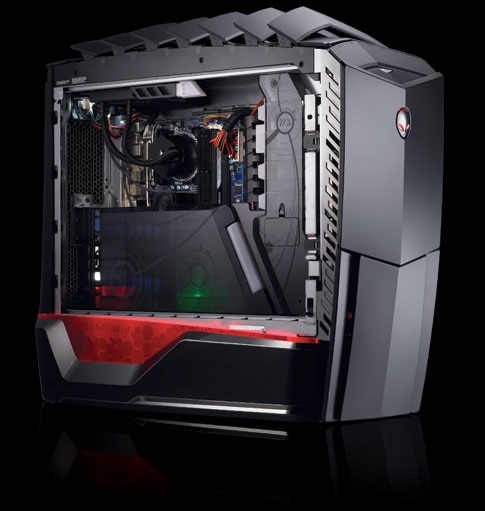
First thing I thought of when I saw the renderings is... Alienware Area 51 ALX with active venting.
OriginalPng


the easiest way to lower the dBa is to simply pick silent hardware.

That is it, in a nutshell.

To further clarify, pick hardware which does not create much heat, which results in less cooling requirements, which results in lower RPM fans, which results in less noise.

If "quiet" is a requirement, your #1 goal should be to start with less noise produced. It should not be "I want the top end stuff, so how can I make it quieter."
 
Back
Top