• Some users have recently had their accounts hijacked. It seems that the now defunct EVGA forums might have compromised your password there and seems many are using the same PW here. We would suggest you UPDATE YOUR PASSWORD and TURN ON 2FA for your account here to further secure it. None of the compromised accounts had 2FA turned on.
    Once you have enabled 2FA, your account will be updated soon to show a badge, letting other members know that you use 2FA to protect your account. This should be beneficial for everyone that uses FSFT.

Question about Intel SU7300 1.3

zod96

Suspected BAD TRADER
Joined
Feb 23, 2008
Messages
2,709
How does the Intel SU7300 1.3 mobile cpu compare to say the Mobile C2D P8700? I see an asus laptop I want but it has the su7300 1.3 cpu which to me seems half as fast as the P8700 according to the spec speed anyway. Where do these Intel SU7300 1.3 cpu's fit in with other C2D cpu's like the P8700 and say the T6600?
 
bottom of the line in terms of performance, these are ULV procs designed to maximum efficiency sipping 10-15w(I believe)

is it the Asus ul line you are looking at?
 
The chips are completely different beasts.

Consumer Ultra Low Voltage chips are pretty much "atom killers", they are using the lastest and greatest 45nm core 2 technology but they are focusing on having as low as tdp as possible. Intel takes the best of the best chips with the lowest volt id and makes the a CULV chip.

Even though the CULV processors have a 5 or 10 watt tdp they still get similar battery lifes to the atom machines. This is because they are much faster allowing them to complete the work faster and and allowing them to then go to the idle mode faster (which allows the cpu to switch to a pstate with a lower frequency and a lower voltage).

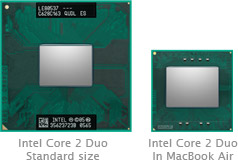
In addition CULV processors due to the lower tdp require less cooling, furthermore they are soldered into the motherboard (instead of having pins) allowing smaller and thiner laptops. Here is a good comparison in size of the cpu (the macbook air is a culv cpu the one on the left is a non culv cpu)
cpu.png

Notice the gray part of the image are exactly the same size, the actually cpu the logic are the same size but the packaging for the cpu is less with CULV processsors.

----------------------------

So in sum think of CULV processors as processors with the power of the first generation core 2 duo processors from 2 to 3 years ago (the laptop cpus were called Merom an intel CULV would compete against T5200 to T5500 range). But with the battery life of an atom processor. The other processors you listed are instead focusing on speed instead of improving the battery life.
 
Back
Top