![[H]ard|Forum](/styles/hardforum/xenforo/logo_dark.png)
Navigation
Install the app
How to install the app on iOS
Follow along with the video below to see how to install our site as a web app on your home screen.
Note: This feature may not be available in some browsers.
More options
-
Some users have recently had their accounts hijacked. It seems that the now defunct EVGA forums might have compromised your password there and seems many are using the same PW here. We would suggest you UPDATE YOUR PASSWORD and TURN ON 2FA for your account here to further secure it. None of the compromised accounts had 2FA turned on.
Once you have enabled 2FA, your account will be updated soon to show a badge, letting other members know that you use 2FA to protect your account. This should be beneficial for everyone that uses FSFT.
You are using an out of date browser. It may not display this or other websites correctly.
You should upgrade or use an alternative browser.
You should upgrade or use an alternative browser.
Please recommend a SSD drive
- Thread starter TTP
- Start date
2x OCZ Vertex Series OCZSSD2-1VTX30GXXX 2.5" 30GB SATA II MLC Internal Solid State Drive (SSD) - Retail $260
2x Kingston SSDNow V Series SNV125-S2BD/40GB 2.5" 40GB SATA II MLC Internal Solid State Drive (SSD) - Retail $260
problem with most SSDs is that they have low write speeds which Raid 0 would fix.
2x Kingston SSDNow V Series SNV125-S2BD/40GB 2.5" 40GB SATA II MLC Internal Solid State Drive (SSD) - Retail $260
problem with most SSDs is that they have low write speeds which Raid 0 would fix.

- Joined
- Jul 17, 2006
- Messages
- 21,828
You'll want either an Intel-based or Indilinx-based SSD (controller manufacturer). Shiro linked the cheapest options from both camps. The Kingston is half the speed of an Intel X25-M, since it has half the channels. If you get a single SSD, it'll be faster than any single mechanical HDD as far as random access and read speeds go. All Indilinx drives perform the same (G.Skill Falcon, Super Talent UltraDrive ME, Patriot TorqX, OCZ Vertex/Turbo, OCZ Agility, etc; Agility uses slower memory, turbo uses an OC'd controller).
The Intel based drives have fast small random write speeds, but have slower sequential speeds. Conversely, the Indilinx based drives have faster sequential speeds, but slower small random write speeds. When you setup the Indilinx drives in RAID0, the small random write speeds increase enough to more than compensate for the single drive's deficiency. Likewise, when you RAID0 Intel drives, the sequential speeds increase more than enough. Small random write speeds are more important for the avg desktop user than sequential speeds. For single SSD usage, the Intel is a better choice because of this. However, Indilinx based drives' small random write speeds are still faster than mechanical drives, so even in a single drive config, it's still a good choice if you can afford it.
http://ssd.alphaq.org -- my SSD page, for more info, benchmarks, and links to good SSD articles.
The Intel based drives have fast small random write speeds, but have slower sequential speeds. Conversely, the Indilinx based drives have faster sequential speeds, but slower small random write speeds. When you setup the Indilinx drives in RAID0, the small random write speeds increase enough to more than compensate for the single drive's deficiency. Likewise, when you RAID0 Intel drives, the sequential speeds increase more than enough. Small random write speeds are more important for the avg desktop user than sequential speeds. For single SSD usage, the Intel is a better choice because of this. However, Indilinx based drives' small random write speeds are still faster than mechanical drives, so even in a single drive config, it's still a good choice if you can afford it.
http://ssd.alphaq.org -- my SSD page, for more info, benchmarks, and links to good SSD articles.
Last edited:
- Joined
- Jul 17, 2006
- Messages
- 21,828
... or a single Intel X25-M.

InvisiBill
2[H]4U
- Joined
- Jan 2, 2003
- Messages
- 2,608
Whereas standard HDDs have pretty good sequential write speeds and horrible random access times, SSDs are pretty much even all around.
Here are the results for my WD6401AALS and 80GB X25-M G2 (from http://www.hardforum.com/showthread.php?p=1034941774#post1034941774).
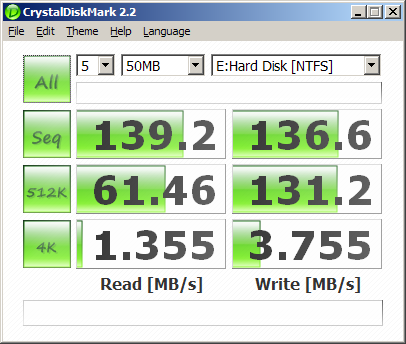
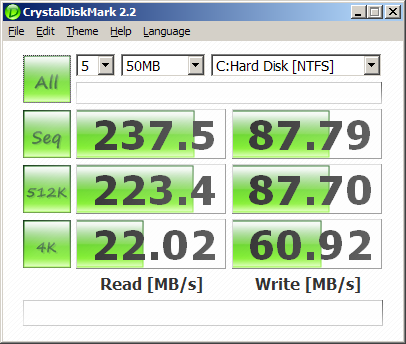
The HDD is about 50% faster on large sequential writes. The SSD is over 16 times as fast (1500% faster) on random 4KB writes though (and almost 30 times as fast on reads). For the many small, random accesses used by something like an OS, SSDs are amazing. They're also very fast for reading large files. However, they will be slightly slower for writing large files. Use your SSD for holding apps, not writing ISOs. In addition to costing an insane amount of money, SSDs wouldn't give the best performance for writing out all the huge files in your media library.
I like this quote regarding the small random writes on a degraded SSD (non-empty blocks).
http://www.anandtech.com/storage/showdoc.aspx?i=3531&p=13
SSDs are an order of magnitude faster than HDDs simply because there's no latency due to parts having to physically move around inside. Other than large sequential writes, any single Intel or Indilinx SSD should be able to give any HDD a beating. Even in large sequential writes, it's still not even that bad, outperforming drives from a few years ago.
Here are the results for my WD6401AALS and 80GB X25-M G2 (from http://www.hardforum.com/showthread.php?p=1034941774#post1034941774).
The HDD is about 50% faster on large sequential writes. The SSD is over 16 times as fast (1500% faster) on random 4KB writes though (and almost 30 times as fast on reads). For the many small, random accesses used by something like an OS, SSDs are amazing. They're also very fast for reading large files. However, they will be slightly slower for writing large files. Use your SSD for holding apps, not writing ISOs. In addition to costing an insane amount of money, SSDs wouldn't give the best performance for writing out all the huge files in your media library.
I like this quote regarding the small random writes on a degraded SSD (non-empty blocks).
http://www.anandtech.com/storage/showdoc.aspx?i=3531&p=13
Anand said:To put things in perspective, look at these drives at their worst compared to Western Digitals VelociRaptor. The degraded performance X25-M still completes write requests in around 1/8 the time of the VelociRaptor. Transfer speeds are still 8x higher as well.
SSDs are an order of magnitude faster than HDDs simply because there's no latency due to parts having to physically move around inside. Other than large sequential writes, any single Intel or Indilinx SSD should be able to give any HDD a beating. Even in large sequential writes, it's still not even that bad, outperforming drives from a few years ago.
ssdforspeed
n00b
- Joined
- Dec 16, 2009
- Messages
- 45
check retailer's end user reviews and manufacturer's user forums, such as newegg.com, amazon.com, ocz, corsair,etc., you will find Indilinx-based SSDs get higher failure cases, intel's SSD is by far the best available option with reliability and speed factor in. incoming micron C300 will beat intel performance wise, but reliability is unknown, micron's crucial brand SSD doesn't seem reliable enough from user reviews.